How to match concrete power floats with laser leveling for high-precision warehouse floor projects
March 4, 2026
How to match concrete power floats with laser leveling for high-precision warehouse floor projects 2
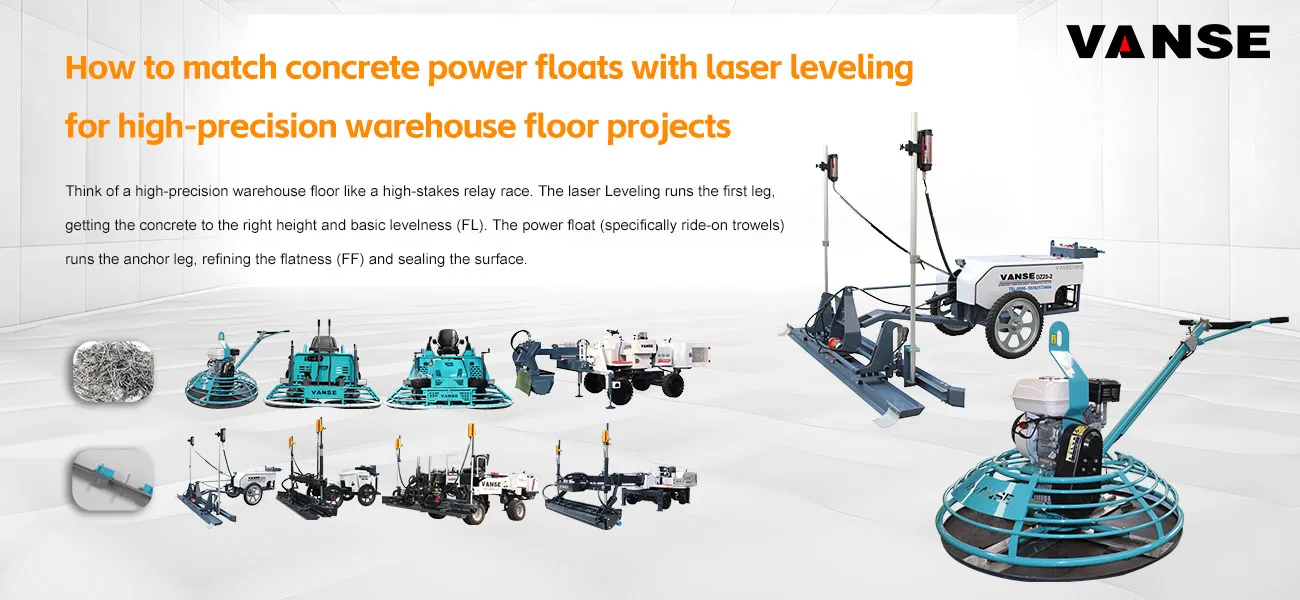
Think of a high-precision warehouse floor like a high-stakes relay race. The laser Leveling runs the first leg, getting the concrete to the right height and basic levelness (FL). The power float (specifically ride-on trowels) runs the anchor leg, refining the flatness (FF) and sealing the surface.
If these two machines aren't perfectly "matched" in timing and technique, you’ll end up with a floor that is level across the building but bumpy under a forklift. Here is how to synchronize them for elite results.
1. The Power Float "Heavyweight" Strategy
For high-precision (Superflat) projects, weight is your friend. While walk-behind floats are fine for small shops, warehouse floors require heavy-duty ride-on power trowels. These machines provide the necessary downward pressure to "cut" high spots and "fill" low spots left by the Leveling.
Machine Role
Laser Leveling (The Macro)
Power Float (The Micro)
Primary Goal
Elevation & Levelness (FL)
Flatness & Density (FF)
Key Component
Laser receiver & Augers
Float pans (Clip-on)
Timing
Immediate (Wet/Plastic)
Delayed (Walkable/Plastic)
Correction
Moves bulk material
Shaves "micro-waves"
2. Panning: The Secret to High FF
The most critical "match" between the Leveling and the float happens during the panning phase. * The Pan: Instead of using individual blades, you clip large, flat steel disks (pans) onto the bottom of the power float. The Synergy: The laser Leveling leaves a "closed" surface, but it’s never perfectly flat. The pans act as a giant plane. Because the ride-on float has a wide wheelbase, the pans cannot fall into small dips; they "bridge" them and shave the peaks. The Technique: To maximize precision, the operator should run the power float perpendicular to the direction the laser Leveling traveled. This cross-cutting action cancels out any rhythmic waves the Leveling may have left behind.
3. Timing the "Window of Finish"
A laser Leveling is fast-it can place 20,000 square feet in a few hours. If your power floating crew can’t keep up, the concrete will "get away" from them. The "Footprint" Test: You shouldn't start power floating until a man can stand on the concrete and leave a footprint about 3 mm to 6 mm deep. Matching the Pace: For every laser Leveling on-site, you typically need at least two high-speed ride-on trowels to ensure the entire slab is panned and finished within the same moisture window. If the concrete hardens unevenly, the float will "bounce" over high spots rather than cutting them.
4. Avoiding "Dish-Out"
One common mistake is over-floating the edges or the areas around columns. The Problem: Power floats naturally want to "dig in" at the edges. The Match: High-precision projects use hand-leveling tools (like a 10-foot highway straightedge) in tandem with the power float. After the first pass of the float, a worker "restraightens" the floor manually to ensure the float didn't create any new "dishes" while trying to fix the old ones.
5. Summary Checklist for Precision
Use Clip-on Pans: Never use just blades if you are chasing high FF numbers. Cross-Pass Pattern: Always float at a 90-degree angle to the laser Leveling’s path. Non-overlapping Passes: Ensure the float operator maintains a consistent overlap (usually 50%) to prevent creating new ridges. Monitor Blade Pitch: As the floor hardens, increase the blade pitch gradually. Moving too fast to a high pitch can "chatter" the surface, ruining the flatness the laser Leveling worked so hard to establish. Pro Tip: On Superflat jobs, use a Floor Profiler (like a Dipstick) between floating passes. This allows the team to identify a low spot while the concrete is still "green" enough to be corrected with the power float.
Would you like to see a step-by-step "Finishing Schedule" that outlines exactly when to switch from pans to combo blades for maximum floor density? Contact us NOW
Note:The parameters provided in this document are for reference only and are not mandatory. Due to differences in technical characteristics between different brands and models of laser levelers, please consult the manufacturer for a suitable solution before actual operation. This reference document assumes no responsibility for any issues arising from failure to follow the manufacturer's instructions.
About the Author: Shandong Vanse Machinery Technology Co., Ltd.


Shandong Vanse Machinery Technology Co., Ltd. is a high-tech manufacturer specializing in concrete construction machinery, including laser screeds and related equipment. The company integrates R&D, production, and global sales, with products exported to over 60 countries and widely used in infrastructure projects worldwide.

VANSE Telescopic Boom Concrete Laser Leveling Machine Helps You Take Over Large Projects
Shandong Vanse Machinery Technology Co., Ltd. is a domestic set manufacturing, sales, technical services in one, specializing in concrete laser leveling machine,Concrete Floor Surface Grinder enterprises. The company is located in the ancient Kyushu one of Shandong Yanzhou, the geographical location of the more, convenient transportation. Has passed National High-tech Enterprise certificationIS09001 quality certification, ISO1400 environmentalProducts have CE certification and SGS and BV approved factory checking reportsthe engines for machines have EURO 5 and EPA, emission meet EU and USA standard. With the rapid development and prosperity of the floor industry, laser leveling machines are more and more used in floor construction, especially in the construction of large-area concrete floors, the use of laser leveling machines can greatly improve construction efficiency. Vanse large-scale telescopic arm laser leveling machine adopts the most advanced laser system and full hydraulic control system to make the concrete construction ground leveling with higher precision and stronger compactness, and to meet high-standard construction requirements at the same time of high-efficiency construction. Another major feature of Vanse large-scale telescopic arm laser leveling machine is that it saves labor and improves efficiency. It can shorten the construction period by two thirds and reduce labor by more than half. The key quality is better, the cost performance is very high, and the maintenance cost can also be reduced. so for the general construction team, the cost is not too high, and the price of the floor industry is also acceptable. Leasing or buying and selling large laser levelers is a very good choice. Shandong Vanse Machinery has experienced senior engineers who serve customers wholeheartedly, develop together, and cooperate for win-win results.

Read More
October 30, 2024
Good maintenance habits really extend the service life of a laser leveler?
Laser leveling machine is a great helper for leveling machinery in construction, but road construction workers can always feel that after several years of use, the equipment is far from being as flexible and convenient as before. What is the reason? Many users only know the surface, but not the reason, and can only procrastinate, and regret it when they use it next time. During the use of laser leveling machine, due to the different intensity of work, it is very likely to have some minor faults after use. At this time, road construction workers should pay attention to it. After use, they should do some daily maintenance on the machine appropriately, which can extend the service life of the machine equipment. 1. Check the connection and fastening of each component of the laser leveling machine, whether the connecting bolts are loose or broken, and tighten or replace them if necessary. Check for leaks and eliminate leaks in various parts in time. Pay attention to the amount of engine oil, fuel, coolant and hydraulic oil, and add new oil to the oil mark as required. Is there an appropriate amount of grease in the centralized lubrication device? 2. Be careful not to work under the maximum load that the machine can bear, and use the machine to the best of your ability. As a laser leveling machine manager, when designating an operator, the laser leveling machine random data and operation manual should be handed over to the operator so that he can master the mechanical performance and operating procedures normally, and the relevant data should not be withheld at will. 3. Try to ensure the uniform addition and subtraction of the mechanical load, so that the machine is in a relatively gentle load change. Specifically, it is to add and subtract the throttle more evenly to prevent the ups and downs of the engine and working device. 4. There will be a lot of dust and mud on the laser leveling machine after construction. First, wipe the dust on the laser leveling machine clean, and wipe the dirt and oil stains with thin paper or cotton cloth. 5. If the laser signal is lost during the construction of the laser leveling machine, the machine needs to be restarted, and the interval time needs to be more than ten seconds. 6. If there are too many stains, you can soak it in water diluted with neutral detergent with a soft cloth, wring it out and wash it. Wanshi laser leveling machine manufacturers remind everyone to remember not to use volatile oil, thinner, gasoline and other chemicals for cleaning and wiping. Developing good habits of operating the laser leveling machine will be of great help in the construction and storage of the laser leveling machine in the future. This not only improves work efficiency, but also extends the service life of the machine to a certain extent.
Read More
May 27, 2024
Maintenance standard for concrete production equipment
Maintenance standards for concrete production equipment Concrete production equipment is an indispensable and important tool in the construction industry, and its normal operation and efficient performance are crucial to protecting concrete quality and construction progress. In order to ensure the stable operation of the equipment and extend its service life, it is particularly important to formulate a set of scientific and reasonable maintenance standards for concrete production equipment. This article will elaborate on the key points of daily equipment inspections, maintenance cycle settings, key component maintenance measures, lubrication and cleaning operations, electrical system maintenance, safety protection measures, and maintenance record management. 1. Key points for daily inspection of equipment Routine inspection of equipment is the basic work to prevent failures and ensure normal operation. During daily inspections, you should focus on the following aspects: ☑ Equipment appearance: Check the equipment for deformation, cracks, rust and other damage, especially damage to wearing parts and key components. ☑ Operating status: Observe whether the equipment is running smoothly and whether there is any abnormal noise or vibration. ☑ Temperature check: Check whether the temperature of each part of the equipment is normal, especially whether the temperature of the motor, reducer and other components is too high. ☑ Leakage: Check whether there is leakage in the lubrication system, hydraulic system, etc. of the equipment. ☑ Instrument display: Check whether the instrument display is accurate, such as whether the oil pressure, oil temperature, water level and other indications are normal. 2. Maintenance cycle setting The maintenance cycle setting should be comprehensively considered based on the frequency of use of the equipment, working environment, equipment performance and other factors. Generally speaking, equipment maintenance cycles can be divided into different levels such as daily maintenance, weekly maintenance, monthly maintenance and annual maintenance. The specific cycle setting should be determined based on the equipment's instruction manual and manufacturer's recommendations, and should be adjusted appropriately based on the actual situation. 3. Maintenance measures for key components Key components are the core part of the equipment, and their maintenanc e is particularly important. For key components of concrete production equipment, the following maintenance measures should be taken: ☑ Mixing host: Regularly check the wear of mixing blades, linings and other components, and promptly replace seriously worn parts; clean the inside of the mixing host to prevent concrete residue from hardening. ☑ Conveyor system: Check the tension and wear of the conveyor belt, adjust or replace the conveyor belt; check the operation of the conveyor roller and idler roller, and clean the concrete residue on the surface of the roller. ☑ Metering system: Regularly check the accuracy and sensitivity of the metering sensor to ensure accurate metering; clean the metering hopper to prevent material residues from affecting metering accuracy. ☑ Electrical system: Check the integrity and insulation performance of electrical components such as motors and cables; regularly check the electrical control system to ensure normal operation. 4. Lubrication and cleaning work Lubrication and cleaning are important aspects of equipment maintenance. ☑ Lubrication work: Lubricate each lubrication point regularly according to the requirements of the equipment lubrication table. Use appropriate oils and greases to ensure a smooth lubrication system. Regularly check the quality and level of lubricating oil and replace contaminated lubricating oil in a timely manner. ☑ Cleaning work: Clean the equipment regularly, especially the mixing host, conveyor belt and other components. Remove dust, oil and concrete residue from the surface of the equipment to keep the equipment clean and hygienic. During the cleaning process, attention should be paid to using appropriate cleaning agents and tools to avoid damage to the equipment. 5. Electrical system maintenance The electrical system is the core control system of the equipment, and its maintenance is crucial. In electrical system maintenance, the following aspects should be focused on: ☑ Check electrical components: Regularly check the integrity and performance of electrical components such as motors, cables, relays, etc. If components are found to be damaged or have degraded performance, they should be replaced in time. ☑ Clean dust: Clean the dust and debris inside the electrical control cabinet regularly to keep the inside of the control cabinet clean and dry. ☑ Check the line connections: Check whether the line connections are secure and whether there are any loose or virtual connections. Problems found should be dealt with promptly to ensure reliable line connections. ☑ Verify safety devices: Verify the electrical safety devices of the equipment, such as overload protection, short-circuit protection, etc., to ensure they are sensitive and effective. 6. Safety protection measures Equipment safety protection is an important measure to ensure the safety of operators and the equipment itself. During equipment maintenance, the following safety protection measures should be strengthened: ☑ Set safety warning signs: Set obvious safety warning signs around the equipment to remind operators to pay attention to safety. ☑ Provide personal protective equipment: Provide operators with necessary personal protective equipment, such as hard hats, protective glasses, gloves, etc., to ensure personal safety during the operation ☑ Regularly check safety protection devices: Check whether equipment protection devices, guardrails and other safety protection devices are intact and effective, and repair or replace damaged parts in a timely manner. ☑ Comply with operating procedures: Operators should strictly follow the operating procedures and are not allowed to change equipment parameters without authorization or perform illegal operations. 7. Maintenance record management Maintenance record management is an important means to ensure that maintenance work is carried out in an orderly manner. During the equipment maintenance process, detailed maintenance records should be established, including maintenance time, content, personnel and other information. Regularly organize and analyze maintenance records, summarize experience and deficiencies in equipment maintenance, and provide reference and basis for future maintenance work. At the same time, maintenance records should be included in equipment file management as an important basis for equipment service life and performance evaluation. By tracking and analyzing maintenance records, potential problems and hidden dangers of equipment can be discovered in time, providing a basis for preventive maintenance. To sum up, the maintenance standards of concrete production equipment are an important guarantee to ensure the normal operation of the equipment and extend its service life. By formulating and implementing this standard, we can standardize the maintenance of equipment, improve the operating efficiency and stability of equipment, and provide reliable technical support for concrete production. In actual work, we should constantly summarize experience and improve maintenance standards to adapt to changing equipment and technical requirements. In the process of maintaining concrete production equipment, we also need to pay attention to some details and special situations. For example, when using equipment in winter, special attention should be paid to anti-freezing measures to ensure that the equipment can operate normally in low-temperature environments. In addition, equipment that has not been used for a long time should be started and run regularly to avoid component aging and functional degradation caused by long-term inactivity of the equipment. In addition to routine maintenance work, preventive maintenance of equipment should also be strengthened. Preventive maintenance is to detect and solve potential problems in advance to avoid equipment failure by regularly checking, predicting and evaluating the operating status of equipment. By implementing preventive maintenance, the failure rate of equipment can be greatly reduced and the reliability and stability of equipment can be improved. In addition, with the continuous advancement of science and technology, some advanced maintenance technologies and methods should also be widely used. For example, IoT technology can be used to remotely monitor and diagnose equipment, understand the operating status of equipment in real time, and detect and handle abnormal situations in a timely manner. At the same time, big data analysis technology can also be used to mine and analyze equipment maintenance data to provide strong support for equipment optimization and improvement. In the process of maintaining concrete production equipment, we should also pay attention to cultivating the maintenance awareness and skills of operators. Through regular training and skill improvement, operators can become proficient in equipment maintenance. knowledge and skills to improve their work ability and sense of responsibility. At the same time, corresponding reward and punishment mechanisms should also be established to encourage operators to actively participate in equipment maintenance. Finally, it needs to be emphasized that concrete production equipment maintenance standards are not static, but should be continuously updated and improved with the development of equipment and technology. We should pay close attention to industry trends and technological developments, promptly apply new maintenance concepts and technologies to actual work, and continuously improve the maintenance level of equipment. In short, concrete production equipment maintenance standards are an important guarantee to ensure the normal operation of the equipment and extend its service life. By formulating and implementing this standard, strengthening the preventive maintenance of equipment, applying advanced maintenance technologies and methods, and cultivating the maintenance awareness and skills of operators, we can continuously improve the maintenance level of equipment and ensure the smooth progress of concrete production. Provide strong protection. In the future maintenance work of concrete production equipment, we should also actively explore new maintenance models and methods. For example, an intelligent maintenance system can be introduced to realize automatic monitoring, early warning and maintenance of equipment through technical means such as sensors and cloud computing. This can not only improve the efficiency and accuracy of maintenance, but also reduce the cost and labor investment of maintenance. In addition, with the increasing awareness of environmental protection, we should also pay attention to environmental protection and energy saving during equipment maintenance. For example, when cleaning equipment, environmentally friendly cleaning agents should be used as much as possible to reduce environmental pollution. At the same time, energy-saving transformation of the equipment can also be carried out, the operating parameters of the equipment can be optimized, and the energy consumption of the equipment can be reduced. In short, the maintenance of concrete production equipment is a long-term and arduous task. We need to constantly summarize experience, explore innovation, and improve standards to adapt to changing market demands and technological development. Only in this way can we ensure the stable operation and efficient production of concrete production equipment and contribute to the sustainable development of the concrete industry. To sum up, the concrete production equipment maintenance standard is a comprehensive system, covering daily equipment inspection, maintenance cycle setting, key component maintenance, lubrication and cleaning, electrical system maintenance, safety protection measures and maintenance record management In many aspects, etc., by strictly implementing this standard, we can ensure the normal operation and extend the service life of the equipment, improve production efficiency, reduce the failure rate, and provide a strong guarantee for the smooth progress of concrete production. At the same time, we should continue to pay attention to the application of new technologies and new methods to adapt to the needs of industry development and promote the continuous progress of concrete production equipment maintenance.
Read More
Online now. Replies personally on WhatsAppFionaCustomer specialist
Hi! I am here to help you find the right solution for your project.
You can share your product, capacity, or project needs. Our specialist will help you work out the next step.
Would you like a quick answer? Tap below to speak directly with our specialist on WhatsApp.