Technical Knowledge
The laser leveling machine needs to be temperature controlled to avoid high temperature ‘burns’

Whether it is winter or summer, the use of laser leveling machines is indispensable for road construction. In the summer, the use of leveling machines may cause some parts inside the machine to overheat due to the increase in temperature, thus affecting the leveling effect of the laser leveling machine. In order to improve the use value of the equipment and improve work efficiency, we need to do a good job of temperature control during the operation of the laser leveling machine.
First of all, controlling the temperature of the laser leveling machine is one of the keys to ensure the quality of leveling. When leveling, the equipment should meet the requirements of relevant standards according to the asphalt type, grade, consistency, ambient temperature, leveling thickness, etc. Secondly, when the construction temperature of highways and roads is lower than 10℃ and the construction temperature of other grades of roads is lower than 5℃, it is not suitable for leveling.
If leveling work is required, the temperature of the road leveling machine should be increased, and there should be low-temperature leveling requirements that meet the regulations. The material transporter should have insulation measures, and high-precision leveling machines should be used as much as possible to start paving, and the trade plate should be heated and leveled immediately after the pressure is applied to shorten the length of the pressure. Remember that leveling should meet the requirements of relevant standards based on asphalt type, grade, consistency, ambient temperature, leveling thickness, etc., so that it is relatively simple and easy to control the temperature.
Mastering the performance characteristics of the laser leveling machine will help us do a good job of temperature control.
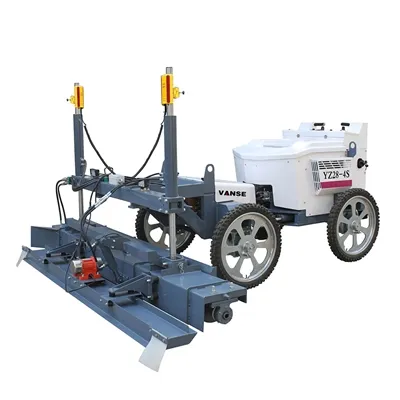
(1) The leveling principle of the laser leveling machine is to use advanced laser technology, closed-loop control technology and high hydraulic system, and realize it under the automatic control of the computer. This is its outstanding feature different from other floor construction processes.
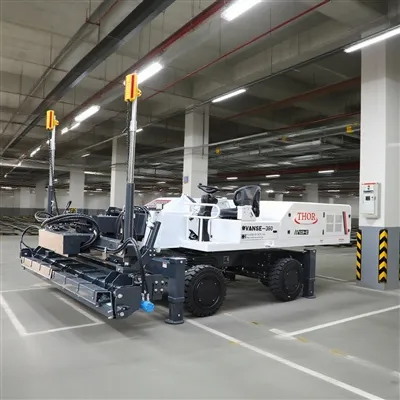
(2) The leveling principle of the leveling machine is to rely on the hydraulically driven leveling head, cooperate with the laser system and computer control system to complete the leveling work while automatically leveling. The leveling head is equipped with an integrated scraper, vibrator and leveling plate, which integrates all leveling, leveling, vibration and compaction work into one, and completes it at one time. The computer control system automatically adjusts the elevation in real time 10 times per second, and the vibration frequency of the balanced vibrator reaches 3000 times/minute.
(3) The laser transmitter used to control the ground elevation is arranged independently, so that the floor elevation is not controlled by the template and no cumulative error will be generated.
(4) The laser leveling machine can also automatically control the longitudinal and transverse slopes, which is also completed by the laser system, computer system, hydraulic system, and mechanical system. For complex-shaped ground with high requirements such as drainage, a three-dimensional special-shaped ground processing system can also be selected to achieve it.
The above is the relevant knowledge told by the manufacturer. We hope that through our narration, you can understand the temperature control method of the laser leveling machine during the construction process, and hope that your equipment can run smoothly and correctly. If you have any questions, please contact us in time. We look forward to cooperating with you.
Thanks to All the Friends Who Support and Trust Shandong Vanse Machinery Technology Co., Ltd.
If you want to know more about Shandong Vanse Machinery Technology Co., Ltd. or have any questions, please feel free to contact us:
Our Factory
Shandong Vanse Machinery Technology Co., Ltd.








Share this article

About the Author: Shandong Vanse Machinery Technology Co., Ltd.
Shandong Vanse Machinery Technology Co., Ltd. is a high-tech manufacturer specializing in concrete construction machinery, including laser screeds and related equipment. The company integrates R&D, production, and global sales, with products exported to over 60 countries and widely used in infrastructure projects worldwide.
Previous Post
Next Post
Related Articles
You Might Also Like
In actual construction, what performance indicators should the construction unit evaluate based on specific needs?
1. Adaptability and adjustability of the construction site The on-site adaptability and adjustability of the concrete laser leveling are also very important evaluation indicators. An excellent leveling should be able to adjust quickly and maintain stable performance in different construction site environments. Terrain adaptability: The equipment should be able to adapt to different terrain conditions, such as slope, height inequality. Equipment with strong terrain adaptability can maintain efficient grading operations in complex construction environments. Material adaptability: Different concrete materials have different characteristics, such as viscosity, fluidity, etc. The equipment should be able to adapt to the characteristics of different concrete materials to ensure smoothing results. Adjustability: Various parameters of the equipment, such as leveling speed, laser ranging range, etc., should be easily adjusted to adapt to different construction needs. 2. Safety and protective measures Safety and protective measures are also aspects that cannot be ignored when evaluating concrete laser levelings. Safety design: The equipment should have good safety design, such as emergency stop buttons, protective covers, etc., to ensure the safety of operators. Fault warning and protection: The equipment should have fault warning and protection functions, which can issue timely warnings when equipment malfunctions or abnormal conditions occur, and take protective measures to prevent accidents. 3. Cost-benefit analysis When evaluating a concrete laser leveling, you also need to consider its cost-effectiveness Purchase cost: Different brands and models of concrete laser levelings may have different purchase costs, which need to be considered comprehensively based on the budget. Operating costs: Operating costs include equipment maintenance, consumable replacement, operator training, etc., and are also factors that need to be considered when evaluating the cost-effectiveness of equipment. Long-term return: Considering the service life and long-term return of the equipment, it is a wiser choice to choose equipment with stable performance and strong durability. 4. After-sales service and support Excellent after-sales service and support can ensure that the equipment is maintained and maintained in a timely manner during use and ensure the normal operation of the equipment. After-sales service network: Evaluate whether the after-sales service network of the equipment manufacturer or seller is complete and whether it can provide timely technical support and maintenance services. Warranty period and maintenance policy: Understand the warranty period and maintenance policy of the equipment to ensure that the equipment can be handled in a timely manner when it fails. 5. Market feedback and user evaluation Understanding the reviews and feedback of other users on the market about concrete laser levelings can help to more fully evaluate the performance of the equipment. Market reputation: Understand the reputation and user reviews of the device in the market by consulting relevant forums, social media and other channels. Professional evaluation: Refer to the evaluation reports of concrete laser leveling machines by professional organizations or media to understand the performance, advantages and disadvantages of the equipment. To sum up, evaluating the performance indicators of concrete laser leveling requires comprehensive consideration from multiple dimensions. Through a comprehensive evaluation of the equipment's leveling efficiency, flatness accuracy, equipment stability, laser control system, energy consumption and environmental protection, ease of operation, maintenance and upkeep, durability and lifespan, adaptability and adjustability of the construction site, Safety and protective measures, cost-benefit analysis, and after-sales service and support can provide comprehensive decision-making support for construction units to choose the appropriate concrete laser leveling. At the same time, paying attention to market feedback and user evaluations will also help to understand the actual performance and user satisfaction of the equipment, and provide a reference for the selection and use of equipment.Auto spreader VS manual spreading—Who ensures even hardener distribution?
In the battle for the perfect bond-whether you're working with resins, adhesives, or body fillers-the goal is homogeneity. If the hardener isn't distributed evenly, you end up with "soft spots" (under-cured) or "brittle spots" (over-cured). Here is the breakdown of how these two methods stack up. Automatic systems (like those used in industrial laminating or high-end body shops) are designed to remove human error from the equation. Mechanical Metering: These machines use synchronized pumps to ensure the ratio of resin to hardener is exact down to the milligram. Static Mixers: Most auto-spreaders force the components through a series of internal baffles (a static mixer) before the material even hits the surface. This ensures that by the time the product is "spread," it is already 100% chemically integrated. Consistency: It provides the same thickness and mix quality on the first inch as it does on the thousandth. Manual spreading relies entirely on the technique, patience, and "eye" of the operator. Human Variable: Even a pro can have an "off" day. Swirl marks or "streaks" of hardener are common if the mixing board isn't scraped properly. The "Pocket" Problem: In manual mixing, unmixed hardener often gets stuck on the spreader tool or the corners of the mixing container, leading to uneven streaks during application. Adaptability: The only area where manual wins is geometry. A human can navigate complex curves or tight corners that a fixed mechanical head might miss. Feature Auto Spreader Manual Spreading Ratio Accuracy Near Perfect Subject to "eyeballing" Chemical Bond Highly Uniform Risks "hot spots" or soft zones Waste Low (precise application) High (excess mixed is often tossed) Initial Cost High (Equipment) Low (Hand tools) The Auto Spreader ensures far superior hardener distribution. While a skilled technician can do a great job manually, they cannot compete with the mechanical integration of an automated system. In manual spreading, you are mixing and spreading as two distinct (and often flawed) steps. An auto-spreader treats them as a single, controlled process. Pro Tip: If you are spreading manually, always use the "Double Mix" method: mix your components, transfer them to a clean second container/board, and mix again with a clean tool to catch any unreacted material from the edges. Would you like me to look into specific auto-spreading equipment recommendations for your industry, or perhaps a guide on manual mixing techniques to minimize "soft spots"? Contact us NOW Note: The parameters provided in this document are for reference only and are not mandatory. Due to differences in technical characteristics between different brands and models of laser levelers, please consult the manufacturer for a suitable solution before actual operation. This reference document assumes no responsibility for any issues arising from failure to follow the manufacturer's instructions.Training guidelines and certification system for concrete laser leveling machine operators
Concrete laser leveling machines are the core equipment for achieving "ultra-flat floors." Their operation involves not only mechanical operation but also integrates laser measurement technology, hydraulic control, and concrete materials science. To become a qualified laser leveling machine operator, training typically covers the following four core aspects and corresponding certification systems: Laser Emitter Setup: Master the horizontal calibration and height setting of the emitter. Operators must ensure the emitter is in a stable, vibration-free interference-free area. Receiver and Control System: Learn how to set parameters through the control panel (such as Somero's OASIS system) to achieve automatic balancing. Leveling Head Adjustment: Adjust the depth of the auger and the frequency of the vibrating plate according to the concrete slump. Slump Sensing: Operators must be able to visually identify the consistency of the concrete. Concrete that is too thin (excessive slump) will cause "waves" after leveling, while concrete that is too dry will result in excessive resistance at the leveling head. Initial Setting Time Judgment: Determine the concrete's setting state based on air temperature and wind speed to determine the leveling machine's travel speed. Overlap Area Handling: Master the overlap width between each leveling path (usually 15cm-30cm) to avoid uneven joint heights. Complex Area Construction: Learn the "manual switching" mode in laser-restricted areas such as column edges, floor drains, and wall corners. Troubleshooting: Emergency procedures in case of laser signal loss, hydraulic hose rupture, or sensor alarm. VR Simulator Training: Top manufacturers (such as Somero) have launched VR simulation systems that allow trainees to practice the entire operation process in a virtual cockpit without entering a real construction site. Currently, there is no globally unified legally recognized certification for operating laser leveling machines. Professional certification is primarily obtained through the following three channels: Somero Concrete Institute (SCI): The most globally recognized certification. Training covers everything from basic operations to advanced 3D floor systems. Those who pass the examination receive an officially issued Operator Certification. (1) Domestic Manufacturer Certification: Leading domestic brands such as Vanse also provide their customers with system operator technical assessments and authorization certificates. American Concrete Institute (ACI): Offers Flatwork Technician/Finisher certification. While not specifically for any particular machine, it covers the core theory for achieving FF/FL values and is a plus in international project bidding. CITB (UK): In the UK, operators must attend a standard course developed by the Construction Industry Training Board (CITB) and undergo practical assessments. In China, laser leveling operators typically hold one of the following two types of certificates: Special Equipment/Construction Machinery Operator Certificate: A "Laser leveling Operator" certificate issued by relevant industry associations (such as the China Construction Machinery Industry Association). Vocational Skill Level Certificate: A skill level certificate issued by local construction skills training institutions (such as advanced-level certificates for plasterers and concrete workers). Assessment Dimensions Standards for Completion: Theoretical Foundation Closed-book exam score ≥ 80%, able to explain the working principle of laser leveling; Preparation Work Laser emitter setup error ≤ 1 mm, leveling head installation time meets standards; Practical Skills Actual measured F_F value in simulated field not less than 45; Safety Awareness Strictly implement three-level safety training, able to correctly identify hazards in the work area. Note: The parameters provided in this document are for reference only and are not mandatory. Due to differences in technical characteristics between different brands and models of laser levelers, please consult the manufacturer for a suitable solution before actual operation. This reference document assumes no responsibility for any issues arising from failure to follow the manufacturer's instructions.