Technical Knowledge
The Future Development Direction of Power Trowels in Automation and Intelligence
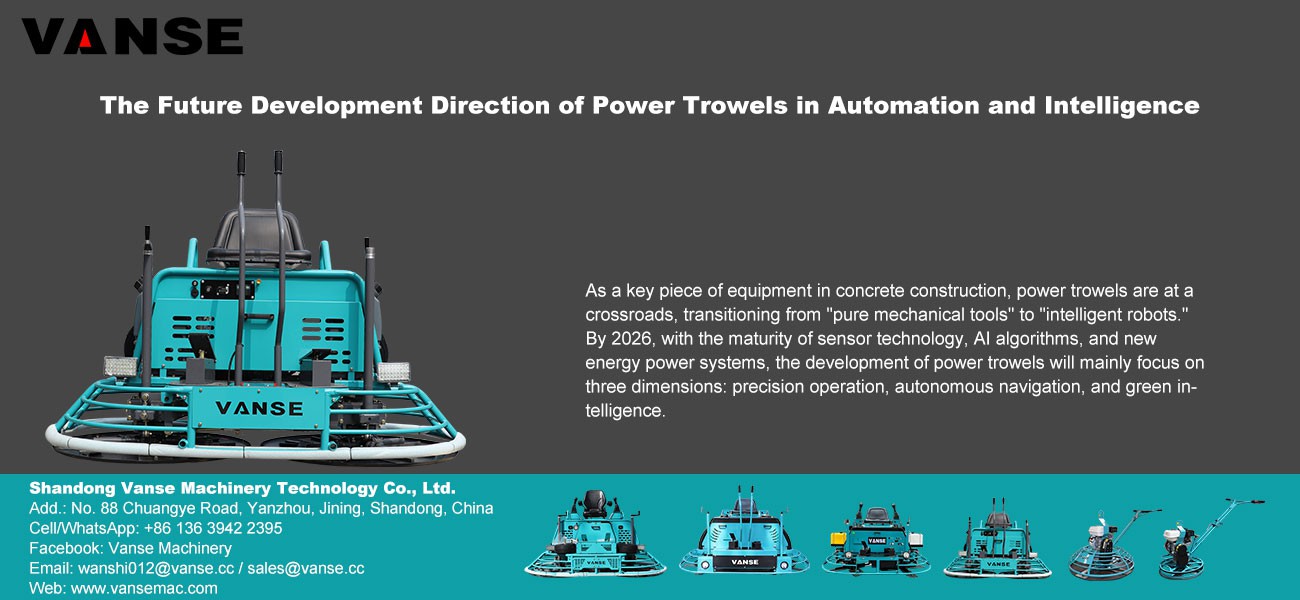
As a key piece of equipment in concrete construction, power trowels are at a crossroads, transitioning from "pure mechanical tools" to "intelligent robots." By 2026, with the maturity of sensor technology, AI algorithms, and new energy power systems, the development of power trowels will mainly focus on three dimensions: precision operation, autonomous navigation, and green intelligence.
Four Core Development Directions for Power Finishing Machines in the Future
1. Embodied Intelligence and Full Autonomy (Autonomous Operations)
Future power finishing machines will no longer rely solely on manual driving or remote control, but will evolve into embodied intelligent robots.
Leak inspection: Carefully inspect the entire hydraulic system, including:
Autonomous Path Planning: Utilizing LiDAR and SLAM (Simultaneous Localization and Mapping) technologies, the machine can automatically identify construction area boundaries and obstacles (such as pre-drilled holes and pillars), and automatically generate the optimal troweling path.
Multi-Machine Collaboration: Similar to "swarm" operations, multiple unmanned trowels can collaborate through a central cloud platform, achieving seamless integration in large-area factory or airport runway construction, avoiding missed areas or repetitive work.
2. Digital and Closed-Loop Control of Construction Quality (Smart Sensing)
Traditional troweling relies on experience-based judgment; future methods will be data-driven.
Real-time Smoothness Monitoring: The machine integrates a laser rangefinder or high-precision sensors to monitor the FF/FL values (smoothness and levelness) of the ground in real time during operation. Once a deviation is detected, the system automatically adjusts the blade pressure or speed to compensate.
Concrete State Sensing: Sensors detect the resistance and frequency of the concrete to determine its initial and final setting states in real time, automatically switching between "finishing" and "slurry enhancement" modes to ensure optimal construction timing and reduce the risk of cracking.
3. Electrification and Decarbonization of Power Systems
With increasingly stringent environmental requirements for indoor construction, fuel-powered systems are rapidly transitioning to electric power.
High-Density Lithium Battery Applications: The mainstream trend after 2026 will be the use of lithium battery packs with long range and fast charging capabilities to address exhaust pollution and noise issues in enclosed indoor environments.
Digital Energy Management: AI systems will automatically optimize current output based on ground resistance, maximizing range while ensuring sufficient finishing intensity.
4. Remote Operation & Augmented Reality (Teleoperation & AR)
In complex or high-risk environments, remote control and visual assistance will become standard.
5G/6G Remote Operation: Operators can control equipment several kilometers away from an air-conditioned room using low-latency visuals.
AR Visual Overlay: When on-site operators wear AR glasses, they can directly see a "heat map" on the ground, showing which areas have met standards and which areas need more polishing.
Value Comparison of Automation Transformation
| Dimensions | Traditional power trowels | Future Intelligent Power Finishing Machine |
| Operating Methods | Require manual or driver operation, heavily reliant on experience | Autonomous navigation or one-button start, standardized operation |
| Precision Control | Are prone to producing wavy lines when viewed by the naked eye | Laser guidance, millimeter-level flatness error |
| Work Efficiency | Are susceptible to fatigue, posing a high risk during nighttime operation | 24-hour continuous operation, efficiency increased by 30%-50% |
| Environmental Friendliness | Are noisy and emit exhaust fumes | Quiet operation, zero emissions (electric drive) |
Note: The parameters provided in this document are for reference only and are not mandatory. Due to differences in technical characteristics between different brands and models of laser levelers, please consult the manufacturer for a suitable solution before actual operation. This reference document assumes no responsibility for any issues arising from failure to follow the manufacturer's instructions.
Thanks to All the Friends Who Support and Trust Shandong Vanse Machinery Technology Co., Ltd.
If you want to know more about Shandong Vanse Machinery Technology Co., Ltd. or have any questions, please feel free to contact us:
Our Factory
Shandong Vanse Machinery Technology Co., Ltd.








Share this article

About the Author: Shandong Vanse Machinery Technology Co., Ltd.
Shandong Vanse Machinery Technology Co., Ltd. is a high-tech manufacturer specializing in concrete construction machinery, including laser screeds and related equipment. The company integrates R&D, production, and global sales, with products exported to over 60 countries and widely used in infrastructure projects worldwide.
Previous Post
Next Post
Related Articles
You Might Also Like
How often should emery floors be cleaned and maintained?
Frequency of cleaning and maintenance of emery floor 1. Characteristics of emery floor Emery floor, as the common name for wear-resistant hardened floor in China, has quickly occupied an important position in the field of floor decoration such as industrial sites, docks, parking lots, commercial stores, and logistics warehouses with its excellent wear resistance, compression resistance, and impact resistance since it was introduced by foreign companies in the 1990s. This floor has various colors, including cement color, gray, green, yellow, red, etc. The surface is dense and not easy to dust, and it is easy to clean. Compared with traditional industrial floor terrazzo, emery floor not only has higher cost performance and service life, but also greatly simplifies the construction process. It can be constructed simultaneously with concrete, saving a lot of time and labor. However, the microstructure of emery floor shows that its surface is relatively rough, and there is a capillary structure of concrete, which makes the floor not resistant to penetration, pollution, and corrosion of substances such as acid, alkali, and oil. Therefore, in daily use, the cleaning and maintenance of emery floor is particularly important. 2. Factors affecting the use environment The use environment is a key factor affecting the frequency of cleaning and maintenance of emery floor. Emery floors are usually faced with a variety of harsh environmental challenges, such as the operation of heavy machinery, the splashing of chemicals, and the penetration of water. These factors will directly affect the life and performance of the floor. For example, the operation of heavy machinery will cause frequent impact and friction on the floor, accelerating the wear of the floor; the splashing of chemicals may cause corrosion and discoloration of the floor surface; and the long-term penetration of water may cause cracking and dusting of the floor. In addition, the way of use will also have an important impact on the frequency of cleaning and maintenance of the floor. If heavy objects are often placed on the floor or a large number of objects are operated, the pressure and load on the ground will increase, thereby accelerating the wear and aging of the floor. 3. Cleaning and maintenance cycle recommendations Considering the characteristics of emery floors and the influence of the use environment, we recommend regular cleaning and maintenance of emery floors. The specific frequency can be adjusted according to actual conditions, but it is generally recommended to clean the floor at least once a week. During the cleaning process, the garbage and debris on the ground should be cleaned up first, and then professional cleaning agents and tools should be used for deep cleaning. In addition, for oil stains or other difficult-to-remove stains, specific cleaning agents or tools may be required for treatment. At the same time, we also recommend regular maintenance and care for the Jinze sand floor. This includes checking the integrity of the floor, promptly discovering and dealing with possible cracks or damage: regularly waxing or applying protective agents to the floor surface to improve its wear resistance and corrosion resistance; and ensuring that the use environment is dry and clean to avoid excessive moisture and chemicals from damaging the floor. 4. Professional cleaning and maintenance process The professional diamond sand floor cleaning and maintenance process usually includes the following steps: first, conduct a comprehensive inspection of the floor and record the areas and problems that need special attention; second, use professional cleaners and tools to deep clean the floor to remove stains and grease; then, make necessary repairs and treatments to the floor surface, such as filling cracks and polishing uneven areas; finally, wax or apply protective agents to the floor as needed to enhance durability and beauty. During the cleaning and maintenance process, standard cleaners and tools should be used to avoid using chemicals or sharp tools that damage the floor. At the same time, the professional skills and operating specifications of the cleaning and maintenance personnel should be ensured to avoid unnecessary damage to the floor. 5. Selection of maintenance materials and equipment When choosing maintenance materials and equipment, attention should be paid to their quality and performance. For cleaning agents, products that are harmless to the diamond floor and have good cleaning effects should be selected; for waxing or coating protective agents, wear-resistant, corrosion-resistant and environmentally friendly products should be selected. In terms of equipment, cleaning and maintenance equipment with stable performance and easy operation should be selected, such as high-pressure cleaning machines, vacuum cleaners, polishing machines, etc. These equipment can not only improve the efficiency and quality of cleaning and maintenance, but also reduce damage to the floor. 6. Daily maintenance and precautions In addition to regular cleaning and maintenance, daily maintenance of diamond floors is equally important. First, the use environment should be kept dry and clean to avoid excessive moisture and chemicals from damaging the floor. Secondly, people and items entering the floor should be properly managed and controlled to avoid scratches or impacts on the floor caused by sharp or heavy objects. In addition, the integrity of the floor should be checked regularly to detect and deal with possible problems in a timely manner. During use, the following points should also be noted: First, avoid scratching the floor surface with hard objects; second, avoid direct contact of strong acids, alkalis and other chemicals on the floor surface; third, regularly clean and maintain to keep the floor clean and beautiful. 7. Common problems and solutions In the process of using diamond sand floor, you may encounter some problems, such as reflection, noise and cracking. For these problems, we can adopt some effective solutions. For example, for reflection problems, it can be handled by grinding, waxing or spraying; for noise problems, sound insulation materials or processes can be used to improve; for cracking problems, it is necessary to pay attention to basic treatment and material selection during construction and maintenance to ensure the integrity and stability of the floor. In addition, stains or scratches that occur during use should be handled and repaired in time. For stains, professional cleaning agents can be used to remove them; for scratches, local repairs or overall renovations can be performed according to the depth and area of the scratches. 8. Summary and long-term planning In summary, the cleaning and maintenance of diamond sand floor is the key to ensuring its long-term performance and aesthetics. Through regular cleaning and daily maintenance, the service life of the floor can be effectively extended and the maintenance cost can be reduced. At the same time, choosing appropriate maintenance materials and equipment and standardized operating procedures are also important factors to ensure the cleaning and maintenance effect. In the future, with the advancement of science and technology and the improvement of environmental protection requirements, the cleaning and maintenance technology of diamond sand floor will also be continuously updated and improved. From a long-term perspective, for the maintenance and management of diamond sand floor, we also need to consider the following points: First, strengthen the training and management of floor users. Through training and publicity, improve the awareness and attention of users to floor protection, and avoid floor damage caused by human factors. Secondly, establish a complete cleaning and maintenance file. Record the time, content, effect, etc. of each cleaning and maintenance, so as to track and analyze the use of the floor, and find and solve problems in time. In addition, pay attention to industry development trends and technological innovation. With the continuous development of the floor industry, new materials, processes and technologies continue to emerge. We should maintain a keen insight, timely understand and master new technologies and methods to improve the cleaning and maintenance effect and service life of the floor. Finally, strengthen the environmental protection management of the floor. When choosing cleaning and maintenance materials and equipment, attention should be paid to their environmental performance and reducing pollution to the environment. At the same time, discarded cleaning and maintenance materials and equipment should be properly handled to avoid adverse effects on the environment. In short, the cleaning and maintenance of diamond sand floor is a long-term and important task, which requires us to invest sufficient time and energy in management and maintenance. Through scientific cleaning and maintenance methods and standardized operating procedures, we can ensure the long-term performance and aesthetics of the floor, and provide strong support for the production and operation of the enterprise. In actual operation, we also need to flexibly adjust the frequency and methods of cleaning and maintenance according to the specific use environment and floor conditions. For example, in areas with heavy oil pollution, it may be necessary to increase the frequency of cleaning or use stronger detergents; in areas with dense traffic, it may be necessary to strengthen daily maintenance and maintenance work. In addition, for some special cases, such as large-scale wear or severe pollution of the floor, we need to take professional repair and renovation measures in time. This may require the help of a professional floor repair team and advanced repair technology to ensure that the integrity and aesthetics of the floor are restored. In future development, with the application of intelligent and automated technologies, the cleaning and maintenance of diamond sand floor is expected to achieve higher efficiency and lower costs. For example, by introducing intelligent cleaning robots and automated maintenance systems, we can achieve regular and fixed-point cleaning and maintenance of the floor, reducing the tediousness and errors of manual operations. In short, the cleaning and maintenance of diamond sand floor is a comprehensive task that requires us to consider and implement from multiple aspects. Through scientific management and maintenance measures, we can ensure the long-term performance and aesthetics of the floor, and provide strong guarantees for the sustainable development of the enterprise.Concrete laser leveling machine+car type power troweling machine
For large-scale industrial plants, the quality of concrete floor construction directly affects the normal production. Therefore, the floors of industrial plants now generally require special bearing capacity, anti-slip wear resistance, and flatness. Through practical research, we found that in the construction of steel fiber concrete wear-resistant ground in industrial plants, using a wider range of concrete laser leveling/ leveling machines for leveling, coupled with driving double-disc trowels for ground finishing, can Greatly improve the construction quality and speed of the floor. The following briefly introduces the characteristics, principles, processes and benefits of the construction of the concrete laser leveling/ leveling machine + car troweling machine. ◤Construction method characteristics◥: ◆ Higher construction quality: The floor elevation can reach laser-level precision, and the ground flatness and levelness are more than three times that of traditional manual leveling operations, which can guarantee the owner's requirements for ground flatness and levelness. ◆ Faster construction speed: It can greatly shorten the construction period and improve the work efficiency by 100~300% (150~300 square meters of paving work can be completed per hour, and 1500~2500 square meters can be completed every day on average), and the manpower can be reduced by more than 30%. It is especially suitable for engineering projects that require tight construction schedules, large injection areas, and high quality requirements. ◆ Better integrity of the ground: It is very easy to achieve large-area overall paving. This paving technology can avoid the hollowing problem caused by layered pouring of the floor. On the other hand, it can reduce a large number of construction joints and make the overall floor Sex is better. ◆ The post-maintenance cost of the ground is greatly reduced: due to the large-area overall paving, the construction joints can be reduced by 3-5 times, and the construction joints are easily damaged by the load, which can greatly reduce the post-maintenance cost of the ground. ◆ Wide scope of application: Not only can it be constructed on reinforced concrete ground with single-layer or double-layer steel mesh. Among them, the light-duty laser leveling machine is suitable for all kinds of concrete floors and reinforced concrete floors with single or double-layer steel mesh, especially suitable for large-scale, high-quality ground construction. ◤Process Principle◥: ◆ Concrete laser leveling machine leveling principle: use precision laser technology, closed-loop control technology and highly precise hydraulic system to achieve leveling under the automatic control of the computer. This closed-loop control can adapt to the elevation of the concrete surface and can Automatic adjustment 6 times. ◆ Concrete laser leveling machine leveling principle: Rely on the hydraulically driven leveling head, cooperate with the laser system and computer control system to complete the leveling work while automatically leveling. The leveling head is equipped with a scraper with integrated design and a leveling beam with a vibrator, which integrates all leveling work into one body. The computer control system automatically adjusts the elevation 6 times per second in real time, and the vibration frequency of the vibrator with balanced design can reach 30005000 times per minute. ◆ Principle of driving-type troweling machine finishing: the driving-type troweling machine is equipped with a double-disk knife holder, and the hydraulic drive system provides power and torque for the two non-overlapping knife holders respectively. To achieve better results, use the joystick on the handle to control the sprinkler system, so that the dry ground can be sprinkled at any time for remediation. ◤Construction process◥: Construction preparation ➨ D ividing separation joints ➨ Processing the ground base ➨ Supporting construction formwork ➨ Setting up laser leveling system and debugging equipment ➨ Pouring concrete ➨ Leveling with concrete laser leveling machine ➨ Manual leveling after mechanical leveling ➨ Disc extraction ➨ Scattering Abrasion-resistant aggregate ➨ disk operation ➨ drive-on trowel finishing ➨ maintenance and cutting. Compared with the original concrete floor construction technology, the benefits of using the dual-machine operation of concrete laser leveling machine + driving trowel machine are: fast construction speed, low construction investment, good overall appearance of the ground, and large investment in ground construction joints and corresponding materials. reduce and so on. In the future, with the continuous improvement of construction quality requirements for building ground engineering, this construction method will be widely promoted and applied.Quantitative assessment of single-machine operation efficiency of the power trowel (such as the number of square meters processed per day)
Quantitative assessment of the single-machine operation efficiency of the power trowel is the key to project planning and cost accounting. It should be made clear that a fixed "daily processing square meters" cannot be provided, as efficiency is significantly influenced by numerous variables. However, we can establish a detailed evaluation model and provide a reasonable efficiency range through calculation. The daily operation efficiency of a single machine (㎡/ day) mainly depends on the following three core factors: Work efficiency (㎡/ day) = Theoretical work efficiency of the machine (㎡/ hour) × daily effective working time (hours) × work coordination coefficient Now let's break down each factor one by one. This refers to the efficiency of the power trowel in continuous operation under "ideal conditions". It is mainly determined by the width of the machine and the operating speed. The common disc diameters of the polishing machine include 800mm, 1000mm, 1200mm, etc. The effective working width is usually about 100-200mm smaller than the disc diameter to prevent collision. Working speed: The speed at which the operator controls the movement based on the slump of the concrete and the required flatness, generally ranging from 10 to 25 meters per minute. Calculation formula Theoretical work efficiency (㎡/ hour) = effective working width (m) × working speed (m/min) × 60 (min) For example, calculate A 1000mm (1 meter) disc diameter power trowel has an effective working width of approximately 0.9 meters and operates at an average speed of 15 meters per minute. Theoretical work efficiency = 0.9m × 15m /min × 60min = 810 square meters per hour Please note: This is the theoretical maximum value and does not take into account U-turns, overlapping areas, process waiting times, etc. A standard construction day is usually measured in 8 hours, but the actual time spent on plastering work is far less than 8 hours. The following time needs to be deducted: Process waiting time (the most crucial factor) : After the concrete is poured, it must be waited for to reach an appropriate initial setting state (the depth of the footprints when a person steps on it is about 5-10mm) before the smoothing process can begin. This waiting time is greatly affected by the weather (temperature, humidity, wind speed), ranging from 2 hours to over 6 hours. This means that only 1 to 2 operation cycles may be carried out within a day. Process connection time: coordination with laser screed machines, edge and corner treatment, water sprinkling and curing, etc. Equipment movement and adjustment time: Transfer between different areas of the construction site. Operator rest time. Therefore, the effective daily polishing operation time is usually between 4 and 6 hours. If only one large working surface is handled in a day, the effective time may only be 2 to 3 hours. This is the key coefficient that brings the theoretical value back to reality, usually ranging from 0.5 to 0.8. It encompasses the following impacts: Overlapping area: To ensure flatness, each walking path needs to have an overlap of approximately 100mm. Turning and U-turn: The time it takes to make a U-turn at the boundary of the area. Multiple operations: Concrete power troweling usually requires 2 to 3 coats (rough power troweling, fine power troweling), and the later coats will be faster, but the same area is counted multiple times. Complex area handling: Areas such as around columns, along walls, and at equipment foundations that require meticulous operations will significantly reduce overall efficiency. On-site conditions: Ground flatness foundation, lighting conditions, etc. We combine the above factors to estimate the two scenarios: Scenario One: Efficient Operations (Large warehouses, factory floors) Conditions: Large and regular area, good weather for quick setting, skilled teamwork, and the use of a 1000mm power trowel. Theoretical efficiency: ~810 square meters per hour Effective time: 5 hours per day Synergy coefficient: 0.7 The daily work volume = 810 × 5 × 0.7 ≈ 2800 square meters Scenario Two: Conventional/Inefficient Operations (Commercial floors, with many obstacles) Conditions: The area is divided, there are many columns and walls, the weather is average, and an 800mm power trowel is used. Theoretical efficiency: (0.7m × 15m /min × 60) ≈ 630 square meters per hour Valid time: 4 hours per day Synergy coefficient: 0.5 The daily work volume = 630 × 4 × 0.5 ≈ 1250 square meters Based on the above analysis, for the most common 800mm – 1000mm power trowelers on the market, the reasonable quantification range of their single-machine daily operation efficiency is between 1,200 square meters and 2,500 square meters. Lower limit (~1200 square meters per day) : Applicable to floors with average conditions, obstacles, and requiring multiple operations. Upper limit (~ 2,500 square meters per day) : Suitable for ground areas with superior conditions and large areas. In extreme cases: Under super-large areas and ideal conditions, experienced teams can achieve over 3,000 square meters per day. For very scattered and complex working surfaces, the efficiency may be lower than 1,000 square meters per day. Manual edge smoothing is a key limitation: no matter how efficient the smoothing machine is, it still requires manual handling of the edges and corners that the machine cannot reach. The number of corners and the difficulty of handling them will directly affect the overall progress. A power troweling machine team is usually equipped with one machine and 2 to 3 workers (1 person operates the machine and 1 to 2 people handle the corners and auxiliary work). The quality of concrete is the foundation: The mix proportion and slump of concrete directly affect its setting speed and workability, and are the fundamental factors determining efficiency. For planning: When making a construction plan, it is recommended to adopt a conservative estimate, such as planning at 1,500 square meters per unit per day, and reserve a certain buffer time to deal with uncertain factors such as weather. It is hoped that this detailed quantitative evaluation model can help you plan projects and calculate costs more accurately. Note: The parameters provided in this document are for reference only and are not mandatory. Due to differences in technical characteristics between different brands and models of laser levelers, please consult the manufacturer for a suitable solution before actual operation. This reference document assumes no responsibility for any issues arising from failure to follow the manufacturer's instructions.