Technical Knowledge
Application Cases of Fully Automated Power Trowel in Large-Area Floor Construction
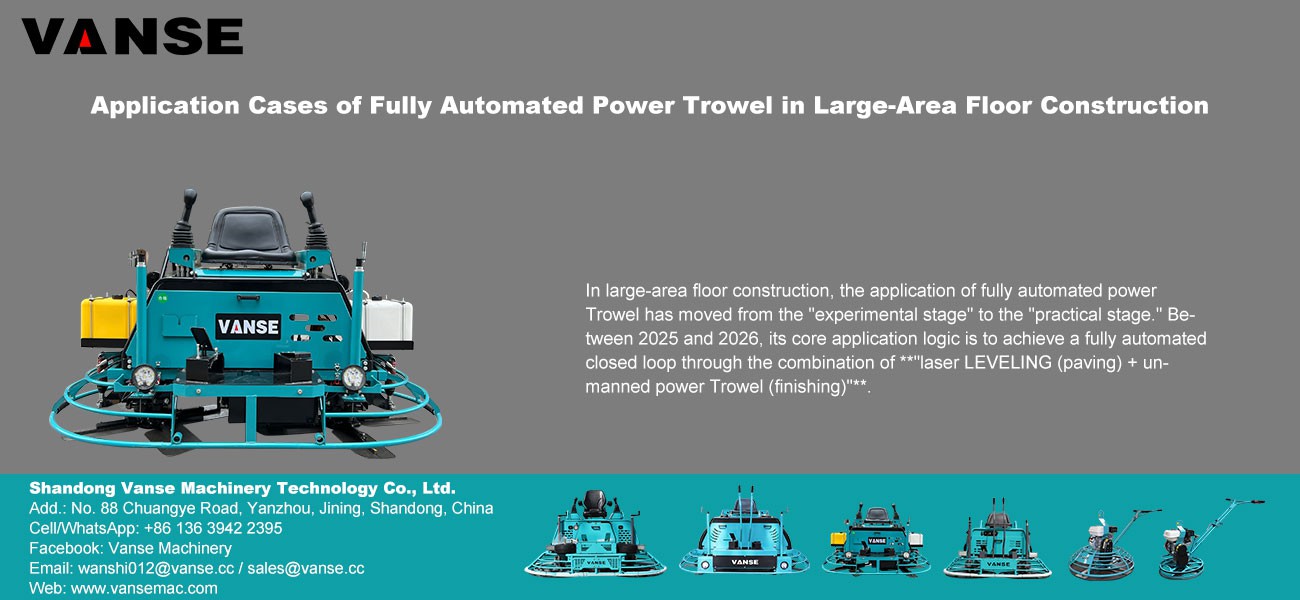
In large-area floor construction, the application of fully automated power Trowel has moved from the "experimental stage" to the "practical stage." Between 2025 and 2026, its core application logic is to achieve a fully automated closed loop through the combination of **"laser LEVELING (paving) + unmanned power Trowel (finishing)"**.
The following are analyses of typical application cases based on current industry trends:
Typical Case: A Smart Logistics Center for a Major International E-commerce Company (30,000 m²)
This project required an ultra-flat floor to support the 24/7 high-speed operation of automated guided vehicles (AGVs). Traditional manual construction methods struggled to maintain consistent quality under such high-intensity conditions.
1. Construction Deployment: Aggregator Collaboration Mode
Configuration: 3-4 fully automated power trowel working collaboratively.
Path Planning: Before construction, a laser scanner models the pouring area. Based on the concrete pouring sequence, the robots automatically calculate the work path for "grouting – smoothing – finishing".
2. Core Technology Application Highlights
Real-time FF/FL monitoring: The robot chassis integrates a laser ranging system, sampling the smoothness multiple times per second during the troweling process. If the FF value (smoothness) of a certain area does not meet the standard, the robot will automatically increase the reciprocating frequency in that area through an algorithm.
Concrete hardening status sensing: The robot monitors the hardening degree of the concrete through blade resistance sensors. In large-area construction, the concrete hardening speed varies in different locations due to wind and sunlight. The robot can automatically adjust its rotation speed to ensure that "faster-drying areas are troweled first, and slower-drying areas are troweled later."
Uninterrupted nighttime operation: With its built-in high-brightness LEDs and infrared obstacle avoidance system, the robot maintains a working efficiency of 400-600 ㎡/h even in nighttime environments, which is more than 3 times more efficient than a manually operated trowel.
Comparison of measured data from automated construction
| Evaluation Indicators | Traditional ride-on power trowel (manual): | Fully Automated Power Trowel (Intelligent) |
| Work Efficiency | Approximately 150-200 ㎡/h (limited by physical strength) | 450-600 ㎡/h (Constant High Speed) |
| FF/FL Pass Rate | Approximately 85% (affected by human experience fluctuations) | > 98% (Precise Algorithm Control) |
| Labor Requirements | One machine, one person, requiring highly skilled and paid workers. | 1 person can operate 3-5 machines, reducing labor intensity by 80% |
| Consistency of Construction | Human error is prone to occur at edges and seams. | Complete standardization, no noticeable unevenness at seams |
Why must large-scale construction projects shift to automation?
**Demand for Robotic Flooring:** Modern smart warehousing has extremely stringent requirements for floor conditions; even slight dust or unevenness can cause AGV sensors to malfunction. Fully automated power trowels provide "Robotic Ready Floors."
**Extremely Short Window of Opportunity:** Concrete sets within a few hours of initial setting. In ultra-large-area projects (single pour exceeding 2000㎡), manual labor often cannot keep up, while automated fleets can achieve full-site coverage.
**Green and Environmentally Friendly:** Modern large-scale indoor projects mostly use electric automated equipment, avoiding the pollution of enclosed indoor environments caused by exhaust fumes from traditional fuel-powered power trowels.
Note: The parameters provided in this document are for reference only and are not mandatory. Due to differences in technical characteristics between different brands and models of laser levelers, please consult the manufacturer for a suitable solution before actual operation. This reference document assumes no responsibility for any issues arising from failure to follow the manufacturer's instructions.
Thanks to All the Friends Who Support and Trust Shandong Vanse Machinery Technology Co., Ltd.
If you want to know more about Shandong Vanse Machinery Technology Co., Ltd. or have any questions, please feel free to contact us:
Our Factory
Shandong Vanse Machinery Technology Co., Ltd.








Share this article

About the Author: Shandong Vanse Machinery Technology Co., Ltd.
Shandong Vanse Machinery Technology Co., Ltd. is a high-tech manufacturer specializing in concrete construction machinery, including laser screeds and related equipment. The company integrates R&D, production, and global sales, with products exported to over 60 countries and widely used in infrastructure projects worldwide.
Previous Post
Next Post
Related Articles
You Might Also Like
How to prevent and deal with concrete laser leveling machine failures to improve equipment reliability?
Concrete laser leveling machine is a key equipment to improve the efficiency and flatness of concrete construction. Its reliability directly affects the progress and quality of the project. Through scientific fault prevention measures and efficient fault handling methods, the reliability of the equipment can be significantly improved. The following is a detailed explanation from the two aspects of fault prevention and fault handling: Prevention is the basis for improving reliability. Through targeted maintenance and standardized operation, the risk of faults can be reduced from the source. Regular inspection and maintenance of key components Laser system: Clean the lens of the laser transmitter and receiver daily to avoid dust and concrete slurry blocking; check the stability of the laser signal weekly, calibrate the horizontal accuracy (using calibration blocks or professional instruments) to prevent construction errors or equipment overloads due to signal deviations. Hydraulic system: Check the hydraulic oil level and oil quality weekly (if emulsification or impurities occur, they must be replaced immediately); clean the hydraulic oil filter element monthly, and replace the hydraulic oil every 500 hours (according to the model required by the equipment manual) to prevent oil contamination from causing wear of the cylinder and pump body. Travel system: Check the tension and wear of the track/tire daily, and clean the concrete lumps between the tracks; lubricate the drive wheel and guide wheel bearings weekly to avoid motor overload due to jamming. Vibration system: Regularly check whether the fixing bolts of the vibration motor are loose and whether the bearings make abnormal noises (add grease every 200 hours) to prevent vibration imbalance from causing structural damage. Standardized operation procedures Operators must be trained before taking up their posts and start (such as preheating the hydraulic system for 3-5 minutes) and shut down (first turn off the vibration, then cut off the laser signal) in strict accordance with the equipment manual. Avoid long-term operation in extreme environments (such as temperature > 40℃, humidity > 90%). When the temperature is high, the heat dissipation of the hydraulic system needs to be strengthened, and the antifreeze hydraulic oil needs to be replaced when the temperature is low. Avoid hard objects such as steel bars and stones during construction to prevent the scraper and vibration plate from colliding and deforming. Storage and idle period maintenance When idle for a long time, clean the concrete residue on the surface of the equipment and apply anti-rust oil (focus on metal connectors and hydraulic rods); Laser transmitters, batteries and other electronic components need to be disassembled and stored in a dry, constant temperature environment, and charged once a month to prevent power loss. Add status monitoring devices Install temperature sensors (monitor hydraulic oil and motor temperature) and pressure sensors (monitor hydraulic system pressure) to warn of abnormal conditions in real time (such as automatic alarm when temperature > 60°C). Add dustproof and waterproof housing (reach IP65 protection level) to the laser system to reduce the impact of environmental factors. Optimize wearing parts Upgrade the scraper material to high-hardness wear-resistant steel (such as quenched 45# steel) to extend service life; The hydraulic pipeline uses a high-pressure hose (working pressure ≥ 25MPa), and a leak-proof seal is installed at the joint to reduce oil leakage failures. Even with good prevention, faults may still occur. Efficient handling can reduce downtime and indirectly improve reliability. Fault type Typical symptoms Processing steps Abnormal laser signal The equipment cannot level itself automatically and displays "signal lost" 1. Check the power supply and position of the laser transmitter for offset; 2. Clean the receiver lens and eliminate obstructions; 3. If the signal is still unstable, replace the transmitter battery or repair the circuit board. Oil leakage in hydraulic system The hydraulic oil level drops and the pipe joints leak oil 1. Stop the machine to check the oil leak point and tighten the loose joints; 2. Replace the damaged seal ring or hose; 3. After adding hydraulic oil, test run to confirm that there is no leakage. Vibration system failure The vibration plate does not work or the amplitude is abnormal 1. Check whether the vibration motor power supply and wiring are loose; 2. Test the motor bearings, and replace the bearings if there is an abnormal sound; 3. Check the hydraulic motor, and repair or replace it if the pressure is insufficient. Travel jam The track/tire moves slowly or deviates 1. Clean foreign matter in the crawler and adjust the tension; 2. Check the output shaft of the travel motor. If it is stuck, disassemble and lubricate or replace the gear box. First check simple causes, then go deeper into complex problems: if the signal is abnormal, check the power supply and cleanliness first, rather than directly dismantling the laser system. Spare parts reserve: Keep vulnerable parts (such as seals, hydraulic oil filters, laser batteries) on site to shorten the waiting time for maintenance. Recording and analysis: Establish a fault ledger to record the time, cause, and treatment of the fault, regularly analyze high-frequency faults (such as monthly statistics), and optimize preventive measures in a targeted manner (such as upgrading the material if a certain component is frequently damaged). Establish equipment life cycle archives: record purchase date, maintenance records, and fault history, provide data support for maintenance, and predict the replacement cycle of vulnerable parts. Regular skills training: Organize training for operators and maintenance personnel every quarter, and update fault handling experience (such as sharing typical cases). Establish a linkage mechanism with manufacturers: For complex faults (such as damage to the laser system circuit board), contact the manufacturer's technical support in a timely manner to avoid secondary damage due to self-repair. To improve the reliability of concrete laser leveling machines, prevention should be the core (daily maintenance + standardized operation + technology upgrade), supplemented by efficient processing (quick response + spare parts reserve + data analysis), and the two should be combined through management mechanisms to form a closed loop of "prevention – processing – optimization", ultimately achieving the goal of reducing equipment failure rate, extending service life, and improving engineering applicability. Click the below to jump immediately!!! ARMOUR JOINT CONCRETE LEVELING MACHINE LIGHT TOWER POWER TROWEL SLIPFORM MACHINE STEEL FIBER TOPPING SPREADER TRACKED MINI DUMPERHow should the engine of a diesel concrete laser leveling machine be maintained? How often should the engine oil be changed?
The engine is the "heart" of the leveling machine. Proper maintenance is of vital importance, which can effectively extend the service life of the equipment, ensure construction efficiency and reduce maintenance costs. The following is a detailed summary of the key points for engine maintenance and the oil change cycle for you Maintenance work can be divided into three parts: daily maintenance, weekly/monthly maintenance and long-term storage maintenance. Machine inspection: Before starting, run the machine once to check for oil or water leakage and whether any components are loose or damaged. Check the engine oil level Park the machine on a level ground, turn off the engine and let it stand for 10 to 15 minutes to allow the engine oil to flow back to the oil pan. Pull out the oil dipstick, wipe it clean with a clean cloth, insert it again and pull it out. Check if the oil level is between the "upper limit" (FULL/Max) and "lower limit" (LOW/Min) marks on the dipstick. When insufficient, it should be added to the upper limit position, but must not exceed. Check the coolant level When the engine is cooling, check whether the water level in the expansion tank is between the "FULL" and "LOW" marks. If it is too low, add the same brand and model of antifreeze coolant. Do not directly add tap water to avoid the formation of scale and rust. Check the air filter Check the vacuum indicator on the air filter housing. If the indicator window turns red, it indicates that the filter element is clogged and needs to be cleaned or replaced immediately. In construction sites with extremely high levels of dust, the air filter elements should be cleaned every day or even after each shift. Check the fuel system Check the fuel level in the fuel tank and replenish it in time. Open the water drain valve of the fuel filter to drain the accumulated water and impurities at the bottom. (For oil-water separators with manual pumps, pump the oil to release air first and then drain the water.) Clean the machine: After the operation is completed, promptly clean the cement, dust and debris on the engine surface and radiator to ensure good heat dissipation. Change the engine oil and oil filter: For details, see Part Two. Clean/Replace the air filter Remove the filter element and repeatedly blow and wash it from the inside out with low-pressure compressed air (pressure < 0.5MPa). Do not strike the filter element. If the filter element is damaged, severely contaminated with oil or the indicator still alarms after cleaning, it must be replaced immediately. Replace the fuel filter It is usually replaced every 250 to 500 hours. After replacement, be sure to expel all the air in the fuel line to ensure a smooth start. Check and tighten the fan belt Check if the belt has any cracks or wear. Press the middle of the belt with your finger. The deflection (downward pressure distance) should be between 10 and 15mm. Both being too loose and too tight will affect the normal operation of the water pump and fan. Check the battery Check whether the battery terminals are securely fastened and free from corrosion (vaseline can be applied for protection), and whether the electrolyte level is normal (this operation is not required for maintenance-free batteries). This is a question without a fixed number of days for the answer. The optimal cycle depends on the "engine working hours" and the "working environment". Primary reference: Equipment user manual The maintenance cycles of engines of different brands and models vary. Please be sure to refer to the "User and Maintenance Manual" of the equipment you purchased. This is the most authoritative basis. General reference standard Standard operating conditions: If your leveling machine operates in an environment with little dust and normal load, the general replacement cycle is every 200 to 250 working hours. Harsh working conditions: If your equipment operates for a long time in the following environments, the replacement cycle should be shortened to 150 hours or even shorter: High-dust environments: such as cement grinding and construction sites with heavy sand and dust, dust can accelerate the deterioration of engine oil. Continuous heavy-load operation: Long-term high-intensity leveling. Frequent starts and stops. How to determine if the engine oil needs to be changed? Dipstick observation method: Near the replacement cycle, pull out the dipstick and drop a drop of engine oil onto a white paper towel. Observe the situation after the oil droplets have spread: The color of the central oil ring: If it is dark black and contains many impurities, it indicates that the engine oil is severely dirty. Diffusion ring boundary: If the boundary is unclear and there is no obvious three-layer diffusion ring, it indicates that the dispersibility of the engine oil has declined. The hand feel method: Rub the engine oil with your fingers. If you feel a distinct granular sensation or it loses its stickiness and smoothness, it indicates that there are too many impurities or it has lost its effectiveness. Important Notice The engine oil and filter must be replaced simultaneously! If only the engine oil is changed but the oil filter is not, the dirty oil in the old oil filter will quickly contaminate the new oil. Use the specified grade of engine oil: According to the season and local temperature, select the CF-4, CH-4 or higher grade diesel engine oil recommended in the manual. If the equipment is planned to be parked for more than one month, the following measures should be taken: Drain all the coolant and engine oil from the engine. Inject approximately 15ml of clean engine oil into each cylinder through the intake port and rotate the crankshaft several times to form an oil film on the inner walls of the cylinders for rust prevention. Fill the fuel tank to the brim to prevent condensation of water droplets and disconnect the negative terminal of the battery. Clean the entire machine thoroughly and park it in a dry and well-ventilated room. For the engine maintenance of diesel concrete laser leveling machines, please keep in mind: Regular inspection: Daily checks of oil, water and air are the foundation. Regular replacement: Follow the instructions and replace the engine oil, oil filter, fuel filter and air filter regularly according to the working hours. Under standard operating conditions, changing the engine oil and oil filter every 200 to 250 hours is a safe reference value. Heavy environmental conditions: Under harsh working conditions, the maintenance cycle should be shortened. Use genuine products: Use genuine oil products and filter elements that meet the specifications. By developing good maintenance habits, your equipment will be able to serve you for a longer time and more efficiently. Note: The parameters provided in this document are for reference only and are not mandatory. Due to differences in technical characteristics between different brands and models of laser levelers, please consult the manufacturer for a suitable solution before actual operation. This reference document assumes no responsibility for any issues arising from failure to follow the manufacturer's instructions.What else should we pay special attention to in the safe operating procedures of concrete laser leveling machines?
✔ Equipment inspection and preparation Before operating a concrete laser leveling, you must ensure that the equipment has been thoroughly inspected and is in good working order. The following are specific requirements for equipment inspection and preparation: 1. Equipment appearance inspection: Check whether the appearance of the leveler is intact and there is no obvious damage, deformation or rust. 2. Power system inspection: Check whether the fuel, lubricating oil and water levels are normal, and whether the engine starts and runs smoothly without abnormal sounds. 3. Laser system inspection: Ensure that the laser transmitter, receiver and control system are working properly, and the laser beam is stable and has no deviation or flickering. 4. Tire and track inspection: Check whether the tires or tracks are intact, whether the air pressure or tension meets the requirements, and whether there is any damage or excessive wear. 5. Safety protection device inspection: Check whether all safety protection devices, such as guards, safety switches, etc. are intact and installed correctly. 6. Electrical system inspection: Check whether electrical components such as cables, plugs, and sockets are intact and free of damage or aging. Special note: During the equipment inspection, if any abnormalities or failures are found, you must stop using it immediately and contact professionals for repair in a timely manner. ✔ Personnel training and safety Personnel operating concrete laser levelings must receive professional training and have corresponding operating skills and safety awareness. The following are specific requirements for personnel training and safety. 1. Professional training: Operators should receive operational training provided by manufacturers or professional training institutions to understand the structure, principles, operating procedures and safety precautions of the equipment. 2. Operating skills: Operators should be proficient in basic operating skills such as starting, stopping, adjusting, maintaining and maintaining equipment. 3. Safety awareness: Operators should have a high degree of safety awareness, understand potential safety risks, and know how to prevent and respond to these risks. 4. Wear protective equipment: Operators should wear protective equipment that meets the requirements during work, such as safety helmets, work shoes, gloves, etc. Special note: Personnel without professional training or without corresponding operating skills are strictly prohibited from operating the concrete laser leveling. ✔ Work environment assessment Before using the concrete laser leveling, the working environment must be evaluated to ensure that the equipment can work in a safe and stable environment. The following are specific requirements for a work environment assessment. 1. Ground conditions: Evaluate the flatness, hardness and stability of the working ground to ensure that the equipment can drive and work normally. 2. Climatic conditions: Pay attention to the climatic conditions of the work area, such as temperature, humidity, wind, etc., to ensure that the equipment can adapt to the current environment. 3. Traffic and obstacles: Assess the traffic conditions and obstacles in the work area to ensure that the equipment will not collide with other objects during driving and operation. 4. Power supply: Ensure a stable power supply in the work area to meet the needs of equipment charging or power supply. Special note: During the work environment assessment process, if any factors that may affect equipment safety or operating results are discovered, corresponding measures must be taken promptly to improve them. ✔ Safety during work During the operation, operators should strictly abide by operating procedures to ensure the safety of themselves and equipment. The following are safety requirements during operations: 1. Stay focused: Operators should stay focused at all times, pay close attention to the operating status of the equipment and the working environment, and promptly discover and deal with potential safety risks. 2. Standardized operation: Operators should start, drive, operate and stop the equipment in accordance with operating procedures. Child-violating operation or speeding is strictly prohibited. 3. Pay attention to the laser system: During the operation, the operator should always pay attention to the operation of the laser system to ensure that the laser beam is stable and guide the operation correctly. 4. Maintain a safe distance: During the operation, the operator should maintain a safe distance from the equipment and other personnel to prevent accidents such as collision or extrusion. 5. Timely shutdown and inspection: During the operation, if any abnormality or safety hazard is found in the equipment, the operator should immediately stop the machine for inspection and contact professionals for repair in a timely manner. Special note: During the operation, any behavior that violates operating procedures or may lead to safety accidents must be stopped immediately and corresponding measures must be taken to correct it. ✔ Maintenance and care In order to ensure the normal operation of the equipment and extend its service life, the equipment must be maintained and maintained regularly. The following are the specific requirements for maintenance and upkeep: 1. Regular cleaning: Clean the equipment regularly to remove dust and stains on the surface and keep the appearance of the equipment tidy. 2. Check and replace lubricating oil: Check and replace the lubricating oil of the equipment according to the manufacturer's recommended intervals and requirements to ensure the lubrication and normal operation of the equipment's moving parts. 3. Check and tighten connecting parts: Regularly check whether the connecting parts of the equipment, such as bolts, nuts, etc., are loose or damaged, and tighten or replace them in time. 4. Check the wear of tires and tracks: Check the wear of tires or tracks regularly. If the damage is serious, replace it in time. 5. Laser system calibration: Calibrate the laser system regularly to ensure the accuracy and stability of the laser beam. Special note: When performing maintenance and upkeep, the manufacturer's operating instructions and safety requirements must be followed to ensure the safety and effectiveness of the operation process. ✔ Emergency response When equipment malfunctions or emergencies occur, operators should quickly take appropriate emergency measures. During the operation of the concrete laser leveling, equipment failures, safety accidents or other emergencies may be encountered. Therefore, operators must have emergency response capabilities to ensure the safety of personnel and equipment. The following are the specific requirements and measures for emergency response: 1. Equipment fault handling: * Once a malfunction or abnormality is found in the equipment, the operator should stop it immediately and cut off the relevant power supply or power source. * Quickly assess the nature and possible scope of the fault, and take necessary precautions to prevent the fault from expanding or causing secondary accidents. * Notify equipment management personnel or professional maintenance personnel to come to the scene for troubleshooting and repair. Operators should cooperate with maintenance personnel in carrying out maintenance work. 2.Safety incident handling: * When a safety accident occurs, first ensure the safety of personnel, quickly evacuate the scene, and take necessary first aid and rescue measures. * Immediately report to superior management or relevant departments, and initiate emergency response procedures in accordance with the emergency plan. * Cooperate with the accident investigation team to conduct accident investigations, analyze the causes of accidents, propose corrective measures, and accept corresponding treatment. 3. Emergency handling: * In case of emergencies, such as natural disasters or emergencies such as fires and earthquakes, operators should stop the machine immediately and follow the emergency evacuation procedures in the emergency plan to ensure the safe evacuation of personnel. * Cut off the power supply of the equipment and other potential sources of danger to prevent the accident from expanding or causing secondary disasters. * Report emergencies to relevant departments in a timely manner and coordinate responses in accordance with the instructions of the emergency plan. ✔ Special Note: • Operators should be familiar with the contents of emergency plans and emergency response procedures, and conduct regular emergency drills and training to improve emergency response capabilities. • During emergency response, stay calm and decisive, follow the instructions in the emergency plan, and do not panic or act blindly. • During emergency response, priority should be given to ensuring the safety of personnel while minimizing equipment losses and environmental impact. ✔ Summary The safe operating procedures of concrete laser leveling machines are an important guarantee to ensure the safety and stable operation of the equipment and the safety of the operators. Through the specific requirements and measures described in this article for equipment inspection and preparation, personnel training and safety, working environment assessment, safety during operation, maintenance and emergency response, etc., we can effectively reduce the probability of safety accidents and protect personnel. life safety and improve the reliability and service life of equipment. Therefore, operators and managers should strictly abide by these procedures and continuously strengthen safety awareness training to ensure the safe and efficient operation of concrete laser leveling machines.