Technical Knowledge
The construction effect of laser leveling machine changes under different climatic conditions, the specific impact and corresponding adjustment methods

The construction effect of laser leveling machine will change under different climatic conditions. Here are some specific effects and corresponding adjustment methods:
1. **Temperature change**:
– Under high temperature conditions, the setting speed of concrete is accelerated, and the laser leveling machine needs to adjust the working speed to adapt to the faster setting time. At the same time, attention should be paid to the heat dissipation of the equipment and the moisture retention of the concrete.
– Under low temperature conditions, the setting speed of concrete slows down, and measures may need to be taken such as using heating equipment or choosing a concrete formula suitable for low temperature construction.
2. **Humidity effect**:
– High humidity environment may affect the drying speed of concrete. When the laser leveling machine is used for construction, it is necessary to extend the curing time to ensure that the concrete is fully hardened.
– Low humidity or windy environment may cause the moisture on the concrete surface to evaporate too quickly. Measures need to be taken to keep the concrete moist, such as covering with wet cloth or increasing the frequency of watering.
3. **Rainfall effect**:
– Rainfall may occur during construction, and rain protection measures, such as temporary shelters, need to be prepared to protect the newly constructed concrete surface from rain erosion.
4. **Influence of wind speed**:
– High wind speed may affect the stability of the laser signal of the laser leveler. It is necessary to consider the impact of wind direction and wind speed on the laser transmitter and receiver, and take corresponding wind protection measures.
5. **Construction process adjustment**:
– Under different climatic conditions, it may be necessary to adjust the construction process, such as the paving speed of concrete, the travel speed of the laser leveler, and the vibration frequency, to ensure the construction quality.
6. **Equipment maintenance**:
– Different climatic conditions have different maintenance requirements for laser levelers. For example, in a humid environment, it is necessary to pay attention to the rust and moisture prevention of the equipment; in a dusty environment, the equipment needs to be cleaned regularly to prevent dust from affecting the performance of the equipment.
7. **Construction plan arrangement**:
– Reasonably arrange the construction plan according to the climatic conditions, avoid construction under extreme climatic conditions, such as avoiding construction in heavy rain or high temperature, to reduce the impact on the construction effect.
Through the above adjustments, the laser leveler can maintain the construction effect under different climatic conditions and ensure the construction quality and efficiency.
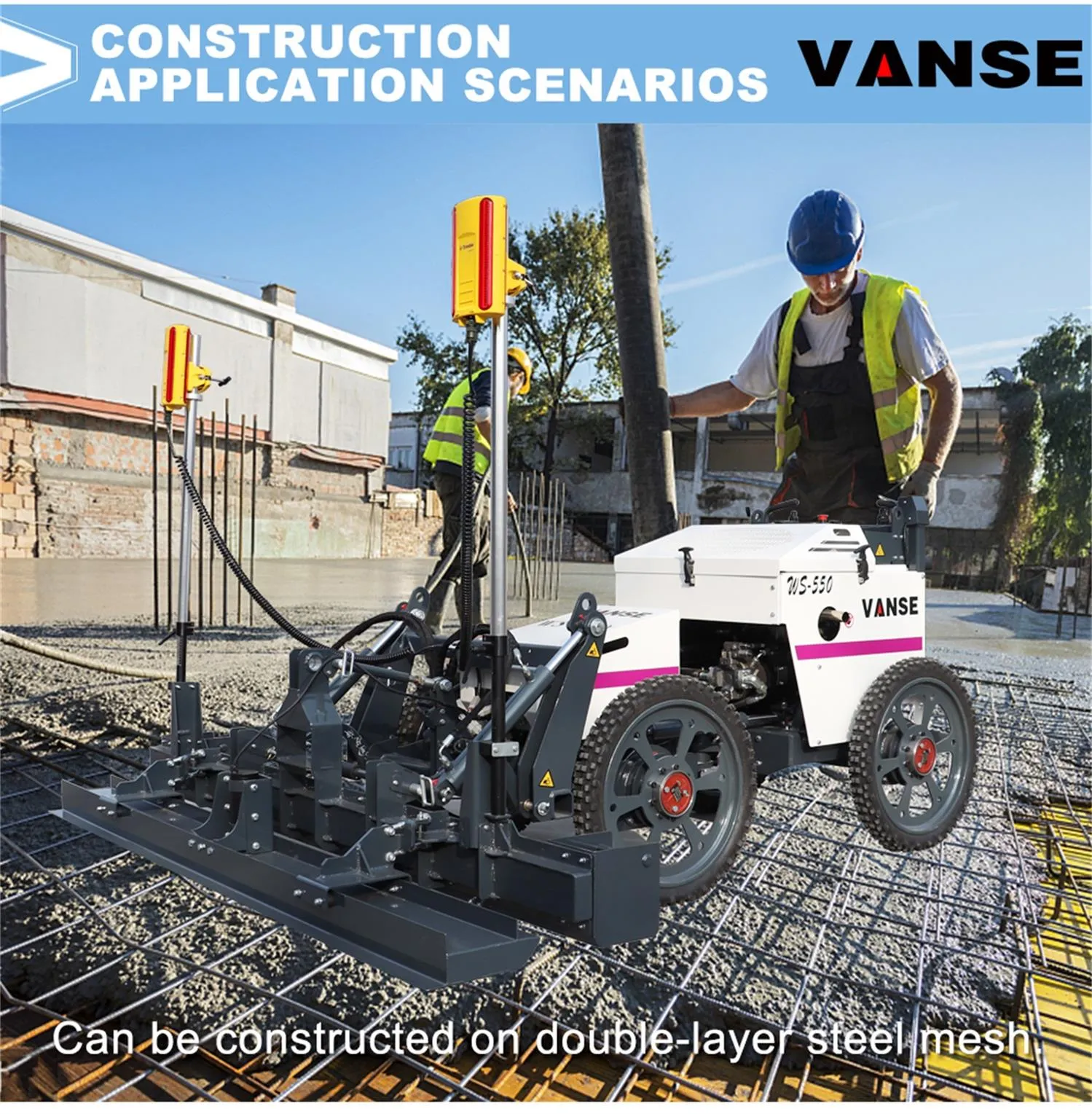
Thanks to All the Friends Who Support and Trust Shandong Vanse Machinery Technology Co., Ltd.
If you want to know more about Shandong Vanse Machinery Technology Co., Ltd. or have any questions, please feel free to contact us:
Our Factory
Shandong Vanse Machinery Technology Co., Ltd.

Share this article

About the Author: Shandong Vanse Machinery Technology Co., Ltd.
Shandong Vanse Machinery Technology Co., Ltd. is a high-tech manufacturer specializing in concrete construction machinery, including laser screeds and related equipment. The company integrates R&D, production, and global sales, with products exported to over 60 countries and widely used in infrastructure projects worldwide.
Previous Post
Next Post
Related Articles
You Might Also Like
Laser leveling machine manufacturers professional sharing: the correct way to use the equipment
Laser leveling machine is an indispensable equipment in the construction industry. It is indispensable in the construction of large highways. In order to ensure the smooth progress of construction and the smoothness of the road surface, it is necessary to master the correct use of laser leveling machine. Secondly, you should read the instruction manual of the equipment before use, because this will make you familiar with the internal structure of the equipment as soon as possible, so as to achieve correct operation. The following laser leveling machine manufacturer will show you the correct use of laser leveling machine. 1. Laser leveling machine manufacturers explain from a professional perspective that it is important not to work under a load that exceeds the load that the machine can bear. The laser leveling machine should be used to the best of one's ability. As a laser leveling machine manager, when designating an operator, the laser leveling machine random data and operation manual should be handed over to the operator so that he can master the mechanical performance and operating procedures normally, and the relevant data should not be withheld at will. 2. Laser leveling machine manufacturers explain from a professional perspective that it is necessary to try to ensure the uniform addition and subtraction of the load of the laser leveling machine, so that the machine is in a relatively gentle load change. Specifically, it is necessary to add and subtract the throttle more evenly to prevent the ups and downs of the engine and working device. 3. Laser leveling machine manufacturers explain the scientific use of lubricants from a professional perspective. According to statistics, more than half of the leveling machine failures are caused by poor lubrication. Due to the precision of the various parts of the laser leveling machine, good lubrication can keep it in a normal working gap and a suitable working temperature, thereby reducing the degree of wear of the parts and reducing mechanical failures. Normal and reasonable lubrication is one of the effective measures to reduce mechanical failures. To this end, first, it is necessary to reasonably select lubricants. During use, neither low-grade lubricants nor other types of lubricants can be used as substitutes, let alone inferior products. Second, the quantity and quality of lubricants should be checked frequently. 4. Laser leveling machines should be maintained and repaired in a timely manner. Laser leveling machines will inevitably have various failures during use. Among these failures, some failures may have a very small impact on mechanical equipment, while some are more serious and may even cause major accidents of machine destruction and death. The knowledge shared by the laser leveling machine manufacturer for you has basically come to an end here. If you have the intention to understand the equipment, you can contact us by phone, or log in to our official website and leave us a message. We will solve your problem as soon as we see it. Thank you for your reading.How does a concrete laser leveling machine work?
The core operating principle of a concrete laser leveling machine is a closed-loop control system combining "laser positioning reference + real-time signal feedback + automatic mechanical execution" to achieve high-precision leveling and vibration of the concrete surface. Essentially, this system replaces the traditional manual "relative level determination" with the laser's "absolute level reference," eliminating human error and ensuring that the flatness and levelness of the finished surface meet high standards. Its workflow can be broken down into four core steps: reference establishment, signal detection, command calculation, and mechanical execution. The detailed principles are as follows: Before understanding the principles, it is necessary to first understand the core components of the device. All actions revolve around the coordination of these three systems: System Name Core Components Core Functions Laser Positioning System Laser Transmitter, Laser Receiver Establishes an "absolute level/slope baseline" and detects height deviations between the concrete surface and the baseline in real time. Electrical Control System Central Controller (PLC), Sensors Receives deviation signals from the receiver, calculates them, and sends action commands (raise/lower, accelerate/decelerate) to the actuators. Mechanical Actuation System Leveling Scraper, Vibrator, Travel Mechanism Executes controller commands: adjusts scraper height for leveling, vibrators for compacting concrete, and travel mechanisms for moving the equipment. The operation of a concrete laser leveling is a dynamic closed-loop process of **"real-time detection → instant adjustment → continuous leveling"**, which can be divided into four steps: This is the prerequisite for high-precision leveling, the purpose of which is to set a fixed, unchangeable reference datum for the leveling surface (replacing the traditional "level + ruler" artificial datum). Operation: Place the laser transmitter on a stable support at the construction site (away from sources of vibration and electromagnetic interference). Use a level to align the transmitter so that it emits a 360° circular laser beam (which can be set to a "level reference" or a "preset slope reference," such as a 2% drainage slope). Principle: Lasers have the physical properties of strong directionality, good monochromaticity, and stable propagation. They exhibit virtually no attenuation over short distances (typically within 100 meters), forming an "absolute level/slope" baseline that remains stable despite manual operation or equipment movement. Key: The laser transmitter must be independently powered and securely fixed to prevent vibration or impact that could cause the baseline to shift. Any shift will cause errors in all subsequent leveling operations. The laser receiver (usually installed on the leveling support or top of the machine) is responsible for capturing the laser reference line in real time, comparing the "concrete surface height" with the "reference line height" and detecting the deviation value. Detection Process: The receiver contains multiple built-in photosensors (or photoelectric sensors). When a laser beam strikes the receiver, the photosensors at different locations determine the current concrete surface height based on the "height at which they are illuminated." If the location of the receiver illuminated by the laser is above a preset reference (indicating a low concrete surface), a signal indicating "raise the scraper" is output; if the location is below the reference (indicating a high concrete surface), a signal indicating "lower the scraper" is output. Deviation signals are transmitted to the central controller in real time via wired or wireless means (such as Bluetooth or radio frequency), typically at a frequency of 10 to 50 times per second, ensuring that the controller is instantly aware of surface height changes. Additional Note: Some high-end equipment may be equipped with multiple receivers (such as one at the front and one at the rear) to simultaneously detect heights at different locations, preventing single-detection errors caused by equipment tilt. The central controller (with a programmable logic controller (PLC) at its core) is the "brain" of the equipment. It receives deviation signals from the receiver, performs rapid calculations based on preset parameters (such as leveling thickness and vibration frequency), and generates specific execution instructions. Operational Logic: If the deviation is small (e.g., ±1mm), the controller will only fine-tune the oil flow in the scraper lift cylinder to achieve slight scraper movement, avoiding over-adjustment and surface fluctuations. If the deviation is large (e.g., ±5mm), the controller will increase the hydraulic cylinder movement and may also adjust the travel mechanism speed (e.g., slowing down the travel mechanism to allow the scraper sufficient time to level). If a "loss of signal" is detected (e.g., the receiver temporarily leaves the laser beam), the controller will immediately pause scraper adjustment and issue an alarm to avoid unintended action. Key: The controller's response speed directly impacts accuracy-high-quality equipment typically has a command calculation and execution delay of less than 0.5 seconds, allowing it to keep up with changes in concrete surface height in real time. The controller's instructions are ultimately transmitted to the mechanical execution system, which adjusts the height of the leveling scraper and compacts the concrete with the vibrator, completing the dual functions of "leveling + compacting". This is also the core advantage of laser leveling machines compared to traditional manual leveling. Leveling Scraper Operation: The scraper is driven by a hydraulic cylinder, raising and lowering in real time according to controller commands. When the concrete surface is low, the cylinder raises the scraper to reduce the amount of concrete removed (or even allows the concrete to naturally accumulate to the reference height). When the surface is high, the cylinder lowers the scraper to remove excess concrete and push it to the lower area, ensuring the surface is flush with the laser reference line. Synchronous Vibrator Operation: Under the scraper are typically multiple sets of high-frequency vibrators (vibrating at a frequency of 3,000 to 5,000 times per minute). These vibrators are inserted into the concrete while leveling, removing air bubbles and compacting the aggregate. This prevents honeycombing and rough surfaces caused by uneven vibration with traditional manual vibrating, while also creating a denser concrete surface and higher strength later on. Travel Mechanism: The equipment moves slowly on wheels or tracks (the travel speed is adjustable, typically 0.5 to 2 m/min), allowing the scraper and vibrator to continuously cover the concrete surface, avoiding "joints." Some ride-on models can also operate autonomously, reducing operator error. Traditional manual leveling relies on a "level rod + ruler" method, requiring repeated measurement and leveling. This is not only inefficient but also prone to poor flatness due to human judgment errors (such as visual deviation and uneven force). The core logic of the laser leveling machine is: The laser's absolute horizontal reference replaces the manually set relative reference, eliminating reference errors. The "detect → calculate → execute" automated closed-loop system replaces the manual "read the ruler → adjust" process, eliminating operator errors. High-frequency vibration combined with continuous leveling replaces the manual "scraping + vibrating" process, ensuring both smoothness and density. Ultimately, the result is a concrete surface construction effect with "millimeter-level precision (usually up to ±2mm/2m), high efficiency (3 to 5 times that of manual labor), and high density." This is particularly suitable for large-scale, high-precision ground projects (such as factories, garages, airport runways, etc.). Click the below to jump immediately!!! ARMOUR JOINT view more CONCRETE LASER LEVELING MACHINE view more POWER TROWEL view more SLIPFORM MACHINE view more STEEL FIBER view more TOPPING SPREADER view moreWhat are the main differences in operation processes among different types of concrete laser leveling?
The four types of concrete laser leveling machines you mentioned represent typical models with different levels of automation and functionality. The main differences in their operation processes lie in several core links such as equipment positioning, elevation control, travel mode and construction scope. Now let's break down the unique operation process of each model one by one. To understand more intuitively, we can compare their differences in key operation links through the following table: Operation link Walk-behind type Four-wheel drive Four-wheel telescopic arm type Remote-controlled four-wheel telescopic arm type 1. Equipment positioning and movement Manual traction consumes a lot of physical effort from the operator and the movement is not precise. Cab operation, like driving a car, requires moving on a leveled or solid ground. The cab operates the movement, but the flat head is precisely positioned at a distance through the telescopic boom. The remote control operates the movement, allowing the operator to stand at the best observation point. 2. Control of a flat hairstyle The flat head is integrated with the main unit and moves along with it. The flat head is usually fixed at the front or bottom of the fuselage and moves along with the body. The flat head is separated from the main unit and controlled independently by a multi-section telescopic arm. The flat head is separated from the main unit and controlled independently by a multi-section telescopic arm. 3. Elevation and slope control It relies on manual adjustment by the operator and requires extremely high levels of experience and a sense of touch. The laser system automatically controls the elevation of the leveling head and can preset single or double slopes. The laser system automatically controls the elevation and slope of the leveling head, unaffected by the posture of the fuselage. The laser system automatically controls the elevation and slope of the leveling head, unaffected by the posture of the fuselage. 4. Construction scope and flexibility Small-scale construction, low flexibility, prone to leaving footprints that need to be repaired. Large-scale construction is carried out, but there are blind spots near walls and columns, and manual material replenishment is required. It has a wide coverage range, with an arm span of up to 6 to 12 meters, and can handle some blind spots. It has the highest flexibility and can be installed closely against walls and column bases with almost no blind spots. 5. Requirements for operators High skills and high physical strength Driving skills and system operation Driving skills, spatial sense and boom operation techniques Advanced remote control skills and spatial sense, with the lowest physical requirements. Core features: Human-machine integration, with humans serving as the power source and main control system. Typical operation process Installation reference: Set up a rotating laser emitter outside the construction area. Positioning and startup: Place the machine at the starting point of the concrete, install the laser receiver, and turn on the vibration motor. Manual traction and leveling The operator holds the handle with both hands and pulls the machine backward relying on physical strength. Keep your eyes fixed on the laser receiver signal light installed on the mast (or listen to the buzzer), and manually rotate the adjustment rod to adjust the height of the scraper in real time to reach the laser plane. Repetition and shifting: After completing one row, turn off the vibration, lift or drag the equipment to the next row with great effort, overlap with the previous row, and repeat the process. Blind spot handling: Corners and edges that machines cannot handle, which need to be repaired manually with traditional tools. Core features: Operator driving, the leveling system and the walking system are closely integrated. Typical operation process Installation benchmark: The same as above. Driving into position: The operator drives the equipment from a solid ground into the starting point of the construction area. System Settings: Set the slope mode (horizontal, single slope, etc.) on the control panel of the cab. Driving and Automatic Leveling Let go of the crew cut. The operator controls the steering wheel and the accelerator to move the machine forward, backward and turn. The elevation and slope of the flat head are automatically maintained by the laser system and do not require human intervention for leveling. Monitoring and Steering: The operator monitors the instruments and the concrete condition ahead in the cab and turns at the end of each row. The fuselage must be moved to allow the entire flat head to cover the new area. Core features: The flat head is separated from the main unit, and the working range is expanded through the telescopic arm. Typical operation process Installation benchmark: The same as above. Driving and strategic positioning: The operator drives the equipment to a strategic fixed position (usually in the middle or on one side of the area to be poured), after which the machine body no longer needs to be moved frequently. Boom operation and automatic leveling The operator operates the multi-way valve handle or rocker in the cab to control the extension, contraction, lifting, lowering and left and right swinging of the telescopic arm. The laser system automatically controls the elevation and slope of the flattening head. The operator only needs to control the boom to move the leveling head to the position that needs to be leveled. Covering construction: Through the flexible movement of the boom, the flat head can cover a large area in a "fan-shaped" or "net-like" path, while the machine body remains stationary. Core feature: Based on the telescopic arm type, it has achieved remote control with "human-machine separation". Typical operation process Installation benchmark: The same as above. Remote control positioning: The operator holds the remote control to remotely control the movement of the equipment and park it at the optimal fixed position, which can easily avoid ground obstacles and steel mesh. Remote precision operation The operator leaves the cab and stands in a position where the overall situation can be overseen. All the movements of the telescopic arm and the flat head can be precisely controlled through the joystick and buttons on the remote control. Panoramic Monitoring and Construction Due to the excellent field of vision, the operator can simultaneously observe the material condition of the concrete, the leveling effect, and the distance between the boom and the surrounding obstacles. The leveling head can be directed to closely adhere to the formwork, wall base and column base for construction, minimizing blind spots and achieving the most efficient and precise leveling operation. Walk-behind type: Suitable for extremely small, irregular or areas where large equipment such as equipment foundations cannot enter. It has a low cost, but it is the most dependent on people and technology. Four-wheel drive type: Suitable for large, open and barrier-free warehouse and factory floors, its efficiency is much higher than that of the Walk-behind type. It is the main force in traditional large-scale construction. Four-wheel telescopic boom type: Suitable for construction sites of medium complexity, such as those with partial columns or equipment foundations. It reduces the number of movements of the fuselage and improves the coverage efficiency. Remote-controlled four-wheel telescopic boom type: It is the top-of-the-line choice, suitable for the highest standards and most complex construction sites (such as super factories, precision workshops, and projects with a large number of columns and obstacles). It offers unparalleled flexibility, vision and construction quality, minimizing manual repair work to the greatest extent. Which model to choose depends on the scale of your project, the complexity of your layout, your budget, and your requirements for construction efficiency and precision. Note: The parameters provided in this document are for reference only and are not mandatory. Due to differences in technical characteristics between different brands and models of laser levelers, please consult the manufacturer for a suitable solution before actual operation. This reference document assumes no responsibility for any issues arising from failure to follow the manufacturer's instructions.