Technical Knowledge
How does a concrete laser leveling machine work?
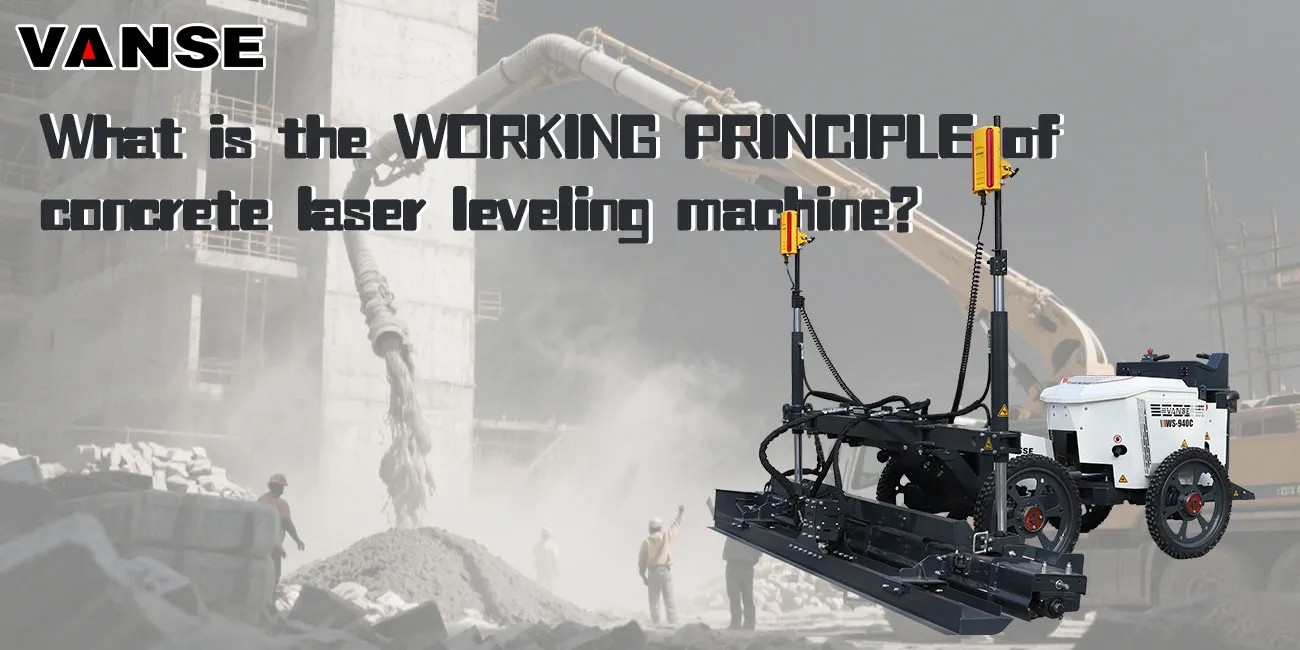
The core operating principle of a concrete laser leveling machine is a closed-loop control system combining "laser positioning reference + real-time signal feedback + automatic mechanical execution" to achieve high-precision leveling and vibration of the concrete surface. Essentially, this system replaces the traditional manual "relative level determination" with the laser's "absolute level reference," eliminating human error and ensuring that the flatness and levelness of the finished surface meet high standards. Its workflow can be broken down into four core steps: reference establishment, signal detection, command calculation, and mechanical execution. The detailed principles are as follows:
1. Core System Composition: Three Key Components Supporting the Working Principle
Before understanding the principles, it is necessary to first understand the core components of the device. All actions revolve around the coordination of these three systems:
| System Name | Core Components | Core Functions |
| Laser Positioning System | Laser Transmitter, Laser Receiver | Establishes an "absolute level/slope baseline" and detects height deviations between the concrete surface and the baseline in real time. |
| Electrical Control System | Central Controller (PLC), Sensors | Receives deviation signals from the receiver, calculates them, and sends action commands (raise/lower, accelerate/decelerate) to the actuators. |
| Mechanical Actuation System | Leveling Scraper, Vibrator, Travel Mechanism | Executes controller commands: adjusts scraper height for leveling, vibrators for compacting concrete, and travel mechanisms for moving the equipment. |
2. Working Principle Step-by-Step Analysis: Closed-Loop Process from "Benchmark" to "Leveling"
The operation of a concrete laser leveling is a dynamic closed-loop process of **"real-time detection → instant adjustment → continuous leveling"**, which can be divided into four steps:
Step 1: Establishing the Laser Reference Line – Determining the "Absolute Level/Slope Standard"
This is the prerequisite for high-precision leveling, the purpose of which is to set a fixed, unchangeable reference datum for the leveling surface (replacing the traditional "level + ruler" artificial datum).
Operation:
Place the laser transmitter on a stable support at the construction site (away from sources of vibration and electromagnetic interference). Use a level to align the transmitter so that it emits a 360° circular laser beam (which can be set to a "level reference" or a "preset slope reference," such as a 2% drainage slope).
Principle:
Lasers have the physical properties of strong directionality, good monochromaticity, and stable propagation. They exhibit virtually no attenuation over short distances (typically within 100 meters), forming an "absolute level/slope" baseline that remains stable despite manual operation or equipment movement.
Key:
The laser transmitter must be independently powered and securely fixed to prevent vibration or impact that could cause the baseline to shift. Any shift will cause errors in all subsequent leveling operations.
Step 2: Real-time detection of height deviations – "discovering" uneven concrete surfaces
The laser receiver (usually installed on the leveling support or top of the machine) is responsible for capturing the laser reference line in real time, comparing the "concrete surface height" with the "reference line height" and detecting the deviation value.
Detection Process:
The receiver contains multiple built-in photosensors (or photoelectric sensors). When a laser beam strikes the receiver, the photosensors at different locations determine the current concrete surface height based on the "height at which they are illuminated." If the location of the receiver illuminated by the laser is above a preset reference (indicating a low concrete surface), a signal indicating "raise the scraper" is output; if the location is below the reference (indicating a high concrete surface), a signal indicating "lower the scraper" is output.
Deviation signals are transmitted to the central controller in real time via wired or wireless means (such as Bluetooth or radio frequency), typically at a frequency of 10 to 50 times per second, ensuring that the controller is instantly aware of surface height changes.
Additional Note: Some high-end equipment may be equipped with multiple receivers (such as one at the front and one at the rear) to simultaneously detect heights at different locations, preventing single-detection errors caused by equipment tilt.
Step 3: Command Calculation and Control – "Judgment" How to Adjust the Leveling
The central controller (with a programmable logic controller (PLC) at its core) is the "brain" of the equipment. It receives deviation signals from the receiver, performs rapid calculations based on preset parameters (such as leveling thickness and vibration frequency), and generates specific execution instructions.
Operational Logic:
If the deviation is small (e.g., ±1mm), the controller will only fine-tune the oil flow in the scraper lift cylinder to achieve slight scraper movement, avoiding over-adjustment and surface fluctuations.
If the deviation is large (e.g., ±5mm), the controller will increase the hydraulic cylinder movement and may also adjust the travel mechanism speed (e.g., slowing down the travel mechanism to allow the scraper sufficient time to level).
If a "loss of signal" is detected (e.g., the receiver temporarily leaves the laser beam), the controller will immediately pause scraper adjustment and issue an alarm to avoid unintended action.
Key: The controller's response speed directly impacts accuracy-high-quality equipment typically has a command calculation and execution delay of less than 0.5 seconds, allowing it to keep up with changes in concrete surface height in real time.
Step 4: Mechanical leveling and vibration – "Solving" the problem of height and density of concrete
The controller's instructions are ultimately transmitted to the mechanical execution system, which adjusts the height of the leveling scraper and compacts the concrete with the vibrator, completing the dual functions of "leveling + compacting". This is also the core advantage of laser leveling machines compared to traditional manual leveling.
Leveling Scraper Operation:
The scraper is driven by a hydraulic cylinder, raising and lowering in real time according to controller commands. When the concrete surface is low, the cylinder raises the scraper to reduce the amount of concrete removed (or even allows the concrete to naturally accumulate to the reference height). When the surface is high, the cylinder lowers the scraper to remove excess concrete and push it to the lower area, ensuring the surface is flush with the laser reference line.
Synchronous Vibrator Operation:
Under the scraper are typically multiple sets of high-frequency vibrators (vibrating at a frequency of 3,000 to 5,000 times per minute). These vibrators are inserted into the concrete while leveling, removing air bubbles and compacting the aggregate. This prevents honeycombing and rough surfaces caused by uneven vibration with traditional manual vibrating, while also creating a denser concrete surface and higher strength later on.
Travel Mechanism:
The equipment moves slowly on wheels or tracks (the travel speed is adjustable, typically 0.5 to 2 m/min), allowing the scraper and vibrator to continuously cover the concrete surface, avoiding "joints." Some ride-on models can also operate autonomously, reducing operator error.
Summary: The core logic of the principle is "using laser reference to replace manual work, and using automatic control to replace manual work"
Traditional manual leveling relies on a "level rod + ruler" method, requiring repeated measurement and leveling. This is not only inefficient but also prone to poor flatness due to human judgment errors (such as visual deviation and uneven force). The core logic of the laser leveling machine is:
The laser's absolute horizontal reference replaces the manually set relative reference, eliminating reference errors.
The "detect → calculate → execute" automated closed-loop system replaces the manual "read the ruler → adjust" process, eliminating operator errors.
High-frequency vibration combined with continuous leveling replaces the manual "scraping + vibrating" process, ensuring both smoothness and density.
Ultimately, the result is a concrete surface construction effect with "millimeter-level precision (usually up to ±2mm/2m), high efficiency (3 to 5 times that of manual labor), and high density." This is particularly suitable for large-scale, high-precision ground projects (such as factories, garages, airport runways, etc.).
Click the below to jump immediately!!!


CONCRETE LASER LEVELING MACHINE


SLIPFORM MACHINE


TOPPING SPREADER
Thanks to All the Friends Who Support and Trust Shandong Vanse Machinery Technology Co., Ltd.
If you want to know more about Shandong Vanse Machinery Technology Co., Ltd. or have any questions, please feel free to contact us:
Our Factory
Shandong Vanse Machinery Technology Co., Ltd.








Share this article

About the Author: Shandong Vanse Machinery Technology Co., Ltd.
Shandong Vanse Machinery Technology Co., Ltd. is a high-tech manufacturer specializing in concrete construction machinery, including laser screeds and related equipment. The company integrates R&D, production, and global sales, with products exported to over 60 countries and widely used in infrastructure projects worldwide.
Previous Post
Next Post
Related Articles
You Might Also Like
What are the advantages of concrete laser leveling machine in construction?
With the continuous advancement of modern construction engineering technology, concrete laser leveling machine has been widely used in the field of construction as an efficient and precise construction equipment. This machine achieves high-precision leveling of the concrete surface through a laser precision control system, significantly improving the construction quality and efficiency. This article will elaborate on the advantages of concrete laser leveling machine in construction from the aspects of high-quality flatness, improved construction efficiency, significantly reduced costs, highly automated operations, wide applicability, laser precision control, and easy maintenance. 1. High-quality flatness The most significant advantage of the concrete laser leveling machine is that it can achieve high-quality flatness. Through the laser beam emitted by the laser transmitter, the leveling machine can adjust the position and height of the leveling head in real time to ensure that the concrete surface meets the predetermined flatness requirements. Compared with traditional construction methods, laser leveling machines can not only greatly improve flatness, but also effectively reduce the errors of manual operation, making the entire construction process more precise and controllable. This high-precision leveling effect can not only improve the beauty of the building, but also effectively prevent cracks, dents and other quality problems on the concrete surface, thereby extending the service life of the building. 2. Improved construction efficiency The use of concrete laser leveling machines can significantly improve construction efficiency. Traditional construction methods often require a lot of manual operation, which is not only time-consuming and labor-intensive, but also inefficient. The laser leveling machine can greatly speed up the construction progress through automated control and precise adjustment. In large-scale engineering projects, the laser leveling machine can quickly complete large-area concrete leveling work, significantly improve construction efficiency, and shorten the construction period. In addition, the laser leveling machine can also reduce the damage to the concrete surface caused by manual operation, further improving the construction quality and efficiency. 3. Significantly reduced costs The application of concrete laser leveling machines can not only improve construction efficiency, but also significantly reduce construction costs. On the one hand, the laser leveling machine can reduce a large number of manual operations, thereby reducing labor costs. On the other hand, since the laser leveling machine can achieve high-precision leveling effects, it reduces the rework and repair costs caused by construction quality problems. In addition, the laser leveling machine also has a long service life and low maintenance costs, so that the comprehensive cost of the entire construction process is effectively controlled. This cost advantage has made concrete laser leveling machines widely used in construction projects. 4. Highly automated operation The concrete laser leveling machine has the characteristics of highly automated operation. During the construction process, the laser leveling machine can automatically adjust the position and height of the leveling head according to the preset parameters and the instructions of the laser control system to achieve continuous and high-precision leveling operations. This automated operation method not only reduces the possibility of manual intervention and reduces operating errors, but also improves the continuity and stability of construction. At the same time, the highly automated operation method also reduces the workload of operators and improves the safety of construction. 5. Wide applicability The concrete laser leveling machine has strong wide applicability. Whether in large commercial buildings, road construction or industrial plant construction, the laser leveling machine can perform excellent performance. Its precise laser control system can adapt to the needs of concrete construction of different scales and shapes, whether it is a flat ground or an area with a complex slope, it can achieve high-precision leveling effects. In addition, the laser leveling machine can also seamlessly cooperate with other construction equipment to form a complete construction system to meet the needs of different engineering projects. 6. Laser precision control The core advantage of the concrete laser leveling machine lies in its laser precision control technology. The laser emitted by the laser transmitter has a high degree of directionality and stability, and can form a precise plane in space. The laser receiver can receive laser signals in real time and convert them into control signals to accurately guide the movement of the leveling head. This laser precision control technology enables the leveling machine to monitor and adjust the leveling effect in real time to ensure that the concrete surface meets the predetermined flatness requirements. At the same time, the laser control system also has strong anti-interference ability and can maintain stable performance in complex construction environments. 7. Easy maintenance The maintenance of the concrete laser leveling machine is relatively simple. Its structural design is reasonable and easy to clean and maintain. During use, you only need to regularly check whether the various components of the equipment are operating normally and replace the worn parts in time to ensure the good performance of the equipment. In addition, the maintenance cost of the laser leveling machine is relatively low, and only a small amount of manpower and material resources are required to complete the maintenance work. This simple maintenance method reduces the cost of equipment use and improves the efficiency of equipment use. In summary In summary, the advantages of concrete laser leveling machines in construction are mainly reflected in high-quality flatness, improved construction efficiency, significantly reduced costs, highly automated operations, wide applicability, laser precision control and easy maintenance. These advantages have made concrete laser leveling machines widely used and recognized in the field of construction engineering. With the continuous advancement and innovation of technology, it is believed that concrete laser leveling machines will play a more important role in future construction and provide strong guarantees for the quality and efficiency of construction projects. However, we must also realize that the advantages of any technology or equipment are relative, and concrete laser leveling machines are no exception. In the process of use, we still need to combine the specific construction environment and needs, reasonably select and use equipment, give full play to its advantages, and avoid possible limitations and deficiencies. At the same time, we need to continuously strengthen technological research and development and innovation, and improve the performance and intelligence level of equipment to meet the growing construction needs. In the future field of construction engineering, with the continuous advancement of science and technology and the improvement of people's requirements for construction quality, concrete laser leveling machines will surely play a more important role. We have reason to believe that in the near future, concrete laser leveling machines will make greater contributions to our construction industry with a more intelligent, efficient and environmentally friendly attitude. In summary, the advantages of concrete laser leveling machines in construction are reflected in many aspects, from high-quality flatness to improved construction efficiency, to significantly reduced costs and highly automated operations, all of which make it an important position in modern construction projects. At the same time, its wide applicability, laser precision control and simple maintenance have further enhanced the market competitiveness of concrete laser leveling machines. When talking about the wide applicability of concrete laser leveling machines, we must note that it can adapt to various working environments and ground conditions. Whether it is a flat indoor floor or a complex outdoor terrain, the laser leveling machine can achieve high-precision leveling operations through a precise laser control system and a flexible mechanical structure. This wide applicability enables the concrete laser leveling machine to perform excellent performance in various engineering projects to meet different construction needs. Laser precision control is another highlight of the concrete laser leveling machine. The use of laser technology makes the leveling process more precise and controllable. Through the precise guidance of the laser beam, the leveling machine can adjust the position and height of the leveling head in real time to ensure that the flatness of the concrete surface meets the preset requirements. This precise control not only improves the construction quality, but also reduces the difficulty and error rate of manual operation, making the entire construction process more efficient and stable. In addition, the maintenance of the concrete laser leveling machine is relatively simple. Its structural design is reasonable and easy to clean and maintain. During use, you only need to perform simple inspections and maintenance on the equipment regularly to ensure the normal operation of the equipment and extend its service life. This simple maintenance method reduces the cost of equipment use and improves the efficiency of equipment use. However, despite the many advantages of concrete laser leveling machines, some issues still need to be noted during use. First, operators need to have certain professional knowledge and operating skills to give full play to the performance of the equipment. Secondly, during the construction process, it is necessary to ensure the safe and stable operation of the equipment to avoid accidents caused by improper operation or equipment failure. Finally, it is also necessary to pay attention to regular maintenance of the equipment to ensure long-term stable operation and extend the service life of the equipment. In summary, the advantages of concrete laser leveling machines in construction are significant and have broad application prospects. With the continuous advancement and innovation of technology, it is believed that concrete laser leveling machines will play a more important role in future construction projects. We look forward to it achieving more outstanding results in improving construction quality, reducing construction costs, and improving construction efficiency, and contributing more to the development of the construction industry. At the same time, we should also see that the development of any technology and equipment is inseparable from the cultivation and introduction of talents. In order to give full play to the advantages of concrete laser leveling machines, we need to strengthen the cultivation and introduction of relevant talents and improve the professional quality and skill level of operators. In addition, we should also strengthen technology research and development and innovation, and continuously improve the performance and intelligence level of concrete laser leveling machines to adapt to the increasingly complex construction environment and the ever-increasing construction quality requirements. In addition, with the increasing awareness of environmental protection, we should also pay attention to the environmental protection performance of concrete laser leveling machines. In the design and manufacturing process, environmentally friendly materials and energy-saving technologies should be used as much as possible to reduce the impact of equipment on the environment during operation. At the same time, during use, environmental protection management of the construction site should also be strengthened to ensure that waste and pollutants in the construction process are effectively handled and controlled. In short, the advantages of concrete laser leveling machines in construction are self-evident, but it is also necessary to pay attention to related issues and challenges during use. By strengthening efforts in talent training, technological innovation and environmental protection management, we can give full play to the advantages of concrete laser leveling machines and make greater contributions to the quality improvement and efficiency improvement of construction projects.Concrete Laser Leveling Machine Application Fields
The concrete laser leveling is an efficient construction equipment that is widely used in modern construction sites. It has a wide range of applications and can be used in many fields, such as industrial plants, workshops, automated three-dimensional warehouses, electronic appliances, food materials, pharmaceutical large-scale warehouse supermarkets, logistics centers, exhibition centers, docks, container yards, cargo yards, Airport runways, aprons, parking lots, squares, residential grounds, municipal roads, etc. In industrial plants and workshops, concrete laser levelings can lay flatter floors for production lines, facilitate the movement of equipment, machines and personnel, and improve production efficiency and product quality. In automated three-dimensional warehouses, this equipment can provide a flat floor for the storage and transportation of goods, improving the operational efficiency of the warehouse and the safety of goods. In the fields of electronic appliances and food materials, concrete laser leveling machines can provide flat floors for production workshops and warehouses to ensure product quality and safety. In the pharmaceutical field, this equipment can provide a dust-free, flat floor for pharmaceutical production and storage, ensuring the quality and safety of pharmaceuticals. In large warehouse supermarkets and logistics centers, concrete laser leveling machines can provide a flat floor for the storage and transportation of goods, improve the turnover efficiency of goods and reduce damage to goods. In the exhibition center, this equipment can provide a flat floor for the exhibition hall to ensure the smooth progress of the exhibition. In terminals and container yards, concrete laser levelings can provide a flat surface for the transportation of goods and equipment, improve terminal operation efficiency and reduce damage to goods. In airport runways, this equipment can provide a flat surface for aircraft to take off and land, ensuring the safety of aircraft and the comfort of passengers. In parking lots and squares, concrete laser levelings can provide vehicles with a smooth driving surface, reduce vehicle wear and noise, and improve driving safety and comfort. In residential grounds and municipal pavements, this equipment can provide residents with smooth and beautiful roads and public facilities, improving residents' quality of life and the image of the city. In general, the concrete laser leveling machine is an efficient, accurate, and flexible sensor device that is used in many fields such as construction, transportation, and T industries. It has injected new impetus into the development of various industries and promoted the construction industry. development of the industry. With the continuous development of new technologies, concrete laser levelings have unlimited development potential and will become an indispensable and important equipment in the construction industry. In addition to the application areas mentioned above, concrete laser levelings can also be used in other places where ground leveling is required. For example, in the construction of garden landscapes, the equipment can provide flat ground for garden roads and squares: in the construction of sports venues, the equipment can provide flat, non-slip ground for sports venues; in the agricultural field, the equipment can provide flat, non-slip ground for farmland. and greenhouses provide a flat ground to improve crop growth efficiency and yield. In addition, concrete laser levelinging machines can also be used in some special environments. For example, in cold areas, the equipment can work normally in low-temperature environments to facilitate winter construction; in desert areas, the equipment can adapt to construction in harsh environmental conditions such as sandstorms; in marine environments, the equipment can be used Construction of offshore platforms and docks In short, the application fields of concrete laser leveling machines are very wide and can be used in various places and special environmental conditions that require smoothing of the ground. With the continuous advancement of technology and the continuous expansion of application fields, the application prospects of concrete laser leveling machines will become even broader.Specific cases of reducing labor reliance & improving labor efficiency by using concrete laser leveling machine (such as one machine replacing three teams).
The improvement of labor force and human efficiency brought about by the use of concrete laser leveling machine is revolutionary. We will break down the details through a specific virtual case, which integrates typical practices within the industry. Project: Ground engineering of a large logistics warehouse, with a concrete floor area of 20,000 square meters. It is required to be a high-grade (C30) wear-resistant floor, and a curing agent floor will be applied subsequently. Traditional craftsmanship: The construction method involves the combination of traditional manual labor and vibrating beams. New process: Construction is carried out using a concrete laser leveling machine machine. Labor force allocation (one team) Technical workers: 4-5 positions. Be responsible for operating the vibrating beam, controlling the elevation, local material replenishment and initial leveling. General workers: 8 to 10 people. Be responsible for unloading materials, initial spreading of concrete, and assisting in moving tools. A standard team consists of approximately 12 to 15 people in total. Working Mode and Issues Reliance on experience: The elevation and flatness are entirely dependent on the accuracy of formwork support and the experience of experienced workers, resulting in significant quality fluctuations. High physical exertion: Operating vibrating beams and paving are heavy physical labors. Workers are prone to fatigue and their efficiency decreases with working hours. Coordination difficulties: A dozen people need to be highly coordinated, and the communication cost is high. Any slowness in any link will affect the overall situation. Construction efficiency: Under ideal circumstances, such a team can complete approximately 600 to 800 square meters in a day (based on 8 to 10 effective working hours). Resources required to complete 20,000 square meters To meet the construction schedule, it is usually arranged for three teams to work simultaneously in different areas. Total labor force: 3 teams * 14 people/team ≈ 42 people. Total construction period: 20,000 square meters/(3 teams * 700 square meters/day) ≈ 9.5 days. Labor force allocation (one leveling machine unit) Operator/Technician: 1-2 people. Be responsible for setting machine parameters, monitoring operation and handling abnormalities. Assistants: 4 to 6 people. Responsible for managing concrete pump pipes, conducting initial material distribution in front of the machine, handling corner areas, and subsequent smoothing and finishing work. A machine crew consists of approximately 6 to 8 people in total. The key difference is that the demand for auxiliary workers has significantly decreased, and the skill requirements for "technical workers" have changed from judging based on experience to being able to operate and maintain equipment. Working mode and advantages Automated leveling: The concrete laser leveling machine automatically levels based on the pre-set three-dimensional digital model (via laser or GPS), with constant precision and not affected by human factors. Human-machine separation: The operator is remotely monitored, while the assistant worker collaborates nearby. There is no need to walk on the wet concrete, reducing the workload of footprint repair. Continuous operation: The concrete laser leveling machine is tireless and can maintain a constant high-speed screed speed. Construction efficiency: One concrete laser leveling machine can easily complete 1,500 to 2,000 square meters in a day (also 8 to 10 hours), which is more than 2.5 times the efficiency of a traditional team. Resources required to complete 20,000 square meters Only one machine is needed to operate continuously. Total workforce: 7 people (for one crew). Total construction period: 20,000 square meters / 1,750 square meters/day ≈ 11.5 days. Comparison item Traditional mode (3 teams) concrete laser leveling machine machine mode (1 unit) Analysis and Conclusion Total number of people ~42 people Seven people The labor force has directly decreased by approximately 83%. This is not merely a decrease in the number of people, but also a shift in reliance on high skills. Average daily efficiency ~2100 square meters (3*700) ~ 1,750 square meters The absolute daily efficiency of the concrete laser leveling machine may be slightly lower than the total of three teams, but considering factors such as quality and continuity, its overall labor efficiency is higher. Total construction period ~9.5 days ~11.5 days The construction period of the concrete laser leveling machine machine plan is slightly longer, but it is achieved under the premise of an 83% reduction in labor force. If the same 42 people are invested, 5 to 6 machines can be operated, and the construction period will be shortened to 3 to 4 days. Quality consistency Relying on workers' skills, it fluctuates greatly and is prone to fatigue errors. Digital control ensures constant precision, with extremely high flatness (less than 3mm for a 2-meter straightedge) and levelness. The quality value is incalculable. It provides a perfect base surface for the subsequent epoxy/cured floor construction, greatly reducing the amount of grinding and material waste. Labor force skills Rely on experienced "master craftsmen". Relying on "new technicians" who can operate the equipment makes personnel easier to train and manage. It has reduced the reliance on traditional scarce occupations and adapted to the changes in the young labor market. Safety and labor intensity Heavy physical labor and working on wet concrete can easily lead to fatigue and work-related injuries. Human-machine collaboration significantly reduces labor intensity and enhances safety. The working environment has been improved, meeting the safety and humanitarian requirements of modern construction. The core essence of the saying "One machine can replace three teams" lies in: To complete the same amount of work, the total number of workers required has been significantly reduced: from 42 to 7. This is the most direct form of labor substitution. A leap in per capita efficiency Traditional model: 20,000 square meters/(42 people * 9.5 days) ≈ 50 square meters/person/day Machine mode: 20,000 square meters/(7 people * 11.5 days) ≈ 248 square meters/person/day The per capita efficiency has increased by approximately five times. Therefore, the concrete laser leveling machine brings about not only a reduction in labor force, but also a comprehensive upgrade in overall efficiency, engineering quality, construction safety and project management level under the "human-machine collaboration" mode. It makes large-scale floor construction more controllable and economical in today's increasingly scarce labor force. Note: The parameters provided in this document are for reference only and are not mandatory. Due to differences in technical characteristics between different brands and models of laser levelers, please consult the manufacturer for a suitable solution before actual operation. This reference document assumes no responsibility for any issues arising from failure to follow the manufacturer's instructions.