Technical Knowledge
The application of concrete topping spreaders in seamless industrial floor construction
In modern commercial construction, seamless (or jointless) industrial floors are the gold standard for high-bay warehouses, heavy manufacturing facilities, and global logistics centers. By minimizing or eliminating control joints, these floors reduce maintenance costs and protect the material handling equipment (like forklifts) that drives over them daily.
However, constructing a massive, jointless slab requires continuous, large-volume concrete pours and highly controlled surface hardening. This is where the concrete topping spreader becomes an indispensable piece of machinery.
For contractors looking to elevate their operational efficiency and meet stringent Floor Flatness (FF) and Floor Levelness (FL) metrics, integrating an automated topping spreader is a critical upgrade. Here is a comprehensive guide on the application and benefits of concrete topping spreaders in seamless floor construction, featuring insights from the equipment ecosystem at Vanse Machinery (www.vansemac.com).
1. The Challenge of Seamless Floor Construction
Seamless floors are designed to handle immense static and dynamic loads. To achieve the necessary surface wear resistance, contractors apply dry-shake hardeners (mineral or metallic aggregates) to the fresh concrete.
In the past, these hardeners were broadcast by hand. For small residential jobs, manual broadcasting is sufficient. But for a continuous, seamless commercial pour covering thousands of square meters a day, manual application is a liability. It leads to:
Uneven Distribution: Patchy application causes inconsistent surface density, leading to localized wear and dusting over time.
Compromised FL Metrics: Manual crews walking on the slab or throwing heavy piles of material disrupt the pristine levelness established during the leveling phase.
Material Waste: Human error inevitably leads to over-application in some areas and under-application in others, destroying material cost calculations.
2. How Automated Topping Spreaders Transform the Pour
A mechanical concrete topping spreader automates the broadcasting of dry-shake hardeners, delivering exact precision across massive spans of concrete.
Precision Dosage and Calibration
Automated spreaders feature variable speed controls for both the drive wheels and the dispensing auger. This allows the operator to lock in an exact dosage rate (e.g., 5 kg/m虏). The machine lays down a perfectly uniform curtain of material, preventing "rat-holing" or clumping. This uniformity ensures the floor cures evenly, which is vital for preventing the micro-cracking that ruins seamless floors.
Protecting Floor Flatness (FF) and Levelness (FL)
Equipped with wide-profile, low-pressure tires, a topping spreader distributes its weight evenly, preventing deep ruts in the semi-cured concrete. By applying the hardener smoothly and mechanically, it preserves the critical FF and FL tolerances required by international e-commerce and logistics clients for their automated sorting systems.
Pacing with High-Output Equipment
Seamless floor construction requires speed to prevent cold joints. A topping spreader is designed to shadow the rapid advancement of modern laser leveling equipment. It covers massive daily outputs, ensuring the hardener is applied during the exact "bleed water" evaporation window, guaranteeing optimal integration into the cement paste.
3. The Vanse Machinery Ecosystem Solution
Achieving a world-class seamless industrial floor requires an integrated approach to equipment. Relying on a single piece of high-tech machinery while using outdated methods for the rest of the pour creates bottlenecks.
As detailed on Vanse Machinery's official website, achieving top-tier E-E-A-T (Experience, Expertise, Authoritativeness, and Trustworthiness) in concrete construction means utilizing a complete, mechanized system:
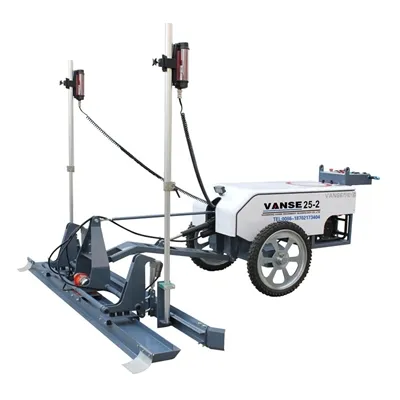
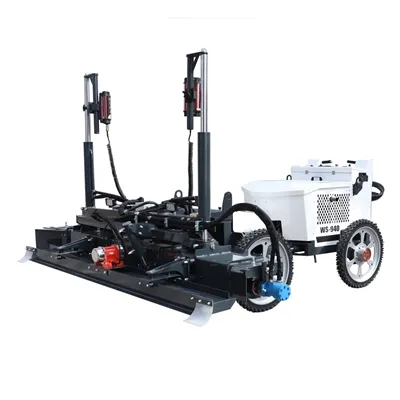
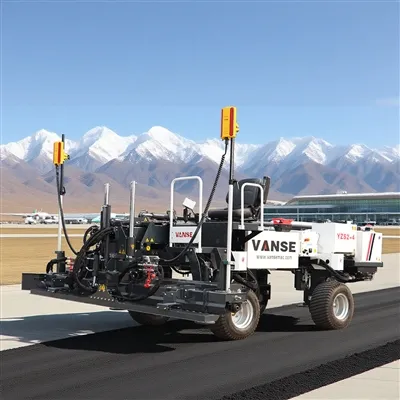
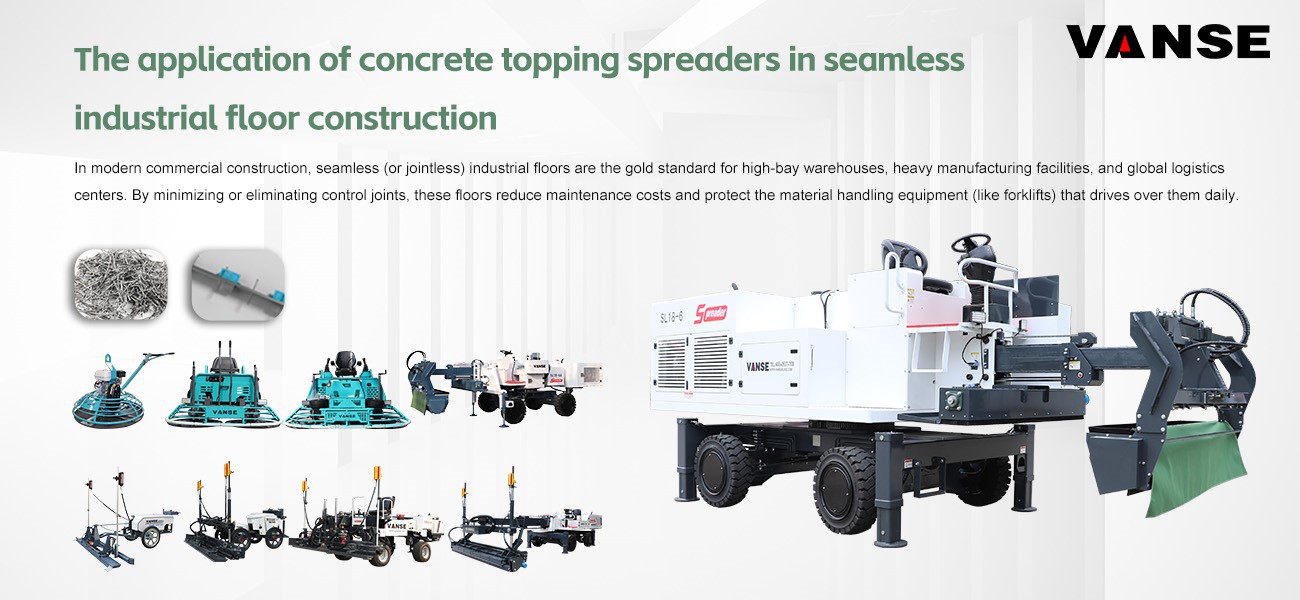
Leveling: The process begins with a high-efficiency telescopic boom concrete laser leveling, such as the Vanse YZ30-4E or YZ40-4E. These machines establish the flawless grade and initial levelness across the wide-area pour.
Spreading: Once the bleed water dissipates, the automated Concrete Topping Spreader steps in, precisely broadcasting the wear-resistant aggregates without disrupting the laser-guided levelness.
Finishing: Finally, heavy-duty ride-on power trowels mechanically compact and burnish the surface, driving the hardener deep into the matrix to seal the seamless floor.
By sourcing a complete suite of compatible, heavy-duty equipment from a single innovative manufacturer like Vanse Group, contractors guarantee that their spreading speed matches their leveling speed, resulting in lower labor costs, zero material waste, and structurally superior industrial floors.
Note: The parameters provided in this document are for reference only and are not mandatory. Due to differences in technical characteristics between different brands and models of laser levelers, please consult the manufacturer for a suitable solution before actual operation. This reference document assumes no responsibility for any issues arising from failure to follow the manufacturer's instructions.
Thanks to All the Friends Who Support and Trust Shandong Vanse Machinery Technology Co., Ltd.
If you want to know more about Shandong Vanse Machinery Technology Co., Ltd. or have any questions, please feel free to contact us:
Our Factory
Shandong Vanse Machinery Technology Co., Ltd.








Share this article

About the Author: Shandong Vanse Machinery Technology Co., Ltd.
Shandong Vanse Machinery Technology Co., Ltd. is a high-tech manufacturer specializing in concrete construction machinery, including laser screeds and related equipment. The company integrates R&D, production, and global sales, with products exported to over 60 countries and widely used in infrastructure projects worldwide.
Previous Post
Next Post
Related Articles
You Might Also Like
How to check whether the laser receiver of the concrete laser leveling machine is working properly?
– Appearance inspection: Carefully check whether the shell of the laser receiver is damaged or cracked, and whether the connecting line is damaged or loose. If these problems exist, it may cause signal transmission failure, and the damaged parts need to be repaired or replaced in time. – Power supply check: Make sure the receiver is connected to the power supply and the power indicator is on normally. If the indicator light is off, check whether the power socket and power cord are normal, and whether the power switch of the receiver is turned on. – Observe the signal indicator: Most laser receivers have a signal indicator. When receiving a laser signal, the indicator will have a corresponding display, such as lighting up or flashing. When the laser transmitter is turned on, observe the signal indicator of the receiver. If the indicator does not respond, the receiver may not receive the signal and further investigation is required. – Manual blocking test: When the laser transmitter is emitting laser normally, use an opaque object to temporarily block the receiving window of the laser receiver and observe the changes in the signal indicator. If the indicator light goes out or changes state when blocked, it means that the receiver responds to the laser signal, and the initial judgment is that the receiving function is normal; if the indicator light does not change, the receiver may have a fault. – Slope control function test: If the concrete laser leveler has a slope control function, set different slope parameters and observe whether the laser receiver can accurately control the leveler to perform construction according to the set slope. If the leveler cannot work according to the set slope, there may be a problem with the slope control function of the laser receiver. – Flatness detection function test: Run the concrete laser leveler on a test platform or ground with known flatness, let the laser receiver work and record the flatness data it measures. Compare the data with the actual flatness to check whether the measurement result is within the allowable error range. If the deviation is large, it means that the flatness detection function of the laser receiver may be inaccurate and needs to be calibrated or repaired. – Different position test: In the working area of the concrete laser leveler, select multiple different positions, including positions close to, far from, and at different angles from the laser transmitter, and observe whether the laser receiver can receive signals normally and work accurately at these positions. If the signal is lost or works abnormally at certain positions, it means that there is a problem with the receiver's receiving range or angle. – Accuracy calibration test: Use professional measuring tools, such as high-precision levels, to compare with the measurement results of the laser receiver. Perform measurement comparisons at multiple different positions to check whether the measurement accuracy of the laser receiver meets the equipment requirements. If the accuracy deviation is found to exceed the allowable range, the laser receiver needs to be calibrated and debugged. Enter the setting interface of the laser receiver and check whether the software settings and parameters are correct. Make sure that the parameters such as working mode, laser wavelength, sensitivity, etc. match the laser transmitter and the entire leveling machine system. Incorrect parameter settings may cause the receiver to work abnormally, and it is necessary to set it correctly according to the equipment manual. If conditions permit, professional optical detection equipment such as optical power meter, laser interferometer, etc. can be used to perform more accurate detection of the laser receiver. These devices can measure the laser power, wavelength stability, beam quality and other parameters received by the receiver, and compare them with the technical specifications of the receiver to accurately determine whether it is working properly. If there are multiple concrete laser leveling machines of the same model, the suspected problematic laser receiver can be interchanged with the receivers on other machines that are working properly. Then observe the working conditions of the two machines. If the original normal machine has the same problem as before, and the original problematic machine returns to normal, it can be determined that the laser receiver itself is faulty and needs to be repaired or replaced.What the special precautions should be taken when using laser leveling machines on different ground materials?
– Material inspection: Make sure that the mix ratio of concrete meets the construction requirements. For laser leveling machine construction, the slump of concrete is generally recommended to be between 12 and 18 cm, so that the concrete has good fluidity and is convenient for the leveling machine to operate. For example, in the construction of large factory floors, the slump of concrete should be tested in advance to avoid affecting the leveling effect due to inappropriate slump. – Base treatment: The ground base needs to be solid and flat. If there are uneven areas on the base, the thickness of the concrete will be uneven, affecting the final flatness of the ground. Therefore, before construction, the base should be cleaned and repaired, debris, dust, etc. should be removed, and potholes should be filled. – Vibration link: After the concrete is laid, before using the laser leveling machine, you can use a vibrating rod for preliminary vibration to make the concrete more compact. But pay attention to the vibration time and depth to avoid excessive vibration causing concrete segregation. During the vibration process, it should be coordinated with the construction sequence of the laser leveling machine. Generally, the leveling operation should be carried out as soon as possible after vibration. – Leveling operation: When the laser leveling machine is used for concrete floor construction, the parameters of the equipment should be adjusted according to the design elevation and slope requirements of the ground. During the construction process, the walking speed of the machine should be uniform, avoiding too fast or too slow. Too fast speed may cause insufficient flatness of the ground, and too slow speed will affect the construction efficiency. At the same time, pay attention to the height and angle of the scraper to ensure that the concrete surface is flat and smooth. – Moisturizing maintenance: After the concrete is leveled, moisturizing maintenance should be carried out in time. Plastic film, straw mats, etc. can be covered on the surface to prevent the concrete from cracking due to excessive evaporation of water. The maintenance time is generally not less than 7 days. In hot weather or dry environment, the maintenance time should be appropriately extended. – Temperature control: The temperature of asphalt material is crucial to the construction quality. During construction, the temperature of hot-mix asphalt mixture should meet the requirements of construction specifications. Generally, the exit temperature of ordinary asphalt mixture is between 140 and 165℃. If the temperature is too low, the asphalt mixture will become viscous, which is not conducive to the construction of the leveling machine; if the temperature is too high, it will accelerate the aging of asphalt. – Base treatment: Similar to concrete floors, the base of asphalt floors also needs to be solid and flat. At the same time, the base must be kept dry, because if there is moisture in the base, after the asphalt is paved, the evaporation of moisture will cause hollowing and cracking problems in the asphalt pavement. – Paving uniformity: During the asphalt paving process, the asphalt mixture must be spread evenly. When the laser leveling machine is in operation, pay attention to controlling the pressure of the scraper to avoid excessive pressure that causes excessive extrusion of the asphalt mixture, affecting its density and surface flatness. – Joint treatment: In asphalt floor construction, joint treatment is a key link. When using a laser leveling machine for multi-width paving, the longitudinal joints between the two widths must be handled well. Generally, the hot joint method can be used, that is, a certain width (generally 10-20cm) of the first paved asphalt mixture is left unrolled for the time being, as the reference surface for the later paving part, and then the joint is leveled with a leveler so that the two asphalt pavements can be well connected. – Compactness inspection: After the asphalt floor construction is completed, the compaction of the ground should be checked. Nuclear density meters and other equipment can be used for testing to ensure that the compaction meets the design requirements. If the compaction is not enough, the asphalt floor will cause rutting and other diseases during use. – Stone selection and processing: Select stones with uniform size specifications and good flatness. Before paving, the back of the stone should be cleaned to remove dust, impurities, etc., and appropriate back coating can be performed to enhance the bonding between the stone and the base. – Base preparation: The base needs to have sufficient strength and stability, and cement mortar is generally used as the base material. The flatness error of the base layer should be controlled within a small range to provide a good foundation for stone laying. – Laying accuracy: When using a laser leveler to assist in laying stones, the laying height and levelness of the stones should be accurately controlled. Since the stone itself is heavy, the leveler should be careful to avoid collision with the stone during operation to prevent the stone from breaking or shifting. For large-sized stones, multiple people may be required to cooperate in the construction and use the leveler for fine-tuning. – Use of bonding materials: When laying stones, the bonding materials (such as cement mortar or special stone glue) should be applied evenly and the thickness should be moderate. The laser leveler can be used to check the flatness of the stone after laying. For uneven stones, adjustments can be made before the bonding materials solidify. – Cleaning and protection: After the construction is completed, the stains and bonding material residues on the stone surface should be cleaned in time. And the stone surface can be protected, such as applying protective agents, to prevent the stone from being polluted and eroded, and extend the service life of the stone floor.What are the key points to keep in mind when using a concrete laser leveling machine?
The key points to pay attention to when using a concrete laser leveler are crucial, as they directly determine the flatness, quality, and service life of the floor. The following is a detailed summary of the key points to pay attention to in each step, from pre-construction preparation to post-construction maintenance: This phase is the foundation for a smooth construction process. Inadequate preparation will lead to numerous subsequent problems. Base treatment is key: Strength and Density: The base layer (usually crushed stone or stabilized layer) must be compacted to meet the specified bearing capacity requirements (usually ≥1.5 MPa) to prevent cracking caused by base subsidence. Elevation and Flatness: The base layer elevation must be strictly controlled to allow sufficient thickness for the surface concrete. Flatness should not be too poor, otherwise excessive concrete consumption will occur. Cleanliness and Moisture: The base layer surface must be thoroughly cleaned and free of loose dust, oil, and debris. Before pouring concrete, it should be thoroughly moistened with water, but no visible water should be allowed. This is to prevent the base layer from absorbing moisture from the concrete, which could lead to plastic shrinkage and cracking. Precise Formwork Installation: The top elevation of the formwork must align with the designed floor elevation, which is one of the benchmarks for laser leveling. The formwork must be securely supported to prevent displacement or deformation caused by the leveling's movement and concrete compression. The formwork is typically constructed of channel steel, which must possess sufficient rigidity and straightness. Laser transmitter installation and calibration: Location Selection: The transmitter should be mounted in the center or at a high point within the construction area to ensure signal coverage across the entire work surface and avoid signal blind spots. Secure Installation: The transmitter tripod must be securely mounted on solid ground, away from sources of vibration, and monitored during construction to prevent movement. Precise Calibration: The height and level of the laser transmitter must be precisely calibrated according to the design elevation. This is the "brain" of the entire automated leveling system; any error can lead to a complete breakdown. Repeated verification is essential. Equipment Inspection and Debugging: Check the leveling's hydraulic system, engine, scraper, vibrator, and other components for proper operation. Install and inspect the laser receiver, sensor, and control panel to ensure they can properly receive and process laser signals. As the saying goes, "A good cook cannot cook without rice." The quality of the concrete itself is crucial. Mix Design: Commercial concrete should be used, with a strength generally not lower than C25. Slump should be strictly controlled, generally recommended to be between 120mm and 140mm. Excessive slump can lead to segregation, significant shrinkage, and low strength; too little slump can result in poor fluidity and difficulty leveling. Aggregate Selection: The maximum aggregate particle size should be moderate (generally ≤25mm), with good gradation and a standard mud content. Transportation and Placement: The time from unloading to completion of placement should be short to prevent initial setting of the concrete. Segregation should be prevented during transportation. This is the core process and directly demonstrates the advantages of the laser leveling. Concrete pouring and initial paving: Discharge should be even, avoiding concentrated unloading to form large piles to prevent aggregate segregation. Preliminary paving can be performed using small equipment or manually, with the height slightly above the designed elevation (the virtual paving height). Key Points for Laser leveling Operation: Travel Direction: Typically, the paving is performed at a constant speed along the longitudinal direction. Coordination between the scraper and vibrating plate: The scraper is responsible for scraping away excess concrete and providing initial leveling; the vibrating plate uses high-frequency vibration to compact and fine-tune the concrete. The leveling's travel speed must be carefully controlled to ensure sufficient vibration time to achieve a compacting effect, but avoid excessive vibration that may cause concrete segregation. Real-time Adjustment: The operator must closely monitor the data on the control panel. The laser receiver monitors the elevation in real time and automatically adjusts the scraper's height via the hydraulic system, achieving unmanned, automatic leveling. The operator's primary responsibilities are to control movement and monitor equipment status. Critical Process Connection – Gun-Smoothing: After the laser leveling completes an area, but before the concrete begins to set (when a person steps on it and the concrete sinks approximately 3-5mm), gun-smoothing should be performed immediately using a double-disc ride-on trowel. Purpose: Removes minor blade marks left by the laser leveling, smoothes any excess cement slurry, seals surface pores, and prepares for subsequent finishing. This step is crucial to the final surface quality. Laser leveling only completes the "leveling" process. To achieve a high-strength, wear-resistant floor, finishing and maintenance are essential. Finishing (Slurry Calendering): After the concrete has initially set but before final set (when slight footprints remain), use a double or triple trowel with metal discs for rough grinding. Once the surface has further hardened and no visible water is visible, replace the trowel blade and perform a smooth finish. The frequency and timing of smoothing must be carefully controlled. Excessive or premature smoothing can cause surface bleeding and peeling. Smoothing further densifies the surface, improving wear resistance and impermeability. Slotting (Seam Cutting): Timing is critical: The concrete must reach a certain strength (usually 6-10 MPa compressive strength) but still be able to be cut smoothly by the cutter without causing edge cracking. This is generally done within 24-48 hours after pouring (the time varies depending on the temperature). Function: Guides concrete shrinkage cracks to develop in predetermined, uniform locations, avoiding random, irregular cracking. Joint Depth: Typically 1/4-1/3 of the slab thickness. Spacing: Generally determined by the concrete mix ratio and slab thickness, typically 24-36 times the slab thickness. Curing: Curing should begin immediately after the concrete has fully set (after finishing is complete). Recommended Method: Spraying a curing agent or covering with plastic sheeting. The curing agent should be evenly applied to form a dense film; the film should be tightly sealed to prevent evaporation. Time: Curing should last no less than 7 days, with the first 3 days being crucial. Purpose: Provide sufficient moisture for cement hydration to prevent rapid surface water loss, which can lead to cracking and reduced strength. A solid and level base: A weak foundation is destabilizing. Precise laser calibration: This is the system benchmark, and no mistakes can be made. Concrete slump control: Materials are fundamental, and 120-140mm is the optimal range. Timing of leveling and blasting: Mechanized, streamlined operations, seamlessly linked. Timing of finishing and slitting: Rely on experience; applying too early or too late can lead to problems. Timely and adequate curing: The final step that determines ultimate strength and cracking. Strict control of each of these steps can fully leverage the technical advantages of laser levelings to create high-strength, high-flatness, crack-free, high-quality concrete floors. Note: The parameters provided in this document are for reference only and are not mandatory. Due to differences in technical characteristics between different brands and models of laser levelers, please consult the manufacturer for a suitable solution before actual operation. This reference document assumes no responsibility for any issues arising from failure to follow the manufacturer's instructions.