Technical Knowledge
How to use the concrete laser level leveling machine? What are the steps?
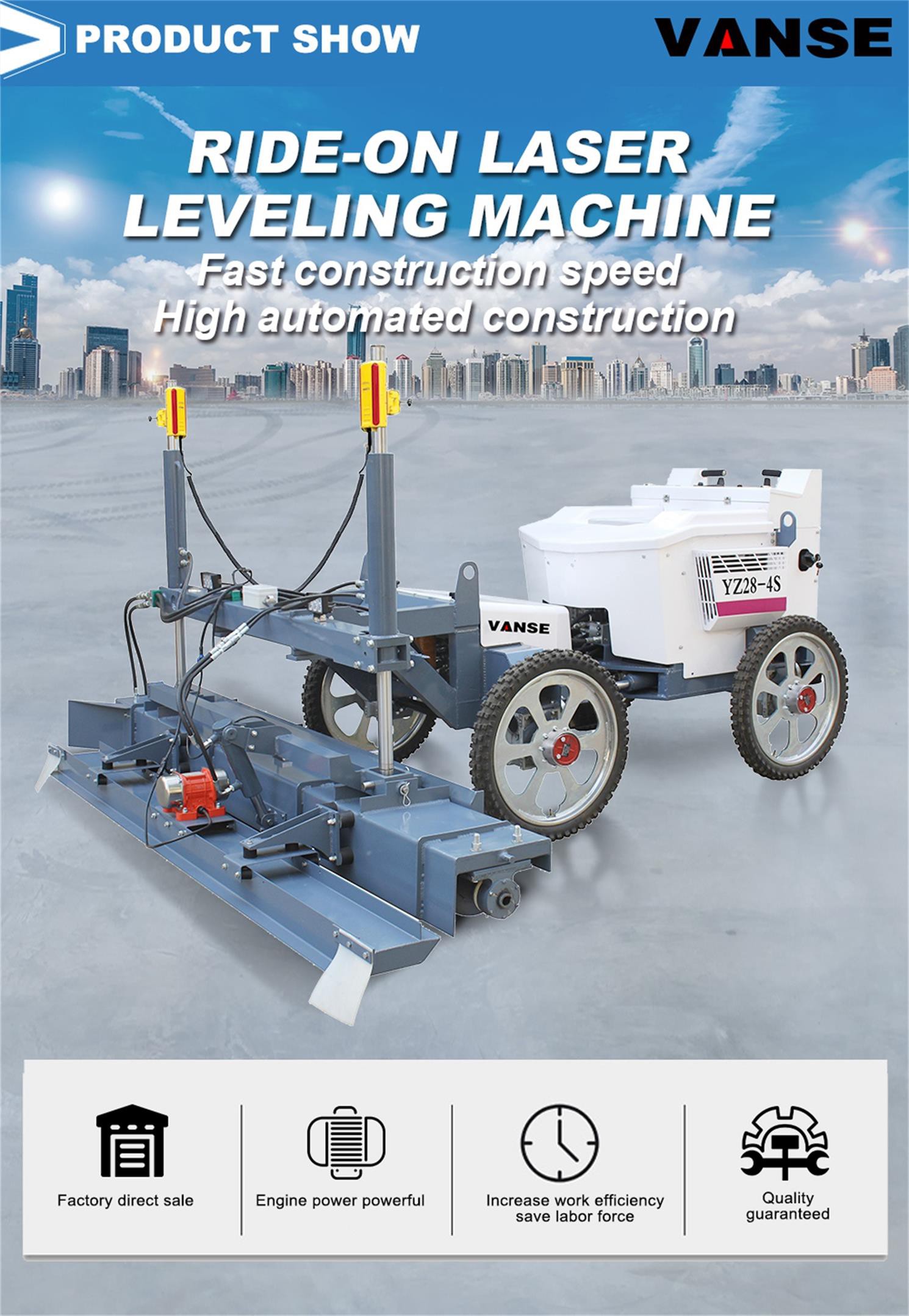
Laser leveling machine manufacturers to introduce to you what to do with this equipment: first check the equipment before use, to ensure that all functions of the equipment are normal, but also adjust the laser reference point before you can use it. After paving, technicians are required to evaluate the ground and determine the flatness before completing. ^-^
1, preparation work
(1) After the base layer is processed, the equipment is debugged on the laser paver, and the fixed reference level is drawn according to the original level; the non-woven fabric is laid, the side mold is supported, the laser emitter is set, and the ground is ground according to the original level. The elevation is introduced into the laser leveler.
(2) conveying concrete
Using the merchandise, the tanker transports the merchandise to the garage entrance and exit, and then transports it to the construction site with a three-wheeled dump truck.
(3) Elevation Calibration
The floor elevation is checked using a hand-held laser receiver, and the elevation is introduced into the laser paver to adjust the reference point (±0.00) on the leveler.
2, concrete paving
Pouring steps:
(1) After the formwork is supported, the chamber should be cleaned one day in advance and rinsed with water before pouring concrete. When pouring, drain the water, sweep the cement slurry or interface agent. Obvious water accumulation is strictly forbidden at this time. If there is, it must be removed carefully to spread the concrete.
(2) After the concrete is put down, it is initially leveled, and the level of leveling is preferably 3 cm above the elevation. Then level it with a laser paver. The corners that are not flattened can be flattened with a gasoline-type flattening ruler or manually.
3) When the warehouse near the wall is pouring, wait until the leveling machine has passed, and then scrape it with a scraper in time. And so on.
(4) For the area where the concrete mixer truck cannot be opened to the site, a tractor is used to transport the concrete. After the pouring is completed, the floor light collection construction is started when the concrete is initially set.
(5) When the warehouse near the wall is pouring, wait until the leveling machine has passed, and then scrape it with a scraper in time. And so on.
(6) For areas where the concrete mixer truck cannot be opened to the site, tractors are used to transport concrete. After the pouring is completed, the floor light collection construction is started when the concrete is initially set.
3. The laser signal received by the laser paver receiver (10 times/second frequency) automatically adjusts the elevation in real time to ensure that the construction elevation is always at the set standard. Because the laser transmitter is fixed after being set up, it can ensure that the construction of a large area of the ground does not cause cumulative errors.
4. During the construction, the operator uses the handheld laser receiver to detect the ground after the machine is constructed, and once again ensure that the flatness error is within the controllable range.
Thanks to All the Friends Who Support and Trust Shandong Vanse Machinery Technology Co., Ltd.
If you want to know more about Shandong Vanse Machinery Technology Co., Ltd. or have any questions, please feel free to contact us:
Our Factory
Shandong Vanse Machinery Technology Co., Ltd.








Share this article

About the Author: Shandong Vanse Machinery Technology Co., Ltd.
Shandong Vanse Machinery Technology Co., Ltd. is a high-tech manufacturer specializing in concrete construction machinery, including laser screeds and related equipment. The company integrates R&D, production, and global sales, with products exported to over 60 countries and widely used in infrastructure projects worldwide.
Previous Post
Next Post
Related Articles
You Might Also Like
Key points for routine inspection, fault early warning and maintenance of the hydraulic system of concrete laser leveling
The routine inspection, fault early warning and maintenance points of the hydraulic system of the concrete laser leveling are a crucial topic, as the health condition of the hydraulic system directly determines the construction efficiency, leveling accuracy and equipment service life of the leveling. The following is a detailed and systematic guide. Objective: To prevent problems before they occur and promptly identify potential issues through daily observation. Oil level check: When the equipment is parked on a level ground and the hydraulic system is not started (or the cylinder has been retracted), check the oil level gauge in the hydraulic oil tank. The oil level should be between the marked upper and lower scale lines. Low oil level can cause the pump to run dry, the system to overheat and get damaged. If the oil level is too high, it may cause excessive pressure or oil leakage from the breather valve when the oil temperature rises. Leak inspection: Carefully inspect the entire hydraulic system, including: Pipe joints: Check for oil stains or dripping oil. Cylinder piston rod: Check for any scratches, bends or continuous leakage. Hydraulic pump, valve block, motor: Check if there is any leakage at the mating surface. Fuel tank surface: Whether it is clean and free of oil stains. Oil color: Observe the color of the hydraulic oil through the oil level gauge. New hydraulic oil is usually transparent amber in color. If it is found to be turbid and opaque (possibly water ingress), darker and blackened in color (possibly oxidation and deterioration), or milky white (definitely water ingress and emulsification), further treatment is required. Abnormal noise: Start the engine and operate various hydraulic actions (lifting, walking, vibration, etc.). Listen carefully for any sharp "click-click" sounds (cavitation sounds) or continuous dull abnormal noises from the hydraulic pump (possibly due to internal wear of the pump or motor). Vibration and Pulse: Touch the hydraulic pipeline with your hand to feel if there is any abnormally intense vibration or pulse sensation. This may be a sign of oil circuit blockage or pump/motor failure. Temperature: After working for a period of time, touch the outer shell of the hydraulic oil tank with your hand. If it feels hot to the touch (the temperature may exceed 60-70°C), it indicates that the system is overheated and needs to be shut down for inspection. Slow movement: Test the movement of all cylinders and motors to see if there is any slowdown in speed, weakness or jamming. Pressure maintenance: For the lifting cylinder, observe whether there is obvious "sinking" (i.e., internal leakage) after it is lifted. Objective: Identify early symptoms of faults to prevent minor issues from evolving into major ones. Warning signal Analysis of Possible causes Potential risk Slow and weak movements 1. Insufficient hydraulic oil or incorrect viscosity of the oil. The leveling accuracy has declined, making it impossible to work normally and resulting in low efficiency. 2. The main pump is worn out and internal leakage occurs, resulting in insufficient pressure/flow. 3. The set pressure of the relief valve (safety valve) is too low or the valve core is stuck. 4. Severe internal leakage of the actuator (cylinder/motor). Abnormal noise from the system (pump 1. The oil suction pipeline is clogged or the filter element is dirty. The hydraulic pump will be severely damaged in the short term and must be shut down immediately. 2. When the oil level is too low, the pump sucks air, causing cavitation. 3. Air mixed into the hydraulic oil (due to poor sealing of the pipelines). 4. The bearings or internal components of the pump itself are damaged. The system is severely overheating. 1. The hydraulic oil cooler is clogged (air-cooled or water-cooled). Accelerate the oxidation and deterioration of the oil, the aging of seals, and the wear of all hydraulic components. 2. The relief valve is frequently opened or the set pressure is too high. 3. Improper viscosity or deterioration of the hydraulic oil. 4. Severe leakage inside the pump or valve causes energy loss, which is converted into heat energy. The cylinder is crawling and shaking 1. There is air in the cylinder. It affects the stability of the leveling operation, causing waves to appear on the ground. 2. The wear of the piston seal in the oil cylinder leads to unstable pressure. 3. Oil contamination leads to the valve core of the control valve getting stuck and discontinuous movement. The hydraulic oil deteriorates rapidly 1. The oil temperature has been too high for a long time, leading to oxidation. Cause abrasive wear and corrosion of all hydraulic components. 2. Water enters the oil (such as leakage from the water cooler). 3. Contaminants (dust, metal shavings) invade the system. External leakage Aging of seals, damage to oil seals, loose joints, and wear and rupture of pipelines. Waste of oil, environmental pollution, insufficient system pressure, and even fire. Objective: Establish a scientific maintenance system to maximize the system's lifespan. Regularly change the hydraulic oil and filter elements: Strictly follow the oil change cycle specified by the equipment manufacturer (usually 500-1000 working hours). In harsh and dusty environments, the cycle should be shortened. When changing the oil, all hydraulic filter elements (suction oil filter, return oil filter, pressure oil filter) must be replaced simultaneously. Refueling must be filtered: When adding or replacing new oil, it is essential to use a dedicated fuel pump and filtering device. It is strictly forbidden to directly pour the oil drum into the fuel tank. Keep the fuel tank clean: Clean the area around the fuel tank cap before refueling to prevent debris from falling in. Regularly clean the magnetic plugs inside the fuel tank. Regularly clean the fins of the hydraulic oil radiator to ensure good ventilation and no blockage from concrete, dust, etc. Avoid the equipment operating under extremely high load for a long time. If the ambient temperature is high, an auxiliary cooler can be considered for installation. Ensure the sealing of all suction pipelines to prevent the pump from being sucked empty. Regularly check whether the fuel tank breathing valve is unobstructed. After the machine stops, regularly check the water outlet at the bottom of the fuel tank for any water. For key equipment, samples can be taken regularly and sent to professional laboratories for testing. The analysis report can inform you of the contamination degree of the oil, the composition of worn metals, water content and physical and chemical indicators, thereby accurately predicting faults, achieving oil replacement based on quality and saving costs. Avoid operating the hydraulic cylinder piston rod only when it reaches the end of its stroke. Instead, release the operating rod before approaching the end to take advantage of inertia to reach the position and reduce the impact. When starting up in winter, it should first run at low speed without load for a period of time to allow the oil temperature to rise and the viscosity to decrease before commencing operations. Maintain the project Daily/ Per shift Weekly/ 50 hours Month/ 250 hours Every six months / 1,000 hours Check the hydraulic oil level ✓ Check for leakage, abnormal noise and temperature ✓ Clean the surface of the fuel tank and radiator ✓ ✓ Check the tightness of the pipelines and joints ✓ Replace the hydraulic return oil filter element ✓ Take oil samples for testing (suggested) ✓ Completely replace the hydraulic oil and all filter elements ✓ (As per the manufacturer's regulations When it comes to the hydraulic system of the concrete laser leveling, the principle that "cleanliness is fundamental and prevention is key" must be adhered to. Only by conducting rigorous daily inspections to identify early warning signals and combining them with regular systematic maintenance can the stability and reliability of the equipment during the construction period be ensured, ultimately achieving high-precision and high-efficiency floor construction and significantly reducing the operating costs throughout the entire life cycle. Note: The parameters provided in this document are for reference only and are not mandatory. Due to differences in technical characteristics between different brands and models of laser levelers, please consult the manufacturer for a suitable solution before actual operation. This reference document assumes no responsibility for any issues arising from failure to follow the manufacturer's instructions.Construction quality control and management of concrete laser leveling machine
The construction quality control and management of concrete laser leveling mainly involves the following aspects: 1. Equipment selection and calibration First of all, choosing a qualified concrete laser leveler is the basis for ensuring construction quality. It is necessary to ensure that the selected equipment can meet various requirements of construction, including accuracy, stability, durability, etc. After the equipment arrives at the construction site, it must be carefully unpacked and inspected to ensure that all parts are intact, and preliminary debugging and calibration must be carried out in accordance with the instructions. 2. Operator training Operating a concrete laser leveling requires professional skills and experience, so operators must be rigorously trained. The training content includes the basic principles of equipment, operating procedures, safety precautions, fault diagnosis and troubleshooting, etc. Only operators who have been trained and obtained certificates can perform actual operations. 3. Construction process quality control Pre-construction quality control: This includes inspection of the construction environment to ensure it is dry, ventilated and dust-free. At the same time, concrete raw materials must be strictly controlled to ensure that their quality meets construction requirements. Quality control during construction: This is mainly to control the operation process of the concrete laser leveling machine. Operators are required to strictly abide by operating procedures and carry out construction according to preset parameters. At the same time, a dedicated person must supervise the construction process to ensure correct operation. Post-construction quality control: After the construction is completed, the concrete surface should be inspected for quality, including surface flatness, smoothness, etc. Any areas that do not meet the requirements must be dealt with promptly and leveled again. 4. Acceptance standards Acceptance standards are an important basis for measuring construction quality. For concrete laser leveling machine construction, the acceptance criteria mainly include the following aspects: Concrete surface flatness: This is the most basic acceptance standard, which requires that the concrete surface has no obvious undulations and the overall flatness meets the design requirements. Concrete surface finish: Good finish can reduce friction on the concrete surface and improve performance. The concrete surface is required to be smooth and flawless during acceptance. Construction accuracy: For high-precision construction projects, the accuracy of the concrete laser leveler must meet the design requirements. During acceptance, the construction accuracy should be measured to see whether it meets the design standards. Equipment stability: The stability of the equipment must be checked during acceptance, including the operation stability and working status stability of the equipment. Equipment reliability: During acceptance, the reliability of the equipment should be checked to see whether the equipment is prone to failure and whether each component of the equipment can operate stably. Economy: Th e economy of using the concrete laser leveling is also an important acceptance criterion. Economical use mainly refers to whether the energy, material and other costs consumed by the equipment during the construction process are reasonable. During acceptance, the economics of the equipment should be evaluated to see whether it meets the requirements of economic benefits. Safety: During acceptance, the safety of the equipment must also be checked, including whether the safety protection measures of the equipment are complete and whether the operators have safety awareness. In addition, it should be ensured that the noise and vibration of the equipment are within an acceptable range and will not affect the surrounding environment and personnel. Environmental protection: The environmental performance of the equipment must also be considered during acceptance. Concrete laser levelings may produce pollution such as dust and noise during the construction process. Therefore, it is necessary to ensure that environmental factors are considered during the design process of the equipment to minimize environmental pollution. 5. Quality inspection and maintenance During and after the construction process, the concrete laser leveling machine should be regularly inspected and maintained for quality. Quality inspection mainly includes inspection of the equipment's operating status, working accuracy, concrete quality, etc. Maintenance mainly includes daily maintenance, regular inspection and repair of the equipment. 6. Recording and archiving During the construction process, various construction parameters, operating procedures, problems and solutions should be recorded. These records can provide a basis for acceptance and quality inspection, and are also an important reference for equipment maintenance and improvement. Records should be organized into files and properly preserved for subsequent review and reference. In summary, the construction quality control and management of concrete laser leveling machines need to be comprehensively considered and implemented from multiple aspects such as equipment selection, personnel training, construction process control, acceptance standard formulation, quality inspection and maintenance, and record archiving. Only in this way can the construction quality of the concrete laser leveling be ensured and the overall quality and efficiency of the project improved.Floor engineering laser leveling/ leveling construction technology
• • • ★ • • •Pre-construction preparation • • • ★ • • • Before carrying out laser leveling construction of floor projects, adequate preparation is the key to ensuring construction quality and progress. The following are the main contents of preparation before construction: 1. On-site investigation and evaluation: Conduct a detailed investigation of the construction site to understand basic conditions such as terrain, landforms, and soil conditions, evaluate the difficulty of construction and possible problems, and provide a basis for the formulation of subsequent construction plans. 2. Construction plan formulation: Based on the on-site survey results and engineering requirements, formulate a detailed construction plan, including construction process, personnel organization, equipment configuration, construction schedule, etc. 3. Personnel training and preparation: Provide operating training for laser leveling equipment to personnel involved in construction to ensure that they are familiar with equipment performance, operating essentials and safety precautions. At the same time, construction personnel should be equipped with necessary labor protection supplies. 4. Equipment inspection and debugging: Conduct a comprehensive inspection of construction equipment such as laser levelers and mixed soil pumps to ensure their good performance, safety and reliability. Carry out necessary debugging and calibration of equipment to ensure that it can work accurately and efficiently during the construction process. 5. Site layout and preparation: Clean the construction site to ensure there is no debris or water accumulation, and provide sufficient working space for construction equipment. Set up construction signs, warning signs and other safety facilities to ensure safety during construction. • • • ★ • • •Material selection and blending • • • ★ • • • The materials required for laser leveling construction of floor projects mainly include cement, aggregates, additives, etc. Choosing appropriate materials and reasonable mixing ratios are crucial to ensuring construction quality. 1. Cement selection: Choose cement with stable quality and meeting the requirements to ensure the strength and durability of the concrete. 2. Aggregate selection: Select appropriate aggregates, such as sand, stone, etc., according to project requirements. Aggregates should have good gradation and particle shape to improve the compactness and workability of the concrete. 3. Use of additives: According to the needs of the project, an appropriate amount of water reducing agent, slow agent and other additives can be added to improve the working performance and hardening performance of the concrete. 4. Material preparation: Material preparation is carried out according to the design requirements, and key parameters such as water-cement ratio and aggregate content are strictly controlled to ensure that the quality of the concrete meets the standard requirements. • • • ★ • • •Basic Processing • • • ★ • • • Before laser leveling construction, the foundation needs to be treated to ensure the flatness and solidity of the floor. 1. Foundation cleaning: Remove oil, debris, etc. from the foundation surface to ensure that the foundation surface is clean and dry. 2. Foundation leveling: If the surface of the foundation is uneven, mortar and other materials must be used for leveling to ensure the quality of subsequent construction. 3. Foundation solidification: The newly poured foundation needs to be cured and cured for a certain period of time to ensure that the foundation strength reaches the required level before laser leveling construction is carried out. • • • ★ • • •Laser Equipment Calibration • • • ★ • • • Laser leveling machine is the core equipment for laser leveling construction of floor projects, and its calibration accuracy is directly related to the quality of construction. 1. Laser transmitter installation and calibration: Install the laser transmitter in a fixed position and ensure that its height and angle meet the requirements. Calibration using a laser receiver ensures that the laser beam is accurately projected onto the ground to be leveled. 2. Laser receiver installation and debugging: Install the laser receiver on the concrete laser leveler to ensure that it can accurately receive the laser signal from the laser transmitter. Make adjustments to the laser receiver as needed to ensure it is working properly. • • • ★ • • • Concrete Pouring • • • ★ • • • Concrete pouring is a key link in laser leveling construction of floor projects, and the quality and speed of concrete pouring need to be strictly controlled. 1. Concrete mixing and transportation: Mix concrete according to the material mixing ratio to ensure that the concrete is evenly mixed and free of impurities. Use equipment such as concrete pumps to transport concrete to the construction site to ensure that the concrete maintains good working performance during the construction process. 2. Concrete pouring speed: According to the construction plan and actual site conditions, the concrete pouring speed should be reasonably controlled to ensure that the concrete can cover the entire construction area in a timely and even manner. 3. Concrete pouring quality: During the pouring process, the uniformity and compactness of the concrete should be checked to ensure that the concrete pouring quality meets the design requirements. • • • ★ • • •Laser Leveling Operations • • • ★ • • • Laser leveling operation is the core step of laser leveling construction in floor engineering, which requires operators to master equipment operation skills. 1. Operator requirements: Operators should receive professional training and be familiar with the performance characteristics, operating essentials and safety precautions of the laser leveler. During the construction process, stay focused and strictly follow the operating procedures. 2. Leveling operation points: After starting the laser leveling machine, adjust the height and angle of the scraper according to the laser signal to ensure that the scraper maintains an appropriate distance and angle from the ground. During operation, the stability of the scraper must be maintained to avoid adverse effects such as shaking or ripples on the scraper. At the same time, the leveling speed must be controlled according to construction requirements to ensure the best leveling effect. 3. Construction quality monitoring: During the leveling process, the construction quality should be monitored in real time to observe whether the ground is flat and smooth, and whether there are cracks, sand and other defects. If problems are found, the machine should be stopped immediately for inspection and equipment parameters or construction methods should be adjusted to ensure that the construction quality meets the design requirements. • • • ★ • • •Conservation and Protection • • • ★ • • • After the laser leveling construction of the floor project is completed, certain maintenance and protection work is required to ensure the durability and beauty of the floor. 1. Maintenance measures: The floor should be maintained within a period of time after the construction is completed (usually 7-14 days). During the maintenance period, adverse factors such as heavy pressure and flooding should be avoided, and the floor surface should be kept dry and clean. At the same time, laser leveling construction technology for floor engineering can be used. • • • ★ • • •Conservation and Protection (continued) • • • ★ • • • 1. Use special curing agents to maintain the floor surface to enhance the wear resistance, dustproof and anti-slip properties of the floor. 2. Protection measures: During the use of the floor, necessary protective measures should be taken to prevent the floor from being scratched, worn and contaminated. For example, set up protective mats or anti-slip mats on the passages in and out of the construction area to reduce wear and tear on the floor: clean and maintain the floor regularly, and remove dirt and debris in a timely manner. • • • ★ • • •Quality inspection and acceptance • • • ★ • • • Quality inspection and acceptance are important links to ensure the quality of laser leveling construction of floor projects, and they need to be carried out in strict accordance with relevant standards and specifications. 1. Quality inspection: During and after construction, the floor should be inspected for various quality indicators, including flatness, levelness, strength, wear resistance, anti-slip, etc. The detection method can use a combination of visual inspection, measuring instrument measurement, laboratory testing and other methods to ensure that the detection results are accurate and reliable. 2. Acceptance standards: The acceptance standards for laser leveling construction of floor projects should comply with relevant national standards and specifications, as well as the stipulations in the project contract. During acceptance, check whether the various quality indicators of the floor meet the requirements and whether there are defects such as cracks, sand, and hollows. If problems are found, rectification and repair should be carried out in a timely manner to ensure that the floor construction quality meets the acceptance standards. 3. Acceptance procedure: The acceptance procedure should include three stages: initial inspection, preliminary inspection and final inspection. The initial inspection is carried out during the construction process, mainly to check whether the construction technology of each roof meets the requirements; the re-inspection is carried out after the construction is completed, and all quality indicators of the floor are comprehensively tested; the final inspection is during the maintenance period Conducted after completion, the final quality of the floor is evaluated and confirmed. During the acceptance process, relevant records and documentation should be compiled for subsequent review and audit. • • • ★ • • •Summary• • • ★ • • • The laser leveling construction technology for floor engineering is an efficient and accurate construction method that can effectively improve the flatness and construction efficiency of the floor. During the construction process, various operations should be carried out strictly in accordance with the construction technology requirements to ensure The construction quality meets the design requirements. At the same time, during the construction process and after the construction is completed, necessary maintenance and protection work should be carried out on the floor to extend the service life and aesthetics of the floor. Finally, through the quality inspection and acceptance process, the reliability and stability of the laser leveling construction quality of the floor project are ensured.