Technical Knowledge
The advantages of concrete laser leveling machine
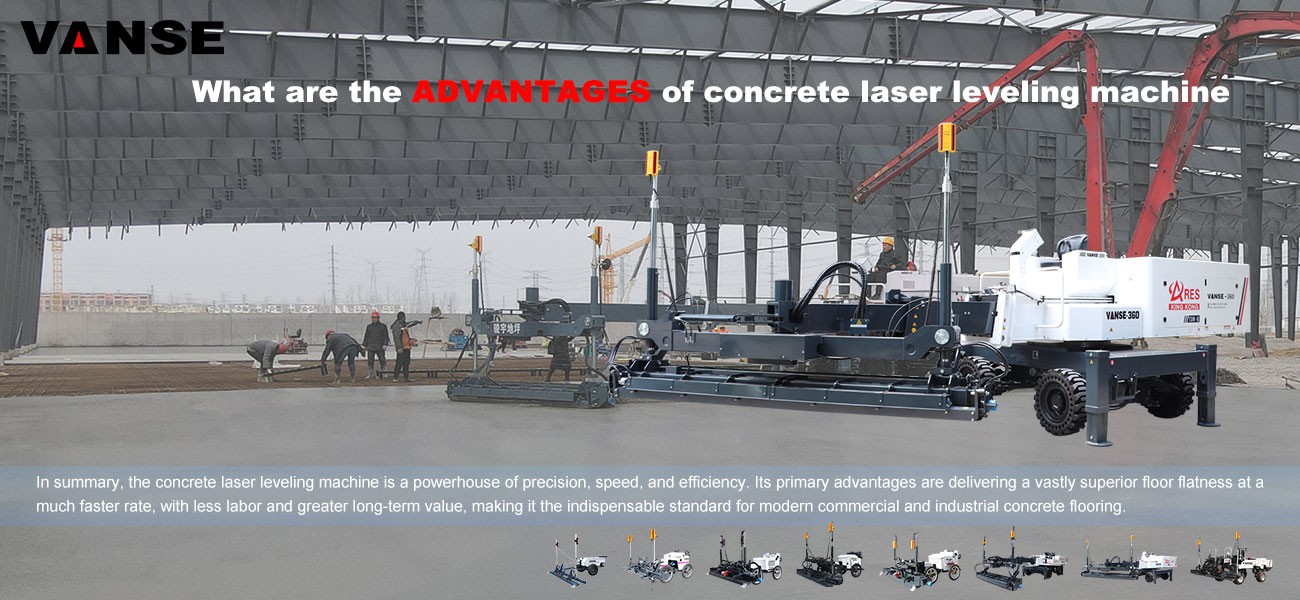
Concrete laser leveling machines, also known as laser leveling, are a transformative technology in the construction industry for placing and finishing large, flat concrete slabs. Their advantages are significant compared to traditional manual methods.
Here are the key advantages, broken down into categories:
1. Unmatched Precision and Quality
Extreme Flatness and Levelness: Laser leveling can achieve tolerances of FF/FL 50 or higher (standard for warehouse floors) and can even reach FF/FL 100 for super-flat floors (e.g., high-rack distribution centers). Manual methods struggle to consistently achieve this.
Eliminates Human Error: The machine is guided by a rotating laser plane, ensuring the entire slab is perfectly level to the established grade. This removes the variability and guesswork of manual rodding and screeching.
Reduced Curling and Cracking: By delivering immediate, precise consolidation and leveling, they minimize the risk of surface water pooling and create a more uniform slab, which reduces the potential for stress-related cracking and edge curling.
2. Dramatic Increases in Productivity and Speed
Rapid Placement: A single laser leveling can replace 10-20 skilled laborers with hand leveling. It can place and level 150-200+ cubic meters of concrete per hour (depending on the model and site conditions).
Earlier Access for Follow-on Trades: Because the slab is placed faster and cures more uniformly, follow-up work like framing or racking installation can often begin sooner, compressing the overall project schedule.
Continuous Operation: It can work non-stop as long as concrete is being delivered, preventing costly delays and concrete set-up issues.
3. Significant Labor and Cost Efficiency
Reduced Labor Dependency and Cost: It requires a much smaller crew (typically 1 operator and 2-3 helpers for finishing). This is a huge advantage in markets with skilled labor shortages.
Lower Long-Term Life-Cycle Costs: The superior flatness reduces wear and tear on forklifts and other equipment, lowers fuel consumption for material handling, and minimizes future maintenance costs for floor toppings or coatings.
Optimized Concrete Usage: By precisely controlling the grade, it minimizes over-pouring of concrete, leading to direct material savings.
4. Enhanced Worker Safety and Reduced Fatigue
Mechanization of Hard Labor: It automates the most physically demanding tasks of spreading, consolidating, and striking off heavy, wet concrete.
Reduced Repetitive Stress Injuries: Less manual raking and screeching means fewer strains, sprains, and long-term injuries for the crew.
Improved Site Organization: The faster, more organized process creates a cleaner, less congested work area.
5. Superior Concrete Consolidation and Surface Integrity
High-Frequency Vibration: The leveling head uses rapid vibration to thoroughly consolidate the concrete, removing air pockets and bringing fines to the surface. This results in a denser, more durable surface with higher compressive strength.
Ideal Surface for Finishing: The laser-leveled surface is perfectly struck off, providing a uniform starting point for finishers with ride-on trowels, leading to a higher quality finish with less effort.
Applications Where Advantages are Most Pronounced:
Large Industrial Slabs: Warehouses, distribution centers, manufacturing plants. Super-Flat Floors: High-rack storage, robotic fulfillment centers. Big Box Retail: Large stores with minimal floor joints. Parking Decks and Pavements: Where drainage and flatness are critical.
Considerations (Potential Disadvantages):
High Initial Investment: The machines are expensive to purchase, making them more suitable for rental or for large contracting firms.
Setup and Technical Knowledge: Requires proper laser setup and a trained operator.
Less Maneuverable in Tight Spaces: Best suited for open areas over 1,000 sq. meters. For very small, complex rooms, traditional methods may still be used.
Summary
The concrete laser leveling machine is a powerhouse of precision, speed, and efficiency. Its primary advantages are delivering a vastly superior floor flatness at a much faster rate, with less labor and greater long-term value, making it the indispensable standard for modern commercial and industrial concrete flooring.
Note: The parameters provided in this document are for reference only and are not mandatory. Due to differences in technical characteristics between different brands and models of laser levelers, please consult the manufacturer for a suitable solution before actual operation. This reference document assumes no responsibility for any issues arising from failure to follow the manufacturer's instructions.
Thanks to All the Friends Who Support and Trust Shandong Vanse Machinery Technology Co., Ltd.
If you want to know more about Shandong Vanse Machinery Technology Co., Ltd. or have any questions, please feel free to contact us:
Our Factory
Shandong Vanse Machinery Technology Co., Ltd.








Share this article

About the Author: Shandong Vanse Machinery Technology Co., Ltd.
Shandong Vanse Machinery Technology Co., Ltd. is a high-tech manufacturer specializing in concrete construction machinery, including laser screeds and related equipment. The company integrates R&D, production, and global sales, with products exported to over 60 countries and widely used in infrastructure projects worldwide.
Previous Post
Next Post
Related Articles
You Might Also Like
To what extent does the scraper of the concrete laser leveling need to be replaced when it wears out? Is it troublesome to replace?
The scraper of the concrete laser leveling (also known as the "scraper plate" or "leveling plate") is its core vulnerable part, and its condition directly affects the construction quality of the floor. The replacement of the scraper cannot be determined solely based on how long it has been used, but should be comprehensively judged according to the form of its wear and the resulting construction consequences. The following are the clear signals that need to be replaced: Key indicator: The depth of the wear groove at the bottom of the scraper. Replacement standard General standard: When the depth of the worn groove reaches 3 to 5 millimeters, it must be replaced. You can place a ruler horizontally at the bottom of the scraper. If a one-yuan coin (about 1.85mm thick) can be easily inserted and there is still a clear gap, it is very close to the replacement critical point. Conservative standard: For projects with high standards (such as super flat floors and epoxy floors), when the wear reaches 2-3 millimeters, replacement should be considered to ensure the best distribution of surface slurry and compaction effect. Abnormal wear pattern Uneven wear (oblique wear) : The wear at both ends of the scraper is inconsistent, resulting in one side being higher than the other. This is usually caused by improper equipment leveling or operating habits. As long as one side reaches the above-mentioned wear depth, it needs to be replaced. Irregular wear: Deep pits or wavy wear appear on the surface of the scraper, which will affect the uniformity of the scraper. Even if the wear measurement values do not fully meet the standards, the scraper should be inspected and replaced immediately if the following construction quality problems occur: Difficulty in lifting slurry: The scraper cannot effectively carry the cement slurry to the surface, resulting in exposed aggregates and a rough surface. The flatness has declined: After construction, the floor shows obvious waves or slight undulations, and the precision of the laser leveling cannot be perfectly reflected. Scratches appear: Severely worn edges of the scraper may become sharp or damaged, leaving scratches on the already leveled surface. Abnormal vibration of the equipment: Severely worn scrapers can alter the vibration characteristics of the leveling, sometimes leading to unstable movement or uneven vibration of the equipment. Core principle: The function of the scraper is to "level", "lift the slurry" and "compact". Once it fails to perform these duties perfectly, it's time to replace it. Don't sacrifice the quality of the entire floor just to save the cost of one scraper; otherwise, the cost of later repairs will be much higher. The answer is: It's not troublesome, but it requires care and correct steps. This is a routine maintenance operation that a skilled operator can complete within 15 to 30 minutes. The following are the general steps and precautions for replacement: Replacement steps Safety first Completely turn off the engine/power supply of the leveling. Stop the machine on a flat and solid ground. If it has just been used up, make sure the scraper and related components have cooled down to avoid burns. Raise and fix the machine Use the randomly provided jack or support rod to steadily lift the front end of the machine, lifting the scraper off the ground for convenient operation. Disassemble the old scraper Find the bolts or clamps that fix the scraper. These are usually located above or on the side of the scraper support. Use an appropriate wrench (usually an open-end wrench or socket wrench) to loosen and remove all the fixing bolts counterclockwise. (Note) Some models of scrapers are relatively heavy. When removing the last bolt, hold it with your hand to prevent it from suddenly falling and injuring your feet. Clean the installation surface Before installing the new scraper, be sure to clean the concrete residue and debris at the bottom of the scraper support with a scraper and brush. A flat and clean installation surface is the prerequisite for ensuring that the new scraper is installed straight. Install a new scraper Align the new scraper with the bracket and ensure it is perpendicular to the machine's central axis. First, screw on all the fixing bolts by hand to ensure that the threads are aligned. Use a wrench to tighten the bolts step by step in a diagonal and cross sequence. This can ensure that the scraper is evenly stressed and will not deform or generate installation stress. Inspection and Debugging Put down the machine, start the equipment, and run it unloaded for a few minutes to check if there is any abnormal shaking of the scraper. A test scrape can be conducted (on the waste material or in the area to be poured) to observe the ground effect and ensure the installation is correct. Details to note Bolt torque: Tighten the bolts strictly in accordance with the torque specified in the equipment manual. If it is too loose, the scraper will shift during operation. Excessive tightness may damage the bolt threads or the fracturing scraper support. Scraper type: Ensure that the model, size and material (usually polyurethane or hard alloy) of the new scraper are exactly the same as those of the old one. The performance and wear life of scrapers made of different materials vary. Spare parts: For important construction projects, 1-2 new scrapers should always be kept on site just in case. The judgment of replacement relies on precise measurement and observation of construction quality, while the execution of replacement is a standardized and simple mechanical operation. Developing the habit of regularly checking the wear of the scraper is the key to ensuring that the concrete laser leveling machine always produces high-quality floors. Note: The parameters provided in this document are for reference only and are not mandatory. Due to differences in technical characteristics between different brands and models of laser levelers, please consult the manufacturer for a suitable solution before actual operation. This reference document assumes no responsibility for any issues arising from failure to follow the manufacturer's instructions.How to extend the service life of concrete laser leveling machine?
In the field of concrete construction, concrete laser leveling machine (concrete laser leveling machine or concrete laser leveler) has become a key equipment to improve construction efficiency and quality. With the vigorous development of the construction industry, the demand for high-precision, large-area concrete construction continues to grow, and the application of concrete laser leveling machine is becoming more and more extensive. According to a market research report, the global concrete laser leveling machine market size is expected to reach US$1.76 billion in 2025, with an annual growth rate of approximately 11.4%. During long-term high-intensity use, how to extend the service life of the concrete laser leveling machine has become the focus of many users. This is not only related to the return on equipment investment, but also affects the smooth progress and cost control of construction projects. After each operation with a concrete laser leveling machine, timely cleaning is essential. Since the equipment will be exposed to a large amount of concrete, mud and other impurities during operation, if it is not cleaned in time, these substances will adhere to the surface of the equipment and key components, accelerating component wear. For example, the body shell, leveling blade, vibrating device and other parts can be washed with a high-pressure water gun (but it should be noted that it is strictly forbidden to directly aim the water gun at the mesh part of the body to prevent water from entering the body and causing a short circuit) to remove the concrete residue and dust on the surface. For some stubborn stains that are difficult to wash off, use a soft cloth dipped in a neutral detergent dilution to wipe. Do not use strong alkali or strong acid cleaning agents to avoid corrosion of the paint and electroplating layer on the surface of the equipment, affecting the appearance and reducing the protective performance. Regularly check the connection and tightening of each component. During the operation of the equipment, the connecting bolts may become loose or even broken due to factors such as vibration and impact. For example, the connecting bolts of the frame, walking mechanism, laser transmitting and receiving device of the laser leveling machine should be carefully checked before and after each operation. If they are loose, tighten them in time. If the bolts are broken, they need to be replaced immediately. At the same time, check whether there is leakage in all parts of the equipment, including engine oil, coolant, hydraulic oil of the hydraulic system, etc. Once leakage is found, the cause should be promptly investigated and repaired to avoid problems such as poor lubrication and overheating of components due to oil leakage, which will affect the service life of the equipment. The timely replacement of wearing parts is the key to ensuring the continuous and stable operation of the equipment. For example, the leveling scraper, vibrator, tires (or rubber tracks) of the leveling machine will wear faster during frequent use. Generally speaking, the wearing parts should be checked after each use. If the wear exceeds the prescribed limit, they should be replaced immediately. Even if the wearing parts do not seem to be damaged during normal use, it is recommended to replace them every six months to ensure that the overall performance of the equipment is not affected. For example, a severely worn leveling scraper cannot effectively scrape the concrete, which will cause the ground flatness to decrease, and will also increase the workload of other parts of the equipment, accelerating the overall loss of the equipment. In a high temperature environment, the concrete laser leveling machine faces many challenges. The engine is prone to overheating, resulting in power reduction and increased wear of parts. Therefore, when constructing in high temperatures in summer, first ensure that the engine cooling system is working properly. Before daily operation, check the coolant level and add it in time if it is insufficient; regularly clean the dust and debris on the surface of the radiator to ensure that the heat dissipation duct is unobstructed. When the engine temperature is too high, you should choose a cool area to stop and cool down. Do not rush to add cooling water. You need to let the engine idle for a while and add it after the temperature drops slightly to prevent the engine cylinder from cracking due to excessive temperature difference. At the same time, high temperature will also affect the performance of the hydraulic system. Check the hydraulic oil temperature frequently. If the oil temperature is too high, stop the machine for a rest to avoid long-term operation of the equipment at high temperatures. For example, in some southern regions during summer construction, if you do not pay attention to the heat dissipation of the equipment, it may cause the hydraulic system seals to age faster and leak oil, which will seriously affect the normal use of the equipment. High humidity environment can easily cause the metal parts of the concrete laser leveling machine to rust and corrode, especially when constructing in coastal areas or rainy seasons. To cope with high humidity environments, the equipment should be parked in a dry place and avoid being placed in the open air. If it is unavoidable to operate in a humid environment, anti-rust oil can be applied to the surface of the equipment, especially to parts that are prone to rust, such as the frame and chassis. At the same time, the electrical circuit should be checked regularly to prevent short circuit failures caused by moisture. For the battery of the equipment, it is necessary to keep it clean and dry, check the electrolyte level and density regularly, and replenish distilled water in time to ensure good battery performance. For example, if the laser leveling machine used for a long time in a high humidity environment does not pay attention to anti-rust treatment, it may cause problems such as frame rust and strength reduction in a short period of time, affecting the safety and service life of the equipment. Concrete contains alkaline substances. If the protection is not appropriate during long-term contact, it will cause corrosion to the components of the concrete laser leveling machine. For parts that are in direct contact with concrete, such as leveling blades, vibrating devices, etc., they can be made of corrosion-resistant materials or undergo special surface treatment to improve their resistance to alkali corrosion. After each operation, clean the equipment thoroughly to remove residual concrete and prevent alkaline substances from adhering to the surface of the equipment for a long time. In a high-alkaline environment, attention should also be paid to the lubrication system of the equipment, and lubricating oils and greases with good alkali resistance should be selected and replaced regularly to ensure that all moving parts are well lubricated and reduce the occurrence of failures caused by corrosion and wear. For example, in the construction of some industrial plant floors, due to the strong alkalinity of concrete, if effective protective measures are not taken, the key components of the equipment may be severely corroded in a short period of time, shortening the service life of the equipment. Strictly operate in accordance with the rated working parameters of the concrete laser leveling machine to avoid operating in a condition that exceeds the equipment's bearing capacity. Overload operation will cause excessive pressure on the engine, hydraulic system, transmission components, etc., accelerate the wear of parts, and even cause equipment failure. For example, behaviors such as leveling thickness exceeding the maximum thickness specified by the equipment and forced operation on a site with a large slope will cause damage to the equipment. As an equipment manager, you should ensure that the operator is familiar with the equipment performance and operating procedures, and strictly prohibit illegal operations. Before construction, arrange construction tasks reasonably according to actual working conditions to ensure that the equipment operates stably within the normal load range. During the operation of the equipment, try to ensure smooth operation and avoid violent operations such as sudden acceleration, sudden braking and frequent steering. Sudden acceleration and sudden braking will cause the engine and transmission system to bear greater impact force instantly, which may easily cause damage to parts; frequent steering will aggravate the wear of tires (or tracks) and steering mechanisms. After starting the equipment, the engine should be allowed to idle for a period of time to allow all parts to be fully lubricated before operation. During the leveling operation, keep the equipment moving at a uniform speed to avoid speed fluctuations, which can not only ensure the construction quality but also reduce the wear of the equipment. For example, when driving a concrete laser leveler, smoothly controlling the throttle and steering wheel can effectively extend the service life of key parts of the equipment. The correct start and stop sequence also has an important impact on the service life of the concrete laser leveler. Before starting the equipment, check the environment around the equipment to ensure that there are no obstacles; check whether the liquid levels of fuel, engine oil, coolant, hydraulic oil, etc. are normal, and whether the indications of various instruments are normal. When starting, first turn the key to the power-on position, wait for the instrument self-check to complete, and then start the engine. After the engine is started, let it idle for a few minutes, observe the engine sound, vibration and whether the display of each instrument is normal, and then proceed to the next step after confirming that it is correct. When shutting down, first park the equipment on a flat and solid ground, lower the working device to the lowest position, and then turn off the engine. If the equipment is not used for a long time, the equipment should be sealed and maintained in accordance with the requirements of the equipment manual, such as draining fuel and coolant, lubricating and protecting key parts, etc. For example, the wrong starting method, such as forcibly starting the engine before the equipment completes the self-check, may damage the engine control system and affect the normal use of the equipment. The hydraulic system is an important part of the concrete laser leveling machine, and regular maintenance is essential. Hydraulic oil will be contaminated and its performance will deteriorate during use, so the hydraulic oil should be replaced regularly. Under normal circumstances, the hydraulic oil should be replaced every 1,000 working hours or so. The specific replacement cycle can be adjusted appropriately according to the equipment use environment and the oil quality monitoring results. When replacing the hydraulic oil, use a clean container to hold the oil. The hydraulic oil must be filtered through the oil filter before adding it to the hydraulic oil tank to ensure that the oil is clean. At the same time, clean the hydraulic oil radiator regularly to ensure good heat dissipation and prevent the hydraulic system from malfunctioning due to excessive oil temperature. In addition, the replacement cycle of the hydraulic oil filter should also be appropriately shortened, generally 750 hours is appropriate. When replacing a new filter, check carefully. It is strictly forbidden to use a deformed, contaminated or rusted filter. For example, at some construction sites, due to the harsh environment, the hydraulic oil is easily contaminated by dust and impurities. If the filter and hydraulic oil are not replaced in time, it may cause blockage, leakage and other faults in the hydraulic system, seriously affecting the normal operation of the equipment. Regularly check the electrical system of the concrete laser leveling machine to ensure that all electrical components are firmly connected and the circuits are not damaged or aged. Check the performance of the laser transmitting and receiving device to ensure that the laser signal is stable and accurate. Start the engine once every two months, charge the battery, and run all hydraulic actuators, such as rotary hydraulic motors, telescopic cylinders, etc., to prevent battery loss and rust and jamming of hydraulic system components. Do not remove the battery from the machine at will to avoid the loss of internal software program failures in the equipment control. At the same time, pay attention to check the grounding of the electrical system to ensure that the grounding is good to prevent safety accidents caused by leakage. For example, if the electrical line is aging and damaged, it may cause a short circuit, causing a fire, and endangering the safety of equipment and personnel. Perform a comprehensive performance test on the concrete laser leveling machine every once in a while (such as half a year or a year). The test content includes key performance indicators such as leveling accuracy, work efficiency, engine power, and hydraulic system pressure. Through testing, potential problems with the equipment can be discovered in time, and targeted repairs and adjustments can be made. For example, if the leveling accuracy is found to be reduced, it may be due to laser system failure, wear of the leveling blade, or looseness of the mechanical parts of the equipment. It is necessary to check and repair them one by one to ensure that the equipment always maintains a good working condition and extends its service life. Click the below to jump immediately!!! ARMOUR JOINT CONCRETE LASER LEVELING MACHINE LIGHT TOWER POWER TROWEL SLIPFORM MACHINE STEEL FIBER TOPPING SPREADER TRACKED MINI DUMPERHow much greater efficiency can a ride-on laser leveling improve compared to a walk-behind model? Is the difference noticeable in actual construction?
The improvement in construction efficiency between ride-on laser leveling machines and walk-behind laser leveling machines, as well as the actual gap in construction, can mainly be analyzed from the following aspects. However, the specific improvement ratio and the severity of the gap may vary due to various factors such as equipment model, construction conditions, and the skill level of operators The moving speed: The ride-on laser leveling usually has a faster moving speed. For instance, the transfer speed of the YZ30-4E and YZ40-4E models can reach 0 to 10Km/h (dual-speed switching), while the walk-behind equipment mainly relies on the walking speed of the operator, which directly affects the construction efficiency. Assignment width: The leveling width of ride-on equipment such as YZ30-4E is 3100mm, and that of YZ40-4E is 4000mm. Compared with walk-behind equipment (such as the vibration plate width of DZ25-2 is 2500mm, and that of DZ30-2 is 3000mm), the single operation coverage area is larger, the number of repetitive operations is reduced, and thus the construction efficiency is improved. Degree of automation: Ride-on laser levelings are usually equipped with more advanced automatic control systems, such as microcomputer laser scanning control, which can achieve automatic leveling, reducing the time for manual adjustment and improving the construction accuracy and efficiency. Project Walk-behind laser leveling Ride-on laser leveling Construction speed Approximately 200 to 300 square meters per hour Approximately 600 to 1,000 square meters per hour Number of operators 2 to 3 people (including assistants) 1 to 2 people (single-person operation is acceptable) Continuous operation capacity Generally, human fatigue has a significant impact Strong, suitable for long working hours Adapted area Small areas and corner zones Large areas, main passage zones Construction accuracy High (laser control Higher (more stable system Significant efficiency improvement: In large-scale site leveling construction, the ride-on laser leveling, due to its high-speed movement and large-area operation capabilities, can significantly shorten the construction period. For instance, when laying large areas of concrete floors, ride-on equipment can quickly complete the leveling work, while walk-behind equipment requires more time and manpower. Precision and flatness: The ride-on laser leveling, through an advanced laser control system, can achieve higher construction precision and flatness, reducing the workload of subsequent repairs and adjustments. This is also one of the important factors for improving construction efficiency. Operator fatigue: Walk-behind equipment requires operators to walk for long periods and operate manually, which can easily lead to fatigue and affect construction efficiency. Ride-on equipment, on the other hand, offers a more comfortable operating environment, reduces the physical exertion of operators, and is conducive to maintaining continuous construction efficiency. The improvement in construction efficiency of the ride-on laser leveling is obvious, especially in large-scale site leveling construction, where its advantages are even more prominent. However, for small or complex terrain construction, hand-held equipment may have more advantages due to its flexibility and portability. Therefore, when choosing equipment, a comprehensive consideration should be made based on specific construction requirements and conditions. Concrete supply efficiency: The ride-on type requires 8-12 cubic meters of concrete per hour (calculated at 600 square meters per hour and a thickness of 150mm). If the concrete supply is insufficient (such as only one pump truck), the efficiency will be limited by the feeding speed, and the gap with the walk-behind type will be narrowed to within 20%. If the supply is sufficient (more than two pump trucks), the ride-on type can operate at full load, with a difference of up to 80%. Operator proficiency: The walk-behind operation is simple, and new operators can start working after one day of training. For the ride-on type, one needs to master functions such as laser system debugging and auger speed adjustment. The training will last for 3 to 5 days. If the operator is not skilled, the efficiency of the ride-on type may only be 20% to 30% higher than that of the walk-behind type. After becoming proficient, one can fully exert their performance, and the gap will expand to over 60%. Equipment maintenance and continuous operation capacity: Core components of the vehicle-type equipment (such as hydraulic systems and telescopic arms) require regular maintenance (hydraulic oil should be replaced every 500 hours). If maintenance is not timely, malfunctions may occur and the equipment may shut down. The walk-behind maintenance is simple (clean the air filter every 100 hours), with a low failure rate. However, long-term operation can easily reduce efficiency due to personnel fatigue. Preferred scenarios for ride-on type: Construction area > 5,000 square meters, regular site, and continuous high-intensity operation required (such as factories, logistics warehouses), with significant efficiency improvement and reduced labor costs (in the long term, one ride-on type can replace 2-3 walk-behind types + 4-6 workers). Preferred scenarios for the walk-behind type: Construction area less than 1,000 square meters, narrow site (such as interior renovation), and limited budget. At this time, the efficiency gap is small, and the procurement cost of the walk-behind type is lower (about 1/3 to 1/2 of that of the ride-on type). From the feedback of actual projects, in the construction of mainstream industrial plants and large commercial complexes' floors, the efficiency advantage of the ride-on type has become the key to "cost reduction and efficiency improvement". Especially when the construction area exceeds 10,000 square meters, choosing the ride-on type can shorten the construction period by 30% to 50%, and reduce the comprehensive cost (labor + construction period) by more than 20%. Note: The parameters provided in this document are for reference only and are not mandatory. Due to differences in technical characteristics between different brands and models of laser levelers, please consult the manufacturer for a suitable solution before actual operation. This reference document assumes no responsibility for any issues arising from failure to follow the manufacturer's instructions.