Technical Knowledge
A complete guide to replacing parts of concrete laser leveling machines, easy to understand in one minute

Any kind of mechanical equipment will inevitably suffer from wear or damage during long-term high-load operation. This is no exception for concrete laser leveling machines. Because the performance of the parts is directly related to the working efficiency and service life of the entire concrete laser leveling machine, it is very necessary to master the replacement and maintenance methods of the various components of the leveling machine. Now let our professional technicians teach you how to correctly replace the various components of the concrete laser leveling machine.
▼ Laser leveling machine piston and piston ring replacement tips
The piston with an upward arrow or other marks on the top should be installed in the direction specified by the mark; if there is no mark, the vortex pit on the top of the piston or the small notch next to the pit should be facing the injector side to ensure uniform mixing of the gas. When assembling the piston ring, the top with "up", "UP" and other marks should face up; the inner circle cut groove or chamfer of the twisted ring without a mark on the top should face down; the chrome-plated ring (shiny shell) should be installed in a piston ring groove, and the openings of each ring should be staggered by 120~180 degrees to ensure its sealing effect.
▼ Tips for replacing the cylinder gasket of a laser leveler
If there is an oil hole, align it with the corresponding oil channel hole on the concrete laser leveler body and cylinder head to avoid friction of the valve mechanism on the cylinder head due to oil cutoff. If there is no oil channel hole and the front and back shapes are the same, it is determined by the material of the cylinder head: for aluminum alloy cylinder heads, the curled side of the cylinder head should face the cylinder body; for cast iron cylinder heads, the curled side of the cylinder head should face the cylinder head.
▼ Tips for replacing the main bearing cap, bearing shell, and bushing of the laser leveler
The main bearing cap and the bearing seat of the concrete laser leveler are both processed by matching boring. They should be seated according to the matching mark. They must not be interchanged or the assembly direction changed at will to avoid damaging the coaxiality and dimensional accuracy of the main bearing seat hole. The bearing shell or bushing with an oil hole should be aligned with the corresponding oil channel hole on the bearing seat and bushing hole to ensure smooth oil passage.
▼ Tips for replacing connecting rods and connecting rod caps of laser levelers
The connecting rods of horizontal diesel engines are split at 45 degrees. The section should be facing downward to change the stress of the connecting rod bolts. The connecting rod caps and connecting rods of concrete laser levelers are processed in pairs. When assembling, the matching marks should be on the same side to ensure that the roundness and cylindricity of the connecting rod bearings meet the specified requirements.
Have you learned the methods and techniques for correctly replacing the pistons, piston rings, cylinder gaskets, main bearing caps, bearing shells, bushings, connecting rods, connecting rod caps and other parts of concrete laser levelers today? If you have any questions, you can call us directly for consultation. We will definitely have professional technicians to answer your questions in time.
Thanks to All the Friends Who Support and Trust Shandong Vanse Machinery Technology Co., Ltd.
If you want to know more about Shandong Vanse Machinery Technology Co., Ltd. or have any questions, please feel free to contact us:
Our Factory
Shandong Vanse Machinery Technology Co., Ltd.








Share this article

About the Author: Shandong Vanse Machinery Technology Co., Ltd.
Shandong Vanse Machinery Technology Co., Ltd. is a high-tech manufacturer specializing in concrete construction machinery, including laser screeds and related equipment. The company integrates R&D, production, and global sales, with products exported to over 60 countries and widely used in infrastructure projects worldwide.
Previous Post
Next Post
Related Articles
You Might Also Like
Laser leveling machine components
This is the core component of the laser leveling machine, responsible for generating high-quality laser beams. Its quality directly affects the working effect and stability of the leveling machine.Leak inspection: Carefully inspect the entire hydraulic system, including: This system is responsible for positioning the laser beam to the surface of the object to be measured for scanning and reflection. It is generally composed of rotating mirrors, oscillators, optical devices, etc. Its accuracy and speed have a direct impact on the leveling accuracy of the leveling machine. This is the part that performs leveling actions. It is usually made of wear-resistant materials and can complete paving, scraping, tamping and other actions. Its one-time forming width can reach 2.5 meters (depending on the machine itself, 2.5m, 3m, 4m, etc.). In addition, the rotating auger can discharge materials in forward and reverse directions, and it discharges materials in the forward direction during normal operation. It is mainly used for lifting and angle adjustment of the leveling mechanism. There are two self-aligning spherical bearings at the hinge of the lifting frame. The nut at the adjusting screw rod can adjust the angle of the leveling mechanism to adapt to different concrete. 2 high-pressure double-rod lifting cylinders are used to fix the leveling head and level it up and down. A front guard is installed in front to secure and protect electrical components such as lamps and aviation plugs. Used to fix the laser receiver. During the construction process, the bracket and the receiver cannot be moved at will, otherwise it will affect the leveling accuracy. This stand can be turned upside down during transportation to reduce the overall height. Including high-strength frame, power part, hydraulic system, electrical system, cleaning system, etc. The high-strength overall frame is the main frame of the laser leveling machine and fixes all components. During transportation, the safety lifting lugs on the frame can be used for lifting. The overall frame makes the machine safer and more reliable. In addition, there are also components such as a leveling feedback system. For more information about laser leveling machines, please speak to our sales manager. Note: The parameters provided in this document are for reference only and are not mandatory. Due to differences in technical characteristics between different brands and models of laser levelers, please consult the manufacturer for a suitable solution before actual operation. This reference document assumes no responsibility for any issues arising from failure to follow the manufacturer's instructions.Comparison of Concrete Floor Construction Equipment Standards in Different Countries
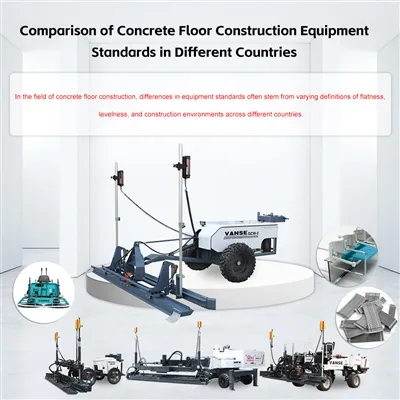
In the field of concrete floor construction, differences in equipment standards often stem from varying definitions of flatness, levelness, and construction environments across different countries. Currently, there are three main standard systems globally: the United States (ACI/ASTM), Europe (EN/TR34), and China (GB/JGJ). The following is a detailed comparative analysis of construction equipment and technical standards: The selection of construction equipment directly depends on how the country evaluates the quality of the flooring. Features American Standards (ACI/ASTM) European Standard (EN/TR34) Chinese Standards (GB/JGJ) Main Measurement System F-Number (FF/FL) FM/DM (TR34) Straightedge Method (2m/3m) Evaluation Dimensions Emphasizes flatness (FF) and levelness (FL) for random traffic areas. Distinguishes between free movement (FM) and defined movement (DM) Measuring surface flatness and perpendicularity deviations Trends in Mainstream Equipment Laser Leveling, digital measuring instrument High-precision laser leveling and grinding correction equipment Laser leveling machine, traditional Leveling, straightedge US Standards: ACI 302.1R strongly promotes large-area automated paving. Due to high labor costs and emphasis on the FF / FL index in the US, their equipment is typically equipped with high-frequency vibration and laser feedback systems to correct flatness in real time.European Standards: Especially in the UK and Germany, for very narrow aisle (VNA) warehouses, the equipment focuses more on lateral tilt control. The TR34 standard has very high requirements for "directional travel," so European floor finishing equipment often combines this with a "grinding and thinning" process. Chinese Standards: Early practices favored traditional construction methods, but with the popularization of standards such as the "Code for Construction and Quality Acceptance of Floor Engineering," large-area laser Leveling have become mainstream. However, the requirements for automated data analysis in equipment are slightly lower than in Europe and the US. United States (CPAA/ASCC): Emphasizes dry grinding and dust collection (OSHA silica dust standards). Equipment often features high power and multi-planetary grinding heads.Europe (CE Standards): Mandatory requirement for equipment to comply with CE safety certification, with a strong emphasis on low noise and low energy consumption during operation. China: Emphasizes efficiency and cost-effectiveness. Currently, domestically produced polishing machines have reached international standards in terms of weight and pressure adjustment, but there is still a gap compared to top European and American brands in terms of operational comfort (ergonomics) and intelligent control. This is the most significant "hard barrier" when using equipment across borders: USA: Commonly 110V/240V, 60Hz. Europe/China: 220V/380V, 50Hz. This means that the specifications for frequency converters and motors must be different. Europe (CE): Mandates emergency stop switches, protective guards, and strict electromagnetic compatibility (EMC) testing. USA (UL/OSHA): Places greater emphasis on fire risk prevention and operator dust protection. American System: The core principle is "data-driven." Equipment often requires the use of laser measuring instruments (such as Dipstick or FloorPro) to provide real-time FF values. European System: The core principle is "application-oriented." Floor surfaces are classified into FM (Free Movement) and DM (Defined Movement), and equipment requires more complex track or laser guidance systems during construction. Chinese System: The core principle is "acceptance-based." Although it is rapidly aligning with European and American standards, there is still greater diversity in the standardized interfaces of construction equipment (such as grinding head fixing methods). If you are planning to procure construction equipment internationally or need to develop construction plans based on specific national standards, I can assist you with: A detailed explanation of the calculation formula for the FF / FL value and equipment requirements; Providing construction process flowcharts for specific countries (such as German DIN or British TR34 standards). Which part would you like to learn more about? Contact us NOW Note: The parameters provided in this document are for reference only and are not mandatory. Due to differences in technical characteristics between different brands and models of laser levelers, please consult the manufacturer for a suitable solution before actual operation. This reference document assumes no responsibility for any issues arising from failure to follow the manufacturer's instructions.The impact of the maturity of the rental market on the sales strategies of power trowels and the business models of manufacturers
The maturity of the leasing market is a core variable influencing the construction machinery industry, especially for equipment like power trowels. It will have a fundamental impact on the sales strategies and business models of manufacturers. Let's explore this influence in detail in two parts below. The maturity of the rental market directly changes who the manufacturers' "customers" are and how they deal with them. Target customers: mainly end users, such as construction team leaders, individual contractors, and small and medium-sized construction companies. Core of sales strategy Price-driven: Customers are extremely sensitive to prices, and their purchase decisions are mainly based on the initial purchase cost. Function and durability promotion: Emphasize the basic functions, power and "durability" of the product, as the equipment is used and maintained by the owner themselves, and what they care about is "how long it can be used without recouping the cost". Channel penetration: Relying on a wide network of distributors to cover scattered end customers, providing timely in-stock purchases and basic after-sales services. Marketing methods: mainly offline stores, industry exhibitions, and referrals from acquaintances. Target customers: Professional leasing companies have become core major customers (such as United Leasing, Solar Belt Leasing, etc.), as well as large contractors. Core of sales strategy Value and total cost of ownership driven: Price is no longer the only factor. Leasing companies are more concerned about the total cost of ownership, including: Reliability & Attendance Rate: Does the machine rarely break down? Because idle machines mean a loss of rent. Maintenance convenience & Service Cost: Is it easy to maintain on a daily basis? Are the components cheap and readily available? Residual value: How much can the equipment still be sold for after several years of use? This is directly related to the asset return of the leasing company. Standardization and universality: Leasing companies hope that for products of the same brand or even the same platform, their operation methods, maintenance procedures and components can be as universal as possible to reduce training costs and inventory pressure. Direct sales to major clients and customization: Manufacturers will establish dedicated major client teams to directly connect with large leasing companies, and even provide customized products based on their specific needs (such as special color markings, software interfaces, and security configurations). Data and service support: Remote data monitoring (optional) is provided to assist leasing companies in managing equipment fleets, predicting maintenance times, and optimizing equipment deployment The maturity of the rental market has not only changed "what to sell" and "to whom to sell", but also profoundly promoted the transformation of manufacturers' "who I am". Core model: Production, manufacturing and sales The core of a manufacturer is to produce a product and then sell it. The business chain is basically over at this point. The profits mainly come from the sales of new machines. After-sales service is a cost center, and its main purpose is to support sales and prevent customer complaints. The rise of the rental market has forced manufacturers to transform from mere "equipment manufacturers" to "comprehensive solution providers". Model Evolution One: From selling products to operating assets Manufacturers have realized that their equipment is the "asset" that leasing companies use to make money. Therefore, they need to ensure that this asset can operate efficiently and economically throughout its entire life cycle. This has given rise to an extreme pursuit of reliability, durability and residual value management. Manufacturers will proactively release residual value reports and design products that are easy to refurbish to maintain their brand's value in the second-hand market. Model Evolution Two: Financial Services Become a key pillar Financial companies affiliated with or cooperating with manufacturers have become crucial. They offer to leasing companies: Flexible financial leasing solutions help it expand its fleet. Credit support helps its customers (end tenants) rent equipment more easily. This is not only a tool to boost sales, but also a source of profit in itself. Model Evolution Three: The proportion of after-market and service revenue has increased The new machine sales market fluctuates with the economic cycle, but the large fleet of existing equipment brings stable after-market income. Manufacturers actively sell original factory parts, repair services, extended warranties and maintenance contracts. The profit margins of these businesses are usually higher than those of new machine sales. Services have transformed from a "cost center" to a "profit center". Model Evolution Four: Exploration of Datafication and Service Orientation By installing sensors on the equipment, manufacturers can offer: Remote diagnosis and predictive maintenance can notify the leasing company in advance that the equipment may need repair, reducing unexpected downtime. Fleet management report helps leasing companies understand equipment utilization rate, fuel consumption, working hours, etc., and optimize business decisions. This initiated an upgrade in the business model from "selling hardware" to "selling hardware + services + data". Model Evolution Five: Entering the second-hand equipment and leasing business Some powerful manufacturers (such as Caterpillar) establish official certification and resale channels for used equipment, which helps control residual value and provides customers with full life-cycle options. A few manufacturers may even directly enter the market, operate their own leasing businesses, compete or cooperate with downstream customers, and gain a deeper understanding of market demands. Dimension A low-maturity rental market A highly mature rental market Core customers Scattered end users Large leasing companies, major contractors Competitive focus Price, basic functions TCO (Total Cost of Ownership), reliability, residual value Product Strategy It meets basic needs with a wide variety of models Platform-based, standardized and customizable Sales relationship One-time transaction, through the distributor Strategic cooperation, direct management of major clients Source of profit It mainly relies on the sales of new models New machine sales + after-market services + financial services Service role Cost center, supporting sales Profit center, independent business segment Business model Equipment manufacturer Provider of equipment asset management and solutions The maturity of the leasing market is a key force driving the evolution of the power trowel machine and even the entire construction machinery industry. It forces manufacturers to shift their focus from one-time sales of products to the value of operating equipment throughout its entire life cycle. In mature markets, the competition among manufacturers is no longer a simple price war, but a comprehensive ecological competition concerning brand reputation, service networks, financial support and digital capabilities. For manufacturers who want to enter or establish themselves in mature markets such as North America and Europe, understanding and adapting to these rules of the game is a prerequisite for success. Note: The parameters provided in this document are for reference only and are not mandatory. Due to differences in technical characteristics between different brands and models of laser levelers, please consult the manufacturer for a suitable solution before actual operation. This reference document assumes no responsibility for any issues arising from failure to follow the manufacturer's instructions.