Technical Knowledge
What is the lifespan of a concrete laser leveling machine
The lifespan of a concrete laser leveling machine (laser leveling) is not a simple number of years, as it depends heavily on usage intensity, maintenance, model/brand, and technological evolution.
Think of it more like a heavy-duty construction vehicle (e.g., an excavator) rather than a consumer electronic device.
Here’s a detailed breakdown of factors and a realistic lifespan framework:
Key Factors Determining Lifespan
Usage Intensity (The Most Critical Factor):
High-Use Contractor: A company using the machine on large projects 200+ days a year will accumulate wear much faster than a rental yard that leases it intermittently.
Cubic Meters/Yardage: The total volume of concrete placed is the true measure of "mileage." A well-maintained machine from a major brand is engineered for tens of millions of cubic meters over its life.
Maintenance & Care:
Rigorous Adherence to Schedule: Following the manufacturer's maintenance schedule for engine (diesel or gasoline), hydraulics, vibrator systems, and the laser transmitter is paramount.
Cleanliness & Storage: Washing down the machine after each use to prevent concrete buildup (which can seize moving parts) and storing it under cover dramatically extends its life.
Operator Skill: A skilled operator who avoids unnecessary stress and impacts will cause less wear and tear.
Technological Obsolescence:
This is a unique factor. The mechanical parts of a laser leveling can last for decades. However, the control system and laser technology may become outdated.
Upgrades (like newer 3D GPS machine control systems) are often available, allowing an older machine's "brain" to be updated, extending its useful economic life.
Realistic Lifespan Ranges
Economic Lifespan (Primary, High-Production Use): 10 – 20 years. This is the period where the machine is a frontline, daily production tool. After this, while it may still run, it might be less efficient, require more frequent repairs, or be technologically outdated compared to newer models.
Physical/Mechanical Lifespan (Total Service Life): 20+ years, potentially 25-30+ years with excellent care. There are many first-generation laser leveling from the 1990s still in operation today, often on smaller projects or as backup machines. They become "classic workhorses."
Common Points of Wear and Failure
Components that typically need attention or replacement long before the machine frame is retired:
Engines and Hydraulic Pumps/Motors: Can be rebuilt or replaced.
Vibrator Systems: High-wear items that require regular rebuilding.
Wear Parts on the leveling Head: Paddles, strike-off plates, and skis are consumable.
Hoses, Seals, and Bearings: Regular replacement items.
Laser Receiver and Transmitter: Can be damaged (e.g., dropped), but are also upgraded over time.
Analogy & Summary
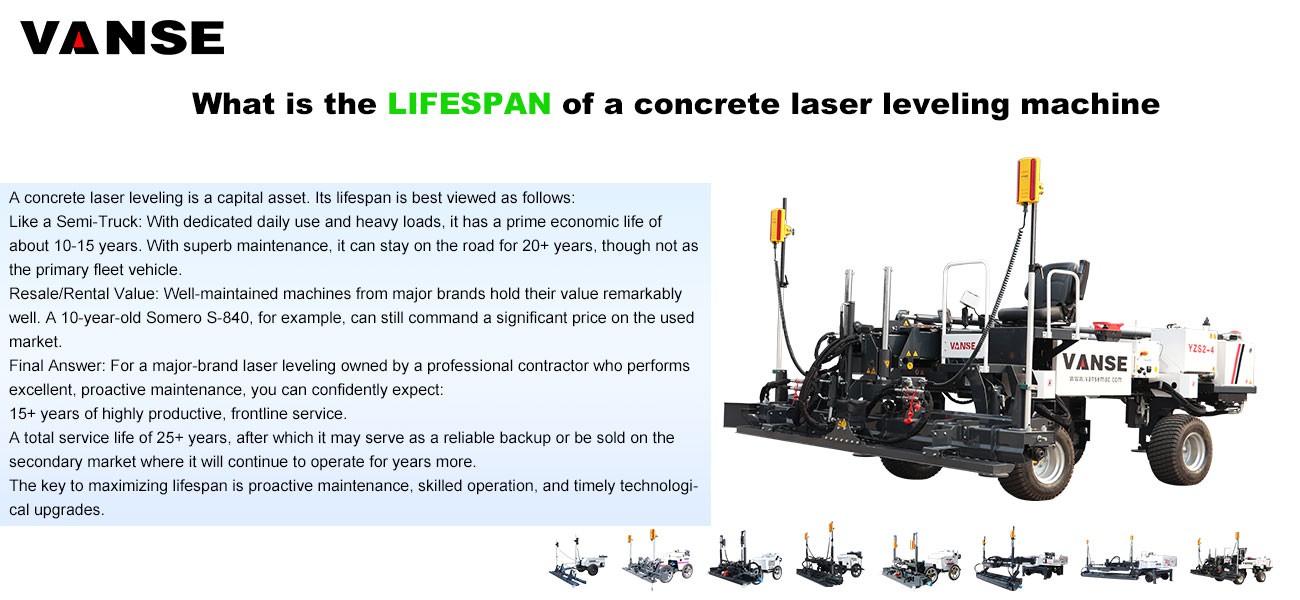
A concrete laser leveling is a capital asset. Its lifespan is best viewed as follows:
Like a Semi-Truck: With dedicated daily use and heavy loads, it has a prime economic life of about 10-15 years. With superb maintenance, it can stay on the road for 20+ years, though not as the primary fleet vehicle.
Resale/Rental Value: Well-maintained machines from major brands hold their value remarkably well. A 10-year-old Somero S-840, for example, can still command a significant price on the used market.
Final Answer: For a major-brand laser leveling owned by a professional contractor who performs excellent, proactive maintenance, you can confidently expect:
15+ years of highly productive, frontline service.
A total service life of 25+ years, after which it may serve as a reliable backup or be sold on the secondary market where it will continue to operate for years more.
The key to maximizing lifespan is proactive maintenance, skilled operation, and timely technological upgrades.
Note: The parameters provided in this document are for reference only and are not mandatory. Due to differences in technical characteristics between different brands and models of laser levelers, please consult the manufacturer for a suitable solution before actual operation. This reference document assumes no responsibility for any issues arising from failure to follow the manufacturer's instructions.
Thanks to All the Friends Who Support and Trust Shandong Vanse Machinery Technology Co., Ltd.
If you want to know more about Shandong Vanse Machinery Technology Co., Ltd. or have any questions, please feel free to contact us:
Our Factory
Shandong Vanse Machinery Technology Co., Ltd.

Share this article

About the Author: Shandong Vanse Machinery Technology Co., Ltd.
Shandong Vanse Machinery Technology Co., Ltd. is a high-tech manufacturer specializing in concrete construction machinery, including laser screeds and related equipment. The company integrates R&D, production, and global sales, with products exported to over 60 countries and widely used in infrastructure projects worldwide.
Previous Post
Next Post
Related Articles
You Might Also Like
Causes and treatment of ground cracks
Causes and treatment of concrete floor cracks 1. Introduction As an indispensable part of building structures, concrete floors are widely used in various construction sites. However, in actual use, cracks often occur in concrete floors, which not only affects the aesthetics of the floor, but also poses a potential threat to the integrity and safety of the structure. Therefore, it is particularly important to deeply study the causes of concrete floor cracks and take corresponding treatment measures. The formation of concrete floor cracks is a complex process involving many factors such as materials, design, construction, and environment. This paper aims to analyze the specific causes of concrete floor cracks, explore effective treatment methods and preventive measures, and provide theoretical support and practical guidance for crack control in actual projects. 2. Analysis of causes of concrete floor cracks ✔ Material factors The material selection of concrete floors is directly related to the generation of cracks. If the quality of raw materials such as cement, aggregates, and admixtures used is unqualified, or the mix ratio is improperly designed, it may lead to insufficient concrete strength and large shrinkage, thereby causing cracks. In addition, impurities, bubbles, and other defects added to concrete may also become the starting point of cracks. ✔ Design factors Improper design is also an important cause of concrete floor cracks. If the design load calculation is inaccurate, the structural layout is unreasonable, the ground thickness is insufficient or too thick, etc., the concrete floor may produce excessive stress concentration when subjected to force, resulting in cracks. ✔ Construction factors Improper operation during construction is also a common cause of cracks. For example, uneven vibration during concrete pouring leads to voids and stratification inside the concrete; failure to maintain in time after pouring causes shrinkage cracks due to excessive water loss during the hardening process; improper construction joint treatment forms weak links, etc. ✔ Environmental factors Environmental factors also have an important impact on the generation of cracks in concrete floors. For example, thermal expansion and contraction caused by temperature changes cause stress changes inside the concrete; humidity changes cause concrete to shrink or expand; foundation settlement, earthquakes and other natural disasters may also cause damage to the concrete floor and cause cracks. 3. Treatment measures for concrete floor cracks According to the different causes of concrete floor cracks, corresponding treatment measures need to be taken. The following are some common treatment methods: ✔ Surface repair method For cracks with smaller width and shallower depth, surface repair method can be used for treatment. Specific operations include cleaning the crack surface, applying repair materials such as ring gold resin to seal the cracks and restore the flatness and aesthetics of the ground. ✔ Filling method For cracks with larger width and deeper depth, the filling method can be used for treatment. First, clean the inside of the crack, and then use high-strength repair materials (such as epoxy mortar, polymer cement, etc.) to fill it to ensure that the filling is dense and tightly combined with the surrounding concrete. ✔ Pressure grouting method For cracks with larger width and deeper depth, the pressure grouting method can be used for treatment. The repair material is injected into the crack with a certain pressure through the grouting equipment, so that the material can be fully diffused and fill the crack space, thereby achieving the purpose of repair and reinforcement. ✔ Replacement method For cracks that are serious and affect structural safety, the replacement method may be required. That is, the damaged concrete part is excavated and new concrete is poured again to restore the integrity and structural safety of the ground. ✔ Structural reinforcement method While dealing with cracks, the overall structural performance of the concrete floor should also be considered. The crack resistance of the ground can be enhanced by adding steel mesh, increasing the thickness of the ground, and setting expansion joints. 4. Preventive measures In order to reduce the probability of cracks in concrete floors, preventive measures should also be taken from the aspects of design, materials, and construction: ✔ Rationally design the floor structure and thickness to ensure that the use requirements and load conditions are met. ✔ Select high-quality raw materials and strictly control the mix ratio to ensure the quality of concrete. ✔ Strengthen the management of the construction process to ensure the pouring, vibration, maintenance and other process operations are standardized. ✔ Fully consider the impact of environmental factors on the concrete floor and take corresponding measures to prevent it. 5. Case analysis In order to better illustrate the causes and treatment measures of cracks in concrete floors, this paper selects a real engineering case for analysis. During the construction process of this project, cracks appeared on the ground due to uneven vibration and untimely maintenance. After on-site investigation and cause analysis, the construction unit adopted the filling method and strengthened maintenance measures to deal with the cracks, and strengthened the management of the subsequent construction process, effectively preventing similar problems from happening again. 6. Technology development trend With the advancement of science and technology and the continuous accumulation of engineering practice, the technology for handling cracks in concrete floors is also developing. In the future, we can expect the emergence of more efficient, environmentally friendly and intelligent crack handling technologies. For example, using nondestructive testing technology to accurately identify and locate cracks; using new repair materials to improve the repair effect and durability; using intelligent monitoring systems to monitor and warn concrete floors in real time, etc. The application of these technologies will further improve the efficiency and accuracy of concrete floor crack treatment, and provide strong support for ensuring project safety and performance. 7. Conclusion The problem of concrete floor cracks is a complex and important engineering problem that requires us to analyze and deal with it from multiple angles. By deeply analyzing the causes of cracks, we can take targeted treatment measures and preventive measures to ensure the quality and safety of concrete floors. At the same time, we should also pay attention to the development trend of technology, continuously introduce and apply new technologies, new materials and new methods, and improve the level and effect of concrete floor crack treatment. In summary, the causes and treatment of concrete floor cracks are a highly comprehensive topic, involving both technical aspects and management and maintenance elements. In-depth research and discussion on the problem of concrete floor cracks will not only help improve the quality of the project, but also provide valuable experience and reference for future building design and construction. First of all, from the perspective of technology and materials, with the advancement of science and technology, new concrete materials and additives are constantly emerging, which have better strength, durability and crack resistance. At the same time, new construction processes and equipment have also improved the accuracy and efficiency of concrete construction and reduced the possibility of cracks. Therefore, we should actively pay attention to and apply these new technologies and new materials to improve the quality of concrete floors. Secondly, from the perspective of management and maintenance, establishing a sound construction management system and quality control system is an important means to prevent cracks in concrete floors. This includes training and supervision of construction personnel to ensure that they operate in accordance with specifications; strictly control the quality of raw materials to prevent unqualified materials from entering the construction site; monitor the construction process throughout the process, and promptly identify and deal with problems. At the same time, strengthening the post-maintenance and maintenance of concrete floors, and conducting regular inspections and repairs are also important measures to prevent the generation and expansion of cracks. In addition, we should also pay attention to the impact of environmental factors on cracks in concrete floors. By improving the construction environment, controlling temperature changes, and reducing humidity changes, the adverse effects of environmental factors on concrete floors can be reduced, thereby reducing the generation of cracks. Finally, we should also pay attention to the innovation and development of concrete floor crack treatment technology, and by introducing and developing new treatment technologies and equipment, improve the efficiency and effect of crack treatment and reduce damage to concrete floors during treatment. At the same time, strengthening the research and application of crack treatment technology and improving the professional level and skills of technicians are also important ways to promote the development of concrete floor crack treatment technology. In summary, the causes and treatment of concrete floor cracks are a complex and important issue. We need to take comprehensive measures from multiple perspectives to prevent and deal with crack problems. Through technological innovation, material upgrades, management optimization and environmental improvement, we can continuously improve the quality and durability of concrete floors and make greater contributions to the development of the construction industry. Of course, we should also realize that although we have achieved certain results, there are still many unknowns and challenges waiting for us to explore and solve the problem of concrete floor cracks. In the future, we need to continue to increase research efforts, deeply explore the mechanism and laws of crack generation, and find more effective treatment methods and preventive measures. At the same time, we should also strengthen international cooperation and exchanges, learn from and absorb international advanced experience and technology, and jointly promote the research and solution of concrete floor crack problems. In short, the problem of concrete floor cracks is an issue that requires long-term attention and continuous efforts. Through continuous exploration and practice, we believe that we will be able to find more effective solutions and make greater contributions to the sustainable development of the construction industry. Before concluding this article, I would like to emphasize that the prevention and treatment of concrete floor cracks cannot be achieved overnight, but requires us to constantly explore and improve in practice. We should always maintain our sensitivity to technology and pursuit of quality, and constantly improve our professional quality and practical ability to better cope with the challenges brought by the problem of concrete floor cracks. At the same time, we should also actively advocate and promote advanced concrete technology and concepts to promote the progress and development of the entire industry. In summary, the causes and treatment of concrete floor cracks is a topic that is both challenging and full of opportunities. Through in-depth research, technological innovation and practical exploration, we will definitely be able to find more effective solutions and make positive contributions to the prosperity and development of the construction industry.The influence of the blade configuration of the power trowel machine on the final surface effect of concrete
The configuration of power trowel blades (commonly known as power trowel blades or power trowel discs) directly determines the final flatness, smoothness, strength and wear resistance of the concrete surface. Improper selection and use can lead to various surface defects. The following elaborates in detail on how the configuration of the power trowel machine blades affects the final surface effect of concrete. Shape: Usually wide and thick, with a relatively small number of blades (commonly 3 or 4), and the blades have a large inclination Angle (negative Angle) with the rotating plane. Main functions: Lifting slurry and leveling. Working mode Scraping effect: The larger negative Angle causes the front edge of the blade to "shovel" the concrete surface. It can effectively level the height difference between aggregates (stones), bring the wetter mortar from the lower layer to the surface, and form a "cement slurry layer". Compaction: Through rolling, the surface aggregates are pressed into the interior of the concrete, making the structure more compact. Influence on surface effect: The front side: It provides a relatively smooth base layer rich in cement slurry for subsequent fine plastering. If this step is not taken, direct fine power troweling may bring out the aggregates, resulting in a rough and uneven surface. Negative: If it is used too late (the concrete is too hard), it will loosen the surface, causing cracks or wavy patterns. If used for too long, it will carry out excessive moisture and slurry, resulting in a fragile surface. Shape: Usually thin and narrow, with a large number of blades (commonly 8 to 12), and the Angle between the blades and the rotating plane is small, even close to horizontal (positive Angle or zero Angle). Main functions: Compaction, sealing and polishing. Working mode Patting and smoothing: Numerous and narrow blades pat and smooth the surface of the cement slurry at high speed and frequency to eliminate the marks left by rough smoothing. Sealing the surface: Compact the fine particles in the cement slurry, force the air out, seal the surface capillary pores, and form a dense, pore-free hardened layer. Generating luster: When the concrete is close to final setting, the high-speed rotating precision power trowel rubbing against the surface generates heat, causing the surface of the slurry to "melt" and present a luster. Influence on surface effect: Front: Achieve a dense, smooth, wear-resistant and dust-free surface. The level of glossiness is also determined at this stage. Negative: If used too early, the blade may get stuck in the concrete, creating wavy patterns or even damaging the surface. If used too late, the surface cannot be effectively sealed, which will cause powdering and sanding on the surface. Configuration factors The influence on the surface effect of concrete Applicable scenarios and suggestions Blade Angle This is the most crucial configuration parameter. Rough scraping stage: Use a negative Angle (with the front edge of the blade facing down) to achieve the effect of scraping and lifting the slurry. Fine smoothing stage: Use a small positive Angle or zero Angle (the blade is nearly horizontal) to achieve the effect of patting and smoothing. The larger the Angle, the stronger the cutting force, but the lower the surface finish. The smaller the Angle, the better the polishing effect. Number of blades The more the quantity, the more times each rotation is tapped, and the smoother the smoothing effect will be. Coarse power trowel (3-4 pieces) : Focuses on efficiency and slurry lifting. Fine power trowel (8-12 pieces or more) : Focuses on achieving extremely high flatness and smoothness. The more pieces there are, the finer the final surface will be. Blade material Wear resistance and toughness directly affect lifespan and performance. Spring steel: The most commonly used, it has good toughness, is not easy to break, and offers high cost performance. Tungsten carbide/hard alloy: Extremely wear-resistant, used for treating super-hard concrete or renovating old floors, with an extremely long service life, but expensive. The newness or oldness of the blade Blades that are severely worn cannot function effectively. Old/worn blades: Low efficiency in slurry lifting and polishing can lead to uneven surfaces and poor smoothness. Regular inspection and replacement are necessary. New blade: It can provide the best design Angle and cutting force to ensure the polishing effect. No matter how good the blade is, if it is used wrongly, the opportunity will be wasted. The blade and operation must be switched according to the setting condition of the concrete (the person standing on it should not sink more than 3mm). Phase One: Rough power troweling (Slurry lifting and leveling Timing: After the concrete has initially set, when it sinks by about 5 to 10mm when stepped on. Configuration: Install a coarse power trowel (negative Angle). Operation: The machine runs at a relatively slow speed and mainly focuses on leveling and large-angle scraping. Press the aggregates down and lift the cement slurry up to eliminate the obvious unevenness. Phase Two: Fine Smoothing (Pressing and smoothing) Timing: After the rough plastering is completed, when the concrete further hardens and sinks by about 1-3mm when stepped on. Configuration: Replace with a fine spatula (zero degree or small positive Angle). Operation: The machine speed can be increased and the smoothing can be carried out in a cross direction. At this point, it should be clearly visible that the surface gradually becomes fine and dense, and the rough knife marks are eliminated. Phase Three: Polishing (achieving a bright finish) Timing: When the concrete is close to final setting and there is almost no subsidence when stepped on. Configuration: Continue to use the fine spatula, but you can increase the Angle to a smaller positive Angle (if the blade head is adjustable). Operation: Run at high speed and "drift light" at a small Angle to the ground. The heat generated by friction will slightly liquefy the surface slurry, creating a mirror-like luster. Surface powdering and sanding Reason: The fine power troweling was done too late, and the surface could no longer be effectively compacted and sealed. Or the number of fine power trowel blades is insufficient or the Angle is inappropriate, resulting in poor polishing effect. The surface has wavy patterns and is uneven. Reason: The rough application was done too late, and it was caused by hard scraping and pulling. Or the blade angles are inconsistent (with different degrees of wear); The machine's walking speed is uneven. Exposed aggregates, rough surface The reason is that the coarse coating was skipped or not done thoroughly, and the fine coating was started before a thick enough layer of cement slurry was formed, which brought out the aggregates. Cracks on the surface: Reason: Using a coarse power trowel when the concrete was still too soft (bleeding period) damaged the surface structure. Or the polishing was done too early, causing the blade to sink and the material to be pushed and cracked. The configuration of a power trowel blade is a systematic project that involves using the "right tool" at the "right time" in the "right way". The rough power trowel is the foundation, responsible for creating a smooth and cement-rich working surface. The fine power trowel is the key, responsible for creating a dense, smooth and wear-resistant final surface. The Angle of the blade is the soul, directly determining whether the machine is a "scraper" or a "polishing machine". The timing of construction is the lifeblood. No matter how perfect the configuration is, it cannot play its role if the window period is missed. Only by mastering the relationship among the three proficiently can consistently produce high-quality concrete surfaces. Note: The parameters provided in this document are for reference only and are not mandatory. Due to differences in technical characteristics between different brands and models of laser levelers, please consult the manufacturer for a suitable solution before actual operation. This reference document assumes no responsibility for any issues arising from failure to follow the manufacturer's instructions.How to realize intelligentization and automation of concrete laser leveling machine?
Introduction With the development of science and technology, intelligence and automation have become an important trend in the development of all walks of life. In the field of construction, the intelligence and automation of concrete laser leveling machine can not only improve construction efficiency, but also effectively reduce labor costs, improve construction quality and achieve green construction. 1. Overview of the intelligence and automation of concrete laser leveling machine Concrete laser leveling machine is a device that uses laser technology to level the concrete surface. The intelligent and automated concrete laser leveling machine can automatically complete the paving, vibration, leveling and polishing of concrete according to preset parameters. 2. Intelligent control system Intelligent control system is the key to realizing the automation of concrete laser leveling machine: – **Sensor integration**: Integrate multiple sensors, such as laser receivers, distance sensors, angle sensors, etc., to monitor the equipment status and construction environment in real time. – **Data processing**: Process the data collected by sensors through advanced algorithms to achieve precise control of the equipment. – **Adaptive adjustment**: The equipment can automatically adjust working parameters according to changes in construction conditions to adapt to different construction needs. 3. Automatic navigation technology Automatic navigation technology enables concrete laser leveling machines to navigate autonomously without manual operation: – **GPS/Beidou navigation**: Use the global positioning system or Beidou navigation system to achieve precise positioning of the equipment. – **Machine vision**: Use machine vision technology to identify the construction environment and achieve autonomous navigation and obstacle avoidance of the equipment. 4. Remote monitoring and operation Remote monitoring and operation improves the automation level of concrete laser leveling machines: – **Remote monitoring system**: Remote monitoring of equipment is achieved through the Internet, and equipment status and construction progress are understood in real time. – **Remote control operation**: Remote operation of concrete laser leveling machines is achieved through remote control equipment, improving construction flexibility. 5. Intelligent diagnosis and maintenance The intelligent diagnosis and maintenance system can detect equipment failures in advance and reduce downtime: – **Fault diagnosis**: Intelligently diagnose potential faults and problems by analyzing equipment operation data. – **Predictive maintenance**: According to the use and wear of the equipment, the maintenance needs are predicted to achieve predictive maintenance. 6. Human-computer interaction technology Human-computer interaction technology improves the usability and operation efficiency of the concrete laser leveling machine: – **Touch screen operation**: The touch screen operation interface is adopted to simplify the equipment operation process. – **Voice control**: Voice control of the equipment is realized through voice recognition technology. 7. Modular design The modular design makes the concrete laser leveling machine more flexible and easy to upgrade and maintain: – **Modular components**: The equipment is decomposed into multiple modular components for easy replacement and upgrading. – **Quick replacement**: Design a quick replacement mechanism to shorten the time for equipment to replace parts. 8. Construction data management Construction data management provides data support for the intelligence and automation of concrete laser leveling machines: – **Data collection**: Collect various data during the construction process, such as concrete temperature, humidity, paving speed, etc. – **Data analysis**: Analyze the collected data to optimize the construction plan and equipment parameters. 9. Environmental adaptability Environmental adaptability is an important aspect of the intelligence and automation of concrete laser leveling machines: – **Temperature adaptability**: The equipment can adapt to different temperature environments to ensure construction quality. – **Terrain adaptability**: The equipment can adapt to different terrain conditions to achieve construction in complex terrains. 10. Conclusion The intelligence and automation of concrete laser leveling machines is a multifaceted system engineering, involving intelligent control systems, automatic navigation technology, remote monitoring and operation, intelligent diagnosis and maintenance, human-computer interaction technology, modular design, construction data management, environmental adaptability and other aspects. Through the application and integration of these technologies, concrete laser leveling machines can achieve a higher level of intelligence and automation, improve construction efficiency and quality, and reduce costs and safety risks.