Technical Knowledge
Specific operating steps of concrete laser leveling machine and trowel machine
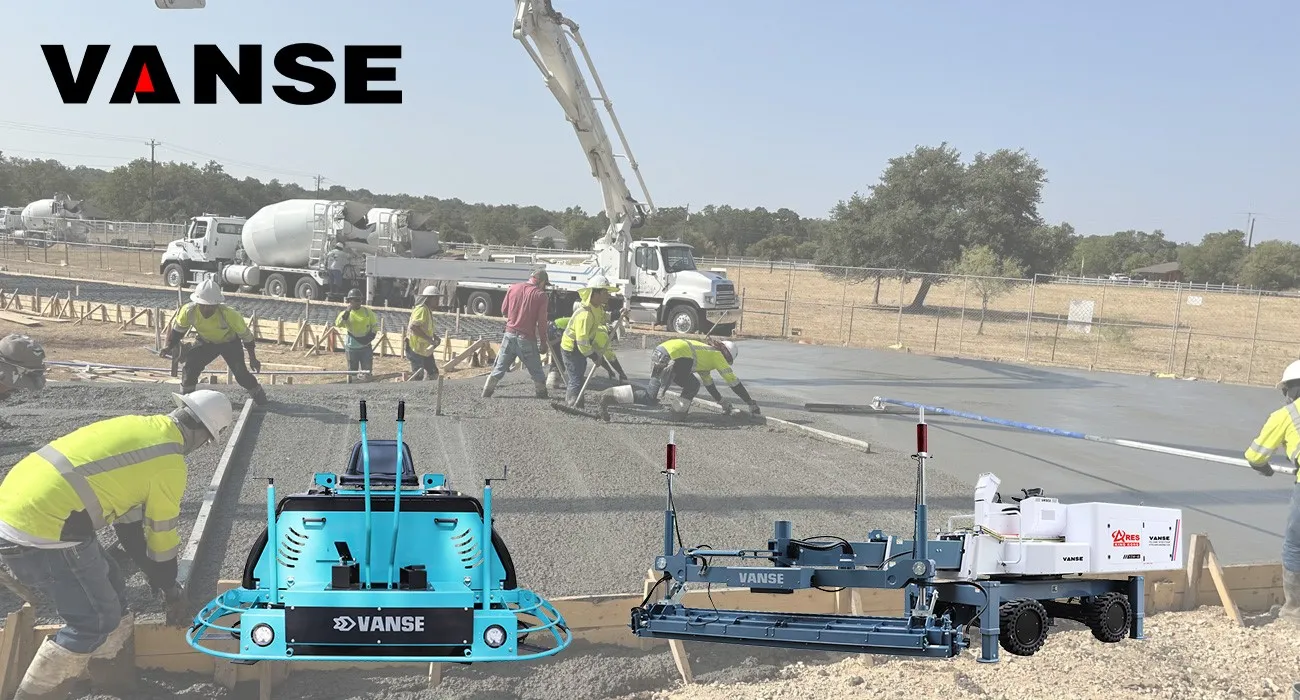
The following are the specific operating steps and precautions for concrete laser leveling machines and trowels to help construction workers complete their work efficiently
A. Concrete laser leveling machine operating steps
1. Preparation before construction
Equipment inspection:
Confirm that the laser transmitter, leveling machine head, vibrator, travel system and other components are operating normally and that the battery/fuel is sufficient.
Benchmark setting:
Arrange fixed points (such as steel chisels) around the construction area, install the laser transmitter and calibrate the level to ensure that the laser covers the entire work surface.
Concrete paving:
Use a dump truck or a spreader to evenly spread the concrete to the designed thickness (usually 2-3cm higher than the leveling machine scraper height), and ensure that the concrete slump meets the requirements (generally 120-180mm).
2. Leveling operation
Start the equipment:
Turn on the laser receiver, adjust the scraper to the preset height, and start the vibration and leveling functions.
Straight line operation:
The operator controls the equipment to travel in a straight line at a uniform speed along the long side, and the laser system automatically adjusts the scraper height to complete the vibration and rough leveling.
Cross operation:
After the initial leveling, repeat the operation in the vertical direction to eliminate surface ripples.
3. Corner treatment
For corners and column root areas that cannot be covered by the laser leveler, first use a scraper to manually scrape and then use a small vibrating beam to assist in compaction.
4. Shutdown and maintenance
After the operation is completed, turn off the equipment and clean the residual concrete on the surface.
Immediately cover with a film or spray a curing agent to prevent the concrete from losing water too quickly.
B. POWER Trowel machine operation steps
1. Preparation before construction
Equipment inspection:
Confirm that the trowel motor, blade/disc, protective cover and other components are intact, and the fuel/battery is sufficient.
Confirmation of concrete status:
There is a slight indentation on the concrete surface when pressing with fingers, but it is not sticky (initial setting stage), and there is no water seepage on the surface.
Environmental control:
In hot and dry weather, water should be sprinkled in advance to moisten the ground to avoid dust.
2. Disc trowel machine operation (slurry lifting stage)
Initial slurry lifting: Install the disc, adjust the speed to 600-800rpm, move slowly from the edge to the center, overlap 1/3 of the working width, and eliminate surface bumps.
Secondary compaction: After the concrete strength increases slightly, reduce the speed to 400-600rpm, raise the slurry and compact it again to ensure a uniform surface.
3. Blade trowel operation (finishing stage)
Angle adjustment: first adjust the blade angle to 10-15°, finish at low speed (300-400rpm), and gradually increase the angle to 25-30° to improve the surface density.
Finishing in multiple passes: usually 2-3 times, with an interval of about 30 minutes between each pass, subject to the concrete surface strength.
4. Edge and corner treatment
For areas that cannot be reached by machinery, use a handheld trowel or manual trowel to finish.
5. Shutdown and maintenance
After the operation, thoroughly clean the concrete residue on the blade/disc and check the bearing lubrication.
C. Operation precautions
Time control
The laser leveling machine must be completed before the initial setting of the concrete (about 1-2 Hours), the trowel machine needs to start after the initial setting to avoid sanding too early or difficulty in finishing too late.
Concrete quality requirements
Strictly control the slump and setting time of concrete to avoid affecting the leveling effect due to material problems.
Equipment safe operation
The operator needs to wear protective equipment such as non-slip shoes and goggles. Personnel are prohibited from entering the working area when the equipment is moving.
Special weather response
The operation speed should be accelerated in hot weather to avoid the concrete surface hardening too quickly; construction should be suspended on rainy days and unsolidified concrete should be covered.
Common problem handling
Surface sanding:
Check whether the trowel machine is operated too early or the concrete water-cement ratio is too high.
Local unevenness:
Correct by manual filling or secondary vibration.
Through standardized operation and detail control, the concrete surface flatness can be ensured to be within ±3mm/3m, meeting the high-precision requirements of industrial plants, commercial floors, etc.
Thanks to All the Friends Who Support and Trust Shandong Vanse Machinery Technology Co., Ltd.
If you want to know more about Shandong Vanse Machinery Technology Co., Ltd. or have any questions, please feel free to contact us:
Our Factory
Shandong Vanse Machinery Technology Co., Ltd.








Share this article

About the Author: Shandong Vanse Machinery Technology Co., Ltd.
Shandong Vanse Machinery Technology Co., Ltd. is a high-tech manufacturer specializing in concrete construction machinery, including laser screeds and related equipment. The company integrates R&D, production, and global sales, with products exported to over 60 countries and widely used in infrastructure projects worldwide.
Previous Post
Next Post
Related Articles
You Might Also Like
How to effectively control the cost of large-area floor laser leveling machine leveling construction methods?
To effectively control the cost of large-area floor laser leveling construction methods, you can start from the following aspects: 1. Reasonable planning of construction process Before construction, conduct a detailed survey and assessment of the construction site, and formulate reasonable construction plans and processes based on the actual situation. Avoid repeated construction, rework, etc. due to improper planning, thereby increasing unnecessary costs 2. Choose appropriate equipment and materials According to the construction needs, choose laser leveling machines and other auxiliary equipment with stable performance and high efficiency. At the same time, choose concrete materials with reliable quality and high cost performance to avoid increased costs caused by equipment failure or material quality problems. 3. Improve construction efficiency Through reasonable construction organization and personnel deployment, the efficiency of large-area floor laser leveling machines can be improved. Ensure continuous and stable operation of equipment, reduce idle and waiting time, thereby reducing construction costs per unit area 4. Strengthen equipment maintenance and upkeep Carry out regular maintenance and upkeep on the laser leveling machine to ensure the normal operation and service life of the equipment. Properly arrange maintenance plans and spare parts inventory to avoid construction interruptions and additional maintenance costs caused by equipment failure 5. Optimize human resource allocation According to the construction progress and personnel skill level, Stinging personnel will be reasonably arranged to give full play to everyone's advantages. Through training and education, the skill level and efficiency of construction personnel are improved and labor costs are reduced. 6. Strengthen quality management During the construction process, quality supervision and acceptance will be strengthened to ensure that the quality of the floor meets the requirements. Avoid additional costs such as rework and repair due to substandard quality. 7. Rational use of resources and energy During the construction process, resources and energy are rationally utilized to reduce energy and resource consumption. For example, measures such as rationally adjusting engine power and using energy-saving lamps can effectively reduce energy In summary, controlling the cost of large-area floor laser leveling machine construction methods requires starting from many aspects, including reasonable planning, selecting appropriate equipment and materials, improving construction efficiency, strengthening equipment maintenance and upkeep, and optimizing manpower Measures such as resource allocation, strengthening quality management and rational utilization of resources and energy. Through the comprehensive application of these measures, construction costs can be effectively reduced and the economic and social benefits of the project can be improved.Is the operation of the ride-on concrete laser leveling difficult?
Overall, the operation difficulty of the ride-on concrete laser leveling is of the type that is "easy to get started with but requires practice to master". For experienced mechanical operators, mastering basic operations is not difficult. However, to achieve the level of efficient and high-quality construction, systematic training and a certain accumulation of on-site experience are required. Now let's break down its operational difficulty in detail from different perspectives: High degree of automation: This is the core reason. The main job of the operator is no longer to manually control the flatness and elevation of the ground, but rather: Management boundary: Control the movement of machines within the boundaries of the construction area. Control speed: Adjust the forward/backward speed and make fine adjustments according to the concrete paving situation (such as more or less material). Observation and monitoring: Monitor whether the laser signal is normal, whether the machine is operating well, and the supply situation of concrete. The true "leveling" work is automatically completed by the machine: the laser receiver captures the laser plane signal, the control system calculates the height of the scraper in real time, and automatically adjusts it through the hydraulic system to ensure that it always remains at the set elevation. The operation controls are intuitive: The controls in the cab are usually simple and clear, mainly including Steering wheel or joystick: used to control the direction of travel (forward, backward, turning). Throttle/Speed control: Controls the driving speed. Scraper lifting control: Used when starting construction and leaving the construction area. Emergency stop switch: For use in emergency situations. Some advanced models may also have vibrator intensity adjustment, etc To truly complete construction independently and with high quality, operators need to master the following knowledge and skills, which require learning and practice: The installation of the laser emitter: This is the source of precision. The operator must know how to correctly select the position, level the laser emitter, and set the correct slope (if necessary). If the setup is unstable, everything will be lost. Calibration and inspection of the machine: Before starting work every day, it is necessary to check whether the laser receiver, control system and hydraulic system are working properly in accordance with the regulations and carry out necessary calibrations. This is directly related to the construction accuracy. The judgment of concrete properties: It is necessary to know how to judge the slump (dryness and thinness) of concrete. The concrete is too dry, causing high resistance for the machine's movement and making it prone to leaving marks. If it is too thin, it will affect the final strength and make it difficult to level. The machine speed and vibration frequency need to be adjusted according to the actual situation. The cultivation of "material sense" : This is the core experience. The operator needs to learn to observe the amount of concrete ahead and plan the walking path in advance to ensure that there is an appropriate amount of concrete in front of the scraper, neither too much nor too little. Excessive materials need to be removed with manual assistance, while insufficient materials need to be replenished in a timely manner.Dealing with unexpected situations: For instance, sudden loss of laser signals (blocked by people or equipment), foreign objects on the ground, interruption of concrete supply, etc., all require operators to handle them calmly and correctly. Planning of walking routes: How to plan the leveling sequence to be the most efficient and avoid repeated rolling on the already leveled area.Coordination with other trades: The coordination and cooperation with personnel such as concrete mixer trucks, pump trucks, formwork support workers, and riveters are of vital importance. Manufacturer training (most recommended) : When purchasing new equipment, the brand usually provides very detailed and systematic operation and maintenance training. This is the fastest and most formal way to learn. Master-apprentice: In construction teams, learning from experienced master workers is the most common way. One can start with auxiliary work and gradually get the hang of it. Watch teaching videos: Nowadays, there are many operation videos released by brands and construction teams online, which can help you understand the operation process and skills intuitively. Read the instruction manual: The operation manual and maintenance manual of the equipment contain all the basic knowledge and safety regulations. They must be read carefully. For beginners: If they have operating experience with other construction machinery (such as excavators and loaders), the transition will be very fast. If not, through 1-2 weeks of systematic study and on-board practice, one can fully master the basic operations and start independently completing some floor construction tasks with relatively low requirements. For experienced masters: Their value does not lie in "being able to drive", but in their ability to handle all kinds of complex working conditions, ensuring that they can deliver extremely flat floors in any situation, and with the highest efficiency and the least material consumption. So, if you are considering taking up this profession, there is no need to worry too much about its operational difficulty. It is a technical job that requires the accumulation of experience through learning and practice, but it is by no means unattainable. Once mastered, it becomes a very valuable skill. Note: The parameters provided in this document are for reference only and are not mandatory. Due to differences in technical characteristics between different brands and models of laser levelers, please consult the manufacturer for a suitable solution before actual operation. This reference document assumes no responsibility for any issues arising from failure to follow the manufacturer's instructions.How is the construction process of concrete pavement with double-layer steel mesh different from that of single-layer steel mesh?
The construction process of concrete pavement with double-layer steel mesh differs from that of single-layer steel mesh in the following aspects: – Single-layer steel mesh: – Steel bar processing mainly involves straightening, cutting, bending, etc. according to design requirements. After the processed steel bars are transported to the construction site, they are laid directly on the base. – Usually, the steel mesh is placed in the designated position by manual or small machinery, and fixed with iron wire or steel bar horse stool to ensure that there is a certain protective layer thickness between the steel mesh and the base, generally 3-5cm. – Double-layer steel mesh: – In addition to basic steel bar processing, for double-layer steel mesh, supporting steel bars or horse stool bars need to be set between the upper and lower steel meshes to ensure that the spacing between the two layers of steel mesh meets the design requirements, generally about 15-30cm. – First lay the lower steel mesh, and then install the upper steel mesh after fixing it. During the process, the position and spacing of the two layers of steel mesh must be strictly controlled to ensure that they do not shift during the concrete pouring process. – Single-layer steel mesh: – The installation of the formwork is mainly to ensure that its position is accurate and firm, and it can withstand the lateral pressure during concrete pouring. The height of the formwork is generally consistent with the design thickness of the concrete pavement. – Double-layer steel mesh: – Due to the existence of double-layer steel mesh, the installation of the formwork requires higher precision. When installing the formwork, it is necessary to consider the position of the steel mesh and the thickness of the protective layer to ensure that the spacing between the formwork and the steel mesh is uniform, and to prevent the formwork from squeezing the steel mesh and causing its position deviation. – Single-layer steel mesh: – When pouring concrete, the concrete can be directly poured into the formwork, and the inserted vibrator and the flat vibrator can be used to vibrate to make the concrete dense. During the vibration process, be careful to avoid the vibrator rod directly touching the steel mesh to avoid displacement of the steel mesh. – Double-layer steel mesh: – When pouring concrete, in order to avoid the upper steel mesh displacement caused by the impact of concrete falling, a more reasonable pouring method needs to be adopted, such as evenly spreading the concrete along one side of the formwork, allowing the concrete to slowly flow to the other side, or using a layered pouring method. – When vibrating, in addition to using an insert vibrator and a flat vibrator, for the concrete between the double-layer steel mesh, it may be necessary to use a small vibrating rod or vibrating sheet for auxiliary vibration to ensure that the concrete can be fully compacted between the two layers of steel mesh. At the same time, pay more attention to the operation of the vibrating rod to avoid touching the steel mesh and causing it to deform. – Single-layer steel mesh: – After the concrete is vibrated, use a scraper to flatten the surface, and then perform surface treatment procedures such as smoothing, and finally cover with a curing film or sprinkle water for maintenance to keep the concrete surface moist and prevent the surface from losing water and cracking. – Double-layer steel mesh: – During surface treatment, due to the restraining effect of the double-layer steel mesh on the concrete surface, more care should be taken during operations such as polishing to avoid uneven surfaces caused by the influence of the steel mesh. – During the curing process, it is necessary to ensure that the curing measures can fully cure both the interior and surface of the concrete, because the double-layer steel mesh will affect the migration and heat dissipation of the moisture inside the concrete to a certain extent, so the curing time may need to be appropriately extended, generally not less than 7 days. CONCRETE LASER LEVELING MACHINE POWER TROWEL TRACKED MINI DUMPER AMOUR JOINT LIGHT TOWER STEEL FIBER