Technical Knowledge
Shandong Vanse Machinery’s laser leveling machine leads the market with four major advantages

The construction machinery industry is becoming more and more mature, and various types of construction machinery are increasingly used in my country's consumer market, especially this year, concrete laser leveling machines are increasingly recognized by customers.
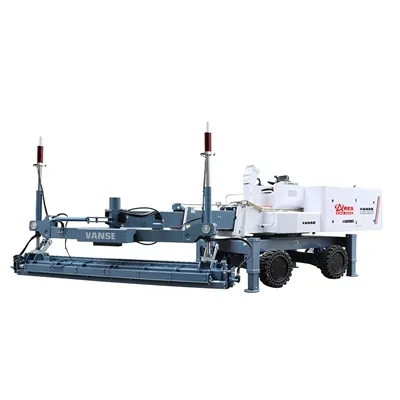
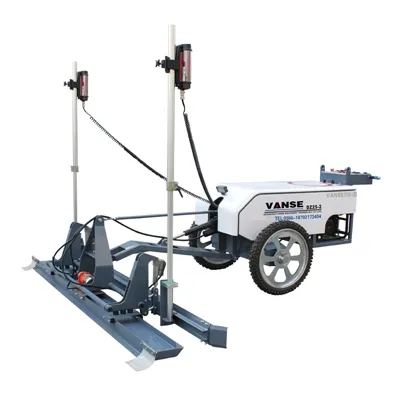
As the leader of concrete laser leveling machines, the concrete laser leveling machines produced by Shandong Vanse Machinery can achieve large-scale construction. By solving the concrete surface layer at one time, all the "quality problems" brought by the secondary approach are completely eliminated. It truly realizes the "three super" floor of flatness, smoothness, density, high strength, one layer as a whole, reduced costs, shortened construction period, and absolutely durable.
Shandong Vanse Machinery Concrete Laser Leveling Machine has several advantages over traditional laser leveling machines:
1. Laser point-to-point, high precision and low error.
Traditional leveling technology requires template support to control the elevation of the ground and pull the control line. The elevation error is large. The horizontality and flatness of the entire floor cannot be guaranteed.
The laser point-to-point transmitter is used, which is suitable for large-area one-time paving. There is a laser measurement and control system to control the elevation in real time. There is no need to pull the line for leveling, and there is no need to support the side plate in the middle to control the ground elevation. Thus, the elevation error caused by the vibration of the formwork (channel steel) during the construction process is avoided, and the elevation error caused by the traditional manual block formwork is also reduced.
2. Reduce labor costs and double efficiency.
The traditional process has a large number of construction workers, and it is necessary to support the formwork (channel steel), dot, and spread. It requires about 20 people. The construction area is 700 square meters per day. The total number of people using the concrete laser leveling machine is more than half less than that of the traditional process. It can be operated by one person. The construction area is 2500-3500 square meters per day, which greatly reduces the labor cost.
3. Better flatness and integrity.
Traditional construction technology, one day of formwork, one day of pouring, can only be skipped one by one, which has great limitations, cannot be operated continuously, and has poor integrity, which is easy to cause cumulative errors in construction joints.
The concrete laser leveling machine is more efficient and integrated for a large area of floor paving at one time. The completion of the entire floor makes the ground integrity better, which is completely impossible for traditional construction.
4. The ground is more compact and uniform.
The high-frequency vibrator of 4000 times per minute allows the leveling head vibrator to produce uniform high-frequency vibration, making the concrete floor more compact and uniform.
Combining the above detailed comparison between ordinary leveling machines and Shandong Vanse Machinery's laser leveling machines, we can know why laser leveling machines are so popular now. In order to better and more effectively serve our customers, Shandong Vanse Machinery will continue to provide customers with safe and reliable products and more complete after-sales services.
Thanks to All the Friends Who Support and Trust Shandong Vanse Machinery Technology Co., Ltd.
If you want to know more about Shandong Vanse Machinery Technology Co., Ltd. or have any questions, please feel free to contact us:
Our Factory
Shandong Vanse Machinery Technology Co., Ltd.








Share this article

About the Author: Shandong Vanse Machinery Technology Co., Ltd.
Shandong Vanse Machinery Technology Co., Ltd. is a high-tech manufacturer specializing in concrete construction machinery, including laser screeds and related equipment. The company integrates R&D, production, and global sales, with products exported to over 60 countries and widely used in infrastructure projects worldwide.
Previous Post
Next Post
Related Articles
You Might Also Like
Whether the laser leveling machine should be maintained in time after use
We found that when many users use the laser leveling machine, they often just know how to use it, but the follow-up maintenance and maintenance are basically not done. They don't know that maintenance and maintenance are actually a crucial step for the leveling machine, because the correct maintenance steps are actually an important prerequisite for ensuring the efficient use of the leveling machine. 1. After the work is completed, please use the arm lift button to manually lift the machine head, and then push it out of the construction site. It is forbidden to push the machine when the vibrating leveling part is in contact with the ground to avoid damage to the vibrating plate. 2. After the construction is completed, it is necessary to rinse the laser leveling machine with a high-pressure water gun in time (it is strictly forbidden to flush the water gun directly at the mesh part of the fuselage, so as to prevent water from entering the inside of the fuselage and causing short circuits, etc.). 3. The place where the laser leveling machine is placed must be kept dry, and debris and flammable and explosive materials must not be piled up around it. 4. The battery of the leveler also needs to be paid attention to. If it is not used together for a long time, make sure to remove all batteries from the host and receiver and store them properly. The transmitter comes with a rechargeable battery with a charging time of eight hours. 5. During the use of the laser leveling machine, please try to charge the battery after the battery is fully used. When charging, try to ensure that it is fully charged for 8 hours at a time. The charging time is recommended to be 12 hours, and it is advisable to charge it for 8 hours later. To avoid damage to the battery and the transmitter, please unplug the power plug in time after it is fully charged. 6. If the laser signal is lost during the construction process, the concrete laser leveling machine needs to be restarted, and the interval time needs to be more than ten seconds. 7. If the laser leveling machine is placed on a stable ground when it is not used for a long time, lubricating grease should be added to each bearing part once a week, and lubricating oil should also be added to each chain to maintain good lubrication. At the same time, attention should be paid to avoid sand and other sundries getting into the chain to prevent premature damage to the chain. Generally, at the end of one month or every construction period, the laser leveling machine should be inspected and maintained once. Always pay attention to the tightness of the V-belt and the chain, adjust it in time if it is too loose, and adjust the fastening bolts frequently to prevent loosening. About the maintenance method of the laser leveling machine, I will introduce you here. I believe that you have understood it clearly after reading it. If you want to know more about the leveling machine, you can continue to pay attention to our website. We will provide you with more information in this regard.Compaction Degree of Sub-base in Superflat Floors and Its Impact on Final Flatness
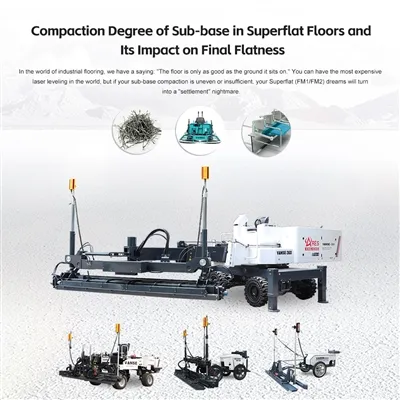
In the world of industrial flooring, we have a saying: "The floor is only as good as the ground it sits on." You can have the most expensive laser leveling in the world, but if your sub-base compaction is uneven or insufficient, your Superflat (FM1/FM2) dreams will turn into a "settlement" nightmare. If you're a contractor or facility owner, understanding the link between sub-base compaction degree and final flatness (FF/FL numbers) is critical. Here's a professional breakdown of how to get the foundation right, featuring the technical workflow from Vanse Machinery. Think of the sub-base as an anvil. When you use a Power Trowel to densify the concrete, the concrete is being compressed between the blades and the sub-base. If the sub-base has "soft spots" (low compaction degree), the slab will deflect under the weight of the machines and the concrete itself. The Impact: Even a 2mm settlement in the sub-base during the pour can tank your FL (Levelness) scores. This is why a compaction degree of at least 95% to 98% Proctor density is usually the standard for high-spec warehouses. A common mistake is compacting the sub-base perfectly, then driving heavy concrete trucks over it, creating deep ruts that ruin the uniformity. The Vanse Solution: Instead of heavy trucks, pro contractors use a Vanse Concrete Distributor or the Vanse Mini Dumper. These machines are designed to be agile. The Vanse Mini Dumper (available in electric or gasoline) allows you to move concrete to the exact spot without the massive point-load of a transit mixer, preserving the integrity of your compacted sub-grade. Even with good compaction, the weight of a leveling machine can sometimes cause micro-movements in the sub-base. The Vanse Solution: This is where the Vanse YZ30-4E Telescopic Boomed Laser leveling is a game-changer. Unlike traditional "drive-in" leveling, the telescopic boom allows the leveling head to reach out 6 meters while the machine stays stationary. This minimizes the "footprint" on the compacted sub-base, ensuring that the laser-accurate strike-off is based on a stable reference point, not a moving one. If the sub-base isn't uniform, the concrete will cure at different rates, leading to "curling" at the joints-the #1 enemy of long-term flatness. Use a Vanse Automatic Topping Spreader to apply hardener uniformly. This ensures the "skin" of the concrete is as tough as the base. Follow up with a Vanse VS1046H Ride-on Power Trowel. The high-torque 35HP BRIGGS & STRATTON engine provides the force needed to "burnish" the floor. If your sub-base is solid, this troweling process creates a rock-hard, Superflat surface that won't shift over time. Finally, protect those joints with a precision Vanse Concrete Cutting Machine (Floor Saw) to ensure stress is relieved exactly where it should be. Factor Poor Compaction Result Vanse-Enabled Professional Result FF/FL Scores Fails due to micro-settlement. Hits FM1/FM2 consistently. Joint Health Spalling and curling. Clean, stable transitions with Floor Saws. Labor Cost High (due to rework/grinding). Low (Get it right the first time). Equipment Performance Machines "sink" or vibrate poorly. Maximum precision with Telescopic leveling. You can't cheat the physics of a Superflat floor. Hitting ±1mm over 3 meters requires a solid sub-base and the world's most precise machinery. By combining the placement agility of the Mini Dumper with the telescopic reach of the Vanse Laser leveling (www.vansemac.com), you ensure that your floor stays flat from the day of the pour until decades of forklift traffic later. Don't build on a weak foundation. Explore the full Vanse fleet today and see how our technology supports your highest-spec projects. Note: The parameters provided in this document are for reference only and are not mandatory. Due to differences in technical characteristics between different brands and models of laser levelers, please consult the manufacturer for a suitable solution before actual operation. This reference document assumes no responsibility for any issues arising from failure to follow the manufacturer's instructions.What Kind Of Consumables Do Concrete Laser Leveling Need?
Concrete laser leveling machine is a kind of equipment used in concrete construction. Its function is to achieve flatness and smoothness of the concrete surface. In the process of using the concrete laser leveling machine, some consumables are needed to ensure the normal operation and construction effect of the equipment. Here are some supplies you may need for your concrete laser leveling: 1. Laser: One of the main components of the concrete laser leveling machine is the laser, which is used to emit laser beams to control the flatness and height of the concrete surface. Therefore, the quality and performance of the laser have an important impact on the effectiveness and service life of the leveler. 2. Laser head: The laser head is the key component of the laser. It is responsible for focusing and projecting the laser beam onto the concrete surface. The quality and performance of the laser head will also affect the effectiveness and service life of the leveler. 3. Mixer: Concrete laser leveling machines are usually equipped with a mixer, which is used to mix the concrete evenly to ensure the construction effect. The quality and performance of the agitator also affects the effectiveness and service life of the leveler. 4. Filter element: The concrete laser leveling machine will inhale a large amount of dust and debris during operation, so a filter element is needed to filter the air to ensure the normal operation of the equipment and construction results. 5. Lubricant: The concrete laser leveling needs regular lubrication to reduce wear and failure. Therefore, lubricating oil is needed to lubricate various parts of the equipment. 6. Cleaning agent: During the operation of the concrete laser leveling machine, it will be affected by dust, debris and other dirt, so cleaning agents need to be used to clean the equipment. In addition, the concrete laser leveling machine also needs some other accessories and tools to clean the equipment. Auxiliary construction, such as scrapers, trowels, measuring rulers, etc. The quality and performance of these accessories and tools will also affect the effectiveness and service life of the leveler In short, the consumables of the concrete laser leveling need to be determined according to the specific model and usage of the equipment. When choosing consumables, you need to choose brands and models with reliable quality and stable performance to ensure the normal operation of the equipment and construction results. At the same time, it is also necessary to regularly inspect and maintain the equipment, promptly replace damaged parts and replenish consumables to ensure the long-term stable operation and service life of the equipment.