Technical Knowledge
How to match a concrete laser leveling machine with the concrete mixture to achieve perfect leveling?
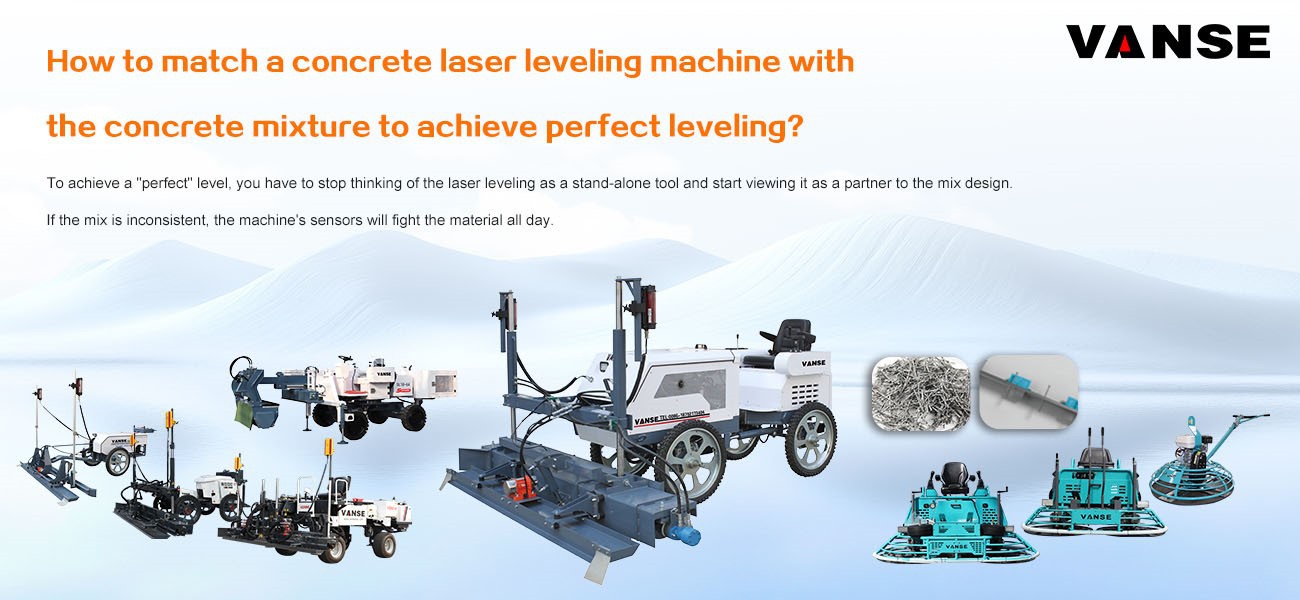
To achieve a "perfect" level, you have to stop thinking of the laser leveling as a stand-alone tool and start viewing it as a partner to the mix design. If the mix is inconsistent, the machine's sensors will fight the material all day.
Here is how to calibrate your mix to your machine for maximum precision.
1. The "Golden Rule" of Slump
For laser leveling, consistency is more important than the actual slump number. However, there is a "sweet spot" for machine performance.
The Target: 4" to 5" (100mm – 125mm) slump.
Too Wet (>6"): The leveling head will "sink" or create a wake like a boat. When the water evaporates, the "perfect" level you just pulled will settle and dip, ruining your FF (Floor Flatness) numbers.
Too Stiff (<3"): The vibrator won't be able to liquefy the paste enough to close the surface, leaving "honeycombs" or tears that the machine can't fix.
2. Aggregate Size and the "Auger Factor"
The auger on the front of the leveling head is designed to move excess concrete out of the way.
The Mix: Use a well-graded aggregate (a mix of large, medium, and small stones).
The Logic: If you use only large 1" stones (Gap-graded), the auger will "catch" them and drag them, creating gouges in the subgrade. A well-graded mix creates a "lubricated" matrix that the auger can trim precisely to the millimeter.
Adjustment: If your mix is "rocky," increase your sand-to-aggregate ratio slightly (usually by 1-2%) to provide a "cream" cushion for the leveling head to glide on.
3. Managing "Set Time" and Chemistry
The laser leveling needs the concrete to stay "live" long enough to finish a full pass, but not so long that it bleeds excessively.
Avoid Sugar-Based Retarders: These can make the concrete "sticky." Sticky concrete clings to the back of the leveling head, causing it to "pull" the surface rather than shaving it.
Use Mid-Range Water Reducers (MRWR): These provide workability (flow) without the massive water content that causes shrinkage. This ensures that the elevation the laser sets stays the same elevation after the concrete cures.
4. Matching Vibration Frequency to Mix Density
Different mixes require different "energy" to settle.
Air-Entrained Concrete (Exterior): Air bubbles act like tiny ball bearings. You should lower the vibrator frequency on the leveling. If you vibrate air-entrained concrete too hard, you’ll pull the air out of the top 1/2 inch, leading to surface scaling later.
Dense Interior Mixes: Use high frequency. You want to "liquefy" the paste immediately as the head passes over so the trailing edge can seal the surface perfectly.
Technical Summary for the Batch Plant
| Element | Specification for Laser leveling |
| Water/Cement Ratio | 0.45 to 0.50 (ideal for strength and minimal shrinkage) |
| Air Content | Interior: < 3% |
| Sand Content | 42% – 45% of total aggregate volume |
| Chemicals | Polycarboxylate-based superplasticizers (for flow without sag) |
Pro-Tip: The "First Load" Adjustment
The first truck of the day is often slightly different than the rest. Always check your grade with a manual stick after the first 20 feet of the first load. If the machine is struggling to "cut" the concrete, tell the plant to add a small dose of plasticizer to the remaining trucks to increase "cream" without adding water.
Would you like me to help you draft a "Mix Design Requirement" sheet to send to your concrete supplier for your next high-tolerance job? Contact us NOW
Note: The parameters provided in this document are for reference only and are not mandatory. Due to differences in technical characteristics between different brands and models of laser levelers, please consult the manufacturer for a suitable solution before actual operation. This reference document assumes no responsibility for any issues arising from failure to follow the manufacturer's instructions.
Thanks to All the Friends Who Support and Trust Shandong Vanse Machinery Technology Co., Ltd.
If you want to know more about Shandong Vanse Machinery Technology Co., Ltd. or have any questions, please feel free to contact us:
Our Factory
Shandong Vanse Machinery Technology Co., Ltd.








Share this article

About the Author: Shandong Vanse Machinery Technology Co., Ltd.
Shandong Vanse Machinery Technology Co., Ltd. is a high-tech manufacturer specializing in concrete construction machinery, including laser screeds and related equipment. The company integrates R&D, production, and global sales, with products exported to over 60 countries and widely used in infrastructure projects worldwide.
Previous Post
Next Post
Related Articles
You Might Also Like
Diagnosis and Solution of Abnormal Walking System of Concrete Laser Leveling Machine
The walking system of the Concrete Laser Leveling is one of its core functions. Once it malfunctions, it will directly affect the construction efficiency and the flatness of the floor. The following is a systematic review of the diagnostic steps and solutions for abnormal walking systems for you. First, make a preliminary classification based on different fault phenomena: Completely unable to walk: The leveling machine is completely stationary. Weak walking/Slow speed: Can walk, but lacks power and cannot reach the set speed. Unstable walking/shaking: Stammering during walking or severe shaking of the body. Abnormal walking on one side: One side is normal, while the other side is motionless, weak or in the wrong direction. Walking deviation: Unable to walk in a straight line, automatically veers to one side. Follow the principle of conducting the investigation from simple to complex and from the outside to the inside. Emergency stop switch and mode selection Diagnosis: Check whether the emergency stop switch on the operation console or remote control has been pressed and whether the working mode (such as manual/automatic) has been selected correctly. Solution: Release the emergency stop switch and select the correct working mode. Power supply and line connection: Diagnosis: Check whether the main power switch and battery terminals are loose, corroded or have insufficient power (for battery-powered models). Check whether the plugs at the main control cabinet and the walking motor are loose. Solution: Tighten all terminal blocks, clean the battery terminals, charge the battery or replace it. Make sure all the plugs are securely connected. Jamming of mechanical transmission components Diagnosis: Check whether the walking wheels (tracks), drive shafts, chains or gears are jammed by solidified cement, crushed stones or other foreign objects. ** Solution ** : Immediately stop the machine and thoroughly clear all obstructions. Check the lubrication condition of the chain or gearbox and add or replace the specified grease if necessary. If there are no issues found during the initial inspection, focus on checking the hydraulic system. Hydraulic oil level and oil quality Diagnosis: Insufficient hydraulic oil can cause the pump to run dry, resulting in weak or no movement during movement. Deteriorated oil (turning black, foaming, or having metal shavings) can damage hydraulic components. Solution: Check the oil level while the machine is shut down and replenish it to the specified mark. If the oil quality is substandard, the hydraulic oil and filter element of the original factory-specified model must be completely replaced. Walking motor and drive pump Diagnosis (Unilateral abnormality) : If only one side of the walking is abnormal, you can try to swap the hydraulic pipelines of the walking motors on both sides. If the fault phenomenon then shifts to the other side, it indicates that the walking motor or pump on the original side is faulty. Solution: Please contact professional maintenance personnel. It may be necessary to inspect or replace the walking motor, variable pump or related control valves. This job requires professional knowledge and tools. Do not disassemble it by yourself. Hydraulic system pressure Diagnosis: Use a hydraulic pressure gauge to check whether the overflow pressure of the main safety valve and the walking circuit of the system has reached the specified value. Low pressure can lead to weakness when walking. Solution: Have a professional technician adjust the corresponding relief valve to the standard pressure. Do not adjust it at will, otherwise the hydraulic system may be damaged. For laser leveling machines that adopt advanced control systems. Laser control system Diagnosis: Check whether the laser transmitter is working properly and whether the signal is stable. Check whether the laser receiver on the leveler is clean and firmly installed. Signal loss or instability can cause the machine to move in confusion or stop. Solution: Ensure that the laser transmitter is stably set up and the signal covers the entire construction area. Clean the laser receiver rod and sensor head. Recalibrate the system. Control module and sensor Diagnosis: Observe whether there are any fault code alarms on the control panel. Check whether the walking speed sensor, Angle sensor, etc. are damaged or the circuit is disconnected. Solution: Check the cause according to the fault code manual. Check and plug in the sensor wiring tightly. Replace it if any damage is found. Remote control/line controller Diagnosis: Weak signal, insufficient battery power or internal faults of the remote control can cause instructions to fail to be sent correctly, resulting in abnormal walking. Solution: Check the battery level of the remote control and try frequency matching or restarting. If possible, switch to the line control mode for comparative testing to determine whether the problem lies with the machine or the remote control. Fault phenomenon Possible reasons Solution Completely unable to walk 1. The emergency stop switch is activated 1. Release the emergency stop switch 2. Main power supply disconnected/Battery discharged 2. Check and connect the power supply/charge 3. Failure of the main hydraulic pump 3. Overhaul the main pump 4. Control signal interruption 4. Check the remote control, receiver and wiring Weakness in walking The hydraulic oil level is too low or the oil quality is poor 1. Add or change the oil 2. The hydraulic filter element is clogged 2. Replace the hydraulic filter element 3. System pressure is too low 3. Adjust the pressure by professionals 4. Leakage inside the walking motor or pump 4. Inspect or replace hydraulic components One side not moving/weak The track/wheel on this side is mechanically jammed 1. Remove foreign objects 2. The walking motor on this side is faulty 2. Swap the hydraulic pipelines for testing and then carry out the repair after confirmation 3. The valve core of the control valve on this side is stuck or damaged 3. Clean or replace the valve assembly 4. The speed sensor on this side is faulty 4. Check or replace the sensor Shaking/Unstable walking There is air in the hydraulic system 1. Perform the exhaust operation 2. The signal of the flow/speed sensor is unstable 2. Check the sensors and circuits 3. Hydraulic oil contamination leads to discontinuous valve core operation 3. Replace the hydraulic oil and filter element Walking off course 1. The laser signal is inaccurate Recalibrate the laser system 2. The tension of the tracks on both sides is inconsistent 2. Adjust the tracks to the same tension 3. The bearing of one of the walking wheels is damaged 3. Replace the damaged bearing 4. Calibration error of the control system 4. Re-perform the walking calibration Before starting work every day, check the hydraulic oil level, battery power, whether there are any foreign objects in the walking mechanism, and whether all sensors are clean. Regular maintenance: Replace the hydraulic oil and filter elements strictly in accordance with the maintenance manual, and lubricate all bearings and chains. Standard operation: Avoid driving at high speed on overly bumpy or foreign object surfaces, and turn smoothly. Timely cleaning: After each day's construction, it is essential to thoroughly clean the machine before the concrete solidifies, especially the traveling wheels and sensor parts. Important Note: The hydraulic and control systems are highly precise. When issues involve the disassembly of internal components and pressure adjustment, it is strongly recommended to contact the equipment manufacturer or an authorized professional service engineer for handling to avoid causing greater damage or safety accidents. Note: The parameters provided in this document are for reference only and are not mandatory. Due to differences in technical characteristics between different brands and models of laser levelers, please consult the manufacturer for a suitable solution before actual operation. This reference document assumes no responsibility for any issues arising from failure to follow the manufacturer's instructions.What materials are suitable for concrete laser leveling machines?
Concrete laser leveling: suitable materials and applications ★1★ Introduction to compact soil laser leveling machine The concrete laser leveling is a high-efficiency, high-precision concrete construction equipment that is widely used in the construction of floors, roads, bridges and other fields. This equipment achieves high-precision positioning and leveling through laser technology, which can greatly improve the quality and efficiency of concrete construction. ★2★ Concrete material properties Concrete is a composite material widely used in construction projects. It is mainly composed of aggregates, cement, water and other additives. The hardening process of concrete involves factors such as hydration reaction and temperature changes, and it requires a certain amount of time and appropriate maintenance to reach the design strength. Due to the diversity of concrete materials, different types and proportions of mixers have different characteristics and application ranges. ★3★ Working principle of concrete laser leveling machine The working principle of the compacted soil laser leveling machine mainly uses laser technology for high-precision positioning and measurement. By installing a laser transmitter and receiver on the equipment, the concrete laser leveling can form a laser beam in the construction area, and monitor and control the height and level of the laser beam in real time through sensors and control systems. During the leveling process, the equipment will automatically adjust the walking track and concrete paving thickness to ensure the flatness and compactness of the floor. ★4★ Applicable material range of concrete laser leveling machine Concrete laser leveling machines are suitable for many types of concrete materials, including but not limited to the following: 1. Ordinary concrete: suitable for concrete construction in general construction projects, such as floors, roads, etc. 2. High-strength concrete: suitable for structures with high strength requirements, such as bridges, high-rise buildings, etc. 3. Durable concrete: Suitable for projects with high durability requirements, such as nuclear power plants, tunnels, etc. 4. Special function concrete: such as thermal insulation concrete, refractory concrete, etc., suitable for projects with specific functions. It should be noted that for different types of concrete materials, appropriate mix design and construction process adjustments need to be carried out according to their characteristics and requirements to ensure Construction Quality. ★5★ Application of concrete laser leveling machine in different scenarios The application of concrete laser leveling machines in different scenarios includes the following aspects: 1. Floor construction: Suitable for floor construction in industrial plants, warehouses, parking lots, shopping malls, etc., which can improve the flatness and durability of the floor. 2. Road construction: It is suitable for the construction of urban roads, highway bridges and other road projects. It can improve the smoothness and durability of the road and reduce maintenance costs. 3. Bridge construction: It is suitable for construction on the surface of bridges, which can improve the flatness and durability of the bridge and extend the service life of the bridge. 4. Airport runway construction: Suitable for the construction of airport runways, it can improve the flatness and durability of the runway and ensure flight safety. 5. Special projects: Suitable for the construction of special projects with extremely high safety requirements such as nuclear power plants, tunnels, and oil depots. ★6★ Advantages and limitations of concrete laser leveling machine The advantages of the compacted soil laser leveler mainly include high precision, high efficiency, and high degree of automation, which can greatly improve construction quality and efficiency, and reduce labor costs and material waste. However, there are also some limitations to the compacted soil laser leveling, such as the higher skill level requirements for operators, additional processing and adjustments that may be required for construction with complex shapes and special requirements, and in addition, the purchase and maintenance costs of the equipment. It also requires reasonable economic considerations. ★7★ Operation and maintenance of concrete laser leveling machine Operating a concrete laser leveling requires professional training and practical experience. Operators need to master the performance and working principles of the equipment and strictly abide by operating procedures and safety regulations. During use, the equipment must be inspected and maintained regularly to ensure the normal operation and service life of the equipment. At the same time, for different types of concrete materials and construction scenarios, corresponding adjustments and treatments are required to ensure construction quality. ★8★ Market Prospects and Investment Value Analysis With the continuous expansion of the scale of construction projects and the continuous improvement of construction requirements, the market demand for concrete laser leveling machines is also gradually increasing. In the next few years, with the continuous advancement of technology and the expansion of application fields, there is still a lot of room for improvement in the accuracy, efficiency and service life of concrete laser levelings. Therefore, for investors with a long-term perspective, concrete laser leveling machines are a potential investment area. However, it should be noted that the investment cost of equipment is relatively high, and adequate preparation and planning are required economically. At the same time, market competition is becoming increasingly fierce, and it is necessary to strengthen technological innovation and service quality improvement to maintain competitive advantages.Application Techniques of Concrete Laser Leveling Machine in Slope Ground Construction
In the routine application of concrete laser leveling machines (Laser leveling), 90% of the cases are for creating "horizontal" surfaces. However, when dealing with slope conditions such as parking lot ramps, drainage slope finding, and outdoor squares with slopes, many construction teams tend to encounter problems and "go off track". When using a laser leveling machine on a slope, the key lies in **"deceiving the machine's reference point"** and **"controlling the flow of concrete"**. Here are some advanced application techniques for slope construction: The machine itself only recognizes laser planes. To create a slope, it is necessary to first have the laser emitter emit a "tilted reference surface". Alignment: The Y-axis (or X-axis, depending on the brand) of the laser emitter must be precisely parallel to the direction of the slope. If the axis is off, the resulting slope will be crooked (like the blades of a propeller). Input slope: Directly enter the slope percentage (%) on the transmitter. Formula: Slope % = (Height Difference / Length) × 10 Example: The length is 100 meters. The height of the top is 2 meters higher than the bottom, and the slope is 2.00%. If the slope change is complex (such as a funnel-shaped drainage), ordinary single/double slope laser emitters cannot handle it. At this point, a 3D spreading system (3D Profiler System) must be used. It does not rely on a single laser plane but instead tracks the machine's position in real time using a total station (Total Station), and adjusts the scraper height in real time based on the CAD topographic map in the computer. ⚠️ Important blind spot: After setting the slope laser, it is essential to use the handheld receiver to verify the elevation at the bottom, middle, and top of the slope. Even if the machine is "blind", it won't tell you if it's off; only a person can do the verification. On the slope, the greatest enemy is not the precision of the machinery, but gravity. The concrete is too thin. As soon as the machine finishes leveling it, the concrete starts to flow down, causing the top of the slope to become thinner and the bottom to become thicker. Gold slump value: The slump value of concrete during slope construction must be lower (more dry) than that on flat ground. Recommended value: 100mm – 120mm. If the slope exceeds 2% (that is, a 100-meter drop of 2 meters), the recommended slump range is 80mm – 100mm. Admixtures: Avoid using formulations with excessive retarders, as the concrete needs to "lose its fluidity" and set up as soon as possible. The driving logic of the operator on the slope is completely different from that on the flat ground. Operation steps Tips and Precautions Direction of movement Recommendation: Walk vertically in the direction of the slope (horizontally) (if the width of the site allows it). This way, the machine will always work in a relatively horizontal state, the tire grip will be more stable, and the pressure on both sides of the scraper will be balanced. Alternative: Retreat from the lower position to the higher position. If you must work along the slope, try to have the front of the machine facing upwards and back up to level it out. This way, the scraper can "support" the concrete, preventing it from flowing. It is strictly prohibited to level from a higher position to a lower position; otherwise, the concrete will flow over the scraper like an avalanche and cannot be scraped at all. Leveling Head floating Many machines have "floating mode" or "tilt compensation for machine head". On slopes, the vehicle body is inclined, but the scraper must be parallel to the laser surface. Ensure that the hydraulic system can sensitively compensate for the errors caused by the vehicle body's inclination. Fabric quantity The spreading here must be "eat less, more frequently" than on flat ground. If the accumulated material in front of the scraper is too heavy, it will drag the machine and cause it to slip (especially for tire-type machines). Solution: Use a crawler-type laser leveling machine, or install anti-skid chains on the tires (if they are rubber wheels). Beyond this slope, the hydraulic oil may tilt in the tank, causing it to be depleted, or the engine may not be adequately lubricated. If the slope is greater than 6%, it is recommended to use a **roller leveling** or to combine manual work with vibration-reducing beams for construction. If your project involves a spiral ramp in an underground garage, a laser leveling machine is usually not applicable (because it is curved and has a narrow space). However, if it is a large-scale logistics park unloading ramp, then a laser leveling machine would be an ideal solution. We suggest that before conducting a large-scale formal construction, you should first create a "test section" measuring 5 meters by 5 meters, specifically to test whether the concrete you ordered will "flow" under this slope condition. Note: The parameters provided in this document are for reference only and are not mandatory. Due to differences in technical characteristics between different brands and models of laser levelers, please consult the manufacturer for a suitable solution before actual operation. This reference document assumes no responsibility for any issues arising from failure to follow the manufacturer's instructions.