Technical Knowledge
See how the laser leveling machine can show its skills in leveling construction

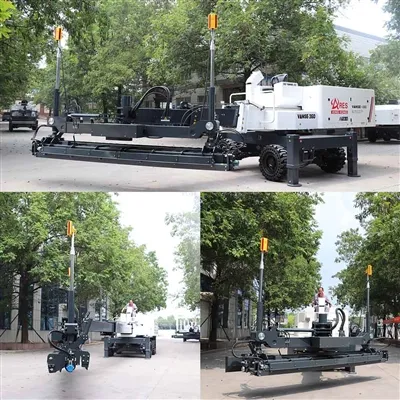
Laser leveling machines are convenient to use, without complicated operating techniques. Even inexperienced users can flexibly operate them. Secondly, traditional leveling machines will cause uneven construction when used, which will bring a lot of trouble to the construction. Moreover, the equipment can achieve large-area construction when used. This construction method effectively shortens the construction time and effectively ensures the smooth progress of the later work.
1. Small error:
Laser leveling machine is used for large-area construction ground. The ground elevation is easy to control and the ground flatness error is very small. Because of the laser point, the entire building only needs 1-2 reference point elevation, which can reduce the error caused by multiple reference points. The laser is independent of the decoration. The ground height rotates the laser to emit a beam of plane control. As long as the laser is not affected by interference, the laser leveling machine can ensure that the overall level of the paved ground is not affected. Therefore, the ground construction is laid in one area, and the level and smoothness of the entire ground can be ensured. The laser level measurement and control system of the laser leveling machine is controlled in real time. The leveling does not require the control of the line, nor does it require the middle horizontal template to control the ground elevation, avoiding the construction process due to the vibration (channel) of the template elevation error, and also reducing the elevation error caused by the traditional artificial block template.
2. The ground is more integrated:
Laser leveling machine, concrete is used in ground construction, it is easy to achieve large-area paving, one-time whole-sound paving process can be carried out according to the needs of any panel block construction, continuous operation and whole-layer construction, so that the surface is complete, which is the traditional construction process, the traditional laser leveling machine construction process, one day of death, pouring concrete, one day only jumps to construction, even if it is a limitation, it cannot be operated continuously, and the integrity is not good, which is easy to cause construction joint cumulative errors.
3. The ground is more compact and more uniform:
In ordinary concrete, the laser leveling machine always moves at a constant speed, and there is a high-frequency vibrator of 4000 times per minute, which makes the entire flat plate vibrate evenly, making the concrete floor more uniform.
The above basic knowledge about the laser leveling machine is basically over here. If you have good suggestions or opinions, you can communicate with us in time. We will have professional technicians to help you solve the problem. Thank you for your attention and support.
Thanks to All the Friends Who Support and Trust Shandong Vanse Machinery Technology Co., Ltd.
If you want to know more about Shandong Vanse Machinery Technology Co., Ltd. or have any questions, please feel free to contact us:
Our Factory
Shandong Vanse Machinery Technology Co., Ltd.








Share this article

About the Author: Shandong Vanse Machinery Technology Co., Ltd.
Shandong Vanse Machinery Technology Co., Ltd. is a high-tech manufacturer specializing in concrete construction machinery, including laser screeds and related equipment. The company integrates R&D, production, and global sales, with products exported to over 60 countries and widely used in infrastructure projects worldwide.
Previous Post
Next Post
Related Articles
You Might Also Like
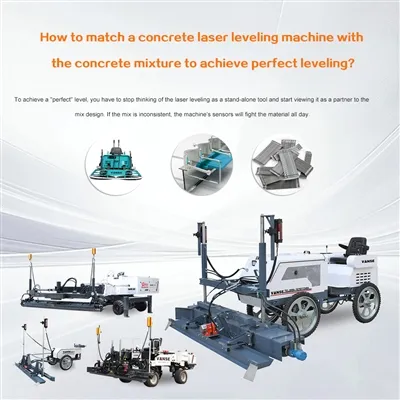
How to match a concrete laser leveling machine with the concrete mixture to achieve perfect leveling?
To achieve a "perfect" level, you have to stop thinking of the laser leveling as a stand-alone tool and start viewing it as a partner to the mix design. If the mix is inconsistent, the machine's sensors will fight the material all day. Here is how to calibrate your mix to your machine for maximum precision. For laser leveling, consistency is more important than the actual slump number. However, there is a "sweet spot" for machine performance. The Target: 4" to 5" (100mm – 125mm) slump. Too Wet (>6"): The leveling head will "sink" or create a wake like a boat. When the water evaporates, the "perfect" level you just pulled will settle and dip, ruining your FF (Floor Flatness) numbers. Too Stiff (<3"): The vibrator won't be able to liquefy the paste enough to close the surface, leaving "honeycombs" or tears that the machine can't fix. The auger on the front of the leveling head is designed to move excess concrete out of the way. The Mix: Use a well-graded aggregate (a mix of large, medium, and small stones). The Logic: If you use only large 1" stones (Gap-graded), the auger will "catch" them and drag them, creating gouges in the subgrade. A well-graded mix creates a "lubricated" matrix that the auger can trim precisely to the millimeter. Adjustment: If your mix is "rocky," increase your sand-to-aggregate ratio slightly (usually by 1-2%) to provide a "cream" cushion for the leveling head to glide on. The laser leveling needs the concrete to stay "live" long enough to finish a full pass, but not so long that it bleeds excessively. Avoid Sugar-Based Retarders: These can make the concrete "sticky." Sticky concrete clings to the back of the leveling head, causing it to "pull" the surface rather than shaving it. Use Mid-Range Water Reducers (MRWR): These provide workability (flow) without the massive water content that causes shrinkage. This ensures that the elevation the laser sets stays the same elevation after the concrete cures. Different mixes require different "energy" to settle. Air-Entrained Concrete (Exterior): Air bubbles act like tiny ball bearings. You should lower the vibrator frequency on the leveling. If you vibrate air-entrained concrete too hard, you'll pull the air out of the top 1/2 inch, leading to surface scaling later. Dense Interior Mixes: Use high frequency. You want to "liquefy" the paste immediately as the head passes over so the trailing edge can seal the surface perfectly. Element Specification for Laser leveling Water/Cement Ratio 0.45 to 0.50 (ideal for strength and minimal shrinkage) Air Content Interior: < 3% Sand Content 42% – 45% of total aggregate volume Chemicals Polycarboxylate-based superplasticizers (for flow without sag) The first truck of the day is often slightly different than the rest. Always check your grade with a manual stick after the first 20 feet of the first load. If the machine is struggling to "cut" the concrete, tell the plant to add a small dose of plasticizer to the remaining trucks to increase "cream" without adding water. Would you like me to help you draft a "Mix Design Requirement" sheet to send to your concrete supplier for your next high-tolerance job? Contact us NOW Note: The parameters provided in this document are for reference only and are not mandatory. Due to differences in technical characteristics between different brands and models of laser levelers, please consult the manufacturer for a suitable solution before actual operation. This reference document assumes no responsibility for any issues arising from failure to follow the manufacturer's instructions.How to select concrete base materials to ensure the long-term flatness of super flat floors constructed with laser leveling and power trowels
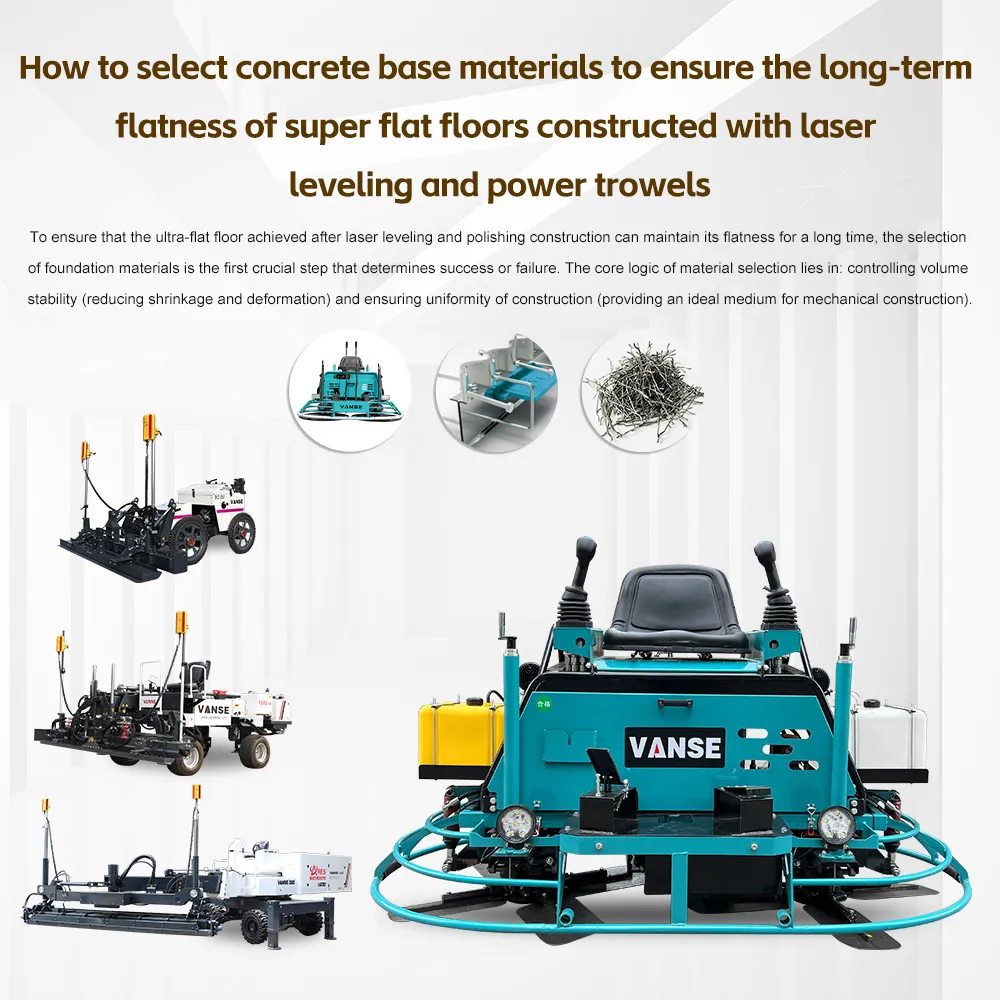
To ensure that the ultra-flat floor achieved after laser leveling and polishing construction can maintain its flatness for a long time, the selection of foundation materials is the first crucial step that determines success or failure. The core logic of material selection lies in: controlling volume stability (reducing shrinkage and deformation) and ensuring uniformity of construction (providing an ideal medium for mechanical construction). The following are the key material selection points summarized based on engineering practice and technical specifications: The design of the concrete mix ratio directly determines the shrinkage rate and crack resistance of the hardened floor, which is the fundamental factor for long-term flatness. Material category Key indicators / recommended requirements The mechanism of the long-term flatness effect Cement Ordinary Portland cement; in the same area and of the same batch number It reduces the surface color difference and internal stress unevenness caused by the chemical shrinkage difference of cement, and lowers the risk of warping. Water-cement ratio ≤0.48 Strictly controlling the water-cement ratio is the fundamental means to reduce the dry shrinkage rate of concrete. The larger the water-cement ratio, the more severe the shrinkage, and the more likely it is to crack and deform in the later stage. Slump For pumping: 100-140mm Provide stable operation for the laser leveling machine. If the slump fluctuates too much, it will make it difficult for the machine to level properly, resulting in local height errors. For non-pumping: 30-35mm Aggregate Sand: Grade II grading, strictly control the clay content A good gradation forms a stable framework structure, reducing the amount of cement paste and thereby lowering shrinkage. High clay content can damage the adhesion between cement and aggregates, causing cracks. Gravel: Continuous grading, maximum particle size ≤ 2/3 of the plate thickness The maximum particle size of the aggregate Recommendation: ≤25mm Excessive particle size will be lifted by the machine during the leveling and polishing processes, thereby damaging the surface flatness and appearance. For high-standard ultra-flat floors, ordinary concrete alone is often insufficient. Functional materials need to be introduced to enhance the overall performance. Steel fibers Concentration reference: 15kg/m³ (determined based on design load) Significantly enhances the tensile and flexural strength of concrete, effectively prevents the expansion of micro-cracks, and prevents plate warping. Compared to steel mesh, steel fiber concrete is more suitable for continuous operation by laser leveling machines, with higher efficiency. Synthetic fibers Macroscopic polypropylene fibers, etc. Mainly controls early plastic shrinkage cracks, reduces surface micro-cracks caused by excessive early water loss, laying a foundation for later flatness. Wear-resistant aggregate Metal or non-metallic aggregates (such as diamond powder, aluminum oxide, etc.) Sprayed on the concrete surface, after being compacted by a trowel, it forms a high-density, high-maintenance surface layer. This "armor" can resist wear and uneven settlement caused by long-term rolling by forklifts. Sealing curing agent Lithium-based or sodium-based liquid hardeners Penetrates into the concrete interior, reacts with calcium hydroxide to form hard calcium silicate, permanently sealing the capillary pores. It can greatly enhance surface hardness, density and impact resistance, preventing damage to flatness caused by later dusting and sanding. If the foundation is unstable, the floor will deteriorate. All the selection of upper materials is based on a stable foundation. Foundation treatment: It is necessary to ensure that the compaction degree meets the design requirements (such as the ground endurance K value is greater than 0.06 N/mm³). Uneven settlement is the fatal flaw that leads to floor cracking and loss of flatness. Base layer design: Usually, a C15 concrete base layer is set up, and a PE moisture-proof membrane is laid to block the upward movement of capillary water and prevent interlayer separation or expansion deformation caused by water vapor. Reinforced mesh (if applicable): For non-steel fiber concrete, the reinforced mesh needs to be configured according to the design to control shrinkage. However, it should be noted that the construction efficiency of the reinforced mesh is lower than that of steel fibers. To achieve long-term flatness of the super-level flooring, the selection of materials should follow the principle of "combining hardness and softness, and advancing steadily while maintaining stability": The foundation must be stable: Use concrete with a low water-cement ratio and high-quality graded aggregates as the base to ensure volume stability. The framework must be strong: Enhance the crack resistance by using steel fibers or steel mesh sheets to counteract shrinkage stress. The surface layer must be resilient: Create a high-strength and durable surface with wear-resistant aggregates and seal curing agents to resist usage wear. What is the specific grade requirement for the flooring flatness in your project (for example, does it need to meet free passage or VNA narrow aisle shelving)? This directly relates to whether steel fiber concrete is needed and the amount of wear-resistant aggregates. Please tell me these details so that I can further optimize the material plan for you. Contact us NOW Note: The parameters provided in this document are for reference only and are not mandatory. Due to differences in technical characteristics between different brands and models of laser levelers, please consult the manufacturer for a suitable solution before actual operation. This reference document assumes no responsibility for any issues arising from failure to follow the manufacturer's instructions.How to maximize the efficiency of the concrete laser leveling machine while ensuring construction safety?
In concrete construction, ensuring safety and improving efficiency requires coordinated efforts in equipment operation, personnel management, and construction process. The following is a detailed implementation plan that combines document safety specifications with construction points: Equipment hardware inspection (15 minutes before each operation): Confirm that the safety signs are complete (such as the "danger" signs on the telescopic arm and vibration beam are not detached), and the protective covers (hydraulic system, rotating parts) are installed in place. Check tire pressure (solid tires are not punctured), brake system (parking brake lock is reliable), and the hydraulic oil level is not lower than 1/2 of the oil gauge window (YZ40-4E hydraulic oil tank is 200L, if it is lower than the lower limit, add oil immediately). Test the signal connectivity between the laser receiver and the transmitter: The transmitter is placed at the reference point (height 3.2 meters), the receiver indicator light is centered, and the deviation exceeds ±1.5mm and needs to be recalibrated. Electrical system verification: Before starting, check the power cut-off switch (press to cut off, lift to turn on), there is no fault code on the instrument panel (such as water temperature > 112℃ warning light is not on), and all control handles are returned to zero position. Requirements for certification: Operators must pass manufacturer training (such as Shandong Wanshi Machinery's practical assessment), and are strictly prohibited from working under the influence of alcohol or while fatigued (continuous operation for more than 4 hours requires rotation). Emergency response drills: Simulate "abnormal equipment shutdown" and "laser signal interruption" scenarios every month, requiring operators to complete the following within 10 seconds: ① Lock the safety lever → ② Turn off the engine → ③ Take out the key. Multi-machine collaboration signal unification: A dedicated person is assigned to command with standard gestures at the construction site (such as "horizontal arm swing" to indicate shutdown), and all personnel must remember the "three-point contact on and off the machine" principle in the "Safety Rules" (maintain three-point support between the body, handrails, and pedals, and jumping is prohibited). Foundation pretreatment: The foundation needs to be compacted to 95% density, and the elevation deviation is controlled within ±20mm (laser elevation technology measurement) to avoid accumulation of leveling errors due to uneven foundation. Dividing construction zones: According to the 4-meter leveling width of YZ40-4E, each zone overlaps 0.5 meters to reduce joints (such as a 1000㎡ site can be divided into 25 40㎡ units). Concrete parameter matching: Use C20-C30 commercial concrete, the slump is controlled above 120mm (insufficient fluidity can easily lead to blockage of the screw conveyor), and the supply speed is matched with the construction efficiency of 24㎡/min to avoid material interruption and shutdown. Telescopic arm and steering coordination: During straight-line construction, the telescopic arm maintains 60% extension length (about 3.6 meters), and the crab steering mode (four wheels turn at the same time) is used for right-angle turns to minimize the time of moving the machine. When working on a slope (≤15°), adjust the automatic leveling system of the outriggers to ensure the level of the machine body, and adjust the excitation force to 3000N (maximum value) to enhance the density of the concrete. Dynamic calibration of the laser system: Use a handheld receiver to randomly check 3 points (such as the four corners and center of the site) every 2 hours of construction. If the FF value deviates by > 5 (such as from FF50 to FF45), immediately reset the laser reference point. Distance control for high-voltage line operation: ≥2 meters from 10kV cables, ≥11 meters from 500kV cables (see document safety distance table), set up warning lines during operation, and signalmen monitor the distance between equipment and cables in real time. If it is necessary to get close to the cable, the operator must wear insulating rubber shoes, lay rubber mats in the cab, and single-person operation is prohibited (2 people are required to cooperate, and 1 person is ready to stop the machine at any time). Operation specifications in high-temperature environments: Wait 30 minutes after the engine is shut down (the oil temperature drops below 60℃) before opening the cover for inspection. When removing the fuel tank cap, slowly unscrew it to release the pressure to avoid hot oil splashing and burns. Daily completion of "15-minute golden maintenance": High-pressure washing (150Bar pressure) of concrete residues on the leveling mechanism and tires to prevent wear of parts after solidification. Apply Mobil XHP222 high-temperature grease to the telescopic arm joints and screw conveyor bearings (deep lubrication once a month). Check that there is no leakage in the oil pipe joints (such as the fuel pipe, replace it every 250 hours), and there is no corrosion on the battery terminals (if the electrolyte splashes on the skin, rinse with water immediately) Maintenance items Cycle Efficiency impact point Replace engine oil 500 hours Power attenuation rate reduced by 15% Clean air filter 100 hours Avoid engine stalling due to insufficient air intake Replace hydraulic oil filter 250 hours Prevent valve core from getting stuck and causing malfunction Safety failures (must be shut down): If a hydraulic oil pipe bursts (risk of high-pressure oil injection), immediately press the power cut-off switch, cover the leak with a wooden board (do not touch it with bare hands), and contact the manufacturer to replace the oil pipe (do not use non-original accessories). When the laser receiver signal is interrupted, switch to manual mode (M gear) and manually calibrate the elevation with a ruler to prevent large-scale leveling deviations. Efficiency failures (temporary handling): When the screw conveyor is stuck, turn off the engine and use a special tool (non-metallic crowbar) to remove the concrete to avoid forced start and damage to the hydraulic motor (downtime is controlled within 10 minutes). If the downtime exceeds 30 minutes due to delayed concrete supply, you need to: ① lower the leveling mechanism to the ground → ② run the engine at idle speed (start every 15 minutes to prevent battery depletion) → ③ use a high-pressure water gun to rinse the working head to prevent the initial setting of the concrete. Record items Safety indicators Efficiency index Daily data Number of illegal operations (≤0 times) Actual construction area (≥2000㎡) Weekly summary Safety inspection pass rate (100%) Equipment utilization rate (≥85%) Monthly analysis Accident hazard rectification rate (100%) Fuel consumption (≤1.2L/100㎡) By converting the safety distance, maintenance cycle, and operating specifications in the documents into executable checklists and process nodes, we can ensure that the operation meets safety standards and improve equipment efficiency through parameter optimization and time management. For example, strict implementation of the "15-minute pre-job inspection" can reduce the equipment failure downtime rate by 20%, and zoning construction planning can maximize the efficiency of a 4-meter leveling width.