Technical Knowledge
Safety precautions for operating ride-on power trowels in confined indoor spaces
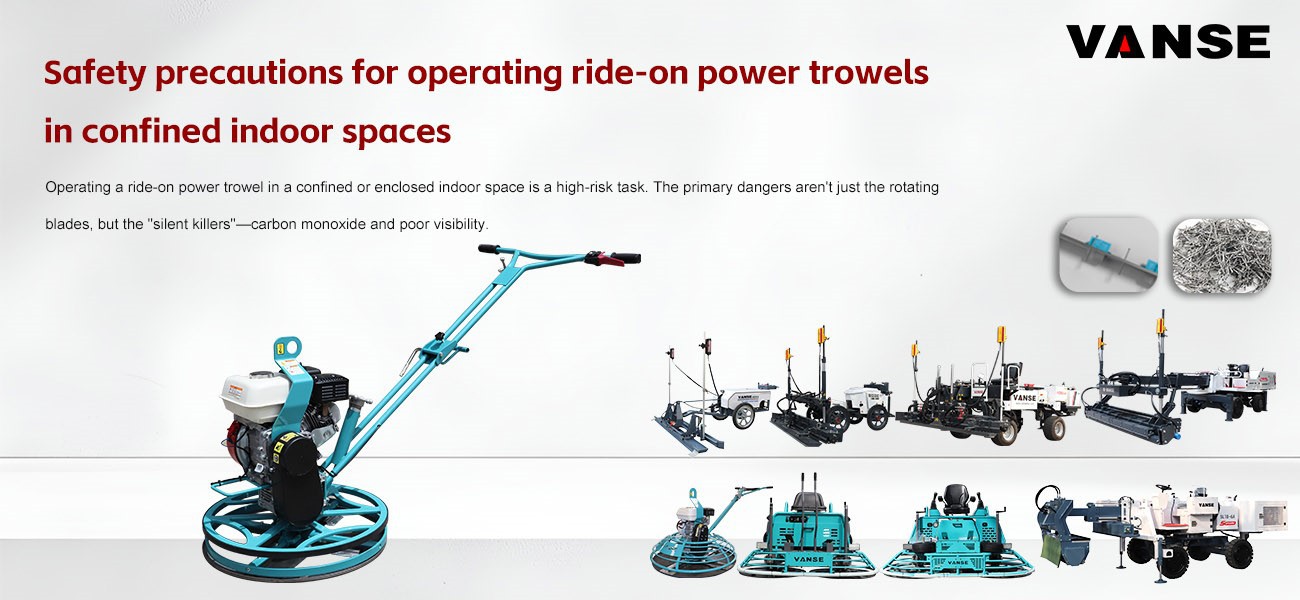
Operating a ride-on power trowel in a confined or enclosed indoor space is a high-risk task. The primary dangers aren't just the rotating blades, but the "silent killers"-carbon monoxide and poor visibility.
Here are the essential safety precautions to implement before the engine ever starts.
1. The Carbon Monoxide (CO) Hazard
Internal combustion engines (gasoline or diesel) in enclosed spaces can reach lethal CO levels in minutes.
Continuous Monitoring: Do not rely on "feeling okay." Use a portable CO monitor clipped to the operator’s vest. If the alarm sounds, evacuate immediately.
Active Ventilation: Natural airflow is never enough. Use high-volume axial fans and "sock" ducting to force fresh air into the work zone and push exhaust out.
Catalytic Converters: Ensure the machine is equipped with a scrubbed exhaust system or a catalytic converter to reduce emissions.
Alternative Power: If the space is truly "permit-required confined," consider using electric ride-on trowels or propane conversions (which still require ventilation but burn cleaner).
2. Physical Clearance and "Crush" Zones
Ride-on trowels are heavy, powerful, and lack the agility of a walk-behind.
The 1-Meter Rule: Maintain a strict "no-go" zone of at least 1 meter (3 feet) between the machine and any wall, column, or person.
Pinch Points: In tight spaces, the operator’s knees or elbows often extend beyond the frame. A slight slip can result in a crush injury against a structural column.
Obstacle Marking: Clearly mark floor drains, conduits, or rebar stubs with high-visibility spray paint. Hitting an obstacle in a tight space can cause the machine to "kick" or spin uncontrollably.
3. Visibility and Lighting
Indoor lighting is often poor during the concrete phase.
Machine Lighting: Ensure the ride-on has functional LED work lights on both the front and rear.
Ambient Light: Use temporary overhead "string" lighting. Shadows can hide the "wetness" of the concrete, leading to steering errors.
Reflective Gear: All ground crew must wear Class 2 or 3 reflective vests so the operator can spot them in the periphery.
4. Operator Safety and Machine Control
The "Dead-Man" Switch: Never bypass the seat sensor. The machine must shut down immediately if the operator is thrown or climbs off.
Hearing Protection: In confined spaces, engine noise is amplified by wall reverberation. Dual-layer hearing protection (earplugs + earmuffs) is recommended.
Fire Suppression: Keep a CO₂ or Dry Chemical fire extinguisher nearby. If a hydraulic line bursts onto a hot engine in an enclosed space, smoke will fill the room instantly.
Emergency Response Checklist
| Action | Protocol |
| Fumes Detected | Shut down machine; move operator to fresh air immediately. |
| Hydraulic Leak | Stop machine; use absorbent "snakes" to prevent slab contamination. |
| Operator Fall | Do not approach if blades are spinning; use remote kill-switch if available. |
5. Managing the "Slick" Surface
In confined spaces, you have less room to recover from a skid.
Slow Maneuvers: Avoid high-speed "spinning" turns near walls. The centrifugal force can slide the machine sideways into a barrier.
Path Planning: Always have an exit strategy. Know which corner you will finish in so you don't "trowel yourself into a corner" where ventilation is worst.
Would you like me to draft a brief "Safety Toolbox Talk" PDF outline that you can use to brief your crew before the next indoor pour? Contact us NOW
Note: The parameters provided in this document are for reference only and are not mandatory. Due to differences in technical characteristics between different brands and models of laser levelers, please consult the manufacturer for a suitable solution before actual operation. This reference document assumes no responsibility for any issues arising from failure to follow the manufacturer's instructions.
Thanks to All the Friends Who Support and Trust Shandong Vanse Machinery Technology Co., Ltd.
If you want to know more about Shandong Vanse Machinery Technology Co., Ltd. or have any questions, please feel free to contact us:
Our Factory
Shandong Vanse Machinery Technology Co., Ltd.
Share this article

About the Author: Shandong Vanse Machinery Technology Co., Ltd.
Shandong Vanse Machinery Technology Co., Ltd. is a high-tech manufacturer specializing in concrete construction machinery, including laser screeds and related equipment. The company integrates R&D, production, and global sales, with products exported to over 60 countries and widely used in infrastructure projects worldwide.
Previous Post
Next Post
Related Articles
You Might Also Like
How much greater efficiency can a ride-on laser leveling improve compared to a walk-behind model? Is the difference noticeable in actual construction?
The improvement in construction efficiency between ride-on laser leveling machines and walk-behind laser leveling machines, as well as the actual gap in construction, can mainly be analyzed from the following aspects. However, the specific improvement ratio and the severity of the gap may vary due to various factors such as equipment model, construction conditions, and the skill level of operators The moving speed: The ride-on laser leveling usually has a faster moving speed. For instance, the transfer speed of the YZ30-4E and YZ40-4E models can reach 0 to 10Km/h (dual-speed switching), while the walk-behind equipment mainly relies on the walking speed of the operator, which directly affects the construction efficiency. Assignment width: The leveling width of ride-on equipment such as YZ30-4E is 3100mm, and that of YZ40-4E is 4000mm. Compared with walk-behind equipment (such as the vibration plate width of DZ25-2 is 2500mm, and that of DZ30-2 is 3000mm), the single operation coverage area is larger, the number of repetitive operations is reduced, and thus the construction efficiency is improved. Degree of automation: Ride-on laser levelings are usually equipped with more advanced automatic control systems, such as microcomputer laser scanning control, which can achieve automatic leveling, reducing the time for manual adjustment and improving the construction accuracy and efficiency. Project Walk-behind laser leveling Ride-on laser leveling Construction speed Approximately 200 to 300 square meters per hour Approximately 600 to 1,000 square meters per hour Number of operators 2 to 3 people (including assistants) 1 to 2 people (single-person operation is acceptable) Continuous operation capacity Generally, human fatigue has a significant impact Strong, suitable for long working hours Adapted area Small areas and corner zones Large areas, main passage zones Construction accuracy High (laser control Higher (more stable system Significant efficiency improvement: In large-scale site leveling construction, the ride-on laser leveling, due to its high-speed movement and large-area operation capabilities, can significantly shorten the construction period. For instance, when laying large areas of concrete floors, ride-on equipment can quickly complete the leveling work, while walk-behind equipment requires more time and manpower. Precision and flatness: The ride-on laser leveling, through an advanced laser control system, can achieve higher construction precision and flatness, reducing the workload of subsequent repairs and adjustments. This is also one of the important factors for improving construction efficiency. Operator fatigue: Walk-behind equipment requires operators to walk for long periods and operate manually, which can easily lead to fatigue and affect construction efficiency. Ride-on equipment, on the other hand, offers a more comfortable operating environment, reduces the physical exertion of operators, and is conducive to maintaining continuous construction efficiency. The improvement in construction efficiency of the ride-on laser leveling is obvious, especially in large-scale site leveling construction, where its advantages are even more prominent. However, for small or complex terrain construction, hand-held equipment may have more advantages due to its flexibility and portability. Therefore, when choosing equipment, a comprehensive consideration should be made based on specific construction requirements and conditions. Concrete supply efficiency: The ride-on type requires 8-12 cubic meters of concrete per hour (calculated at 600 square meters per hour and a thickness of 150mm). If the concrete supply is insufficient (such as only one pump truck), the efficiency will be limited by the feeding speed, and the gap with the walk-behind type will be narrowed to within 20%. If the supply is sufficient (more than two pump trucks), the ride-on type can operate at full load, with a difference of up to 80%. Operator proficiency: The walk-behind operation is simple, and new operators can start working after one day of training. For the ride-on type, one needs to master functions such as laser system debugging and auger speed adjustment. The training will last for 3 to 5 days. If the operator is not skilled, the efficiency of the ride-on type may only be 20% to 30% higher than that of the walk-behind type. After becoming proficient, one can fully exert their performance, and the gap will expand to over 60%. Equipment maintenance and continuous operation capacity: Core components of the vehicle-type equipment (such as hydraulic systems and telescopic arms) require regular maintenance (hydraulic oil should be replaced every 500 hours). If maintenance is not timely, malfunctions may occur and the equipment may shut down. The walk-behind maintenance is simple (clean the air filter every 100 hours), with a low failure rate. However, long-term operation can easily reduce efficiency due to personnel fatigue. Preferred scenarios for ride-on type: Construction area > 5,000 square meters, regular site, and continuous high-intensity operation required (such as factories, logistics warehouses), with significant efficiency improvement and reduced labor costs (in the long term, one ride-on type can replace 2-3 walk-behind types + 4-6 workers). Preferred scenarios for the walk-behind type: Construction area less than 1,000 square meters, narrow site (such as interior renovation), and limited budget. At this time, the efficiency gap is small, and the procurement cost of the walk-behind type is lower (about 1/3 to 1/2 of that of the ride-on type). From the feedback of actual projects, in the construction of mainstream industrial plants and large commercial complexes' floors, the efficiency advantage of the ride-on type has become the key to "cost reduction and efficiency improvement". Especially when the construction area exceeds 10,000 square meters, choosing the ride-on type can shorten the construction period by 30% to 50%, and reduce the comprehensive cost (labor + construction period) by more than 20%. Note: The parameters provided in this document are for reference only and are not mandatory. Due to differences in technical characteristics between different brands and models of laser levelers, please consult the manufacturer for a suitable solution before actual operation. This reference document assumes no responsibility for any issues arising from failure to follow the manufacturer's instructions.Maintenance standard for concrete production equipment
Maintenance standards for concrete production equipment Concrete production equipment is an indispensable and important tool in the construction industry, and its normal operation and efficient performance are crucial to protecting concrete quality and construction progress. In order to ensure the stable operation of the equipment and extend its service life, it is particularly important to formulate a set of scientific and reasonable maintenance standards for concrete production equipment. This article will elaborate on the key points of daily equipment inspections, maintenance cycle settings, key component maintenance measures, lubrication and cleaning operations, electrical system maintenance, safety protection measures, and maintenance record management. 1. Key points for daily inspection of equipment Routine inspection of equipment is the basic work to prevent failures and ensure normal operation. During daily inspections, you should focus on the following aspects: ☑ Equipment appearance: Check the equipment for deformation, cracks, rust and other damage, especially damage to wearing parts and key components. ☑ Operating status: Observe whether the equipment is running smoothly and whether there is any abnormal noise or vibration. ☑ Temperature check: Check whether the temperature of each part of the equipment is normal, especially whether the temperature of the motor, reducer and other components is too high. ☑ Leakage: Check whether there is leakage in the lubrication system, hydraulic system, etc. of the equipment. ☑ Instrument display: Check whether the instrument display is accurate, such as whether the oil pressure, oil temperature, water level and other indications are normal. 2. Maintenance cycle setting The maintenance cycle setting should be comprehensively considered based on the frequency of use of the equipment, working environment, equipment performance and other factors. Generally speaking, equipment maintenance cycles can be divided into different levels such as daily maintenance, weekly maintenance, monthly maintenance and annual maintenance. The specific cycle setting should be determined based on the equipment's instruction manual and manufacturer's recommendations, and should be adjusted appropriately based on the actual situation. 3. Maintenance measures for key components Key components are the core part of the equipment, and their maintenanc e is particularly important. For key components of concrete production equipment, the following maintenance measures should be taken: ☑ Mixing host: Regularly check the wear of mixing blades, linings and other components, and promptly replace seriously worn parts; clean the inside of the mixing host to prevent concrete residue from hardening. ☑ Conveyor system: Check the tension and wear of the conveyor belt, adjust or replace the conveyor belt; check the operation of the conveyor roller and idler roller, and clean the concrete residue on the surface of the roller. ☑ Metering system: Regularly check the accuracy and sensitivity of the metering sensor to ensure accurate metering; clean the metering hopper to prevent material residues from affecting metering accuracy. ☑ Electrical system: Check the integrity and insulation performance of electrical components such as motors and cables; regularly check the electrical control system to ensure normal operation. 4. Lubrication and cleaning work Lubrication and cleaning are important aspects of equipment maintenance. ☑ Lubrication work: Lubricate each lubrication point regularly according to the requirements of the equipment lubrication table. Use appropriate oils and greases to ensure a smooth lubrication system. Regularly check the quality and level of lubricating oil and replace contaminated lubricating oil in a timely manner. ☑ Cleaning work: Clean the equipment regularly, especially the mixing host, conveyor belt and other components. Remove dust, oil and concrete residue from the surface of the equipment to keep the equipment clean and hygienic. During the cleaning process, attention should be paid to using appropriate cleaning agents and tools to avoid damage to the equipment. 5. Electrical system maintenance The electrical system is the core control system of the equipment, and its maintenance is crucial. In electrical system maintenance, the following aspects should be focused on: ☑ Check electrical components: Regularly check the integrity and performance of electrical components such as motors, cables, relays, etc. If components are found to be damaged or have degraded performance, they should be replaced in time. ☑ Clean dust: Clean the dust and debris inside the electrical control cabinet regularly to keep the inside of the control cabinet clean and dry. ☑ Check the line connections: Check whether the line connections are secure and whether there are any loose or virtual connections. Problems found should be dealt with promptly to ensure reliable line connections. ☑ Verify safety devices: Verify the electrical safety devices of the equipment, such as overload protection, short-circuit protection, etc., to ensure they are sensitive and effective. 6. Safety protection measures Equipment safety protection is an important measure to ensure the safety of operators and the equipment itself. During equipment maintenance, the following safety protection measures should be strengthened: ☑ Set safety warning signs: Set obvious safety warning signs around the equipment to remind operators to pay attention to safety. ☑ Provide personal protective equipment: Provide operators with necessary personal protective equipment, such as hard hats, protective glasses, gloves, etc., to ensure personal safety during the operation ☑ Regularly check safety protection devices: Check whether equipment protection devices, guardrails and other safety protection devices are intact and effective, and repair or replace damaged parts in a timely manner. ☑ Comply with operating procedures: Operators should strictly follow the operating procedures and are not allowed to change equipment parameters without authorization or perform illegal operations. 7. Maintenance record management Maintenance record management is an important means to ensure that maintenance work is carried out in an orderly manner. During the equipment maintenance process, detailed maintenance records should be established, including maintenance time, content, personnel and other information. Regularly organize and analyze maintenance records, summarize experience and deficiencies in equipment maintenance, and provide reference and basis for future maintenance work. At the same time, maintenance records should be included in equipment file management as an important basis for equipment service life and performance evaluation. By tracking and analyzing maintenance records, potential problems and hidden dangers of equipment can be discovered in time, providing a basis for preventive maintenance. To sum up, the maintenance standards of concrete production equipment are an important guarantee to ensure the normal operation of the equipment and extend its service life. By formulating and implementing this standard, we can standardize the maintenance of equipment, improve the operating efficiency and stability of equipment, and provide reliable technical support for concrete production. In actual work, we should constantly summarize experience and improve maintenance standards to adapt to changing equipment and technical requirements. In the process of maintaining concrete production equipment, we also need to pay attention to some details and special situations. For example, when using equipment in winter, special attention should be paid to anti-freezing measures to ensure that the equipment can operate normally in low-temperature environments. In addition, equipment that has not been used for a long time should be started and run regularly to avoid component aging and functional degradation caused by long-term inactivity of the equipment. In addition to routine maintenance work, preventive maintenance of equipment should also be strengthened. Preventive maintenance is to detect and solve potential problems in advance to avoid equipment failure by regularly checking, predicting and evaluating the operating status of equipment. By implementing preventive maintenance, the failure rate of equipment can be greatly reduced and the reliability and stability of equipment can be improved. In addition, with the continuous advancement of science and technology, some advanced maintenance technologies and methods should also be widely used. For example, IoT technology can be used to remotely monitor and diagnose equipment, understand the operating status of equipment in real time, and detect and handle abnormal situations in a timely manner. At the same time, big data analysis technology can also be used to mine and analyze equipment maintenance data to provide strong support for equipment optimization and improvement. In the process of maintaining concrete production equipment, we should also pay attention to cultivating the maintenance awareness and skills of operators. Through regular training and skill improvement, operators can become proficient in equipment maintenance. knowledge and skills to improve their work ability and sense of responsibility. At the same time, corresponding reward and punishment mechanisms should also be established to encourage operators to actively participate in equipment maintenance. Finally, it needs to be emphasized that concrete production equipment maintenance standards are not static, but should be continuously updated and improved with the development of equipment and technology. We should pay close attention to industry trends and technological developments, promptly apply new maintenance concepts and technologies to actual work, and continuously improve the maintenance level of equipment. In short, concrete production equipment maintenance standards are an important guarantee to ensure the normal operation of the equipment and extend its service life. By formulating and implementing this standard, strengthening the preventive maintenance of equipment, applying advanced maintenance technologies and methods, and cultivating the maintenance awareness and skills of operators, we can continuously improve the maintenance level of equipment and ensure the smooth progress of concrete production. Provide strong protection. In the future maintenance work of concrete production equipment, we should also actively explore new maintenance models and methods. For example, an intelligent maintenance system can be introduced to realize automatic monitoring, early warning and maintenance of equipment through technical means such as sensors and cloud computing. This can not only improve the efficiency and accuracy of maintenance, but also reduce the cost and labor investment of maintenance. In addition, with the increasing awareness of environmental protection, we should also pay attention to environmental protection and energy saving during equipment maintenance. For example, when cleaning equipment, environmentally friendly cleaning agents should be used as much as possible to reduce environmental pollution. At the same time, energy-saving transformation of the equipment can also be carried out, the operating parameters of the equipment can be optimized, and the energy consumption of the equipment can be reduced. In short, the maintenance of concrete production equipment is a long-term and arduous task. We need to constantly summarize experience, explore innovation, and improve standards to adapt to changing market demands and technological development. Only in this way can we ensure the stable operation and efficient production of concrete production equipment and contribute to the sustainable development of the concrete industry. To sum up, the concrete production equipment maintenance standard is a comprehensive system, covering daily equipment inspection, maintenance cycle setting, key component maintenance, lubrication and cleaning, electrical system maintenance, safety protection measures and maintenance record management In many aspects, etc., by strictly implementing this standard, we can ensure the normal operation and extend the service life of the equipment, improve production efficiency, reduce the failure rate, and provide a strong guarantee for the smooth progress of concrete production. At the same time, we should continue to pay attention to the application of new technologies and new methods to adapt to the needs of industry development and promote the continuous progress of concrete production equipment maintenance.Vanse Laser Leveling Machine – Strive To Create High-End Ultra-Flat Ground
Vanse Laser Leveling Machine – Strive To Create High-End Ultra-Flat Ground With the continuous advancement of science and technology, in the construction of modern building floors, more and more things are not manually operated, but replaced by more efficient machines. For example, the laser leveling machine produced by our VANSE Machinery is a Such a machine is an excellent product to replace labor. The concrete floor poured out by VANSE Concrete Laser Leveling Machine is smooth, compact and time-saving. It can more than double the efficiency of manual laying and pouring the ground, but it greatly saves manpower. The solidity is three times that of artificial paving, making the cement floor more solid and dense. Therefore, this machine is regarded as the first choice for ground paving by many construction teams. Today, VANSE Machinery will summarize the construction advantages of concrete laser leveling machines. The biggest feature of our concrete laser leveling machines is to save labor and improve efficiency. Let's take a look at the specific and more detailed aspects: 1. High construction quality The laser leveling machine can level the ground, which can significantly improve the flatness of the ground. For the ground constructed by the laser leveling machine and the traditional method, 22 points are detected (one point every 5mx4m), and the average flatness is 1.3mm and 4.1mm respectively. Laser leveling The leveling quality of equipment such as leveling machines is more than three times higher than that of traditional methods. The laser leveling machine can realize large-scale construction, reduce a large number of construction joints, reduce the slump of concrete, and ensure the strength of concrete, so that the ground has good integrity and is not prone to cracks. 2. Fast construction speed Using laser leveling machine and other equipment to construct large concrete slabs can improve the work efficiency by 3 times compared with the traditional beam vibrator method, save 30%, and can complete 3,000 square meters per day on average. It is especially suitable for concrete surfaces with simple shapes and large surface areas. construction. 3. Reduce the amount of side formwork support and dismantling Based on the statistics of 20,000 square meters of concrete pavement, the traditional method needs to dismantle 5800m of side formwork, but with advanced equipment such as laser leveling machine, the dismantling is only 2500m, reducing the support modulus by more than 74% 4. High degree of automation and low labor intensity The use of laser leveling machines and other equipment turns heavy manual labor into mechanical paving, vibrating, leveling, slurry extraction, and surface plastering, reducing the number of operators by 30% and reducing labor intensity. 5. High economic benefit The application of laser leveling machine and other equipment saves the cost of 2-3 yuan/㎡ compared with the traditional process, with fewer seams and lower maintenance costs in the later period, so that the economic benefits are significantly improved. Advanced equipment such as laser leveling machines are especially suitable for projects such as docks, storage yards, expressways, airports, large squares, parking lots, and municipal roads that have relatively simple shapes, large amounts of action, and high construction quality requirements. Now our laser leveling machine is very mature. Customers who have bought it have used it for a period of time. During the return visit, our sales staff all said that it has been used very well. We are honored and very happy. The user's feedback that the concrete laser leveling machine is easy to use comes from their own heartfelt words. Only after using a good product can they have the most personal experience. VANSE laser leveling machine – strive to create high-end ultra-flat ground!