Technical Knowledge
How to match power trowel with concrete laser leveling machine for warehouse floors
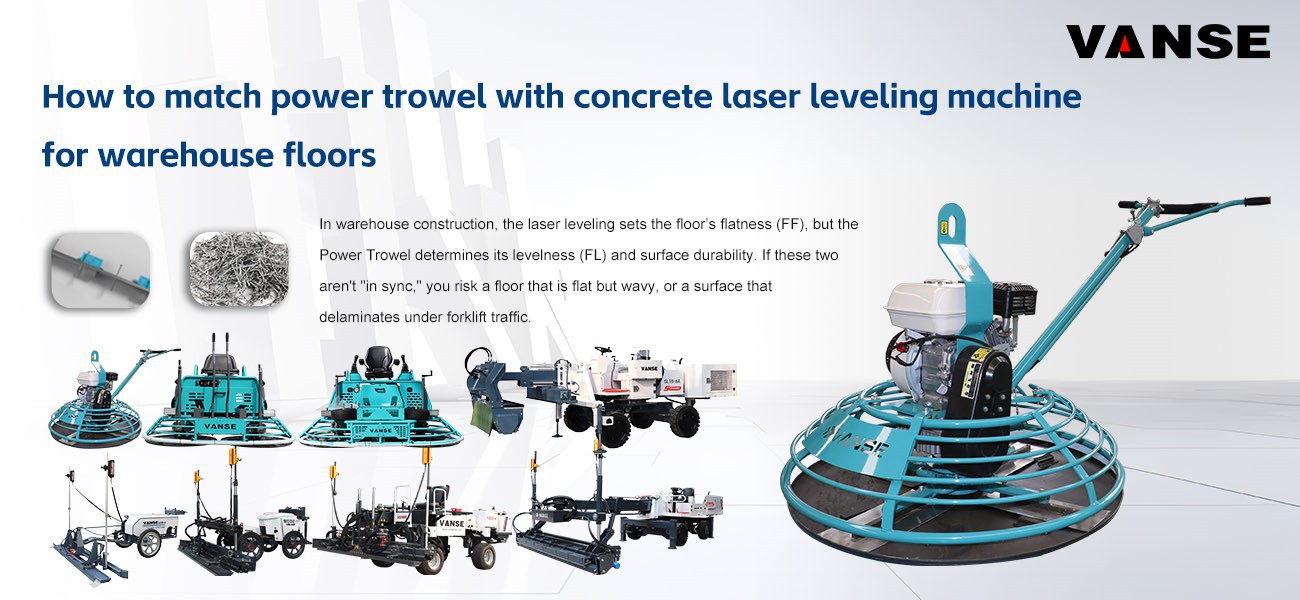
In warehouse construction, the laser leveling sets the floor’s flatness (FF), but the Power Trowel determines its levelness (FL) and surface durability. If these two aren't "in sync," you risk a floor that is flat but wavy, or a surface that delaminates under forklift traffic.
Here is the strategy to match these machines for a high-tolerance warehouse floor.
1. Timing the "Window of Workability"
The most critical "match" isn't speed-it's chemistry. You must time the trowel start based on the leveling's progress.
The Footprint Test: In a warehouse setting, the ride-on trowel should enter the slab when a worker’s boot leaves an indentation of roughly 3mm to 5mm.
The "Pass" Offset: Typically, the first power trowel should be starting its "panning" pass exactly 2 to 4 hours (depending on temperature and mix) after the laser leveling finished that specific section.
Rate Matching: If your laser leveling is placing 500 m² per hour, you need enough trowel capacity to finish 500 m² per hour. Usually, this requires one 8ft or 10ft ride-on trowel for every 400–600 m² of daily pour to stay ahead of the "set."
2. Panning for Levelness (FL)
The laser leveling is excellent at striking off concrete, but it can leave minor "micro-ridges" from the vibration.
The Large-Diameter Advantage: To match a laser-levelinged floor, use large-diameter ride-on trowels (10ft or 12ft) equipped with float pans.
Why Pans? Unlike blades, pans act like giant flat-edges. They "cut" the high spots left by the leveling and "fill" the low spots, effectively magnifying the accuracy of the laser leveling.
Cross-Troweling: Always run the power trowel perpendicular to the direction the laser leveling traveled. This eliminates any rhythmic undulations caused by the leveling head.
3. Matching Blade Pitch to Concrete "Tightness"
As the warehouse floor hardens, you must transition from floating to finishing.
| Stage | Tooling | Matching the leveling Result |
| Break-in | Float Pans | Levels the ridges left by the laser leveling head. |
| Second Pass | Combo Blades | Begins to "close" the surface pores. |
| Final Pass | Finish Blades | High-pitch "burnishing" for that mirror-like warehouse shine. |
4. Equipment Synergy Checklist
To ensure the machines work as a team, verify these specs:
Non-leveling Zones: For areas near docks or pits where the laser leveling can't reach, ensure your trowel operators have handheld vibratory leveling to maintain the same consolidation density as the main slab.
Weight Ratio: Use heavy-duty ride-on trowels (e.g., 1000KG + machines) for warehouse floors. The weight is necessary to densify the surface that the laser leveling has already flattened.
Fuel/Power: Ensure your trowels are running clean-burning engines (or have scrubbers) if the laser leveling is working in an enclosed warehouse space to prevent carbon monoxide buildup.
The "Burnish" Factor
In modern warehouses, "burnished" floors are the standard. This requires the power trowel to "burn" the surface at high RPMs. If the laser leveling didn't do its job, high-speed troweling will actually highlight the defects. Rule of thumb: If the trowel is "chattering" (jumping), the laser leveling pass was likely too fast or the mix was too stiff.
Would you like me to create a labor-to-machine ratio table based on your typical daily pour size (in square feet or meters)? Contact us NOW
Note: The parameters provided in this document are for reference only and are not mandatory. Due to differences in technical characteristics between different brands and models of laser levelers, please consult the manufacturer for a suitable solution before actual operation. This reference document assumes no responsibility for any issues arising from failure to follow the manufacturer's instructions.
Thanks to All the Friends Who Support and Trust Shandong Vanse Machinery Technology Co., Ltd.
If you want to know more about Shandong Vanse Machinery Technology Co., Ltd. or have any questions, please feel free to contact us:
Our Factory
Shandong Vanse Machinery Technology Co., Ltd.








Share this article

About the Author: Shandong Vanse Machinery Technology Co., Ltd.
Shandong Vanse Machinery Technology Co., Ltd. is a high-tech manufacturer specializing in concrete construction machinery, including laser screeds and related equipment. The company integrates R&D, production, and global sales, with products exported to over 60 countries and widely used in infrastructure projects worldwide.
Previous Post
Next Post
Related Articles
You Might Also Like
The one-step forming construction technique for high-precision, wear-resistant floors without cutting joints, which is based on laser leveling technology
The equipment is equipped with a HONDA GX690 engine with a power of 18.4kW (25HP). It uses gasoline as fuel. The 20L fuel tank capacity can ensure that the equipment can operate stably for a certain period of time and provide reliable power for floor construction. This power configuration enables the equipment to operate stably for a long time in large-area floor construction scenes such as large industrial plants and commercial plazas, avoiding the impact of insufficient power on the construction progress. ❶. **Vibration leveling equipment**: The vibration system of the equipment is driven by an electric motor with an excitation force of 2000N. After the concrete is poured, the equipment makes the concrete more compact through vibration, effectively eliminates the gaps and bubbles inside the concrete, and lays the foundation for creating a high-precision wear-resistant floor. In actual operation, this vibration leveling equipment can quickly and evenly process the concrete surface to ensure the flatness of subsequent construction. ❷. **Paving and leveling equipment**: It adopts hydraulic screw conveying paving mode with a leveling width of 2.5m (8.20ft). During the construction process, it can spread the concrete evenly and level it accurately. Whether it is indoor flooring or outdoor road flooring construction, this paving and leveling method can ensure that the thickness and flatness of the concrete meet high-precision requirements. The equipment is equipped with two types of solid anti-skid tires and pneumatic wide tires. The net weight of the whole machine is 990kgs (2183lbs) and the overall dimensions are 3600x3000x1650mm (11.81×9.84×5.41ft). Such tire configuration and body specifications enable the equipment to move flexibly and operate stably under different ground conditions, such as on rough construction site floors or smooth indoor floors. Before construction, the construction site needs to be accurately measured and cleaned. At the same time, debug the construction equipment to ensure that the engine is running normally, the vibration system and hydraulic system are in good performance, and the laser receiving device can accurately receive signals, so as to make full preparations for construction. The mixed concrete is transported to the construction site for pouring, and the pouring thickness and speed of the concrete are controlled to provide a good foundation for subsequent leveling operations. The laser transmitter is used to establish a reference plane. After the laser receiver on the equipment receives the signal, the scraper height is automatically adjusted. Through the hydraulic screw conveying paving mode, precise leveling is performed according to the leveling width of 2.5m (8.20ft). At the same time, the vibration system works with an exciting force of 2000N to make the concrete dense and the surface flat. When the floor concrete is initially set, evenly spread the wear-resistant material. Afterwards, professional equipment is used to perform surface finishing treatment to make the floor surface smooth and flat, improve the wear resistance and aesthetics of the floor, and complete the one-time molding construction of high-precision wear-resistant floor without cutting. With the help of laser leveling technology and advanced equipment, the flatness of the floor can be accurately controlled, and the error can be controlled within a very small range, meeting the needs of various places with extremely high requirements for floor accuracy, such as precision instrument manufacturing workshops, electronic production workshops, etc. By optimizing the concrete mix ratio and construction process, the generation of floor cracks is effectively reduced, and free cutting construction is achieved, which not only improves the overall aesthetics of the floor, but also reduces the subsequent maintenance costs. The high-performance parameters of the equipment, such as the powerful engine, efficient hydraulic paving system and stable vibration system, ensure the rapid advancement of construction, greatly shorten the construction period and improve construction efficiency. Equipment equipped with two types of tires can adapt to different working site conditions, whether indoors or outdoors, dry or wet ground, can stably and efficiently complete construction tasks.How to improve the emergency handling capabilities of laser leveling machines?
How to improve the emergency handling capabilities of laser leveling machines for equipment failures 1. Personnel training One of the keys to improving the emergency handling capabilities of laser leveling machine equipment is personnel training. Through regular training, operators will be familiar with the principles, operation and maintenance of equipment, and master basic fault identification and response methods. The training content should include theoretical knowledge and practical operations to ensure that operators have basic fault emergency handling capabilities. 2. Failure plan Developing detailed failure plans is one of the key measures to improve emergency response capabilities. The fault plan should include the phenomenon, causes and treatment methods of common faults, so that operators can quickly take corrective measures when encountering faults. At the same time, the plan should be flexible enough to cope with failures in different situations. 3. Emergency spare parts inventory To ensure that faults can be dealt with promptly, an emergency spare parts inventory should be established. The inventory should contain spare parts for wearing parts and critical components, and should be checked and replenished regularly to ensure the effectiveness and availability of spare parts. When equipment failure occurs, spare parts can be quickly replaced to shorten troubleshooting time. 4. Failure warning system Establishing a fault early warning system is one of the effective means to improve emergency response capabilities. By installing sensors and monitoring equipment, the operating status and various parameters of the equipment can be monitored in real time. When an abnormality occurs in the equipment, the early warning system can issue an alarm in time and notify the operator to take quick measures to prevent the fault from expanding or causing more serious consequences. 5. Equipment maintenance plan Developing a detailed equipment maintenance plan is one of the effective measures to improve emergency response capabilities. The maintenance plan should include daily inspections, regular maintenance and repairs of the equipment. Through regular maintenance and upkeep, we ensure the normal operation of the equipment, discover and deal with potential faults in a timely manner, and reduce the probability of equipment failure. 6. Fault recording and analysis Establishing an equipment failure recording and analysis system is one of the necessary means to improve emergency response capabilities. Keep detailed records of equipment failures that occur, including failure symptoms, causes and treatment methods. By analyzing the records, we can find out the patterns and potential causes of faults so that targeted measures can be taken for improvement and prevention. At the same time, fault records can also provide reference and reference for operators to improve their emergency handling capabilities. 7. Regular drills Regularly conducting equipment failure emergency drills is one of the effective ways to improve actual processing capabilities. By simulating equipment failure scenarios, operators can perform actual emergency handling operations to improve their ability and psychological quality to cope with emergencies. After the drill, the process should be evaluated and summarized, existing problems and deficiencies should be identified, improvement measures should be proposed, and the emergency handling capabilities of the equipment should be continuously improved and improved.What is the difference of concrete laser leveling machine VS man construction?
In recent years, with the continuous development of the economy and society, there are more and more construction demands for large-area sites such as parking lots, large squares, and industrial plants, because these sites mainly use concrete to pour the foundation on site, and then cover it with floor tiles or floor tiles. Flat paint, so higher requirements are put forward for the flatness of the base layer. In order to ensure that the flatness of the ground after construction reaches an ideal level, a concrete laser leveling machine is required at this time. So, what is the difference between concrete laser leveling machine construction and manual construction? What are the significant construction advantages of the concrete laser leveling machine itself? █Traditional construction methods The common concrete floor construction method is to manually level it, and then use a trowel to smooth it. This method requires a lot of labor, and the quality of the construction process is not controlled. It needs manual corrections, repeated measurement and adjustment of the ground under construction, and the efficiency is not high. The construction of large-area concrete floors requires the use of a large number of wooden or metal plates in advance to form the side formwork, and the height of the side formwork is measured by a level to control the height of the concrete after laying. Due to the need to use a level instrument for multi-point measurement, re-measurement is required after the side formwork is laid to ensure accuracy. Therefore, the process is prone to human error. In addition, the dismantling of the side formwork also requires a lot of labor. █Intelligent construction method 1. Operating principle Pre-set up the Topcon laser transmitter on the construction site to provide the working elevation reference surface, use the Topcon receiver LS-B110 fixed on the laser leveling machine to receive the laser elevation position signal, and transmit the real-time elevation position signal to the controller, which automatically controls The electric push rod or hydraulic system of the concrete laser leveling machine ensures that the elevation of the receiver is equal to the reference surface, and the mechanical device of the leveling machine realizes paving according to the set height. 2. Construction advantages The advantages of using concrete laser leveling machine for concrete leveling are highlighted in the following aspects: (1) It can easily lay high-strength concrete, low-slump concrete and fiber cement concrete; (2) The construction quality is high, and the leveling quality of the laser leveling machine is more than three times higher than that of the traditional manual construction method, reaching an ultra-flat ground; (3) Improve work efficiency and save labor. Concrete laser leveling machine is used for construction to shorten construction time, improve work efficiency and save labor; (4) Change the heavy physical labor to mechanical paving, vibrating, leveling, pulping, and plastering, reducing the number of operators, reducing labor intensity, and creating high-quality ground; (5) The application of concrete laser leveling machine not only saves costs compared with traditional manual processes, but also has fewer ground joints and greatly reduces maintenance costs in the later period, thereby significantly improving economic benefits; (6) The use of concrete laser leveling machine can realize large-scale construction, reduce a large number of construction joints, reduce the slump of concrete, ensure the strength of concrete, make the ground integrity good, and cracks are not easy to appear. Summary of this chapter: Although the concrete laser leveling machine is a new equipment with sophisticated technology emerging in recent years, it is widely used in airport runways, high-speed rail platforms, large workshop roads, etc., which have extremely high requirements for ground flatness. In engineering projects, if it can be widely popularized and promoted, it will definitely bring very considerable construction benefits.