Technical Knowledge
Ride-on power trowel 12 paddle and 8 paddle under the 3 mm FF requirement, how much difference in leveling time?
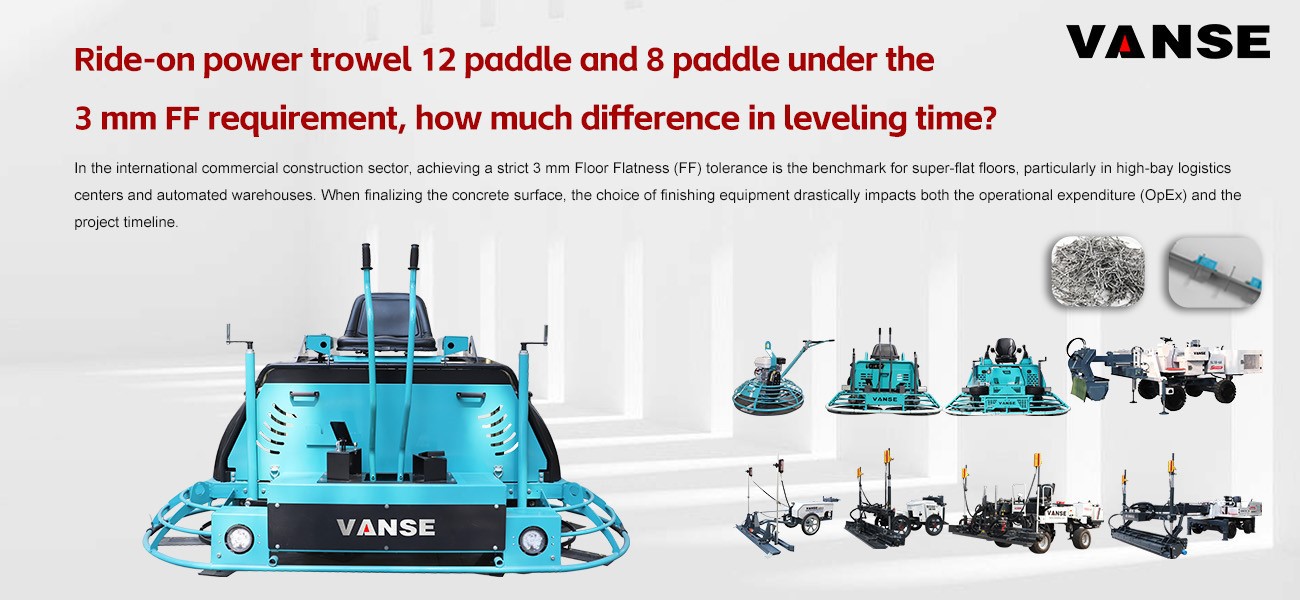
In the international commercial construction sector, achieving a strict 3 mm Floor Flatness (FF) tolerance is the benchmark for super-flat floors, particularly in high-bay logistics centers and automated warehouses. When finalizing the concrete surface, the choice of finishing equipment drastically impacts both the operational expenditure (OpEx) and the project timeline.
A frequent debate among concrete contractors is whether to utilize an 8-paddle (dual 4-blade rotors) or a 12-paddle (dual 6-blade rotors) ride-on power trowel. When racing against the concrete curing clock to secure a 3 mm FF rating, the 12-paddle machine significantly reduces leveling and finishing time.
Here is a comprehensive, technical breakdown of the time differences and mechanical efficiencies between the two configurations, featuring integrated solutions from Shandong Vanse Machinery Technology Co., Ltd. (www.vansemac.com).
1. The Mechanical Advantage: Surface Contact Area
The primary difference between an 8-paddle and a 12-paddle ride-on trowel is the surface contact area per revolution.
8-Paddle Trowels: With four blades per rotor, there are wider gaps between the blades as they spin. While effective for standard commercial applications, these gaps mean the machine must make more passes over the same area to achieve deep compaction and a uniform burnish.
12-Paddle Trowels: A 12-paddle machine (six blades per rotor) provides 50% more blade contact per revolution. This increased surface contact acts like a broader, more consistent smoothing plane. The densely packed blades bridge minor surface undulations much more effectively than a 4-blade rotor, physically preventing the machine from dipping into micro-depressions and thereby actively preserving the 3 mm FF tolerance.
2. Time Difference in Achieving 3mm FF
When aiming for a super-flat 3 mm specification, contractors cannot simply rush the machine; they must rely on the mechanical efficiency of the equipment.
The Time Savings: In practical field applications on large-area pours, a high-performance 12-paddle ride-on power trowel typically reduces the final polishing and finishing time by 20% to 30% compared to an 8-paddle machine.
Fewer Passes Required: Because the 12-blade configuration imparts more friction, heat, and downward pressure simultaneously, it draws the cement paste to the surface and densifies the matrix much faster. An area that might require four passes with an 8-paddle machine to achieve a mirror-like, 3 mm compliant finish may only require two or three passes with a 12-paddle unit.
Risk Mitigation: Concrete sets quickly, especially in high temperatures or strong winds. Saving 20-30% of your finishing time means the entire slab is burnished and sealed well within the optimal curing window, completely eliminating the risk of cold joints or a dull, porous finish.
3. The Prerequisite: You Cannot "Trowel In" a 3mm FF
It is critical to note that no ride-on power trowel-whether 8-paddle or 12-paddle-can create a 3 mm FF floor from a poorly poured slab. The trowel's job is to compact, burnish, and preserve the levelness.
To achieve world-class E-E-A-T (Experience, Expertise, Authoritativeness, and Trustworthiness) standards in industrial flooring, the 3 mm tolerance must be established during the initial strike-off phase.
As demonstrated by the equipment ecosystem at Vanse Machinery, achieving this requires a two-step mechanized process:
Initial Laser Leveling: The concrete must first be placed and struck off using an advanced telescopic boom concrete laser Leveling, such as the Vanse YZ30-4E or the high-efficiency YZ40-4E. These machines utilize aviation-grade aluminum leveling heads and high-frequency 4,000 RPM vibration to establish a flawless, super-flat base.
High-Speed Finishing: Once the bleed water dissipates, a heavy-duty ride-on concrete power trowel (such as the Vanse VS836 or the versatile VS1046) is deployed. By utilizing equipment with overlapping, multi-blade configurations, contractors can rapidly lock in the precise grade established by the laser Leveling before the concrete sets.
Conclusion
For contractors targeting strict 3 mm FF requirements on massive commercial or industrial slabs, upgrading to a 12-paddle ride-on power trowel is a highly profitable investment. The 20% to 30% reduction in finishing time dramatically lowers labor costs, expands daily pour capacity, and ensures that the precision grade achieved by your Vanse laser Leveling is permanently locked into a dense, wear-resistant surface.
Note: The parameters provided in this document are for reference only and are not mandatory. Due to differences in technical characteristics between different brands and models of laser levelers, please consult the manufacturer for a suitable solution before actual operation. This reference document assumes no responsibility for any issues arising from failure to follow the manufacturer's instructions.
Thanks to All the Friends Who Support and Trust Shandong Vanse Machinery Technology Co., Ltd.
If you want to know more about Shandong Vanse Machinery Technology Co., Ltd. or have any questions, please feel free to contact us:
Our Factory
Shandong Vanse Machinery Technology Co., Ltd.








Share this article

About the Author: Shandong Vanse Machinery Technology Co., Ltd.
Shandong Vanse Machinery Technology Co., Ltd. is a high-tech manufacturer specializing in concrete construction machinery, including laser screeds and related equipment. The company integrates R&D, production, and global sales, with products exported to over 60 countries and widely used in infrastructure projects worldwide.
Previous Post
Next Post
Related Articles
You Might Also Like
How to ensure that the parameters and performance of the concrete laser leveling machine meet the requirements
To ensure that the parameters and performance of the concrete laser leveling machine meet the standards, the core is to establish " Source selection → Preoperative calibration → Intraoperative verification → Postoperative maintenance "The whole process is closed-loop controlled, and each link is closely linked to "parameter standards" and "matching of actual working conditions", avoiding single reliance on debugging or calibration. The factory parameters of the equipment itself are the performance bottom line and must be strictly checked upon purchase and arrival to avoid "innate deficiencies". Selection and benchmarking parameter standards: Clarify core parameter requirements: Based on construction requirements (such as ground flatness grade and working area), benchmark against national standards (such as "Concrete Laser Leveling Machine" GB/T 37497-2019), and lock in key parameters – laser system accuracy (≤±0.1mm/m), maximum leveling thickness (such as 100-300mm), travel speed (0-6m/min adjustable), and flatness error (≤3mm/2m) to ensure that the selected parameters cover construction requirements. Give priority to brands with "parameter traceability": require manufacturers to provide calibration certificates for laser transmitters and receivers (such as those issued by a third-party metrology agency) to confirm that the parameters of core components are within the validity period, and avoid purchasing equipment with "three no's" or ambiguous parameters. After unpacking, check the "document compliance" first: check the product certificate and instruction manual, and confirm that the standard values of each parameter (such as the effective distance of the laser signal and the working pressure of the hydraulic system) are clearly marked in the manual. Simple core performance test: Use a high-precision level (0.02mm/m) to check the levelness of the laser transmitter. After powering on, observe the signal stability of the receiver within a range of 5 meters (uninterrupted flashing). Manually push the leveler to check that the travel wheels are not stuck and the blade rises and falls smoothly, preliminarily eliminating mechanical faults. Calibration before use is the key to "making the equipment work according to the standard". The core system needs to be calibrated item by item according to the instructions and standards. Transmitter calibration: Place it on a stable base and adjust the bottom feet so that the built-in level bubble is centered (or the electronic level displays "0±0.1mm"). Set the "elevation reference" according to the instructions and use a tape measure to measure the height from the center of the transmitter to the ground. The deviation from the designed elevation must be ≤1mm. Receiver and mechanical linkage: Fix the receiver to the "zero point scale" of the lifting rod and ensure that the receiver sensing surface is flush with the bottom surface of the leveling blade (verify by placing a ruler close to the blade); start the equipment and let the receiver sense the laser signal. If the display on the operation panel is not "0", adjust it to zero using the "zero point calibration" button to ensure that "signal deviation = mechanical action deviation". Travel system: Mark a 10-meter straight line on the ground, start the leveling machine and move it along the straight line. After the line is drawn, use a tape measure to measure the deviation of the machine body. The requirement is ≤5mm/10m. If it exceeds the standard, use the "travel speed fine-tuning" function on the operation panel to calibrate the speed difference of the motors on both sides. Level the blade: Use a spirit level to press against both ends of the blade. If the bubble is offset, adjust the hydraulic cylinders on both sides of the blade until the spirit level shows level (deviation ≤ 0.02mm/m) to prevent the blade from tilting and causing a height difference on the ground. After calibration, performance needs to be verified through actual operation, and parameters must be monitored in real time during construction to avoid "calibration passed but operation failed". Pour 2-3㎡ concrete test blocks according to the normal process. After completion, use a 2-meter ruler + feeler gauge to check the flatness. The deviation is required to be ≤3mm/2m (in accordance with the "Concrete Structure Engineering Construction Quality Acceptance Code" GB 50204); use a laser altimeter to check the ground elevation. The deviation from the design value is ≤2mm. If it does not meet the standard, return for calibration. Test performance stability: Operate continuously for 30 minutes to observe whether the laser signal is continuously stable (the receiver indicator light does not flicker) and whether the blade raises and lowers in a timely manner (the blade moves within 0.5 seconds after the signal offset) to avoid parameter drift caused by long-term operation. For every 100 square meters of work, stop the machine and randomly check 3-5 points with a ruler. If the flatness deviation exceeds 3mm, stop the machine immediately to check whether the laser transmitter is shifted or the receiver is blocked by dust, and recalibrate in time. Pay attention to abnormal signals: If the operation panel displays errors such as "weak laser signal" or "low hydraulic pressure", stop the machine immediately for investigation to avoid operating with faults that may cause parameters to lose control. Equipment parameters will decay with use, and long-term maintenance is required to prevent performance degradation. The core is "regular inspection + recalibration upon expiration." Daily maintenance: preventing parameter drift After each use: Clean the lenses of the laser transmitter and receiver (wipe with a dust-free cloth to avoid scratches), and check whether the travel wheel and blade connecting bolts are loose (tightening torque is in accordance with the instructions, such as M16 bolt torque 40-50N·m). Weekly inspection: Check the hydraulic oil level (must be between the oil mark "MIN-MAX") and the circuit terminals for oxidation to avoid delayed operation due to insufficient hydraulic pressure or poor circuit contact. Perform a "simple recalibration" once a month: focus on calibrating the laser transmitter level and the receiver zero point to ensure that the parameters are within the standard range. Perform a "full recalibration" every 3 months or after 500 hours of operation: contact the manufacturer or a third-party metrology agency to conduct professional testing of the laser system's accuracy, travel linearity, and blade levelness, and issue a calibration report. If any parameters are out of tolerance, immediately adjust or replace components (such as aging laser modules). Ensuring that equipment parameters and performance meet requirements is essentially "Don't let standards remain on paperFrom benchmarking during model selection to precise calibration before use, real-time verification during operation, and regular maintenance, every step is based on measurable parameters, avoiding empirical judgment. Only by establishing a "traceable and verifiable" control system throughout the entire process can we continuously ensure leveling accuracy.What should we pay attention to when maintaining concrete?
Concrete curing is a key link to ensure the quality of concrete. The following points need to be noted: 1. Maintain appropriate humidity and temperature: During concrete curing, appropriate humidity and temperature should be maintained to promote the hardening and strength development of the concrete. Excessively high temperature and leakage may cause concrete to crack or deform, while too low temperature and humidity may cause drying shrinkage cracks on the concrete surface. Therefore, appropriate moisturizing and heat preservation measures need to be taken according to specific maintenance conditions and requirements. 2. Avoid excessive exposure time: During the setting curing period, the exposure time of surface mixing should be minimized, and the exposed surface of the concrete should be tightly covered in a timely manner to prevent surface moisture from evaporating. Before the concrete of the exposed surface protective layer is initially set, the covering should be rolled up, and the surface should be rubbed with a trowel at least twice to make it flat and then covered again. At this time, care should be taken that the covering should not directly contact the concrete surface until the concrete is finally set. 3. Increase the thickness of the protective layer appropriately: In order to increase the wear resistance and durability of concrete, the thickness of the protective layer can be appropriately increased. When pouring concrete, you can lay a layer of plastic film or wet cloth on the surface to keep the concrete surface moist and smooth. During the maintenance period, the thickness of the protective layer should be checked regularly to ensure that it meets the design requirements. 4. Control the construction temperature: During the concrete construction process, the construction temperature should be controlled to avoid excessively high or low temperatures affecting the quality of the concrete. During summer construction, measures should be taken to reduce the temperature of concrete entering the mold to avoid the phenomenon of "thermal bridge"; during construction in winter, measures should be taken to increase the temperature of concrete entering the mold to avoid the phenomenon of "cold bridge". 5. Regular inspection and maintenance: During the concrete curing period, the concrete structure should be inspected and maintained regularly to ensure its quality and safety. If cracks, deformation or other problems are found in the concrete structure, timely measures should be taken to repair and reinforce it. In short, concrete curing is a key link to ensure the quality of concrete. It is necessary to pay attention to maintaining appropriate humidity and temperature, avoiding excessive exposure time, appropriately increasing the thickness of the protective layer, controlling construction temperature, and regular inspection and maintenance. Only in this way can we ensure that the strength and durability of the concrete structure meet the design requirements and provide a strong guarantee for the safety and quality of the construction project.How to maintain and service the riding power trowel to extend its service life?
– After each use of the ride-on trowel, clean the concrete, dust and other debris on the machine surface in time. You can use a damp cloth or a soft brush to clean it to prevent debris from sticking to the machine body for a long time and causing corrosion. For example, chemicals in concrete may react with the metal material of the machine body, so it must be cleaned in time. – Pay special attention to cleaning the chassis and around the blade of the trowel. These parts are in direct contact with concrete and are most likely to accumulate dirt. – Check the wear of the blade before and after use every day. If the blade is worn too much, it will affect the troweling effect. Generally, it is judged by observing whether the blade edge becomes blunt or has a notch. – If the blade is found to be severely worn, it needs to be replaced in time. And when installing a new blade, make sure the blade is firmly installed and tighten the fixing screws to prevent the blade from loosening during work and causing safety accidents. – For fuel-powered ride-on trowels, check the fuel quantity and quality regularly. Use qualified fuel and avoid using fuel containing impurities or water to prevent damage to the engine. – At the same time, check the oil level and oil quality of the lubricating oil. Insufficient lubricating oil will increase the friction between machine parts and lead to increased wear. If the lubricating oil is found to be dirty or insufficient, it should be added or replaced in time. It is generally recommended to replace the lubricating oil according to the time and model specified in the machine's instruction manual. – Regularly check the connecting parts of the ride-on trowel, such as screws, nuts, etc., for looseness. Because the machine will vibrate during operation, these connecting parts may become loose. – Use tools such as wrenches to check and tighten various connecting parts, especially the connecting screws of key parts such as chassis, engine, and joystick. – The function of the air filter is to filter the air entering the engine and prevent impurities such as dust from entering the engine. If the air filter is clogged, it will cause insufficient air intake to the engine, affecting its performance and service life. – The air filter can be removed and cleaned with compressed air or water. After cleaning, make sure it is completely dry before installing it back. It is generally recommended to clean the air filter once a week or every two weeks. The specific cycle depends on the dust conditions in the working environment. – The engine oil plays a role in lubrication, cooling and cleaning during the operation of the engine. As the use time increases, the engine oil will become dirty and deteriorate, so it needs to be replaced regularly. – At the same time, the oil filter also needs to be replaced to ensure the filtering effect. Generally, the engine oil and oil filter need to be replaced every 50-100 hours of work (the specific time depends on the machine's instruction manual). – If the ride-on trowel is to be stored for a long time, a dry and well-ventilated indoor environment should be selected. Avoid storing in humid or corrosive places to prevent the machine from rusting and corrosion. – Before storage, the machine should be thoroughly cleaned, including the body, chassis, blades and other parts. And apply a layer of anti-rust oil on the metal surface to protect the machine. – You can use special anti-rust oil or lubricating oil for application, focusing on parts that are prone to rust, such as blades, screws, etc. – For electric driving trowels, pay attention to battery maintenance when stored for a long time. Take out the battery after it is fully charged and store it in a dry and cool place. Charge the battery once every period of time (generally recommended every month) to prevent damage caused by battery self-discharge.