Technical Knowledge
Requirements and Measures for Safety Construction of Concrete Cutting
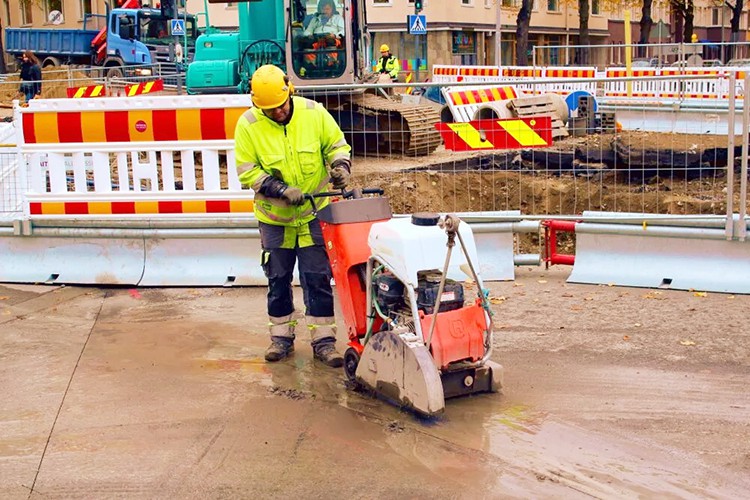
1, before starting, should check the motor, cable is normal, protective grounding, protective devices, saw blade is in line with the requirements, the installation is correct.
2, after the start, the first no-load operation, check the direction of running saw blade, lift is flexible, the operation is abnormal, all normal, before operation.
3, the cutting thickness should not exceed the machinery factory regulations.
4, to prevent the card saw blade, rope saw and so on.
5, concrete cutting operations, there are abnormal sound, should immediately stop checking, troubleshooting, before they can continue to operate.
6, the size of the cut concrete block should be strictly calculated.
7, after work, should clean the fuselage, wipe the saw blade rope saw, drain the water tank to recover the cable, and stored in a dry, ventilated place.
Thanks to All the Friends Who Support and Trust Shandong Vanse Machinery Technology Co., Ltd.
If you want to know more about Shandong Vanse Machinery Technology Co., Ltd. or have any questions, please feel free to contact us:
Our Factory
Shandong Vanse Machinery Technology Co., Ltd.








Share this article

About the Author: Shandong Vanse Machinery Technology Co., Ltd.
Shandong Vanse Machinery Technology Co., Ltd. is a high-tech manufacturer specializing in concrete construction machinery, including laser screeds and related equipment. The company integrates R&D, production, and global sales, with products exported to over 60 countries and widely used in infrastructure projects worldwide.
Previous Post
Next Post
Related Articles
You Might Also Like
What effect will improper adjustment of the power trowel blade angle have on the concrete surface?
If the blade angle is too large, the blade will cut into the concrete surface excessively when the trowel is running, resulting in scratches of varying depths on the concrete surface, making it difficult to form a flat surface. If the blade angle is too small, the contact area between the blade and the concrete surface is too large, and the pressure is insufficient, so that the unevenness of the concrete surface cannot be effectively smoothed, making the concrete surface flatness fail to meet the requirements. When the blade angle is not appropriate, such as a slightly large angle, the blade cannot evenly squeeze and smooth the concrete surface during the troweling process, which will cause uneven distribution of cement slurry on the surface. In some places, the cement slurry is excessively scraped away, and in some places, too much is retained, thereby affecting the surface finish and making the surface look rough and matte. If the angle is too small, the blade will not compact the concrete surface enough, and the pores on the surface cannot be effectively filled and closed, which will also reduce the surface finish of the concrete. Improper blade angle adjustment will cause the trowel to exert uneven force on the concrete surface during operation. If the angle is too large, the scraping force of the blade will be too strong, which will easily leave obvious marks on the concrete surface. In severe cases, excessive scraping may cause micro cracks on the concrete surface. Uneven force caused by inappropriate angles may also cause inconsistent shrinkage in different parts of the concrete surface, which in turn causes surface cracks and affects the durability and aesthetics of the concrete structure. Due to improper blade angles, the compaction degree of the concrete surface is different during the troweling process, which will lead to differences in the density of different areas of the concrete surface. For example, in areas with too large angles, the concrete is over-extended and the surface is too dense, while in areas with smaller angles, the concrete density is insufficient, which makes the strength distribution of the concrete surface uneven, reducing the overall quality and performance of the concrete.Welfare! Four steps to clean the laser leveler
With the addition of concrete laser leveling machines in the construction industry and road construction, both quality and speed have been improved, and users have saved a lot of costs. However, in the face of high-frequency use, users cannot ignore the cleaning of the equipment. This step must not be sloppy. Let's take a look at the steps of cleaning the leveling machine! 1. The liquid crystal surface on the body of the laser leveling machine also needs to be cleaned. You can use organic resin or lens cleaning cloth to wipe the dirt. If there is too much dirt, you can use lens cleaning fluid to remove it. 2. There will be a lot of dust and mud on the laser leveling machine after construction. First, wipe the dust on the laser leveling machine clean, and wipe the dirt and oil stains with thin paper or cotton cloth. 3. If the laser signal is lost during the construction of the laser leveling machine, the machine needs to be restarted, and the interval time needs to be more than ten seconds. 4. If there are too many stains, you can soak a soft cloth in water diluted with a neutral detergent, wring it out and wash it. The best laser leveling machine manufacturers remind everyone not to use volatile oil, thinner, gasoline and other chemicals for cleaning and wiping. The laser leveling machine uses a scraper to take away the raised concrete and initially scrape it flat to reach the design elevation. The hydraulically driven vibration motor produces vibrations at a frequency of 4000 times/minute, driving the entire vibration plate to vibrate the concrete together. The laser paver does not need to pull a control line or support a side template to control the ground elevation. Instead, it is controlled in real time by the laser measurement and control system on the laser leveling machine. As long as the laser transmitter is not disturbed, no matter where the laser leveling machine moves, it can ensure that the overall elevation of the paved ground is not affected. The concrete floor laser leveling machine is a construction machine that spreads the mixed concrete along the roadbed according to the given thickness, width and road type requirements, and then completes the paving of the concrete road through vibration, leveling and polishing procedures. The working device of the concrete floor laser leveling machine generally consists of a distributor, a scraper, a vibrator (including a vibrator and a vibrator), a leveler, a trowel and other devices. At the same time, it also requires the organic coordination of the frame, the walking mechanism, the operating control system and some other auxiliary mechanisms. Some models integrate all the devices into one, and some are divided into two or more independent units.Concrete laser leveling machine market situation and development trends
1. Market Overview The concrete laser leveling machine market is in a stage of rapid development. With the prosperity of infrastructure construction and the real estate market, the requirements for concrete construction quality are getting higher and higher. As an efficient and high-precision construction equipment market, the concrete laser leveling machine market Demand continues to grow. 2. Competitive Landscape At present, the concrete laser leveling machine market is showing fierce competition among domestic and foreign brands. Domestic brands have advantages in price and service, while foreign brands have advantages in technology and brand influence. In the future, with the continuous advancement of technology and the gradual maturity of the market, competition will become more intense. 3. Product innovation In order to meet the changing market demand, manufacturers of compacted soil laser leveling machines continue to innovate products. In the future, product innovation will continue to be an important driving force for market development. The main directions include improving leveling accuracy, increasing automation, and optimizing the human-machine interface. 4. User needs Users' demands for concrete laser leveling machines are increasingly diversified. They not only pay attention to the leveling effect and efficiency of the equipment, but also pay attention to the reliability, ease of use and after-sales service of the equipment. Manufacturers should actively understand user needs, strengthen communication with users, and continuously optimize products and services. 5. Technological progress With the continuous development of laser technology and computer technology, the technical level of concrete laser leveling machines continues to improve. In the future, technological progress will continue to drive market development, including improving equipment accuracy, increasing equipment functions, and reducing energy consumption. 6. Policy Impact The government's emphasis on infrastructure construction and environmental protection continues to increase, and the introduction of relevant policies will have an impact on the concrete laser leveling machine market. Manufacturers should pay attention to policy trends, strengthen communication and cooperation with the government, and seize market opportunities. 7. Future Outlook In the future, the concrete laser leveling machine market will continue to maintain steady growth. With the intensification of market competition and technological advancement, the market will gradually mature. Manufacturers should increase investment in R&D to improve product competitiveness, while focusing on environmental protection and energy-saving design to meet market demand and policy requirements. 8. Industry Challenges The concrete laser leveling machine industry faces some challenges, such as technical bottlenecks, high costs, and talent shortages. Manufacturers should actively respond to challenges, strengthen technology research and development and talent training, and improve production efficiency and service quality. At the same time, the industry should strengthen cooperation and exchanges to jointly promote industry development. 9. International Market With the continuous development of global infrastructure construction and the strengthening of technical exchanges, the demand for concrete laser leveling machines in the international market is also growing. Domestic manufacturers should actively explore international markets and increase brand awareness and influence. In the international market, attention should be paid to local market demands and policy environments, and cooperation and communication with local customers should be strengthened. At the same time, it is also necessary to strengthen the internationalization and localization design of products to better adapt to the market needs of different countries and regions.