Technical Knowledge
Manual leveling VS laser leveling—Which is better for large concrete floors?
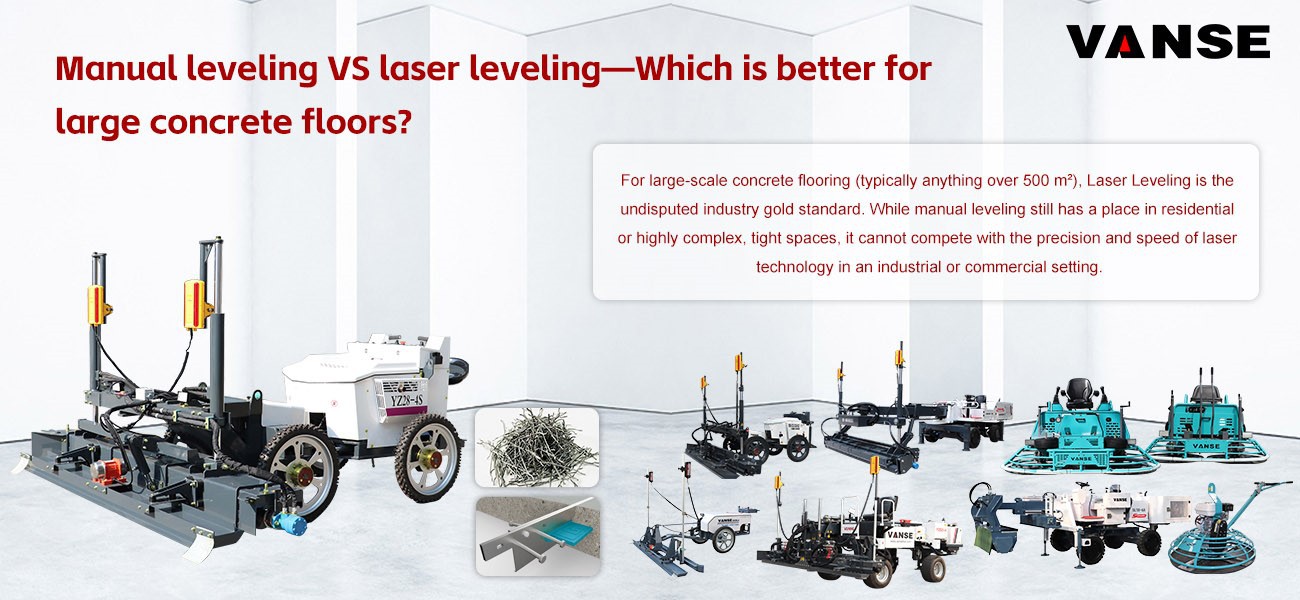
For large-scale concrete flooring (typically anything over 500 m²), Laser Leveling is the undisputed industry gold standard. While manual leveling still has a place in residential or highly complex, tight spaces, it cannot compete with the precision and speed of laser technology in an industrial or commercial setting.
Here is a detailed breakdown of how they compare across critical performance metrics:
1. Technical Performance Comparison
Objective: To prevent problems before they occur and promptly identify potential issues through daily observation.
| Feature | Manual Leveling (Traditional) | Laser Leveling (Automated) |
| Accuracy (FF / FL) | Low to Moderate (FF 20-35) | High to Ultra-High (FF 50-100+) |
| Daily Output | ~300–500 ㎡ | 1,500–3,000+ ㎡ |
| Labor Intensity | Extremely high (8-12 people) | Moderate (3-5 people) |
| Joint Frequency | Many construction joints (every 4-6m) | Fewer joints (large pour strips) |
| Consistency | Highly dependent on worker fatigue | Machine-consistent precision |
2. Why Laser Leveling Wins for Large Floors
A. Precision & "Superflat" Capabilities
Laser Levelings receive a signal from a stationary transmitter 300 times per minute. This real-time hydraulic adjustment ensures the floor is leveled to within millimeters.
Manual Downside: Humans using straightedges naturally create "waves" as they get tired, leading to poor FF (Flatness) scores.
B. Structural Integrity (Fewer Joints)
In large floors, joints are the "weakest link"-they are where cracks start and forklift tires wear out.
Laser: Allows for large-area pours (e.g., 2,000 ㎡ in one go), significantly reducing the number of construction joints.
Manual: Requires "form-to-form" pouring in narrow strips, creating a grid of joints that increases maintenance costs.
C. Concrete Density & Compaction
Laser Levelings use high-frequency vibration (usually 3,000–4,000 rpm) integrated into the leveling head.
This ensures the concrete is uniformly compacted from bottom to top. Manual tamping often leaves air pockets or inconsistent density, especially in thicker slabs.
3. When Manual Leveling is Actually "Better"
Despite the superiority of lasers, manual methods are preferred in these specific scenarios:
Highly Congested Areas: Floors with hundreds of vertical penetrations (pipes, columns, or drains) where a machine cannot maneuver.
Sloped Drainage: While 3D laser systems can handle slopes, simple manual Leveling is often more cost-effective for small wash-down areas with complex multi-directional falls.
Low-Budget/Small Scale: For a small garage or a space under 200 ㎡, the mobilization cost of a laser Leveling is rarely justifiable.
4. Economic Analysis: The "Hidden" Savings
While a laser Leveling has a higher daily rental/operation cost, it is usually cheaper per square meter on large projects because:
Reduced Labor: You need fewer skilled finishers.
Faster Schedule: You can finish a 10,000 ㎡ warehouse in 4-5 days instead of 20 days.
Lower Material Waste: Precision leveling prevents "over-pouring" (lowering concrete waste by 3-5%).
The Verdict
For a warehouse, hangar, or factory floor, Laser Leveling is mandatory. Manual leveling in these environments is a liability that leads to poor floor performance and high long-term maintenance costs.
Would you like me to help you calculate the estimated "Time vs. Cost" savings for a specific floor area you are planning? Contact us NOW
Note: The parameters provided in this document are for reference only and are not mandatory. Due to differences in technical characteristics between different brands and models of laser levelers, please consult the manufacturer for a suitable solution before actual operation. This reference document assumes no responsibility for any issues arising from failure to follow the manufacturer's instructions.
Thanks to All the Friends Who Support and Trust Shandong Vanse Machinery Technology Co., Ltd.
If you want to know more about Shandong Vanse Machinery Technology Co., Ltd. or have any questions, please feel free to contact us:
Our Factory
Shandong Vanse Machinery Technology Co., Ltd.








Share this article

About the Author: Shandong Vanse Machinery Technology Co., Ltd.
Shandong Vanse Machinery Technology Co., Ltd. is a high-tech manufacturer specializing in concrete construction machinery, including laser screeds and related equipment. The company integrates R&D, production, and global sales, with products exported to over 60 countries and widely used in infrastructure projects worldwide.
Previous Post
Next Post
Related Articles
You Might Also Like
Is there a direct relationship between the power of the trowel machine and the trowel effect?
– Trowels with higher power are usually more powerful. For example, in the concrete floor construction of large-scale construction projects, if a driving trowel with higher power (such as 5.5kW – 7.5kW) is used, its motor can provide enough torque to rotate the trowel blade at a higher speed. In this way, when facing a large area of rough ground, the unevenness of the concrete surface can be quickly smoothed, effectively improving work efficiency. – A high-power trowel has more advantages when dealing with thicker concrete surfaces or ground materials with a certain hardness. Because it can more easily overcome resistance, cut the trowel blade into the material surface to a certain depth, compact and smooth the material, and make the ground smoother. – High-power trowels may have better speed stability. Due to its sufficient power, the speed of the trowel blade can be kept relatively stable during operation, even if the local hardness of the ground changes or it is uneven. This helps to achieve a more uniform trowel effect. For example, when troweling the floor of an industrial plant, a high-power trowel can better deal with the small potholes and bumps that may exist on the ground, making the troweled ground more uniform in gloss and flatness. – The material and design of the trowel blade are crucial to the trowel effect. For example, the use of high-quality alloy steel trowel blades has better hardness and wear resistance. Driven by a trowel of the same power, this trowel blade can better smooth the ground and has a longer service life. – Different types of trowel blades are suitable for different ground materials and construction requirements. For example, for indoor floors with high precision requirements, a trowel blade with fine texture may be required. This trowel blade can achieve a delicate trowel effect at a lower power through its special texture design. – The operator's proficiency in operating the trowel will affect the trowel effect. An experienced operator can reasonably control the trowel's walking speed, trowel angle and other parameters according to the actual situation of the ground. Even if a trowel with a smaller power is used, a better trowel effect can be obtained through reasonable operation, such as multiple cross trowels. – The operator's control over the construction process is also very important. For example, the use requirements of the trowel are different in the initial setting stage and the final setting stage after concrete pouring. If the operator can accurately grasp the timing and choose the appropriate power and trowel method, the ideal trowel effect can be achieved. – The initial flatness and material quality of the ground have a great influence on the trowel effect. If the ground itself is seriously uneven, such as large cracks, potholes or local looseness caused by unreasonable concrete material ratio, then relying solely on the power of the trowel will not be able to obtain a good trowel effect. In this case, the ground foundation needs to be repaired first, and then the trowel is used for troweling.Concrete laser leveling machine operation method
1. Preparation before operation of concrete laser leveling machine Before operating the concrete laser leveling, a series of preparations are required. First, you need to check whether all parts of the laser leveling machine are intact, including the engine, laser transmitter, scraper, etc. At the same time, you need to ensure that the power supply of the laser leveling machine is sufficient and the cables are intact. In addition, you need to prepare the required tools and materials, such as levels, elevation lines, sandpaper, etc. 2. Installation and debugging of laser leveling machine When installing the laser leveling machine, you need to follow the instructions. First, you need to place the laser leveler on a flat ground and make sure it is stable. Then, you need to connect the cables and check that the engine and laser transmitter are working properly. When debugging, the angle and height of the laser transmitter need to be adjusted to ensure that it can correctly scan the concrete surface. At the same time, the pressure and angle of the scraper also need to be adjusted to ensure a good scraping effect. 3. Operation process of laser leveling machine When operating a laser leveling machine, you need to follow a certain process. First, the concrete surface needs to be cleaned and elevation lines marked. Then, you need to start the laser leveling machine and adjust various parameters. Next, you need to use a scraper to smooth the concrete surface and use a level to check the flatness. If any uneven areas are found, they need to be re-scraped and inspected again. Finally, the surface needs to be sanded down to improve its finish. 4. Maintenance and maintenance of laser leveling machine In order to maintain the good working condition of the laser leveling machine, regular maintenance and upkeep is required. First of all, the laser emitter and scraper need to be cleaned regularly to avoid the impact of debris and dirt. At the same time, it is necessary to regularly check whether components such as cables and engines are working properly. If damage or aging is found, it needs to be replaced or repaired in time. In addition, critical parts need to be lubricated regularly to reduce friction and wear. 5. Common faults and troubleshooting methods of laser leveling machines During use, some common faults may occur with laser leveling machines. For example, the engine cannot start, the laser transmitter fails, the scraper does not scrape the compacted soil surface, etc. These faults need to be analyzed and dealt with based on specific circumstances. For example, if the engine fails to start, you may need to check whether the cables and the engine itself are working properly; if the laser transmitter fails, you may need to adjust its angle or height. In addition, equipment needs to be inspected and maintained regularly to prevent potential problems. 6. Safety precautions for laser leveling machines When using a laser leveler, you need to pay attention to safety issues. First of all, you need to ensure that the power cord is safe and reliable to avoid electric shock accidents. At the same time, it is necessary to wear protective glasses and other personal protective equipment during the operation to avoid damage to the eyes and other parts caused by splashed concrete and other debris. In addition, when handling and moving the laser leveling machine, you need to operate with caution to avoid accidents. 7. Sharing of skills and experience in using laser leveling machine When using a laser leveler, mastering some skills and experience can help improve work efficiency and quality. For example, when scraping the surface of compacted soil, you need to master the pressure and angle of the scraper: when adjusting the laser transmitter, you need to follow the principle of "first the whole and then the part"; when polishing the surface, you need to pay attention to the choice of sandpaper and Instructions. At the same time, experience can be continuously accumulated during use and adjustments can be made to better adapt to various working conditions and improve project quality. 8. Economic and cost-effective evaluation As a modern concrete construction equipment, laser leveling machine has significant economic and cost-effective advantages. Firstly, compared with the traditional manual smoothing method, using laser leveling machine can greatly improve work efficiency and reduce labor costs. Secondly, laser leveling machine has Better durability and stability reduce the cost of repair and maintenance. Finally, in the long run, using a laser leveler can improve the quality of the T process and reduce the cost of later maintenance and rework. Therefore, from the perspective of economy and cost-effectiveness, using concrete laser leveling machine Flat machines have higher value. 9. Precautions during concrete construction When using concrete for construction, you need to pay attention to the following points. First, you need to choose the appropriate cement variety and proportion to ensure the strength and quality of the concrete. Second, you need to control the mixing and transportation of concrete during the construction process to avoid segregation and initial setting. At the same time, it is also necessary to pay attention to the temperature and humidity control during construction to avoid problems such as shrinkage and cracking. Finally, adequate maintenance is required after the pouring is completed to ensure the quality of the mixer. 10. Relevant laws, regulations and standards When using concrete laser leveling machines, you need to comply with relevant laws, regulations and standards to ensure safety and quality. National and local laws and regulations on construction site safety management have clear provisions on the use and management of construction equipment. At the same time, during construction The technical requirements and operating procedures of laser leveling machines are stipulated in detail in the industry's standards and specifications for construction equipment and technology. Therefore, when using concrete laser leveling machines, you need to carefully study and abide by relevant laws, regulations and standards to ensure safety and quality. .What are the applicable scopes of concrete trowels?
Concrete trowel is a kind of equipment specially used for concrete surface treatment. It is widely used in various construction sites, municipal roads, factory warehouses, park roads, community roads, rural streets and other fields. It can perform rough and fine troweling on concrete floors, and has functions such as slurry lifting, compaction, smoothing, and troweling. It is one of the indispensable equipment in modern building construction. ★★★★. Scope of application 1.Construction site In construction sites, concrete troweling machines are mainly used for construction on floors, roofs, outdoor floors and other occasions where troweling is required. By using a concrete trowel, you can greatly improve work efficiency, shorten the construction period, reduce project costs, and ensure project quality. 2. Municipal roads Municipal roads are one of the most widely used areas for concrete trowels. In urban planning, road construction, bridge construction and other projects, the road surface needs to be polished to improve the wear resistance and skid resistance of the road surface and ensure traffic safety. 3. Factory warehouse Factory warehouse is one of the important places where concrete trowel machine is used. In the industrial field, the ground needs to be polished to improve the wear resistance and slip resistance of the ground, and the ground also needs to be leveled to meet the requirements of the production process. 4. Park Road Park roads are one of the important places where concrete trowels are used. In parks, the ground in public places such as walking paths, parking lots, and squares needs to be polished to improve the appearance and comfort of the ground. 5. Community streets Community streets are one of the important places where concrete trowels are used. In residential areas, the floors in public places such as roads and squares need to be polished to improve the aesthetics and comfort of the floors. At the same time, local ground needs to be leveled to meet the living needs of residents. ★★★★. Applicable objects Concrete trowels are suitable for a wide range of applications, including but not limited to the following: 1.Construction Developer Construction developers need to polish the ground during the construction process to improve the overall quality and aesthetics of the house. Using a concrete trowel can greatly improve work efficiency and reduce costs. 2. Property management company Property management companies need to perform routine maintenance and upkeep on the floors of the properties under their jurisdiction. Using a concrete trowel machine can quickly and accurately trowel the ground, improving the service life and aesthetics of the ground. 3.Building construction unit The construction unit needs to polish the ground during construction. Using a concrete trowel can improve work efficiency, shorten the construction period, and ensure project quality. 4. Municipal management department Municipal administrations need to maintain and maintain city roads. The concrete troweling machine can be used to quickly and accurately trowel urban roads, improving the service life and safety of the roads. 5. Public Administration Office The Park Service is required to maintain and maintain park roads. The concrete troweling machine can be used to quickly and accurately trowel park roads, improving the service life and aesthetics of the road. In short, the scope of application of concrete troweling machines is very wide. Whether it is high-standard factories, warehouses, parking lots, squares, airports and other tall buildings, or ordinary civil buildings and road construction, compact soil troweling machines can be used. construction. At the same time, due to its excellent treatment effect on the surface of concrete, it is also widely used in bridge construction and other fields.