Technical Knowledge
Optimization of the construction sequence for concrete laser leveling machines, spreading machines, and troweling machines
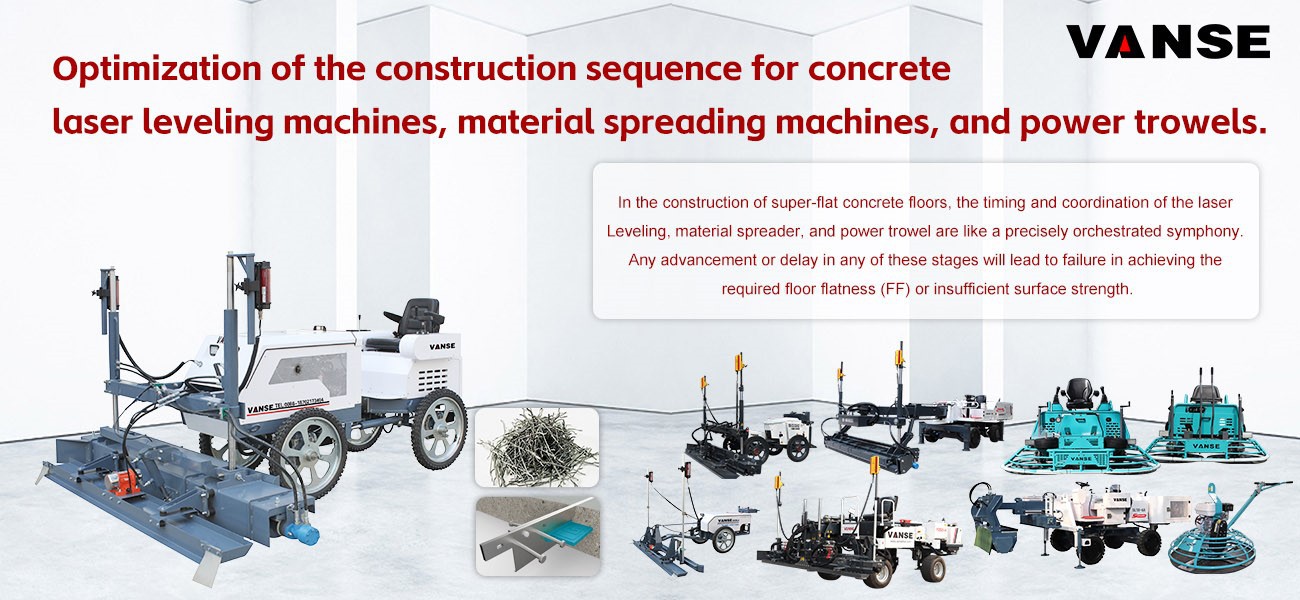
In the construction of super-flat concrete floors, the timing and coordination of the laser Leveling, material spreader, and power trowel are like a precisely orchestrated symphony. Any advancement or delay in any of these stages will lead to failure in achieving the required floor flatness (FF) or insufficient surface strength.
The following is an optimized construction sequence plan for large-area super-flat concrete floor construction:
1. Core Timing Flowchart
The core logic of the construction process is to drive equipment deployment based on the setting state (degree of hardening) of the concrete.
| Stages | Core Equipment | Timing for application | Construction Objectives |
| 1. Spreading and leveling | Laser Leveling machine | When the concrete slump is maintained at the design value; | To achieve high-precision initial leveling and compaction through vibration. |
| 2. Water drainage treatment | Rubber squeegee/slurry roller | 0.5 – 1 hour after leveling; | To remove surface bleeding water and prevent subsequent peeling. |
| 3. Aggregate spreading | Automatic material spreader | When a person's footprint leaves an indentation of approximately 5mm; | To evenly cover the surface with hardening aggregates, ensuring the thickness of the wear-resistant layer. |
| 4. Rough troweling and slurry application | Ride-on power trowel (disc type) | After the dry-shake material has been applied and absorbed moisture, turning darker; | To press the wear-resistant material into the base layer, achieving mechanical bonding. |
| 5. Fine troweling and finishing | Ride-on power trowel (blade type) | When the surface has initially set and a person's footprint leaves only a shallow mark. | To improve surface density, gloss, and flatness. |
2. Optimization Strategies for Each Stage
A. Laser Leveling: Seizing the "Golden Paving Period"
Optimization Key Points: Laser Leveling must be completed within 30-45 minutes after concrete unloading.
Key Actions:
Path Planning: Use an "S" shape or a horizontal and vertical intersecting path to ensure smooth transitions at overlapping areas. Frequency Monitoring: The vibration frequency should be adjusted according to the concrete consistency to avoid over-vibration, which can lead to aggregate settling and excessive mortar thickness.
B. Automatic Spreading Machine: Balancing Uniformity and Timing
Optimization Points: Manual spreading is strictly prohibited. The automatic spreading machine should be deployed during the "window period" after laser leveling.
Key Actions:
Staged Spreading: A 2+1 mode is recommended (i.e., spreading 60-70% first, then spreading the remaining portion after leveling).Speed Synchronization: The spreading speed must match the troweling speed of the power trowel to prevent the initially spread material from drying out too quickly and failing to bond with the base layer.
C. Power Trowel: Step-by-Step Pressure Management
Optimization Points: Power troweling is not a one-time process, but rather a multi-stage process involving varying speeds and angles.
Key Actions:
Disc Stage: Low speed, large area troweling to bring up the slurry and eliminate the small ripples left by laser leveling.
Blade Stage: As the concrete hardens, gradually increase the blade angle and rotational speed.
Cross-Directional Operation: Each pass of troweling should be perpendicular to the previous pass; this is the core technique for improving the FF value.
3. Troubleshooting Guide to Avoiding "Timing Conflicts"
Preventing "material waiting" cracks: The concrete mixing plant's supply speed must be greater than the paving speed of the laser Leveling (usually recommended at 40-60 m³/h). If the Leveling stops working for more than 1 hour waiting for materials, cold joints are highly likely to occur at the joints.
Avoiding "forced finishing": If the ambient temperature is too high, causing rapid surface dehydration (false setting), direct watering for finishing is strictly prohibited. A special spray additive should be used; otherwise, the surface hardness will decrease significantly.
Equipment Configuration Optimization: * 1 laser Leveling (medium-sized)
Requires 1 automatic material spreader
Requires 3-4 ride-on double-disc power trowels (to ensure full coverage before large-area hardening).
4. Digital-Assisted Solutions
To achieve the ultimate ultra-flat surface, it is recommended to incorporate laser scanning verification into the construction sequence:
Before the final finishing pass with the power trowel, use a laser scanner to generate a heat map. Focus on grinding down the red areas (high points) and avoid the green areas (low points) as much as possible.
Would you like me to prepare a table outlining adjustments to the construction sequence for different temperature environments (summer VS winter)? Contact us NOW
Note: The parameters provided in this document are for reference only and are not mandatory. Due to differences in technical characteristics between different brands and models of laser levelers, please consult the manufacturer for a suitable solution before actual operation. This reference document assumes no responsibility for any issues arising from failure to follow the manufacturer's instructions.
Thanks to All the Friends Who Support and Trust Shandong Vanse Machinery Technology Co., Ltd.
If you want to know more about Shandong Vanse Machinery Technology Co., Ltd. or have any questions, please feel free to contact us:
Our Factory
Shandong Vanse Machinery Technology Co., Ltd.








Share this article

About the Author: Shandong Vanse Machinery Technology Co., Ltd.
Shandong Vanse Machinery Technology Co., Ltd. is a high-tech manufacturer specializing in concrete construction machinery, including laser screeds and related equipment. The company integrates R&D, production, and global sales, with products exported to over 60 countries and widely used in infrastructure projects worldwide.
Previous Post
Next Post
Related Articles
You Might Also Like
Techniques for Using a Power Trowel in Colored Concrete Flooring
The biggest challenge in using a power trowel in colored concrete (such as colored reinforced concrete, stamped concrete, or monolithic colored concrete) is avoiding color variations (patchy finish), trowel burn, and surface cracking. Because the pigments are extremely sensitive to moisture and pressure, more delicate operating techniques are required: **Strictly Prohibited:** Never spray water onto the surface during the polishing process to make it easier to spread. Water will dilute the surface pigments, causing the color to lighten or resulting in efflorescence (whitening). If the surface dries too quickly, use a dedicated evaporative retarder. **Spinning Speed Control:** On colored flooring, low to medium speed is recommended. High-speed rotation generates high temperatures, which can easily cause chemical reactions or physical "burning" of the surface metal oxide pigments, resulting in a blackening of the color. **Plastic Blades (Critical):** For extremely high color consistency, it is recommended to replace the steel blades with **plastic blades** or blades with plastic protective covers. The black metal shavings produced by the friction between the steel blades and the concrete are the main cause of the "darkening" or blackening of colored flooring. First Coat Application: After applying the first coat of pigment, use a power trowel with a **float pan** attached to it at low speed to rub the pigment into the grout. Avoid Over-Rubbing: The purpose of this step is to allow the pigment to absorb moisture from the grout and darken, not to completely polish it. Over-rubbing will lift the underlying gray concrete grout, contaminating the color. Consistent Angle: When working in the same area, the blade angle must be consistent. A larger blade angle results in greater localized pressure, leading to a darker color. Same Direction of Work: Maintain a consistent finishing direction as much as possible. Cutting lines in different directions will create visual color differences under light. Control the Number of Finishing Coats: Compared to ordinary flooring, colored flooring should have fewer finishing coats. More coats result in a denser surface, increasing the risk of "scorching" and discoloration. Power Trowel Finish: For stamped concrete, the power trowel operation ends before the release powder is applied. Required Finish: The power trowel must achieve a smooth but not glossy surface. If the surface is too glossy or too matte, the release powder will not adhere properly, and the stamped texture will appear stiff and unnatural. Fault Symptoms Possible causes Solutions Burn marks High temperature generated by high-speed friction of steel blades Reducing the speed and replacing the blades with plastic ones. Blotchy Uneven water spraying or slurry distribution during troweling Strictly prohibiting water spraying and increasing the initial disc leveling time. Efflorescence Excessive water-cement ratio or premature troweling Strictly controlling the slump and waiting for the seepage to completely disappear. Exposure Trelmmer cutting too deep, removing the color layer Lowering the blade angle to reduce machine weight. Note: The parameters provided in this document are for reference only and are not mandatory. Due to differences in technical characteristics between different brands and models of laser levelers, please consult the manufacturer for a suitable solution before actual operation. This reference document assumes no responsibility for any issues arising from failure to follow the manufacturer's instructions.Automatic obstacle avoidance capability of concrete laser leveling machines
The term "automatic obstacle avoidance" for concrete laser leveling machines, including those from Vanse Machinery, generally refers to operator-aided maneuverability enabled by advanced machine design, rather than fully autonomous sensing and navigation technology. Vanse machinery utilizes several design features, particularly in their advanced telescopic boom models (like the YZ40-4E), that significantly help the operator avoid obstacles and work in complex environments: The primary method for "obstacle avoidance" with Vanse machines relies on operator control enhanced by the machine's flexible design. Feature: Vanse's boom-type machines (e.g., YZ40-4E, YZ30-4E) feature a body that can rotate infinitely (360 degrees). Benefit for Obstacle Avoidance: This high degree of agility means the operator can easily reposition the leveling head and boom around columns, existing walls, or complex boundaries without needing to move the entire chassis. This greatly reduces the non-levelinged area that must be finished manually. Feature: Larger ride-on models often include Two-wheel, Four-wheel, and Crab Steering modes. Benefit for Obstacle Avoidance: These multiple steering modes allow the operator to navigate the chassis in tight spaces and around perimeter forms with greater precision than a traditional fixed-steering vehicle. Crab steering, for instance, allows for lateral movement, which is helpful when parallel-parking next to a wall. Primary Reliance: Like most laser leveling, the ultimate obstacle avoidance is performed by the trained operator. Vanse's documentation emphasizes preliminary survey and path optimization using 3D modeling to mark obstacle locations (rebar, pipes, etc.). Procedure: The operator is trained to deliberately circumvent obstacles by 10-15 cm and then manually compensate and level the blocked-out area using small vibrators and a straightedge to ensure a smooth connection to the machine-levelinged area. It's important to clarify that the "automatic" functions on Vanse machines focus on: Automatic Leveling: Using the laser receiver and microcomputer control system to automatically adjust the leveling head height to a precision of ±1.5mm (or better) across the pour. Automatic Body Leveling: Some models offer "One-click leveling of the body" to handle various complex road surfaces before leveling begins. Vanse laser leveling machines do not currently advertise a system of autonomous obstacle sensing (using sensors or radar) that automatically stops or steers the machine away from an object. Instead, they provide superior mechanical flexibility (360° boom, multi-mode steering) to empower the human operator to efficiently navigate around complex obstacles. Would you like to know more about the different types of Vanse laser leveling machines (Walk-behind, Four-wheel ride-on, Boom) and which are best suited for areas with many obstacles? Note: The parameters provided in this document are for reference only and are not mandatory. Due to differences in technical characteristics between different brands and models of laser levelers, please consult the manufacturer for a suitable solution before actual operation. This reference document assumes no responsibility for any issues arising from failure to follow the manufacturer's instructions.How to avoid excessive wear and damage to equipment when dealing with uneven floors?
When dealing with uneven floors, in order to avoid excessive wear or damage to the equipment, the following measures can be taken: 1. Understand the ground conditions: Before dealing with uneven floors, you should fully understand the ground conditions, including the hardness of the ground, the size and distribution of particles, and whether the ground is wet. This information helps select appropriate equipment and operating parameters to ensure that the equipment can withstand uneven ground conditions. 2. Choose appropriate equipment: According to the ground conditions and construction requirements, choose equipment that can handle uneven ground. For very uneven floors, you can choose more sturdy and durable equipment, or use some specially designed equipment to reduce the risk of equipment wear and damage. 3. Adjust working parameters: When using equipment to deal with uneven ground, the working parameters, such as pressure, speed and working time, should be adjusted in a timely manner. Appropriate parameters can reduce the friction and impact between the equipment and the ground, thereby reducing equipment wear and damage. 4. Control the operating speed of the equipment: When dealing with uneven ground, the operating speed of the equipment should be controlled. A slower speed can reduce the relative movement speed of the equipment and the ground, reducing the impact and wear on the equipment. At the same time, avoid running the equipment continuously for a long time to avoid overheating or excessive wear of the equipment. 5. Regular maintenance: In order to ensure the normal operation of the equipment and extend its service life, the equipment should be maintained regularly. This includes checking the worn parts of the equipment, lubricating key parts, replacing wearing parts, etc. Regular maintenance can detect and solve potential problems in time and avoid serious wear or damage to equipment when dealing with uneven floors. 6. Operator training: Operators should undergo professional training and be familiar with the operating procedures and usage techniques of the equipment. Operators should have basic equipment maintenance knowledge and safety awareness, be able to correctly respond to equipment problems, and take appropriate measures to avoid excessive wear or damage to equipment. 7. Pay attention to safety: When dealing with uneven floors, special attention should be paid to safety issues. The equipment may become unbalanced or tip over when walking on uneven ground, causing equipment damage or personal injury. Therefore, operators should always remain alert and take necessary safety measures to ensure the safety of the construction process. By understanding the ground conditions, selecting appropriate equipment, adjusting working parameters, controlling equipment operating speed, performing regular maintenance, training operators, and paying attention to safety measures, excessive wear or damage to equipment can be effectively avoided when dealing with uneven ground.