Technical Knowledge
Dust Control and Environmental Protection Measures in Concrete Spreader Construction
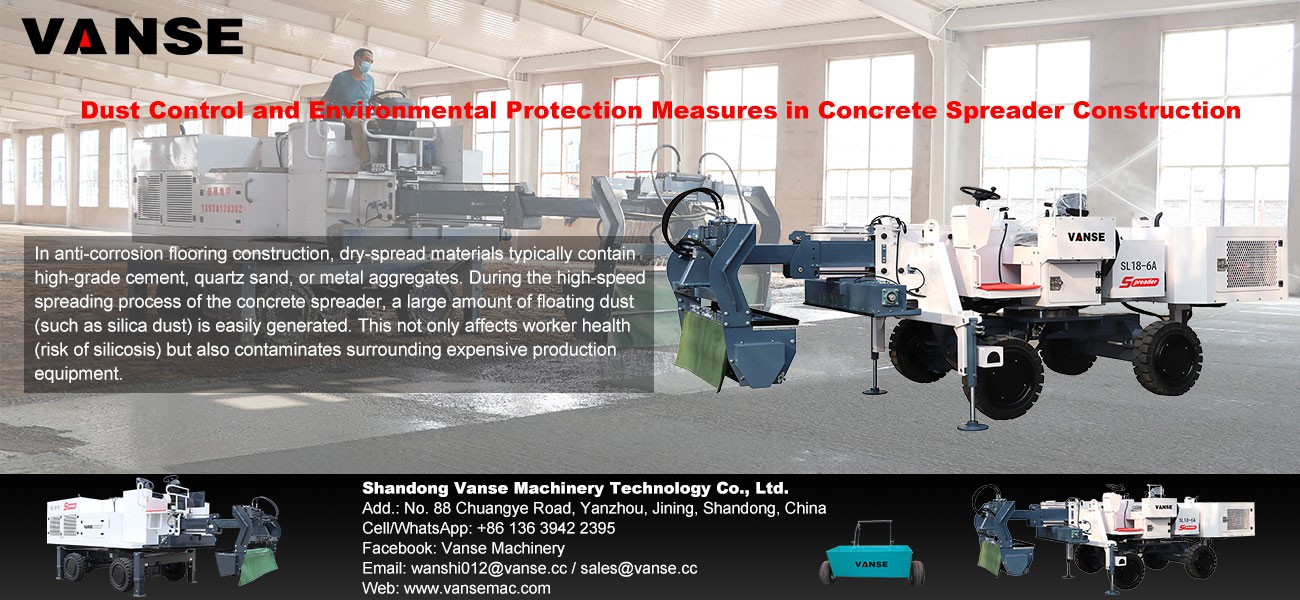
In anti-corrosion flooring construction, dry-spread materials typically contain high-grade cement, quartz sand, or metal aggregates. During the high-speed spreading process of the concrete spreader, a large amount of floating dust (such as silica dust) is easily generated. This not only affects worker health (risk of silicosis) but also contaminates surrounding expensive production equipment.
The following are the mainstream dust control and environmental protection measures in concrete spreader construction:
1. Dust Suppression Design of the Concrete Spreader Itself
Modern automated concrete spreaders (especially ride-on or large laser-leveling spreaders) are designed with dust suppression in mind:
Enclosed Hopper: Changing the traditional manual throwing method, materials are stored in an enclosed hopper and discharged via a bottom screw conveyor or roller, greatly reducing the material's exposure time to air.
Windproof Enclosure/Soft Curtain: Anti-static rubber soft curtains are installed at the discharge port, as close as possible to the concrete surface (maintaining a distance of 10cm-15cm), confining dust to a very small local space.
Low-Level Discharge Technology: The spreader's boom has an adjustable height, allowing for "ground-hugging" discharge, reducing airflow disturbance caused by free fall of materials.
2. Comprehensive Environmental Protection Measures at the Construction Site
A. Humidity Control (Key Point)
Substrate Water Control: Strictly control the "water discharge" state of the concrete. Utilize the concrete's own seepage water to moisten freshly applied powder.
Environmental Humidification: Deploy mobile water mist fans or micro-mist dust suppression systems around the construction area.
Note: Water mist must not be sprayed directly onto unpainted concrete surfaces to avoid altering the local water-cement ratio and affecting corrosion resistance.
B. Vacuum Cleaning Assistance
Localized Vacuuming: For manual replenishment areas in corners, a high-grade industrial vacuum cleaner with a HEPA filter must be used for simultaneous vacuuming.
Collection and Disposal: Dry powder scattered along the spreader's path should be disposed of promptly to prevent it from being re-entered into the air due to the high-speed rotation of the power trowel.
3. Green Construction Management Standards
According to national and industry environmental protection requirements (such as the "Construction Site Environmental and Sanitary Standards"), the following operations must be performed:
| Measures Category | Specific Operational Procedures: | Objectives |
| Packaging Handling | Using large bags (ton bags) in conjunction with an automatic feeding machine is mandatory to reduce the instantaneous release of dust when opening small bags. | Reduce start-up dust by over 70% |
| Waste Management | Empty bags remaining after feeding must be immediately placed into sealed recycling bags; littering or burning is strictly prohibited. | Prevent secondary pollution |
| Personnel Protection | Construction personnel must wear P100/N95 dust masks and windproof goggles. | Protect occupational health and safety |
| Enclosed Construction | When working indoors, a negative pressure ventilation system must be established or a large centrifugal fan must be used to exhaust filtered air. | Prevent dust from spreading to other clean areas |
4. Special Environmental Requirements for Corrosion-Resistant Flooring
In the construction of acid-resistant, oil-resistant, and other special flooring materials, dry-spread mixes may contain special chemical additives:
Water Solubility Monitoring: It is strictly forbidden to spray excessive water directly after spreading the mix to reduce dust, as this will lead to the loss of effective anti-corrosion components and contaminate the on-site drainage system.
Material Selection: Pre-granulated dry-spread mixes should be given priority. These materials have low fly ash content, a heavy granular texture, and naturally generate less dust.
Next Steps
If you are undertaking renovations or refurbishments within a pharmaceutical, food, or precision electronics factory, dust control requirements are extremely stringent.
Would you like me to recommend a "clean-state" construction and coordination plan? Or are you preparing for an on-site inspection by the environmental protection bureau and require relevant compliance documentation?
Note: The parameters provided in this document are for reference only and are not mandatory. Due to differences in technical characteristics between different brands and models of laser levelers, please consult the manufacturer for a suitable solution before actual operation. This reference document assumes no responsibility for any issues arising from failure to follow the manufacturer's instructions.
Thanks to All the Friends Who Support and Trust Shandong Vanse Machinery Technology Co., Ltd.
If you want to know more about Shandong Vanse Machinery Technology Co., Ltd. or have any questions, please feel free to contact us:
Our Factory
Shandong Vanse Machinery Technology Co., Ltd.








Share this article

About the Author: Shandong Vanse Machinery Technology Co., Ltd.
Shandong Vanse Machinery Technology Co., Ltd. is a high-tech manufacturer specializing in concrete construction machinery, including laser screeds and related equipment. The company integrates R&D, production, and global sales, with products exported to over 60 countries and widely used in infrastructure projects worldwide.
Previous Post
Next Post
Related Articles
You Might Also Like
About the summer maintenance of laser leveling machine
As we all know, summer is the time of year when the temperature is particularly high. Like winter, laser leveling machines are used in harsh environments. If the maintenance is not in place, coupled with the high temperature, the laser leveling machine is likely to have various problems. Therefore, when using the laser leveling machine in summer, special attention should be paid to the maintenance and maintenance. So how should the laser leveling machine be maintained and maintained in summer? 1. In summer construction, the engine should be prevented from overheating first. Under normal circumstances, the engine temperature should not exceed 95°. If the temperature is too high, a relatively cool area should be selected for shutdown and cooling. At the same time, the engine hood can be lifted for ventilation and heat dissipation. 2. The cooling water volume should be checked in time. When the water radiator reaches 100°, do not rush to add cooling water. Instead, the engine should be shut down immediately to cool down the engine at idle speed, and then add coolant. 3. The construction temperature is high in summer. Check the tire pressure and tire temperature of the laser leveler frequently. If the tire temperature is too high, stop the machine in time and place it in a cool place to cool down. Remember to use the wrong method of deflation or pouring cold water to cool down. 4. Check the liquid level of the laser leveler battery frequently, add distilled water in time, dredge the vents, pay attention to the density of the electrolyte, and maintain a good charging state. 5. Prevent the laser leveler engine from deflagration. Before entering the summer, the carbon deposits in the combustion chamber, valve top and other parts should be thoroughly removed to maintain good heat dissipation and normal compression ratio; and check and adjust the fuel supply advance angle to prevent engine deflagration. 6. Check the temperature of the hydraulic oil and hydraulic transmission oil frequently. If the temperature is too high, stop the machine for rest. Do not exceed high temperature operation. 1. Quality. When choosing a laser leveler, you should pay attention to the quality. If the quality of the laser leveler is not good, problems may occur during work, which may delay the construction period and the loss is immeasurable. 2. Operation effect. When purchasing a laser leveler, you should conduct an on-site inspection. If it is inconvenient, you can ask the manufacturer to provide some photos for reference. 3. After-sales service. When purchasing a laser leveler, you should also pay attention to the after-sales service. When purchasing a laser leveler, you should identify regular and professional manufacturers, and verify the manufacturer's technical capabilities and after-sales service. Only regular manufacturers can guarantee the performance of the machine, solve problems in time when the machine has problems, and extend its service life. It can be seen that when using equipment in extreme weather, you must pay special attention to its maintenance content, so as to ensure the smooth operation of the equipment. After reading the above article, I hope that everyone will pay attention to the above points when maintaining the laser leveler in the future. Thank you for your reading and support.What is the impact of driving mechanical trowel construction on concrete strength?
Driving mechanical troweling construction is a technology widely used in concrete surface treatment. It replaces traditional manual troweling with mechanized operation, improving construction efficiency and surface quality. However, this construction method has a direct impact on the strength of concrete. The following is a detailed analysis of the impact of driving mechanical troweling construction on concrete strength. Introduction As the most commonly used structural material in the construction industry, the strength of concrete is a key factor in ensuring structural safety and durability. Driving mechanical troweling construction treats the concrete surface by mechanized means to achieve the required flatness and density. This article will explore the impact of this construction method on concrete strength. 1. Overview of driving mechanical troweling technology Driving mechanical troweling technology is a concrete surface treatment method with a high degree of automation. It uses mechanical troweling equipment to smooth and compact the concrete surface to improve the flatness and density of the concrete surface. 2. Definition and importance of concrete strength Concrete strength generally refers to the ability of concrete to resist pressure, tension and other external forces. The strength of concrete directly affects the bearing capacity and durability of the structure. 3. The positive impact of driving mechanical troweling on concrete strength – **Improving density**: Mechanical troweling can compact concrete more effectively and reduce internal pores, thereby improving the density and strength of concrete. – **Improving uniformity**: Mechanical troweling can distribute aggregates in concrete more evenly and avoid uneven strength caused by aggregate concentration. – **Reducing surface defects**: Mechanical troweling can reduce cracks and holes on the surface of concrete, which may become weaknesses that reduce strength. 4. Potential negative impact of driving mechanical troweling on concrete strength – **Over-troweling**: If the mechanical troweling process is not properly operated, the concrete surface may be over-smoothed, thereby weakening the strength of the concrete surface. – **Aggregate sinking**: Mechanical troweling may cause fine aggregates to sink and coarse aggregates to float. This uneven distribution of aggregates may affect the overall strength of concrete. – **Moisture migration**: During the troweling process, the moisture on the concrete surface may be excessively squeezed out, causing the concrete surface to dry, affecting the hydration reaction of cement, and thus affecting the strength. 5. Control of concrete strength during construction – **Select appropriate troweling time**: Concrete should be troweled after initial setting to avoid over-smoothing and aggregate sinking. – **Control the number and intensity of troweling**: Reasonably control the number and intensity of troweling to avoid negative impact on concrete strength. – **Maintain appropriate concrete workability**: Ensure that concrete has good workability to facilitate mechanical troweling and reduce the impact on strength. 6. Impact of construction environment on concrete strength – **Temperature and humidity**: The temperature and humidity of the construction environment will affect the coagulation and hardening process of concrete, thereby affecting the strength. – **Construction season**: Climate changes in different seasons have a significant impact on the strength of concrete, and corresponding construction measures need to be taken. 7. Professional skills of construction personnel – **Operation skills**: Construction personnel need to have professional operation skills to ensure the quality and efficiency of mechanical troweling construction. – **Experience judgment**: Experienced construction personnel can make correct construction decisions based on the state of concrete and the construction environment. 8. Conclusion Drive-type mechanical troweling construction has a direct impact on concrete strength. Through reasonable construction methods and strict construction control, the positive impact of mechanical troweling can be maximized while avoiding potential negative effects. The professional skills and experience of construction personnel are essential to ensure the strength of concrete. With the development of technology and the improvement of construction methods, driving mechanical troweling construction will further improve the quality and performance of concrete structures.What are the specific advantages of concrete laser leveling machine in construction efficiency?
As a leading domestic laser leveling machine company, with a 60% market share and exported to more than 60 countries, we are well aware that the advantages in construction efficiency are crucial for customers to choose our products. The following is a specific analysis of the advantages of concrete laser leveling machines in construction efficiency. Introduction With the rapid development of the construction industry, the requirements for construction efficiency and project quality are increasing. As a high-tech construction equipment, concrete laser leveling machines have shown excellent performance in construction efficiency with their unique advantages. 1. Significant improvement in construction speed Compared with traditional manual leveling, the construction speed of concrete laser leveling machines has been significantly improved: High degree of automation: The laser leveling machine has achieved automated leveling, reduced manpower requirements, and greatly increased the construction speed. Continuous operation capability: The machine can operate continuously without being restricted by the workers' rest time, further accelerating the construction progress. 2. Strict control of construction accuracy Construction accuracy directly affects the quality of the project and the subsequent use effect: Laser positioning technology: Using laser positioning technology, ensure that the flatness and levelness of the concrete floor meet the design requirements. Precision control system: The precision control system equipped with the leveling machine can adjust the working parameters in real time to maintain construction accuracy. 3. Guarantee the consistency of construction quality Consistency of construction quality is an important indicator to measure construction efficiency: Standardized operation: The laser leveling machine operates according to the preset standards to ensure the consistency of construction quality. Reducing human factors: Reducing the uncertainty of human operation and avoiding quality problems caused by differences in workers' technical levels. 4. Effective reduction of construction costs Reducing construction costs is a direct reflection of improving construction efficiency: Reducing labor costs: Reducing dependence on workers, thereby reducing labor costs. Increasing material utilization: Accurately controlling the laying thickness of concrete, reducing material waste and improving material utilization. 5. Enhanced construction safety Construction safety is an important guarantee for construction efficiency: Reducing construction risks: Automated operations reduce the exposure time of workers at the construction site and reduce construction risks. Safety protection design: Laser leveling machines are usually equipped with safety protection designs, such as emergency stop buttons, guardrails, etc. 6. Adaptability to construction environment Adapting to different construction environments is the key to improving construction efficiency: Multiple terrain adaptation: The laser leveling machine can adapt to different terrain conditions, such as indoors, outdoors, slopes, etc. Different climatic conditions: The equipment design takes into account the influence of different climatic conditions, such as waterproofing and dustproofing. 7. Improved construction flexibility Flexibility during the construction process is crucial to cope with emergencies: Quick adjustment: The laser leveling machine can quickly adjust the leveling parameters according to construction needs. Versatility: Some laser leveling machines have multiple functions, such as leveling and compaction, which improves the flexibility of construction. 8. Intelligent management of construction data Intelligent management of construction data to provide decision support for construction efficiency: Construction data collection: The laser leveling machine can collect key data during the construction process. Data analysis and optimization: Through data analysis, optimize the construction plan and improve construction efficiency. 9. Continuous innovation of construction technology Technological innovation is the driving force for improving construction efficiency: R&D investment: Continuous investment in R&D, and continuous introduction of new technologies and new products. Industry cooperation: Cooperate with scientific research institutions and universities to jointly promote technological progress in the industry. 10. Future prospects Looking to the future, concrete laser leveling machines will make greater breakthroughs in intelligence, automation, green environmental protection, etc.: Intelligent development: Introduce more intelligent technologies, such as artificial intelligence, the Internet of Things, etc., to achieve intelligent management of the construction process. Green and environmental protection: Develop more energy-saving and environmentally friendly equipment to reduce the impact of construction on the environment. Conclusion The advantages of concrete laser leveling machines in construction efficiency are multifaceted, including the improvement of construction speed, the control of construction accuracy, the consistency of construction quality, the reduction of construction costs, the enhancement of construction safety, the adaptability of the construction environment, the improvement of construction flexibility, the intelligent management of construction data, the continuous innovation of construction technology and the prospect of future development. These advantages not only win us a leading position in the domestic market, but also make our products highly competitive in the international market.