Technical Knowledge
Key Role of Power Trowel in the Finishing Stage of Superflat Floor Construction
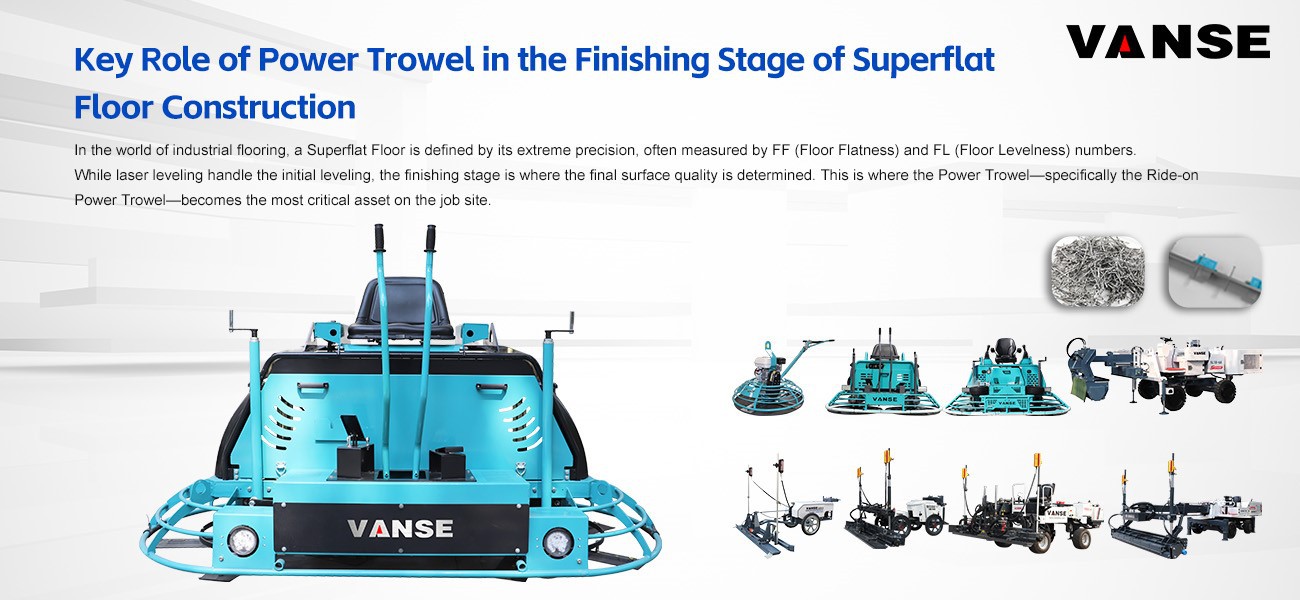
In the world of industrial flooring, a Superflat Floor is defined by its extreme precision, often measured by FF (Floor Flatness) and FL (Floor Levelness) numbers. While laser leveling handle the initial leveling, the finishing stage is where the final surface quality is determined. This is where the Power Trowel-specifically the Ride-on Power Trowel-becomes the most critical asset on the job site.
1. Achieving High FF (Floor Flatness) Tolerance
The primary role of a power trowel in superflat construction is to eliminate minor surface irregularities left after leveling. Foreign buyers prioritize equipment that can maintain a consistent blade pitch and speed.
Vanse Integration: Advanced models like the Vanse VS836 are engineered for this exact purpose. Equipped with high-precision blade adjustment systems, these machines allow operators to fine-tune the finishing process, ensuring the floor meets or exceeds strict international FF standards.
2. Improving Surface Density and Durability
A superflat floor must not only be flat but also incredibly durable to withstand heavy forklift traffic in warehouses. Power trowels compact the concrete surface, forcing out air pockets and bringing cement paste to the top to create a "hard-shell" finish.Vanse Integration: The heavy-duty design of Vanse machinery provides the necessary weight for superior compaction. For instance, the Vanse VS1046 series utilizes a dual-rotor system that maximizes the density of the concrete ground, significantly improving wear resistance and reducing long-term maintenance costs for the facility owner.
3. Efficiency in Large-Scale Industrial Projects
For international contractors, "Time is Money." Finishing a large-scale warehouse floor requires high-productivity equipment that can work continuously without mechanical failure.
Vanse Integration: By utilizing reliable HONDA GX690 (25HP) engines, Vanse ride-on power trowels offer the high-torque performance needed for extended finishing sessions. The mechanical or hydraulic drive options (like the VS836 series) provide smooth, responsive control, allowing operators to cover large areas with consistent quality and minimal fatigue.
Key Technical Advantages of Vanse Power Trowels for Superflat Floors
Objective: Identify early symptoms of faults to prevent minor issues from evolving into major ones.
| Feature | Benefit for Superflat Construction | Vanse Equipment Advantage |
| Dual-Rotor System | Overlapping or non-overlapping options for maximum coverage. | VS836 / VS1046 models for high productivity. |
| Precision Control | Essential for hitting high FF numbers. | Ergonomic steering and precise blade pitch adjustment. |
| Engine Reliability | Ensures non-stop operation during the critical "curing window." | Powered by Honda GX690/ BRIGGS & STRATTON, global service availability. |
| Compaction Weight | Increases floor density and surface hardness. | Optimized weight-to-power ratio for professional finishing. |
Conclusion
The finishing stage is the "make or break" moment for superflat floor construction. Choosing a professional-grade Power Trowel is not just an equipment choice; it is a quality assurance strategy. Vanse ( www.vansemac.com ) provides the specialized machinery required to transform a standard concrete pour into a world-class, superflat industrial surface.
Note: The parameters provided in this document are for reference only and are not mandatory. Due to differences in technical characteristics between different brands and models of laser levelers, please consult the manufacturer for a suitable solution before actual operation. This reference document assumes no responsibility for any issues arising from failure to follow the manufacturer's instructions.
Thanks to All the Friends Who Support and Trust Shandong Vanse Machinery Technology Co., Ltd.
If you want to know more about Shandong Vanse Machinery Technology Co., Ltd. or have any questions, please feel free to contact us:
Our Factory
Shandong Vanse Machinery Technology Co., Ltd.








Share this article

About the Author: Shandong Vanse Machinery Technology Co., Ltd.
Shandong Vanse Machinery Technology Co., Ltd. is a high-tech manufacturer specializing in concrete construction machinery, including laser screeds and related equipment. The company integrates R&D, production, and global sales, with products exported to over 60 countries and widely used in infrastructure projects worldwide.
Previous Post
Next Post
Related Articles
You Might Also Like
How to reduce the fuel consumption of laser leveling machine?
Fuel consumption can be said to be a point that most laser leveling machine users are particularly concerned about. Since the leveling machine is used very frequently during the construction stage, the fuel consumption will continue to increase accordingly. In the long run, the overall cost of using the laser leveling machine will inevitably rise sharply. As a result, it will be difficult to obtain ideal economic benefits. In fact, fuel consumption can be reduced in the process of using the laser leveling machine, of course, the premise is that you need to master the correct operation method. ❥ Reduce unnecessary idling: If you want to save fuel, you need to reduce the necessary idling speed of the engine. It should be clear that when the laser leveling machine is running at idling speed, the hydraulic pump is also used to circulate the hydraulic oil. The longer the idling time, the more fuel wasted. The correct way to save fuel is to try not to drive the laser leveling at idle speed during standby and rest, which is one of the secrets of fuel saving. ❥ Master the correct operation: In order to reduce unnecessary operations that increase fuel consumption in the laser leveling machine, the premise is that you must first be familiar with the basic operations of the leveling machine, and master the correct operations of loading, walking, turning, leveling, and slope repairing. If the foundation is not good, who is to blame for the oil leveling machine, and I would like to remind novices who have just entered the industry to listen to the advice of the old driver and learn the leveling operation well. ❥Reduce the engine speed: When carrying out the same excavation operation, when the engine is at a high speed, the laser leveling machine is fast, but the fuel consumption is high; when operating under non-full throttle, the engine speed is properly reduced, although the working speed is reduced, but Can reduce fuel consumption and improve fuel efficiency. ❥Non-full throttle walking: The laser leveling machine should run under the non-full throttle of the engine. Everyone should know that the higher the engine speed, the faster the walking speed and the higher the fuel consumption. Reducing the engine speed during operation can improve the fuel consumption efficiency during walking. ❥Try not to do invalid actions: If you want to save fuel, you should also pay attention to reducing the ineffective actions of the laser leveling machine as much as possible. Ineffective actions can only waste more oil in vain. Operate according to the specific conditions of the construction work to avoid unnecessary rotation. ❥ Reduce the rotation angle: Minimize the rotation angle. If the rotation angle is small, the operation cycle can be shortened, the workload per unit time can be increased, and the fuel consumption efficiency can be improved. Then, the laser leveling machine should be placed closer to the operation. As a user of the laser leveling machine, using scientific methods to reduce fuel consumption can not only save the cost of use, but also help to prolong the service life of the leveling machine. In order to make the laser leveling machine work better for us, we also need to I hope everyone will refer to the above content to formulate a set of simple and effective leveling machine consumption reduction strategies.How to use the concrete laser level leveling machine? What are the steps?
Laser leveling machine manufacturers to introduce to you what to do with this equipment: first check the equipment before use, to ensure that all functions of the equipment are normal, but also adjust the laser reference point before you can use it. After paving, technicians are required to evaluate the ground and determine the flatness before completing. ^-^ 1, preparation work (1) After the base layer is processed, the equipment is debugged on the laser paver, and the fixed reference level is drawn according to the original level; the non-woven fabric is laid, the side mold is supported, the laser emitter is set, and the ground is ground according to the original level. The elevation is introduced into the laser leveler. (2) conveying concrete Using the merchandise, the tanker transports the merchandise to the garage entrance and exit, and then transports it to the construction site with a three-wheeled dump truck. (3) Elevation Calibration The floor elevation is checked using a hand-held laser receiver, and the elevation is introduced into the laser paver to adjust the reference point (±0.00) on the leveler. 2, concrete paving Pouring steps: (1) After the formwork is supported, the chamber should be cleaned one day in advance and rinsed with water before pouring concrete. When pouring, drain the water, sweep the cement slurry or interface agent. Obvious water accumulation is strictly forbidden at this time. If there is, it must be removed carefully to spread the concrete. (2) After the concrete is put down, it is initially leveled, and the level of leveling is preferably 3 cm above the elevation. Then level it with a laser paver. The corners that are not flattened can be flattened with a gasoline-type flattening ruler or manually. 3) When the warehouse near the wall is pouring, wait until the leveling machine has passed, and then scrape it with a scraper in time. And so on. (4) For the area where the concrete mixer truck cannot be opened to the site, a tractor is used to transport the concrete. After the pouring is completed, the floor light collection construction is started when the concrete is initially set. (5) When the warehouse near the wall is pouring, wait until the leveling machine has passed, and then scrape it with a scraper in time. And so on. (6) For areas where the concrete mixer truck cannot be opened to the site, tractors are used to transport concrete. After the pouring is completed, the floor light collection construction is started when the concrete is initially set. 3. The laser signal received by the laser paver receiver (10 times/second frequency) automatically adjusts the elevation in real time to ensure that the construction elevation is always at the set standard. Because the laser transmitter is fixed after being set up, it can ensure that the construction of a large area of the ground does not cause cumulative errors. 4. During the construction, the operator uses the handheld laser receiver to detect the ground after the machine is constructed, and once again ensure that the flatness error is within the controllable range.Rapid calibration and repair of sudden deviation in the leveling accuracy of Concrete Laser Leveling
The problem of sudden deviation in the leveling accuracy of the concrete Laser Leveling during the construction process is an extremely urgent situation. The following is a systematic guide for troubleshooting, calibration and repair aimed at helping you resume construction quickly. When there is a sudden deviation in accuracy, please follow the principle of "from the outside to the inside and from the easy to the difficult" to conduct a systematic investigation. Check the laser signal source Stability: Immediately check whether the tripod of the laser emitter has been knocked over or settled by personnel or equipment. Battery power: Make sure the laser is fully charged. Low battery power may cause unstable beam. Cleanliness: Quickly check if there are any mud spots or dust on the light-emitting lens of the laser emitter, and clean it with special lens cleaning paper. Inspect the body of the leveling machine Receiver rod: Check whether the mast on which the receiver is installed has been bent or loosened. Receiver cleaning: Check if the surface of the receiver sensor is contaminated by cement slurry or dust, and clean it immediately. Scraper and flattening head: Check whether the bottom plate of the flattening head and the scraper have severe wear or concrete accumulation, as this can cause physical scratches and affect the perception accuracy. If the initial inspection does not solve the problem, please perform the following in-depth operations. 1. Calibration verification of the laser system Manual rotation test: Manually and slowly rotate the laser emitter 360 degrees to observe whether the signals of the leveler receiver are consistent and stable in all directions. If there is a continuous deviation in a certain direction, it might be that the transmitter's reference is inaccurate. Check the reference height: Use a tower ruler or steel tape measure to measure whether the reference height set by the laser emitter is consistent with the actual height of the ground control point, and eliminate errors in the reference setting. 2. Mechanical inspection of the leveling machine body Hydraulic system pressure: Check whether the hydraulic pressure of the lifting mechanism is normal and stable. Insufficient pressure can cause the flat head to "sink" in the concrete, resulting in overly deep scratches. Sensor and actuator connection: Check whether the mechanical or electrical connection between the receiver signal and the hydraulic valve is loose or damaged. Try to conduct a "manual/automatic" switching test. In the automatic mode, slightly cover the receiver manually and observe whether the flat head responds quickly to rise and fall. If there is no response or the response is slow, it indicates a fault in the signal transmission or hydraulic control system. 3. Perform rapid on-site calibration (key step) Most modern laser screeners are equipped with "quick calibration" or "learning" functions. Please refer to the manual of your equipment (such as YZ30-4E from Shandong Vanse Technology) for operation. The general process is as follows: Enter calibration mode: Go to the calibration menu on the control panel. Locate the high and low points: Turn on the Leveling to a known reference plane (or have the laser emitter sweep out a plane), and move the receivers to a known "high point" (with the display bar at the top) and a "low point" (with the display bar at the bottom) respectively. Data collection: Confirm the position at each point and let the machine record the corresponding relationship between the Angle of the laser signal received at this time and the height of the flattening head. Complete and test: Save the calibration data and exit the menu. Move the machine on the reference plane and observe whether it can be stably maintained at the "zero position" (with the green light constantly on). If obvious mechanical faults such as mast bending or hydraulic cylinder leakage are found, use should be stopped immediately and maintenance personnel should be contacted. Electronic system failure: If it is highly suspected after investigation that the fault lies within the control mainboard, receiver or laser transmitter, the "replacement method" should be adopted. Replacing the spare laser transmitter or receiver for testing is the fastest way to locate the source of the fault. Activate the backup plan: When the fault cannot be immediately eliminated and the construction task is urgent, it can be used as a temporary measure to switch to manual mode. Relying on the experience of skilled operators, the current section construction can be completed, and the equipment can be moved aside for maintenance to avoid prolonged downtime. Stop: Immediately shut down the machine to prevent the defect from expanding. Look: Conduct a quick visual inspection of the laser, receiver, and flattening head for any obvious abnormalities. Clean: Clean all optical and mechanical components. Check: Verify the laser reference and the response of the leveling machine. Calibration: Carry out on-site rapid calibration procedures. Replace: Conduct replacement tests using spare parts. If the above steps are ineffective, contact the technical support of the equipment supplier immediately. Following this process quickly and calmly can minimize downtime to the greatest extent and ensure the quality and efficiency of construction. Regular preventive maintenance of equipment is the best way to avoid such unexpected problems. Note: The parameters provided in this document are for reference only and are not mandatory. Due to differences in technical characteristics between different brands and models of laser levelers, please consult the manufacturer for a suitable solution before actual operation. This reference document assumes no responsibility for any issues arising from failure to follow the manufacturer's instructions.