Technical Knowledge
New technology application of concrete laser leveling machine
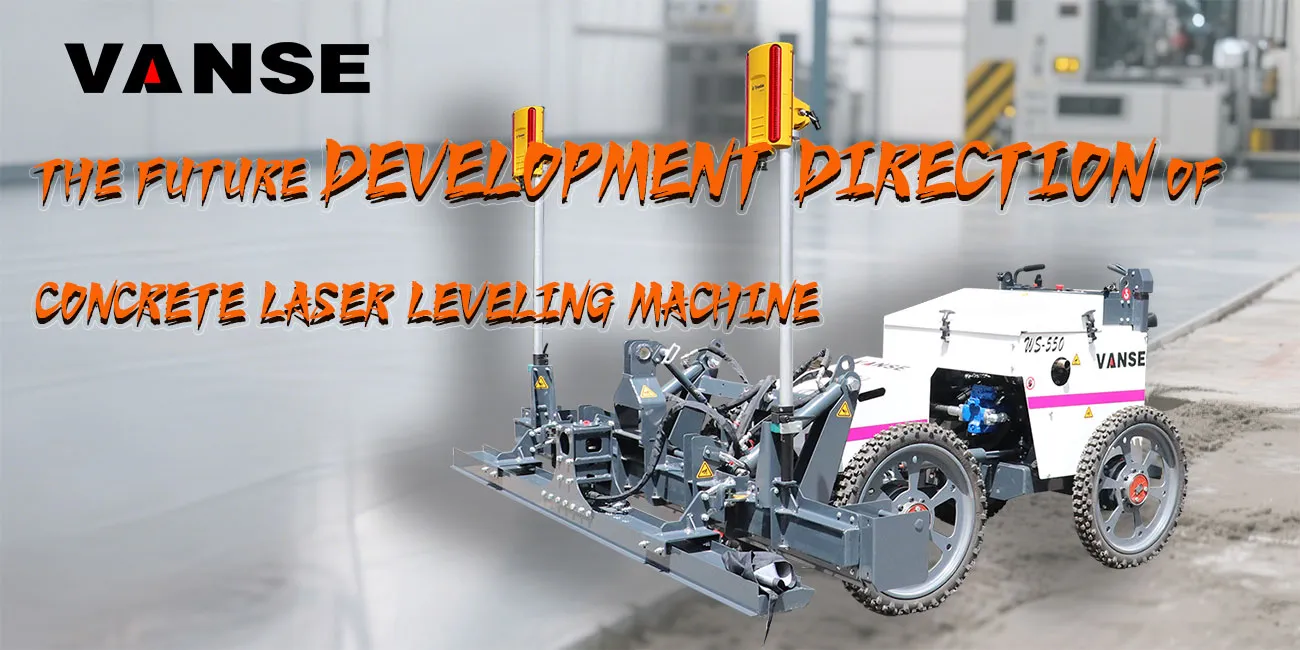
Based on the current application of new technologies and major trends in the construction industry, its future development will focus on the core dimensions of "intelligence," "unmanned operation," "greening," and "integration." The following is a detailed outlook:
1. Advanced Unmanned Operation and Fully Autonomous Construction
This is one of the ultimate goals of future development. Current automation only assists operators, but in the future, true "unmanned operation" will be achieved.
Environmental Perception and Obstacle Avoidance: leveling machines will be integrated with advanced sensors such as LiDAR, millimeter-wave radar, and computer vision cameras, enabling real-time perception of their surroundings, identifying obstacles (such as materials, workers, and other equipment), and automatically planning paths or initiating emergency braking to ensure construction safety.
High-Precision Navigation and Positioning: Combining GNSS (Global Navigation Satellite System), RTK (Real-Time Kinematic), and SLAM (Simultaneous Localization and Mapping) technologies, leveling machines will achieve centimeter-level positioning and autonomous movement in the dynamic and unstructured environment of construction sites, without the need for human intervention.
Cluster collaborative work: On a large construction site, multiple unmanned leveling machines, unmanned trowels, and unmanned transport vehicles will be uniformly dispatched and directed by a central control system ("honeycomb brain"), working together like a swarm of bees, automatically dividing areas, and efficiently and seamlessly connecting to achieve 24-hour uninterrupted construction.
2. Artificial Intelligence and Predictive Maintenance (AI & Predictive Analytics)
AI will be upgraded from a "support" role to a "decision-making" one.
AI Predicting Construction Quality: Using machine learning models, AI can analyze data such as vibration frequency, concrete slump feedback, and ambient temperature and humidity during the leveling process in real time to predict potential quality issues (such as cracking and sanding) in the final floor, and instantly adjust leveling parameters (such as speed and vibration intensity) to avoid defects.
Intelligent Path Planning and Optimization: AI algorithms will automatically calculate and select the most efficient and appropriate leveling path and sequence based on factors such as the work area shape and the initial setting time of concrete, maximizing equipment utilization and construction efficiency.
Predictive Maintenance Upgrade: Future systems will not only generate alarms but also accurately predict the remaining life of components (such as engines and hydraulic pumps) by analyzing historical data and real-time operating status (such as hydraulic oil temperature and engine vibration spectrum). This allows for pre-ordering of parts and scheduling of repairs, significantly reducing the risk of unplanned downtime.
3. Digital Twin & Full Visibility
The leveling machine will become a key data collection terminal for building a "digital twin construction site."
Real-time Mapping: Sensors on the leveling machine will simultaneously generate a high-precision digital twin model of the physical floor during construction. This model includes not only geometric dimensions but also attribute data such as construction time and compaction level.
Full Traceability: Owners and project managers can review every moment of floor construction and access construction data at any point, enabling precise tracing of quality issues and significantly streamlining the acceptance process.
Providing a Foundation for Subsequent Processes: The resulting high-precision digital model can be directly used for subsequent automated construction (such as AGV navigation and rack installation), facilities management (FM), and operations and maintenance (BIM operations and maintenance), becoming the data cornerstone for building lifecycle management.
4. Powertrain & Eco-Innovation
Full-Scale Adoption of Pure Electric Vehicles: With increasing battery energy density and decreasing costs, pure electric levelings will become mainstream, particularly in indoor applications and areas with stringent environmental requirements. Their advantages of quiet operation, zero emissions, and low operating costs are irreplaceable.
Exploring Hydrogen Fuel Cells: For large-scale, outdoor projects requiring long, continuous operations, hydrogen fuel cells may become a complementary solution, offering faster energy replenishment and longer battery life, enabling truly zero-carbon construction.
Lightweighting and New Material Applications: The use of more advanced composite materials and optimized structural designs can reduce equipment weight, reducing stress on unpaved floors and improving energy efficiency.
5. Modular & Multifunctional Design
Quick-Change Attachments: The main machine design will be more modular, allowing for quick connection and replacement of actuators with different functions, such as switching from a "leveling head" to a "dry hardener spreader" or "curing agent sprayer." This allows for multiple uses of one machine and reduces equipment investment costs.
Adaptability to Diverse Materials: With the increasing use of new concrete materials (such as self-leveling, ultra-high-strength, and fiber-reinforced concrete), the leveling machine's vibration system and scraper design will become more intelligent and adjustable to adapt to the rheological properties of different materials for optimal application results.
Summary: Future Vision
The future concrete laser leveling will no longer be a single-function construction machine, but a self-driving robot with an integrated AI brain and perceptual capabilities. It will be an intelligent node in the smart construction site network, seamlessly connected to all aspects of the process, including design, scheduling, and operations and maintenance, via the cloud.
For construction companies, this means:
Ultimate Quality: Construction results will closely resemble the perfect design of the digital model.
Maximize Efficiency: Labor costs will drop dramatically, and construction cycles will be significantly shortened.
Digital Management: Decisions will be based on real, comprehensive data, resulting in more transparent and precise management.
Safer/Greener Operations: Reduced manual labor risks will enable low-carbon, environmentally friendly construction.
Click the below to jump immediately!!!
Thanks to All the Friends Who Support and Trust Shandong Vanse Machinery Technology Co., Ltd.
If you want to know more about Shandong Vanse Machinery Technology Co., Ltd. or have any questions, please feel free to contact us:
Our Factory
Shandong Vanse Machinery Technology Co., Ltd.








Share this article

About the Author: Shandong Vanse Machinery Technology Co., Ltd.
Shandong Vanse Machinery Technology Co., Ltd. is a high-tech manufacturer specializing in concrete construction machinery, including laser screeds and related equipment. The company integrates R&D, production, and global sales, with products exported to over 60 countries and widely used in infrastructure projects worldwide.
Previous Post
Next Post
Related Articles
You Might Also Like
Laser leveling machine manufacturers: Standardized use to extend its life is no longer a problem
As we all know, the service life of the laser leveler is limited. If you don't want the life of the leveler to end early, you need to follow the rules during use. As an expert in the production and use of levelers, laser levelers naturally have a lot of knowledge that others don't know. In order to help users learn to use the leveler, laser levelers will give a detailed introduction in today's content, so please don't miss it. ▲ After the laser leveler manufacturer completes the leveling operation, it will perform routine maintenance operations in accordance with the contents of the routine maintenance procedures. ▲ The working devices and motion mechanisms of the leveler that are in direct contact with the asphalt mixture during the operation are sprayed with diesel after the operation and then run for a period of time to remove the residual asphalt on them, so that they can operate freely and rotate flexibly. It is forbidden to spray diesel on the electronic control system and spiral wire to prevent fire and burning when the power is turned on. ▲ After leveling the fly ash soil operation, flush with water to flush away the white material. After flushing, use waste hydraulic oil to lubricate the active parts of the scraper conveyor chain, and apply anti-rust oil to the piston rod. Be careful not to flush the electrical appliances and bearings with water to prevent short circuits and foreign objects from entering the bearings. ▲ Clean and check the vertical slope meter lifting and adjustment device, and apply grease to the screw. Apply grease to the floating arm slide rail. Grease each oil filling point until the joints overflow. For leveling machines with oil filling cups, observe the consumption and fill them up at any time. ▲ Due to the high efficiency of construction, the later seam cutting needs to keep up. Generally, each laser paving leveling machine is equipped with 7-8 seam cutting machines to meet the requirements. ▲ The speed of the laser leveling machine should not be too fast during the leveling operation; ▲ The laser leveling machine manufacturer should perform initial leveling before concrete leveling, and the concrete after initial leveling should be higher than the established elevation. ▲ It is advisable to use ground film covering maintenance in the early stage, and cover the non-woven fabric after cutting the seam. ▲ When installing the laser transmitter, be careful to avoid obstacles; ▲ During the construction process, due to the side pressure of concrete, the steel mesh is easy to move horizontally. For this reason, an isolation bench is directly placed on the adjacent steel mesh, and the horizontal movement of the steel mesh is effectively controlled, and the bench can be used in rotation. The above is the relevant matters that our concrete laser leveling machine manufacturer tells you. I hope it can help you. If you want to buy it, please contact us as soon as possible. The contact number and company address of our company are at the bottom of the screen. Whether you call for details or come to the factory for inspection, we warmly welcome you.What Impact Does The Maintenance Of Concrete Laser Leveling Have On Construction?
What impact does the maintenance of concrete laser leveling have on construction? Concrete laser leveling machine is an indispensable key equipment in modern construction. It plays an important role in concrete leveling operations with its high precision and high efficiency. However, any equipment needs to be properly maintained to ensure stable performance, extended service life, and maximum effectiveness during the construction process. This article will deeply explore the impact of concrete laser leveling maintenance on construction efficiency, quality, machine life, construction safety and cost-effectiveness, and propose some maintenance recommendations. 1. Overview of maintenance of leveling machine The maintenance of concrete laser leveling machine is a comprehensive work, covering many aspects such as cleaning, inspection, adjustment, lubrication and replacement of wearing parts of the equipment. These tasks are not only to ensure the normal operation of the equipment, but also to improve construction efficiency, ensure construction quality, extend the service life of the equipment and ensure construction safety. Maintenance work is usually performed before and after the equipment is used, including daily maintenance and periodic maintenance. Routine maintenance mainly involves cleaning and inspecting the equipment to ensure its appearance is clean and free of debris, and checking whether all components are intact and tight. Regular maintenance requires more in-depth inspection and adjustment of the equipment, such as changing lubricating oil, cleaning filters, checking transmission components, etc. 2. Impact on construction efficiency and quality The maintenance of the Thermosol Laser Leveler has a direct impact on the construction efficiency and quality. First, if the equipment is not properly maintained, it may cause malfunctions or performance degradation during operation, thereby affecting the construction progress. For example, if sludge accumulates on the underside of the walking track of the leveling machine, it will not only affect the walking speed, but also cause the leveling accuracy to decrease. Secondly, improper maintenance may also have a negative impact on the quality of construction. The main function of the concrete laser leveler is to ensure the flatness and compactness of the concrete surface. If the equipment performance is unstable or malfunctions, it will directly lead to poor leveling results and affect the quality of the project. Therefore, regular maintenance of the concrete laser leveling to ensure that it is in optimal working condition is of great significance to improving construction efficiency and quality. 3. Extend the service life of the machine As a high-precision, high-load equipment, the service life of the concrete laser leveling is closely related to daily maintenance. By regularly lubrication, cleaning and inspection of equipment, potential problems can be discovered and solved in time, preventing small problems from gradually deteriorating into big problems, thereby extending the service life of the equipment. In addition, correct maintenance can also slow down the wear rate of equipment. For example, regular replacement of hydraulic oil and filter elements can prevent oil contamination and increased wear; lubrication and maintenance of bearings can reduce friction and wear. These measures can effectively extend the service life of the concrete laser leveling and save the company the cost of replacing equipment. 4. Ensure construction safety and stability Construction safety is an important link that cannot be ignored during the construction process. The maintenance of concrete laser leveling machines is of great significance to ensure construction safety. First of all, the stability and reliability of equipment directly affect the safety of construction workers. If the equipment is faulty or performs erratically, there may be an increased risk of injury to the operator. Secondly, maintenance can also ensure that the safety devices and protective facilities of the equipment are in good condition. For example, the equipment's emergency braking devices and protective devices require regular inspection and maintenance to ensure normal operation in emergencies and protect the safety of operators. Therefore, by strengthening the maintenance of concrete laser leveling machines, safety hazards can be discovered and eliminated in time to ensure the safety and stability of the construction process. 5. Maintenance cost-effectiveness Although maintenance work requires a certain cost, including investment in manpower, material resources, etc., these investments are negligible compared with the benefits brought. First of all, maintenance can extend the service life of the equipment and reduce the risk of equipment scrapping. And bring replacement costs. Secondly, maintenance can improve construction efficiency and quality, and reduce economic losses caused by construction delays and quality problems. In addition, maintenance can also reduce equipment failure rates and reduce repair costs. Therefore, in the long run, maintenance of concrete laser leveling machines is a cost-effective investment. 6. Maintenance recommendations For the maintenance of concrete laser leveling machines, the following are some recommended measures: ☑ Develop a detailed maintenance plan, clarify the content and cycle of each work, and ensure the comprehensiveness and timeliness of maintenance work. ☑ Strengthen the training and management of operators, improve their maintenance awareness and skill level, and ensure that they can correctly perform daily and regular maintenance of equipment. ☑ Conduct comprehensive inspections and assessments of equipment on a regular basis to discover and solve potential problems in a timely manner to prevent small problems from gradually deteriorating into big problems. ☑ Choose appropriate maintenance tools and materials to ensure the quality and effect of maintenance work. ☑ Establish maintenance files to record the maintenance status and historical data of the equipment to provide a reference for subsequent management and maintenance of the equipment. In summary, the maintenance of concrete laser leveling machines has an important impact on construction efficiency, quality, machine life, construction safety and cost-effectiveness. By strengthening maintenance work, we can ensure the stable operation and efficient use of equipment, providing a strong guarantee for the smooth progress of the construction process. At the same time, this is also one of the important ways to improve the economic efficiency and market competitiveness of enterprises.Laser leveling machine operation steps and slope adjustment?
•••▶★◀••• Introduction As an indispensable construction equipment in the modern construction industry, the laser leveler's efficient and accurate leveling capabilities provide a strong guarantee for the construction of large-area concrete floors. Correct operation of the laser leveler and reasonable adjustment of the slope can not only ensure Improve construction quality, improve construction efficiency and reduce costs. This article aims to introduce in detail the operating steps and slope adjustment methods of the laser leveling machine, with a view to providing clear and practical operating guidelines for relevant construction personnel. •••▶★◀••• Equipment inspection and preparation Before operating the laser leveling machine, a comprehensive equipment inspection and preparation must be carried out. Specific steps are as follows: 1. Check the appearance of the equipment to ensure that the leveler has no obvious damage, deformation or rust. 2. Check the power system, including engine, battery, etc., to ensure that it is in good condition and has sufficient fuel or power. 3. Check the laser system, including laser transmitter, receiver, etc., to ensure that they are intact and working properly 4. Check the walking system of the leveler, including tires, tracks, etc., to ensure smooth walking and no jamming. 5. Check the control system, including the operation panel, sensors, etc., to ensure that its functions are normal and the display is accurate. After completing the above inspection, the operator should be familiar with the various function keys and operation panel of the leveling machine to ensure that they can operate it skillfully. •••▶★◀••• Laser system calibration The leveling accuracy of a laser leveler depends largely on the calibration of the laser system. The specific steps for laser system calibration are as follows: 1. Set a reference point in the construction area to ensure that the reference point is stable and at the same height. 2. Install the laser transmitter on the reference point, adjust the level of the transmitter, and ensure that the laser beam is projected vertically downward. 3. Turn on the laser transmitter and place the laser receiver on the ground to be leveled to ensure that the receiver can accurately receive the laser signal. 4. According to the data displayed by the receiver, adjust the parameters of the laser system to ensure that the laser beam is consistent with the actual ground height. After completing the laser system calibration, a test should be conducted to ensure that the leveler can accurately level according to the guidance of the laser beam. •••▶★◀••• Set leveling parameters Before officially starting the leveling operation, the leveling parameters need to be set according to the construction requirements. The specific steps for setting leveling parameters are as follows: 1. According to the construction drawings or design requirements, determine the flatness, levelness and other indicators of the ground. 2. Set the leveling speed, lifting range and other parameters of the leveling machine according to the ground indicators. 3. Set the vibration frequency, spatula angle and other parameters of the leveler according to the construction environment. After completing the parameter setting, a trial run should be carried out to ensure that the leveling machine can perform leveling operations according to the set parameters. •••▶★◀••• Start leveling operation After equipment inspection, laser system calibration and parameter setting are completed, leveling operations can begin. The specific steps are as follows: 1. Turn on the leveler and drive the leveler to the ground to be leveled. 2. According to the guidance of the laser system, operate the leveling machine to perform leveling operations. During the leveling process, the operator should promptly adjust the speed and lifting range of the leveling machine according to the actual situation to ensure the leveling quality. 3. During the leveling process, attention should be paid to the operating status and leveling effect of the leveling machine. If any abnormality is found, the machine should be stopped in time for inspection and treatment. After the leveling operation is completed, the leveling machine should be closed and necessary cleaning and maintenance should be carried out. Work. •••▶★◀••• Adjust the slope If the slope needs to be adjusted, this can be achieved by adjusting the lifting device of the leveling machine. The specific steps to adjust the slope are as follows: 1. Set up slope control points in the construction area to ensure that the control points are stable and highly accurate. 2. Install the slope sensor on the leveling machine and calibrate its sensitivity. 3. Determine the slope requirements of the ground according to construction drawings or design requirements. 4. Operate the leveling machine to the slope adjustment area. According to the instructions of the slope sensor, adjust the lifting device of the leveling machine so that the ground reaches the preset slope. During the slope adjustment process, attention should be paid to maintaining the stability and stability of the leveling machine. Level the quality to avoid obvious waves or unevenness. •••▶★◀••• Monitoring and Adjustment During the leveling operation, the leveling quality should be monitored and adjusted in real time. The specific steps are as follows: 1. Use a laser receiver or other measurement tools to measure the leveled ground in real time to ensure that the leveling quality meets the requirements. 2. According to the measurement results, timely adjust the parameters and operating methods of the leveling machine to improve the leveling quality. 3. During the leveling operation, attention should be paid to observing the operating status of the leveling machine and changes in the surrounding environment to ensure the safety and continuity of the leveling operation. 8. End operation and maintenance After the leveling operation is completed, necessary equipment cleaning and maintenance work should be carried out. Specific steps are as follows: 1. Turn off the leveler and clean the dust and debris on the surface of the leveler. 2. Check all components and systems of the leveler to ensure they are intact and functioning properly. 3. Lubricate and maintain the lubricating parts of the leveling machine to ensure that the equipment can operate normally the next time it is used. 4. Park the leveler in a dry and ventilated place, and take necessary protective measures to prevent the equipment from getting damp or damaged. •••▶★◀••• Safety precautions When operating a laser leveling machine, the following safety precautions must be strictly observed to ensure the safety of the operator and the normal operation of the equipment: 1. Operator training: Ensure that all operators have received professional training and are familiar with the operating instructions and safety procedures of the leveling machine. 2. Wear protective equipment: When working near the leveling machine, operators should wear personal protective equipment that meets regulations, such as hard hats, protective glasses, protective shoes, etc. 3. Regular inspection and maintenance: Regular inspection and maintenance of the leveling machine to ensure that the equipment is in good working condition. In particular, important components such as laser systems and power systems should be inspected and calibrated regularly. 4. Pay attention to the surrounding environment: When operating the leveling machine, you should pay attention to changes in the surrounding environment, such as terrain, obstacles, other construction personnel, etc. Avoid operating the leveling on unstable or dangerous ground. 5. Overloading is prohibited: The leveler should operate within the specified load range and must not be overloaded. Overloading may cause equipment damage or cause safety accidents. 6. Observe the operating procedures: When operating the leveling machine, the operating procedures should be strictly followed, and the operating sequence or equipment parameters should not be changed at will. 7. Stop the machine to deal with abnormal situations: During the leveling operation, if any abnormality or malfunction is found in the equipment, the machine should be stopped immediately and professionals should be sought for inspection and repair. Do not disassemble or repair the equipment without authorization. 8. Keep away from power sources and water sources: The leveler should be placed away from power sources and water sources to prevent electrical failure or equipment damage. 9. Prevent dust and noise hazards: The leveling machine may produce dust and noise during operation. Operators should wear corresponding protective equipment, such as dust-proof mouthpieces, earplugs, etc. 10. Obey safety warning signs: When operating the leveling machine, pay special attention to the safety warning signs and prompt information on the equipment, and operate as required. •••▶★◀••• Summary As an important piece of equipment in modern building construction, the laser leveling machine's operation steps and slope adjustment methods are of great significance to ensure construction quality and improve construction efficiency. This article introduces in detail the operating steps and slope adjustment methods of the laser leveling machine, and emphasizes the importance of safety precautions. It is hoped that this article can provide useful reference and guidance for relevant construction personnel to ensure the safe and efficient operation of laser leveling machines. At the same time, it is also recommended that construction units strengthen the training and management of operators, improve the skill level and safety awareness of operators, and jointly promote the healthy development of the construction industry.