Technical Knowledge
How to realize automatic operation of concrete laser leveling machine?
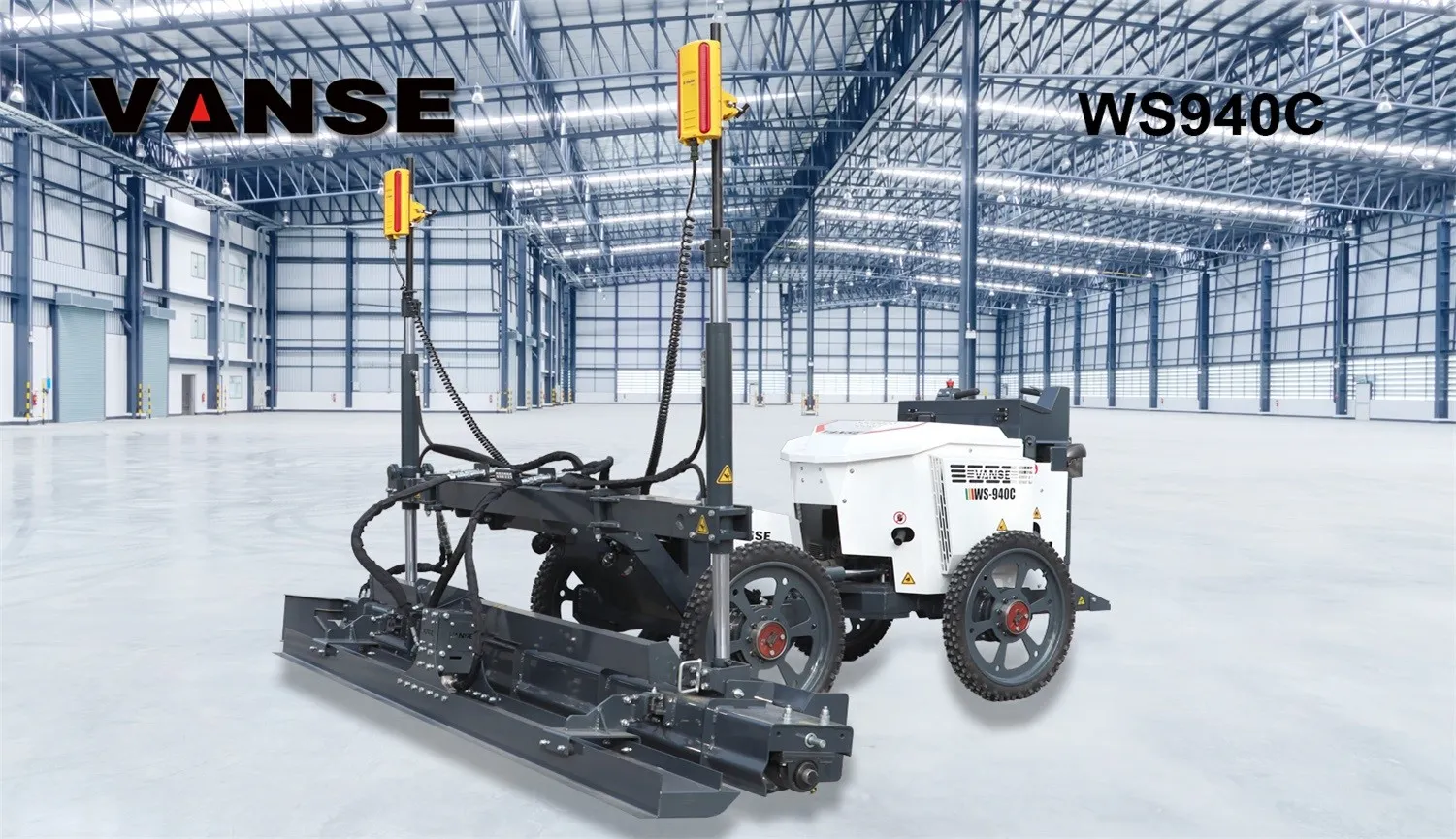
The automated operation of concrete laser leveling machines usually relies on advanced control systems and sensor technologies, which together realize the intelligence and automation of the equipment. The following are some key technologies and methods to achieve automated operation:
1. Laser control system:
Laser leveling machines use laser transmitters and receivers to ensure the best ground flatness by precisely controlling the height of the laser beam. This system can monitor and adjust the height of the leveling head in real time to ensure the flatness of the ground.
2. Sensors and actuators:
The built-in sensors of the machine can monitor construction parameters such as the density and moisture of the concrete in real time, and the actuators automatically adjust the construction actions according to these parameters to ensure the construction quality.
3. Computer control system:
The core components of the laser leveling machine include a high-strength integral frame and a microcomputer control system, which is responsible for controlling the upper and lower heights and the front and rear height balance of the leveling mechanism to ensure that the angle of the fuselage relative to the horizontal plane is fixed.
4. Automated construction process:
The automated construction process includes a series of actions such as concrete paving, vibration, and leveling, which are completed by the laser leveling machine at one time, improving construction efficiency and ground density.
5. Remote control and monitoring system:
Operators can remotely control the laser leveling machine through remote control equipment or monitoring system to achieve automated operation and reduce manual intervention.
6. Intelligent safety monitoring:
Automated equipment is usually equipped with an intelligent safety monitoring system, which can timely detect safety hazards at the construction site through video monitoring and intelligent alarm system to ensure the safety of workers and on-site personsity.
7. Data analysis and optimization:
By collecting construction data such as construction speed and concrete density, the system can analyze and optimize the construction process to further improve the effect of automated operation.
Through the above technological innovations, the concrete laser leveling machine can achieve automated operation, improve construction efficiency and quality, and reduce labor costs and labor intensity.
Thanks to All the Friends Who Support and Trust Shandong Vanse Machinery Technology Co., Ltd.
If you want to know more about Shandong Vanse Machinery Technology Co., Ltd. or have any questions, please feel free to contact us:
Our Factory
Shandong Vanse Machinery Technology Co., Ltd.








Share this article

About the Author: Shandong Vanse Machinery Technology Co., Ltd.
Shandong Vanse Machinery Technology Co., Ltd. is a high-tech manufacturer specializing in concrete construction machinery, including laser screeds and related equipment. The company integrates R&D, production, and global sales, with products exported to over 60 countries and widely used in infrastructure projects worldwide.
Previous Post
Next Post
Related Articles
You Might Also Like
The official maintenance guide and recommended cycle for the power trowel machine
The power trowel (concrete power trowel) is a heavy-duty construction equipment, and its performance and service life are highly dependent on regular and correct maintenance. The following is a comprehensive official maintenance guide and recommended cycle, applicable to common fuel (gasoline/diesel) -driven power trowels. Safety first: Before any maintenance, make sure the machine is completely shut down, the engine is off, and the blades/power trowels have completely stopped. Use genuine accessories: Always use the engine oil, lubricating oil, air filter, spark plugs and other accessories recommended by the manufacturer. Record maintenance logs: Detail the date, items and usage hours of each maintenance. Immediately after use: Remove all concrete slurry, dirt and debris from the power trowel, blades, chassis and all parts of the machine. The remaining concrete will harden, causing imbalance and damage to the machine. Clean the body: Wipe the body with a damp cloth to prevent dust from clogging the heat sink and air filter. Check and tighten all bolts and nuts, especially the blade fixing bolts, the power trowel plate connecting parts and the engine base bolts. Vibration can easily cause it to loosen. Check the wear condition to ensure that its edges are flat and free from severe wear or cracks. Change or adjust the Angle as needed. Fuel tank: If the machine will be idle for more than 30 days, it is recommended to empty the fuel in the fuel tank and carburetor, or add fuel stabilizer to prevent clogging of the fuel lines and carburetor. Air filter In environments with extremely high levels of dust (such as concrete construction), it may be necessary to clean after each use. Remove the paper filter element and gently tap it to remove the dust. If there is compressed air, blow it clean from the inside out (the air pressure should not be too high). Check if the filter element is damaged. If it is, it must be replaced. Check and clean the sponge pre-filter element (if any). On a level ground, check the engine oil level with an oil dipstick. Add engine oil of the specified grade (SAE 10W-30 or as per the instructions) as needed. Check the lubricating oil level of the gearbox (if there is an observation window or dipstick), and add the specified gear oil if necessary. Change the engine oil (for four-stroke engines) : The first change should be made 25 hours after the first use, and then every 50 hours thereafter. When warming up the machine, drain the old oil and add new engine oil to the specified amount. Thoroughly clean the air filter and consider replacing it: Even if cleaned frequently, the paper filter element has a lifespan and should be replaced regularly. Check/clean the spark plugs: Remove carbon deposits, check the electrode gap, and adjust it to the value specified in the manual (usually 0.6-0.8mm). Use a grease gun to apply high-quality lithium-based grease to all oiling nozzles (steering bearings, lifting screws, connecting rods, etc.). Check the movable joint areas and apply lubricating oil manually to prevent rust. Inspect the drive belt/V-belt: Check for cracks, wear or looseness, and adjust the tension as required by the manual or replace it. Replace the air filter element: Regardless of its appearance, it is recommended to replace it regularly. Replace the fuel filter: Clean the fuel system and replace the fuel filter screen or filter. Check/adjust idle speed and throttle line: Ensure stable engine idle speed and flexible operation. Thoroughly inspect the gearbox oil: If there is turbidity or metal shavings, consider replacing the gear oil. Comprehensive major maintenance: It is recommended to send it to an authorized service center for handling. Deep cleaning: Thoroughly clean the entire machine. Replace all filters: air, fuel and oil filters (if any). Replace spark plugs: Replace with new spark plugs of the specified model. Inspect/Replace carbon brushes (for motorized power trowels) : For electric power trowels, check the wear of the motor carbon brushes and replace them in a timely manner. Fuel system completely drained Drain all the fuel from the fuel tank and carburetor. Or fill up the tank with fuel and add fuel stabilizer, and run the engine for a few minutes to allow the stabilizer to circulate to the carburetor. Battery maintenance (electric start model) Disconnect the negative terminal of the battery. Charge the battery and maintain it regularly (charge it once every 1-2 months). Storage location: Store the machine in a clean, dry and well-ventilated room and cover it with a cover. If the equipment is idle for more than one month during the non-construction season, the following steps must be carried out Fuel treatment: As mentioned above, drain or add stabilizer. Engine protection Inject a small amount of engine oil into the spark plug hole, pull the starting rope several times to lubricate the cylinder with the engine oil, and then install the spark plug. Place the engine at the top dead center of compression (stop when you feel resistance when pulling the start rope). Rust prevention treatment: Apply rust prevention oil to all exposed metal parts. Lift the power trowel: Use a wooden board to prop up the power trowel and lift it off the ground to reduce the pressure on the tires and suspension. Oil and water inspection: Engine oil, fuel oil. Visual inspection: Check for any oil leakage or damaged components. Operation test: Start the machine under no-load conditions in a safe area to check if the steering and lifting are flexible and if there are any abnormal noises. Protective devices: Ensure that all protective covers (belts, gears) are in good condition and firmly installed. Final reminder: This guide is general advice. For the most accurate maintenance requirements, please be sure to refer to the "User Operation and Maintenance Manual" of the polishing model you have purchased. Adhering to the cycles and norms specified in the official manual for maintenance is the key to ensuring the performance, safety and service life of the equipment. Note: The parameters provided in this document are for reference only and are not mandatory. Due to differences in technical characteristics between different brands and models of laser levelers, please consult the manufacturer for a suitable solution before actual operation. This reference document assumes no responsibility for any issues arising from failure to follow the manufacturer's instructions.Comparison of concrete laser leveling machines and other equipment
1. Work efficiency Traditional concrete construction methods often require a lot of manual operations, are inefficient and difficult to guarantee accuracy. In contrast, the compacted soil laser leveling machine uses advanced laser technology and automated control systems, which can quickly complete large-area concrete leveling work in a short time, greatly improving work efficiency. 2. Construction quality Traditional construction methods are easily affected by human factors, such as the skill level and fatigue level of operators, resulting in unstable construction output. The concrete laser leveling machine can ensure the stability of leveling accuracy and construction quality through precise laser positioning and automatic control technology, effectively avoiding the defects of traditional methods. 3. Material consumption The concrete laser leveling machine can achieve precise quantitative batching and leveling, avoiding the waste of materials. In contrast, traditional manual operations tend to cause a lot of material loss and waste. 4. Operation convenience Concrete laser levelings usually use remote control or automated control systems, which are easy to operate and greatly reduce the labor intensity of workers. The traditional method requires a lot of manual operations, is labor-intensive, and is easily affected by environmental factors such as weather. 5. Security The concrete laser leveler can quickly level the construction site, reducing manual working time in dangerous areas, thereby improving construction safety. At the same time, the operation of the machine is easier to control than traditional manual operation, which can reduce the occurrence of construction accidents. To sum up, the compacted soil laser leveling machine is superior to traditional construction methods in terms of work efficiency, construction quality, material consumption, operational convenience and safety. With the continuous advancement of technology and the gradual maturity of the market, concrete laser levelings are expected to become mainstream concrete construction equipment in the future.Application Case of Ultra-flat Floors in Automated Warehousing and Logistics Centers
The routine inspection, fault early warning and maintenance points of the hydraulic system of the concrete laser leveling are a crucial topic, as the health condition of the hydraulic system directly determines the construction efficiency, leveling accuracy and equipment service life of the leveling. The following is a detailed and systematic guide. In a traditional warehouse, minor floor undulations might only cause slight operator discomfort. In an automated facility, they can lead to catastrophic inefficiencies. VNA Forklift Stability: VNA trucks routinely lift heavy loads to heights exceeding 15 meters (50 feet). A floor variation of just a few millimeters at ground level translates to significant mast sway at maximum height. Ultra-flat floors, measured by strict Floor Flatness (FF) and Floor Levelness (FL) metrics, eliminate this static lean, preventing collisions with racking systems. AGV and Robotics Performance: Automated Guided Vehicles use sophisticated optical and laser sensors for navigation. Uneven surfaces cause sensor misalignment, triggering automatic safety shutdowns and halting the entire supply chain. A perfectly leveled floor ensures AGVs run continuously at their designed maximum speeds. Investing in an ultra-flat floor poured and leveled with advanced concrete laser leveling provides immediate and long-term ROI for logistics operators: Maximized Operational Speed: Material Handling Equipment (MHE) can operate at 100% capacity without the need to slow down for floor defects. Reduced Equipment Maintenance: Bumps and uneven joints cause severe wear and tear on the expensive polyurethane wheels and bearings of VNA trucks and AGVs. A seamless, ultra-flat surface dramatically extends the lifespan of this machinery and reduces maintenance downtime. Optimized Storage Density: Super-flat conditions allow racks to be built higher and closer together, maximizing the cubic storage capacity of the warehouse footprint. Achieving these exacting standards requires more than traditional manual pouring. The construction of logistics center floors demands state-of-the-art concrete laser leveling machines. These machines utilize advanced laser receivers and automated hydraulic systems to continuously adjust the leveling head, guaranteeing precise elevation control and eliminating human error. Furthermore, integrating high-quality steel fibers and precision armor joints during the construction process ensures the floor remains durable under heavy dynamic loads, preventing joint spalling and shrinkage cracks. In the era of smart logistics, the concrete floor is no longer just a structural component; it is an active operational asset. By prioritizing ultra-flat floor construction, logistics centers lay the literal foundation for automation success, ensuring high-speed throughput, maximum safety, and unparalleled efficiency. Note: The parameters provided in this document are for reference only and are not mandatory. Due to differences in technical characteristics between different brands and models of laser levelers, please consult the manufacturer for a suitable solution before actual operation. This reference document assumes no responsibility for any issues arising from failure to follow the manufacturer's instructions.