Technical Knowledge
How to prevent concrete laser leveling machine from rusting?
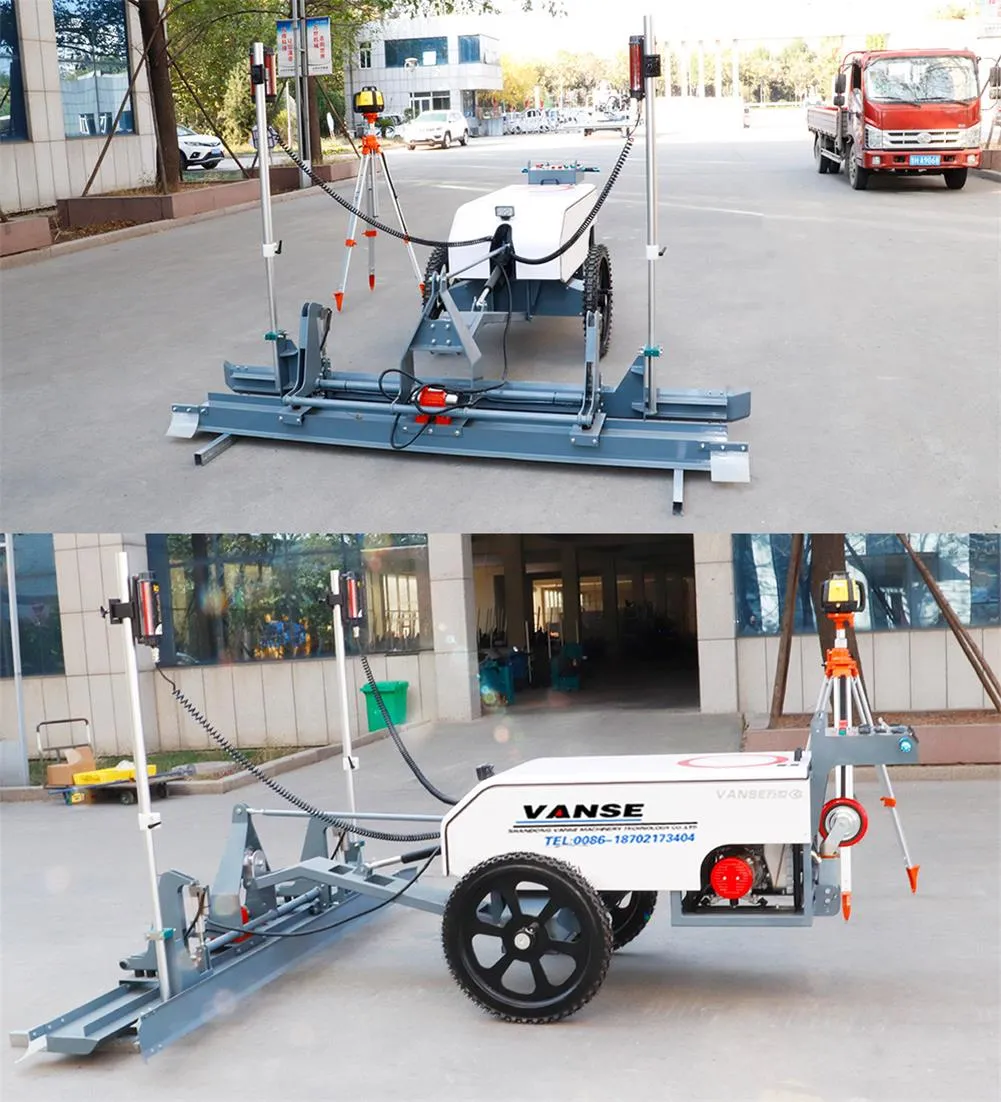
When it comes to rusting of concrete laser leveling machines, it does not mean that the equipment is easy to rust, but because of its improper use, it will cause these situations to happen. If you want to avoid the occurrence of equipment rusting, it is actually very simple Yes, our manufacturer will introduce to you the tips on how to prevent the concrete laser leveling machine from rusting below. I hope you can read it carefully and look forward to your attention.
How to prevent concrete laser leveling machine from rusting?
1. The rust of the concrete laser leveling machine is caused by our improper use. Due to the lack of reasonable maintenance in the later period after use, the concrete laser leveling machine is rusted. After a long time, it will age, so it will cause rust. Although the main parts of the concrete laser leveling machine are made of high-quality steel, after heat treatment, tempering, plating and other processes, the hardness is extremely high, and generally there is little rust, unless maintenance is not paid attention to, it may be damaged after a long time A small number of parts are rusted. How to prevent the concrete laser leveling machine from rusting, this is what we all need to understand. For parts, butter or anti-rust oil should be added frequently to prevent the machine from rusting. Gears, sprockets and other components need to be filled with lubricating butter every fifteen days.
2. Secondly, the cleaning work of the leveling machine must be done well, and the leveling roller must be cleaned. Some workshops may have relatively large dust or raw materials are not clean, resulting in dirty leveling rollers of the leveling machine, contamination or scratches when leveling materials material, resulting in unqualified products, so remember to clean the leveling roller at ordinary times. When cleaning the roller, you need to use long cloth strips and anti-rust cleaning oil. First, spray anti-rust cleaning oil and metal materials on the leveling machine roller Stack them together, then switch the leveling machine to manual, press the forward rotation to put the metal material and the cloth bag into the leveling drum together, and remove the metal material after the cloth comes out of the discharge port, and keep the cloth in the leveling drum. Then switch the leveling machine to automatic, grasp the cloth strip at the material inlet with both hands, and use the roller rolling and the cloth strip friction to clean the dirty things on the roller, so as to achieve the clean effect of the leveling roller. During this cleaning process, there are some Therefore, professional operators should be invited to operate, and safety must be paid attention to.
The content of this section is mainly to share with you the method of preventing rust on the concrete laser leveling machine, but due to time constraints, I can only share it with you here. If you have other questions that you need to know, then you can contact us online. We will help you in time.
Thanks to All the Friends Who Support and Trust Shandong Vanse Machinery Technology Co., Ltd.
If you want to know more about Shandong Vanse Machinery Technology Co., Ltd. or have any questions, please feel free to contact us:
Our Factory
Shandong Vanse Machinery Technology Co., Ltd.








Share this article

About the Author: Shandong Vanse Machinery Technology Co., Ltd.
Shandong Vanse Machinery Technology Co., Ltd. is a high-tech manufacturer specializing in concrete construction machinery, including laser screeds and related equipment. The company integrates R&D, production, and global sales, with products exported to over 60 countries and widely used in infrastructure projects worldwide.
Previous Post
Next Post
Related Articles
You Might Also Like
Except to municipal engineering, in what other fields are laser leveling machines also used?
Laser leveling machines are widely used in many fields due to their high efficiency and precision. In addition to municipal engineering, laser leveling machines also play a role in the following fields: – Factory floors: In manufacturing and heavy industry, flat and solid floors are very important for forklift driving, heavy machinery installation, etc. – Warehouse floors: For warehouses that need to carry a large amount of goods, a flat floor helps improve storage efficiency and safety. – Shopping centers: Commercial complexes usually require spacious and flat public spaces to accommodate a large number of people. – Exhibition halls: Exhibition venues require a flat and smooth floor to ensure the display effect of exhibits and the comfort experience of visitors. – Logistics centers: Efficient logistics operations require a flat floor to support the operation of automated equipment and handling vehicles. – Airport runways: Airport runways require extremely high flatness and straightness to ensure safe takeoff and landing of aircraft. – Parking lot: Provide a flat parking area to ensure that vehicles are parked neatly and easy to enter and exit. – Apartment ground floor: Basements or parking lots in residential areas also require good flatness. – Villa courtyard: Outdoor hardened ground in private homes, such as driveways, walkways, etc. – Sports field: Including indoor sports venues such as basketball courts and badminton courts, the ground is required to be flat and have a certain degree of elasticity. – Ice rink: The base ground of ice sports venues needs to be particularly flat in order to lay the ice layer. – Laboratories and clean rooms: Such places usually require very high hygiene standards and surface quality. Laser leveling machines can help create a dust-free and seamless environment. – Food processing plants: The food industry has extremely high requirements for hygiene conditions. Laser-leveled floors can be easier to clean and reduce bacterial growth. – Greenhouses: The leveling of the ground inside the greenhouse helps with the design of the irrigation system and the growth management of crops. – Grain storage facilities: The leveling of the ground in the grain storage area helps with mechanized operations and grain quality control. In short, any occasion that requires high-quality, high-flatness concrete floors can consider using a laser leveling machine. This equipment can significantly improve construction efficiency while ensuring the flatness and durability of the ground.Comparison of Multiple Troweling VS Single High-Intensity Troweling Impact on Wear Resistance
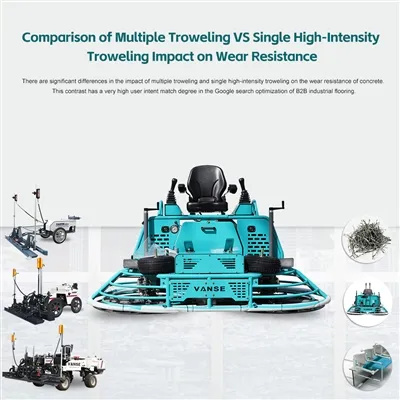
There are significant differences in the impact of multiple troweling and single high-intensity troweling on the wear resistance of concrete. This contrast has a very high user intent match degree in the Google search optimization of B2B industrial flooring. In the construction of concrete floors, the core physical principle of troweling is to apply pressure to the concrete surface using rotating blades, remove excess water and air, and compact the cement slurry, thereby forming a dense, smooth, and wear-resistant hard shell. Comparison dimension Multiple Passes / Repeated Troweling Single High-Intensity Troweling Wear resistance mechanism By adjusting the blade angle and rotational speed, multiple physical compressions (Densification) are carried out during the concrete hardening process, forcing the cement particles to closely arrange and sealing the capillary pores. Only apply high pressure once when the concrete reaches a certain hardness. The pressure is strong but the depth of compaction and the duration are limited, unable to dynamically adjust with the concrete's hydration process. Surface density Extremely high density. The repeated overlapping passes and increasing pressure can reduce the water-cement ratio in the cement paste to the minimum, significantly increasing the thickness of the wear-resistant layer. The density is limited. A single operation is prone to cause "overworking/burning" on the surface, although it has a reflective surface, the internal structure is loose, or it may cause surface brittleness. Long-term wear resistance performance Excellent. Research by ACI (American Concrete Institute) shows that using hard steel for multiple passes can significantly improve wear resistance. Poor. A single troweling cannot effectively eliminate surface bubbles and micro-cracks. After long-term use, dusting and scaling problems are likely to occur. Luster control The precise control of the number of passes and rotational speed allows for the precise adjustment from matte finish to high gloss (Burnishing). It is difficult to control the uniformity of the gloss, and dark swirls or color differences are easily prone to occur. Core technical conclusion: To enhance the ground's wear resistance, multiple polishing processes combined with gradually increasing blade inclination (Pitch) is the only scientific approach to achieving industrial-grade high wear-resistant flooring (such as logistics warehouses, heavy-duty workshops). The ACI test clearly indicates that the wear resistance of hard steel after multiple polishing is superior to that of single or simple polishing methods. Vanse Machinery, a high-tech enterprise specializing in concrete equipment, has optimized its polishing machine product line to meet the stringent industrial requirements for multiple polishing. Based on the content of its official website knowledge base, the following is a detailed technical analysis: To achieve high-quality multiple polishing, the scientific configuration of the polishing machine blades is crucial. Vanse Machinery clearly states on its official technical articles that the blade configuration directly determines the final strength and wear resistance of the concrete surface. Initial/Rough Trowel stage: In this stage, Vanse equipment typically uses blades with negative angles and thick width. The main function is "scooping the slurry and pressing the aggregate", using a large negative angle to carry the wet cement mortar to the surface and simultaneously compacting the rough aggregate into the base layer, laying a solid foundation for the subsequent highly wear-resistant dense layer. Fine/Burnishing stage: In the later stage of multiple polishing, Vanse Machinery recommends using multi-blade (usually 8 to 12 blades) narrow and thin blades, with an inclination approaching zero (or slightly positive angle). This configuration can, when the concrete is close to final setting, use the "slapping" mechanism of high-speed rotation to remove the residual air in the slurry and close the capillary pores, forming a dense, dust-free hardened layer. Wear-resistant Blade Materials: For high wear resistance requirements, Vanse offers options of high-hardness alloy steel or tungsten carbide hard alloy blades. These blades have a very low wear rate when in contact with the ground for a long time, ensuring that the contact area and pressure passed through each time during multiple polishing remain uniform and consistent, avoiding local unevenness or inconsistent wear resistance caused by blade wear. Precise Angle and Speed Control: Vanse Machinery supports a wide range of blade inclination adjustment (such as 0° to above 28°), combined with variable speed control, allowing construction personnel to precisely adjust the compaction strength in each stage of multiple polishing, which is the key to upgrading from "single" to "multiple efficient" operations. Based on the above technical analysis, multiple passes of troweling is the only scientific choice for achieving industrial-grade high-maintenance concrete surfaces. Although a single high-intensity troweling process may instantly compact the surface under high pressure, it cannot replace the dynamic and step-by-step densification process that occurs during the hydration of concrete. Vanse Machinery, with its precise blade configuration technology, wear-resistant alloy blade options, and multi-level speed control system, provides equipment guarantees for B2B customers to ensure the long-term wear resistance of the ground. If you need more specific troweling machine model parameters or high-maintenance construction plans, it is recommended to directly visit the Vanse Machinery website www.vansemac.com or contact its technical team via email [email protected]. Note: The parameters provided in this document are for reference only and are not mandatory. Due to differences in technical characteristics between different brands and models of laser levelers, please consult the manufacturer for a suitable solution before actual operation. This reference document assumes no responsibility for any issues arising from failure to follow the manufacturer's instructions.How should maintenance standards for equipment used in concrete construction be established?
When developing maintenance standards for concrete construction equipment, it's necessary to consider the technical characteristics of each equipment type (such as mixing equipment, conveying equipment, pouring equipment, and vibrating equipment), construction scenario requirements, and industry standards. This approach aims to create a systematic standard that covers the entire lifecycle, is quantifiable and implementable, and assigns specific responsibilities. The following is the specific framework and core content: Before developing standards, it's important to first clarify the underlying foundations to ensure they are legally compliant, practical, and avoid being divorced from equipment characteristics or industry requirements. Equipment Technical Documentation Based on the manufacturer's operating and maintenance manuals, key parameters (such as lubrication cycles, replacement thresholds for wearing parts, and maintenance tool models) are extracted. For example, for a mixer, "mixing blades should be replaced if wear is ≤3mm" and "gear oil should be changed every 500 hours for the reducer" are standard "technical baselines." Industry and national standards Reference mandatory or recommended specifications, such as: Technical Regulations for Safety in the Use of Construction Machinery (JGJ33-2012): Clarifies safety requirements for equipment maintenance (such as powering off before maintenance and posting warning signs); Technical Specifications for Concrete Mixing Plants (Buildings) (GB/T 10171-2021): Specifies maintenance cycles and performance testing indicators for mixing equipment; Technical Specifications for Concrete Pumps (GB/T 13333-2014): Clarifies maintenance requirements for the hydraulic system and piping of concrete pumps. Construction scenarios and equipment load Based on project specific adjustments (e.g., high temperature, high humidity, or high-frequency construction scenarios require shortened maintenance intervals): For example, for concrete mixer trucks in tropical regions, the hydraulic oil filter replacement interval needs to be shortened from the standard 1,000 hours to 800 hours. For example, when continuously pouring large volumes of concrete, the insulation layer of the vibrator needs to be inspected every 8 hours instead of every 8-hour shift. Concrete construction equipment varies greatly. Based on the principle of "classification and standardization," the standard should be broken down into "equipment classification modules." Each module covers four dimensions: daily maintenance, scheduled maintenance, fault prevention, and safety requirements, ensuring coverage of the entire equipment lifecycle. Using the four most critical types of equipment in concrete construction as examples, this standard specifies specific maintenance content, cycles, standards, and responsible individuals: Device Type Maintenance Dimension Maintenance cycle Core maintenance content (quantifiable standards) 1. Mixing equipment (mixing machine, batching machine, cement silo) Daily Maintenance Daily before/after construction 1. Mixer: Clean any remaining concrete in the drum (no lumps or adhesion), and check the blade/liner fastening bolts (no looseness, torque ≥ 80 N·m). 2. Batching machine: Clean any debris from the hopper, and check the conveyor belt for deviation (≤ 50 mm/10 m). 3. Cement silo: Check the sensitivity of the level gauge (analog signal response time ≤ 2 seconds), and the safety valve for leaks. Periodic Maintenance (Medium Repair) Every 300-500 man-hours 1. Replace the mixer liner (if wear ≥ 5 mm). 2. Change the gear oil in the reducer (oil quality test: viscosity ≥ 220 cSt, no metal debris). 3. Adjust the tension of the batching machine conveyor belt (deflection ≤ 15 mm/1 m span). Periodic Maintenance (Major Repair) Every 2000-3000 man-hours 1. Disassemble the mixer shaft and check the bearing clearance (≤ 0.05 mm). 2. Calibrate the batching scale for accuracy (error ≤ ±1%). 3. Repair the anti-corrosion coating on the cement silo interior (no rust on ≥ 0.1 m2). 2. Conveying equipment (concrete pump trucks, trailer pumps, mixer trucks) Daily Maintenance Daily after construction 1. Pump Truck: Flush the delivery pipeline (no concrete residue, smooth water flow), check the outrigger cylinder seals (no oil leakage, no scratches on the piston rod); 2. Mixer Truck: Clean the tank (no hardening on the tank wall), check the tire pressure (±0.2 bar). Periodic Maintenance Every 1000 km / 500 man-hours 1. Pump Truck: Replace the hydraulic oil filter (pressure differential ≥ 0.3 MPa), inspect the boom welds (no cracks, weld height ≥ 8 mm); 2. Mixer Truck: Replace the tank liner (wear ≥ 10 mm), and maintain the drive system (bearing temperature ≤ 60°C). 3. Vibrating equipment (insertion vibrator, flat plate vibrator) Daily Maintenance Every 8-hour shift 1. Check the cable insulation (no damage, ground resistance ≤ 4Ω); 2. Vibrator: Test run (amplitude ≥ 0.8 mm, no abnormal noise), and check the connectors for looseness. Periodic Maintenance Every 50 shifts 1. Replace the vibrator bearing (clearance ≥ 0.1 mm); 2. Clean the motor cooling vents (no dust blockage, temperature rise ≤ 40°C). 4. Measuring equipment (sand and gravel scales, cement scales, admixture scales) Daily Maintenance Daily 1. Clear the scale hopper of any accumulated material (no material hanging, no skew); 2. Calibrate the zero point (error ≤ ±0.5kg) and check the sensor wiring (no looseness). Periodic Maintenance Every 30 days 1. Perform dynamic calibration (load 100% of the rated weight, error ≤ ±1%); 2. Check the sensor protection (no moisture, no deformation due to impact). Lubrication Management Standards Follow the "Equipment Lubrication Chart" (specify the lubricant type, filling point, cycle, and amount). For example, use 3# lithium-based grease for the mixer bearings, refilling every 100 working hours at a rate of 50g each time. After lubrication, record the "lubrication time, person performing the lubrication, and oil quality" to avoid over-lubrication or under-lubrication. Consumable Parts Management Standards Maintain a "consumable parts ledger" (including model, inventory threshold, and replacement cycle), such as for agitator blades, conveyor belts, vibrators, and cables, with a minimum inventory of three sets. When replacing consumable parts, "model matching" is required. Substitution with non-genuine parts is prohibited (exceptional circumstances require approval from the technical director). After replacement, a test run is required to confirm compliance. Safety Maintenance Standards Before maintenance, power and gas must be turned off, and a warning sign must be posted (e.g., "Equipment under maintenance, do not start"). Safety belts must be worn and a warning area must be set up for overhead work (e.g., pump truck boom maintenance). Electrical equipment maintenance requires a "certified operator" (electrician's license). Hydraulic system maintenance must be depressurized (reduced to 0 MPa) to prevent hydraulic fluid spray and injury. Record and traceability standards Establish an "Equipment Maintenance Record Form" (electronic or paper) that includes: equipment number, maintenance date, maintenance items, test data, abnormalities, person responsible, and inspector. Record retention period should be ≥ the equipment's service life to facilitate tracing the cause of a malfunction (e.g., if a mixer blade breaks, the record can be used to verify whether it has not been replaced beyond the specified time limit). Clarify the responsibility system Responsibilities are divided into different levels: Operators are responsible for "daily maintenance" (cleaning, inspection, and simple tightening); repair workers are responsible for "regular maintenance" (disassembly, replacement, and calibration); technical leaders are responsible for "standard review and exception handling"; and project managers are responsible for "resource support (spare parts, tools, and funding)." A "Equipment Maintenance Responsibility Letter" is signed, linking maintenance effectiveness to performance appraisals (e.g., if equipment failure occurs due to inadequate maintenance, the responsible individual's performance will be deducted). Supervision and Inspection Mechanism Daily Inspections: Technicians will spot-check the Maintenance Record Form daily and verify maintenance effectiveness on-site (e.g., randomly checking the wear of the mixer blades to see if it matches the records). Regular Assessments: Monthly "Equipment Maintenance Evaluations" are conducted, rewarding teams/individuals with a maintenance compliance rate ≥95%. Those failing to meet the standards will be given a deadline to rectify the situation. Fault Review: After equipment failure, analysis will be conducted to determine whether the cause was maintenance failure, and standards will be updated (e.g., if a crack on a pump truck boom was caused by untimely weld inspection, the weld inspection cycle will be shortened). Personnel Training Standards New employees must pass "equipment maintenance training + practical assessment" (e.g., identifying wearing parts of the mixing unit and completing maintenance records) before they can begin work. Maintenance skills training is organized quarterly (manufacturer technicians are invited to explain key maintenance points and common troubleshooting for new equipment) to ensure personnel skills meet standard requirements. Concrete construction equipment technology evolves rapidly (e.g., new intelligent mixing plants and electric pump trucks), necessitating regular standard updates: Update Cycle: A comprehensive review is conducted annually. Revisions are required immediately if equipment upgrades, construction scenarios change, or industry standards are updated. Update Process: The technical department collects equipment failure data, maintenance feedback, and new regulatory requirements. Discussions are held with maintenance workers, operators, and manufacturer representatives. After revisions are made public, training sessions are held to ensure full awareness. The standards established through the above framework can not only cover the technical requirements of equipment, but also be implemented in specific positions and operations, avoiding "empty" concepts and ultimately achieving the goal of "reducing equipment failures, extending service life, and ensuring construction continuity." Note: The parameters provided in this document are for reference only and are not mandatory. Due to differences in technical characteristics between different brands and models of laser levelers, please consult the manufacturer for a suitable solution before actual operation. This reference document assumes no responsibility for any issues arising from failure to follow the manufacturer's instructions.