Technical Knowledge
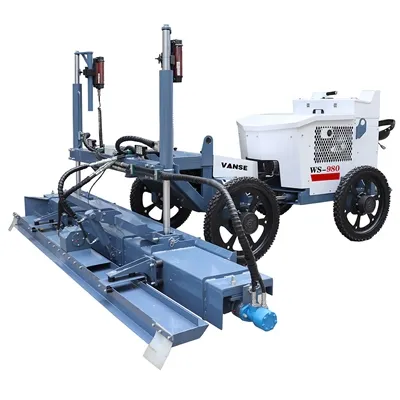
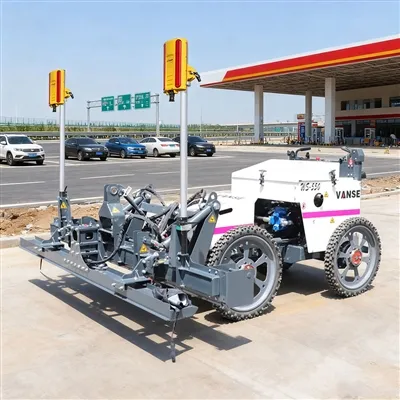
Comparison of concrete laser leveling machines and other equipment


1. Work efficiency
Traditional concrete construction methods often require a lot of manual operations, are inefficient and difficult to guarantee accuracy. In contrast, the compacted soil laser leveling machine uses advanced laser technology and automated control systems, which can quickly complete large-area concrete leveling work in a short time, greatly improving work efficiency.
2. Construction quality
Traditional construction methods are easily affected by human factors, such as the skill level and fatigue level of operators, resulting in unstable construction output. The concrete laser leveling machine can ensure the stability of leveling accuracy and construction quality through precise laser positioning and automatic control technology, effectively avoiding the defects of traditional methods.
3. Material consumption
The concrete laser leveling machine can achieve precise quantitative batching and leveling, avoiding the waste of materials. In contrast, traditional manual operations tend to cause a lot of material loss and waste.
4. Operation convenience
Concrete laser levelings usually use remote control or automated control systems, which are easy to operate and greatly reduce the labor intensity of workers. The traditional method requires a lot of manual operations, is labor-intensive, and is easily affected by environmental factors such as weather.
5. Security
The concrete laser leveler can quickly level the construction site, reducing manual working time in dangerous areas, thereby improving construction safety. At the same time, the operation of the machine is easier to control than traditional manual operation, which can reduce the occurrence of construction accidents.
To sum up, the compacted soil laser leveling machine is superior to traditional construction methods in terms of work efficiency, construction quality, material consumption, operational convenience and safety. With the continuous advancement of technology and the gradual maturity of the market, concrete laser levelings are expected to become mainstream concrete construction equipment in the future.
Thanks to All the Friends Who Support and Trust Shandong Vanse Machinery Technology Co., Ltd.
If you want to know more about Shandong Vanse Machinery Technology Co., Ltd. or have any questions, please feel free to contact us:
Our Factory
Shandong Vanse Machinery Technology Co., Ltd.








Share this article

About the Author: Shandong Vanse Machinery Technology Co., Ltd.
Shandong Vanse Machinery Technology Co., Ltd. is a high-tech manufacturer specializing in concrete construction machinery, including laser screeds and related equipment. The company integrates R&D, production, and global sales, with products exported to over 60 countries and widely used in infrastructure projects worldwide.
Previous Post
Next Post
Related Articles
You Might Also Like
How to judge the wear resistance of power trowel blades?
– Metal material: If the trowel is made of metal, such as alloy steel, the type and content of the alloying elements will affect the wear resistance. For example, alloy steel containing elements such as chromium (Cr), molybdenum (Mo), and vanadium (V) usually has good wear resistance. Chromium can form a dense oxide film on the metal surface to prevent further oxidation and wear of the metal; molybdenum can improve the hardness and toughness of the metal and enhance its wear resistance; vanadium can refine the grains and make the metal structure more uniform, thereby improving wear resistance. – Non-metal material: For non-metallic trowels such as polyurethane, its wear resistance mainly depends on the hardness, elasticity and internal structure of the material. Generally speaking, polyurethane trowels with higher hardness, appropriate elasticity and uniform internal structure have better wear resistance. For example, the length and degree of crosslinking of the molecular chain in polyurethane will affect its hardness and elasticity. When the molecular chain is longer and the degree of crosslinking is moderate, it can provide better wear resistance. – Coating treatment: Some trowels have coatings on their surfaces to enhance wear resistance. For example, ceramic coatings are used, and the ceramic material itself has high hardness and good wear resistance. The quality and thickness of the coating are also key factors in judgment. High-quality coatings should be uniform, free of pores, and of appropriate thickness (generally between a few microns and tens of microns). Too thin coatings may be worn away in a short time and fail to play their wear-resistant role; while too thick coatings may cause the coating to fall off due to internal stress and other problems. – Heat treatment process: The hardness and wear resistance of trowels can be improved through heat treatment processes such as quenching and tempering. For heat-treated trowels, it is necessary to understand their heat treatment process parameters, such as quenching temperature, tempering temperature and time. Appropriate heat treatment processes can optimize the internal structure of the material and improve its wear resistance. For example, too high a quenching temperature or too short a tempering time may lead to uneven hardness or insufficient toughness of the material, thereby affecting wear resistance. – Hardness index: The hardness of the trowel is an important parameter to measure its wear resistance. It can generally be measured by Rockwell hardness (HRC), Brinell hardness (HB), etc. The higher the hardness, the better the wear resistance to a certain extent. But it should also be noted that too high hardness may cause the trowel to become brittle and easy to break. For example, for metal trowels, Rockwell hardness between 50-60HRC usually has a good balance of wear resistance and toughness. – Density parameter: Density can also be used as one of the reference factors. For some composite trowels, appropriate density means that the internal material is evenly filled and the structure is tight, which helps to improve wear resistance. For example, under the same material composition, a trowel with a higher density may be more wear-resistant because the internal particles are more tightly bound and can better resist wear. – Simulated working condition test: The actual working scene of the trowel can be simulated in a laboratory environment for testing. For example, prepare a test plate simulating the concrete surface, set a certain pressure, speed and friction time, and perform a friction test on the test plate. Then observe and measure the degree of wear of the trowel, such as weight loss after wear, surface roughness change, etc. – User feedback and evaluation: Referencing other users' experience is also an effective way to judge the wear resistance of the trowel. You can learn about the actual wear resistance of trowels of different brands and models by checking the user reviews of the product, consulting professional construction teams, or on relevant construction equipment forums. The feedback from users after long-term use in actual construction environments can truly reflect the wear resistance of the trowel.What are the construction advantages of concrete laser leveling machine?
The concrete laser leveling is a high-tech concrete construction equipment. Its construction advantages are mainly reflected in the following aspects: High precision and efficiency: The concrete laser leveling machine uses advanced laser technology to level large areas of concrete in a short time. At the same time, due to the high precision and efficiency of laser, labor costs can be greatly reduced and construction efficiency improved. High flatness: The concrete laser leveling machine uses laser point-to-point construction, which can ensure the flatness of the concrete surface, making the entire construction area more flat and meeting high-precision requirements. High strength and durability: The concrete surface leveled by the concrete laser leveling is very dense and has higher structural strength, which can improve the durability of the concrete. At the same time, due to the fast construction speed of the leveling machine, problems such as cracking and deformation of concrete can be reduced. Environmental protection and energy saving: The concrete laser leveling machine is driven by electricity, which does not produce noise and pollution, and meets the requirements of environmental protection and energy sa ving. At the same time, due to the fast construction speed of the leveling, concrete waste and energy consumption can be reduced. Wide range of applications: Concrete laser leveling machine is suitable for various types of concrete construction, including roads, bridges, tunnels, airports, etc. At the same time, due to its high efficiency and high-quality construction, it can be widely used in various large-scale engineering and commercial buildings. Reduce labor costs: Concrete laser leveling machines can replace traditional manual construction methods, reduce labor costs, and improve construction efficiency. At the same time, due to its high-precision and high-efficiency construction, it can reduce reliance on skilled workers and reduce labor costs. Improve construction quality: The concrete laser leveling can accurately control the flatness and flatness error of the concrete surface, which can improve the construction quality and aesthetics. At the same time, due to its high efficiency and high-quality construction, it can reduce rework and repair problems during construction and improve construction efficiency. In summary, the construction advantages of concrete laser leveling machines are mainly reflected in high precision, high efficiency, high flatness, high strength and durability, environmental protection and energy saving, wide range of applications, reduced labor costs and improved construction quality. These advantages can make concrete construction more efficient, precise and quality-reliable, thereby increasing the lifespan and value of buildings.Analysis of the Causes of Unstable Laser Signals in Concrete Laser Leveling and Treatment Measures
The following is a detailed answer to the analysis of the causes of unstable laser signals in Concrete Laser Leveling and the corresponding treatment measures. Unstable laser signals are one of the common faults in the construction of Concrete Laser Leveling, which will directly lead to a decrease in the leveling accuracy and affect the flatness and quality of the floor. It is of vital importance to quickly locate and solve problems. The main causes of unstable laser signals come from four aspects: the laser emitter, the signal receiver, the external environment and the machinery itself. Power supply issue: Insufficient battery power or poor contact of the power adapter leads to unstable power supply to the laser and fluctuations in output power. Laser itself malfunction: Aging, damage of the laser module or loosening or contamination of internal optical components (such as lenses) can cause the beam to diverge or drift. Unstable reference point: The tripod of the laser emitter is not stably set up and may slightly move or sink under the influence of wind or human touch. Automatic calibration failure: The calibration system of the transmitter with self-leveling function (such as pendulum, magnetic damping or electronic sensor) malfunctions and cannot maintain a stable level reference. Power connection issue: The connection cable between the receiver and the main body of the leveler is loose, poorly connected or damaged. Sensor failure: The photoelectric sensor on the receiver is aged, its sensitivity has decreased, or it is covered with dirt (dust, cement slurry), making it impossible to accurately identify the laser signal. Improper installation: The receiver is not correctly installed on the mast, or there is severe vibration at the installation position, which affects signal reception. Strong light interference: The intense sunlight at noon, especially its infrared spectrum, can interfere with the receiver's recognition of laser signals. Obstruction: Temporary obstructions such as scaffolding, personnel, and equipment at the construction site block the laser beam, causing signal discontinuity. Vibration interference: There are large equipment (such as excavators, heavy trucks) operating nearby, or the laser emitter is set up on a platform with obvious vibration, causing the reference optical path to jitter. Atmospheric disturbance: At super-large construction sites, heat waves caused by high ground temperatures can lead to uneven air density, resulting in slight refraction and jitter of laser beams. Mechanical vibration: If the engine of the Leveling machine operates unsmoothly or the hydraulic system vibrates excessively, the vibration will be transmitted to the receiver, introducing signal noise. Electrical system interference: The generator, frequency converter or high-current circuit of the leveling machine itself generates electromagnetic interference, affecting the sensitive receiver circuit. Follow the principle of "from simple to complex and from outside to inside" in the investigation. Check the power supply: Ensure that the laser emitter is fully charged and all power connections are firm and reliable. Clean and inspect optical components: Use dedicated lens cleaning paper to clean the output lens of the laser emitter and the sensor window of the receiver. Stable reference: Confirm that the laser emitter tripod is firmly set up on a solid floor and kept away from vibration sources. Use counterweights to stabilize the tripod when necessary. Eliminate environmental interference Shading: Install a sunshade on the receiver to prevent direct exposure to strong light. Obstacle clearance: Inspect and clear all possible obstacles along the laser propagation path. Vibration avoidance: Suspend operations that generate strong vibrations nearby or move the position of the laser emitter. 5. Restart the system: Turn off the power of the laser emitter and the leveler, wait for one minute, and then restart to reset the electronic system. 6. Calibration check Manually rotate the transmitter to check if it can provide a stable signal throughout the entire 360-degree range. Use professional tools to check whether the automatic leveling function of the laser emitter is normal. If necessary, send it for repair and calibration. 7. Substitution method test Install the receiver on another confirmed normal level machine for testing. If the problem persists, it indicates that the receiver is faulty. Replace it with a confirmed normal laser emitter. If the problem is solved, the original emitter needs to be repaired. 8. Inspect the cables and connections: Carefully check all the cables from the receiver to the main controller for any signs of compression, wear or breakage, and reinsert all the connectors. 9. Seek professional support: If none of the above steps can solve the problem, it is very likely that there is a hard fault with the electronic components inside the laser or the receiver. At this point, you should immediately contact the after-sales service department of the equipment manufacturer (such as Shandong Wansai Technology) for diagnosis and repair by professional technicians. Do not disassemble the core components by yourself. Regular maintenance: Clean and calibrate the laser transmitter and receiver regularly in accordance with the operation manual. Standard operation: Set up and move the equipment correctly to avoid violent impacts. On-site investigation: Observe the on-site environment before construction, plan the installation position of the laser emitter in advance, and avoid potential interference sources. Backup equipment: For critical projects, it is recommended to prepare backup laser transmitters or receivers to deal with sudden malfunctions. Through systematic analysis and step-by-step investigation, the problem of unstable laser signals of concrete Laser Leveling machines can be efficiently solved, ensuring the quality and efficiency of construction. Note: The parameters provided in this document are for reference only and are not mandatory. Due to differences in technical characteristics between different brands and models of laser levelers, please consult the manufacturer for a suitable solution before actual operation. This reference document assumes no responsibility for any issues arising from failure to follow the manufacturer's instructions.