Technical Knowledge
How to control power trowel blades speed to avoid super flat floor cracks?
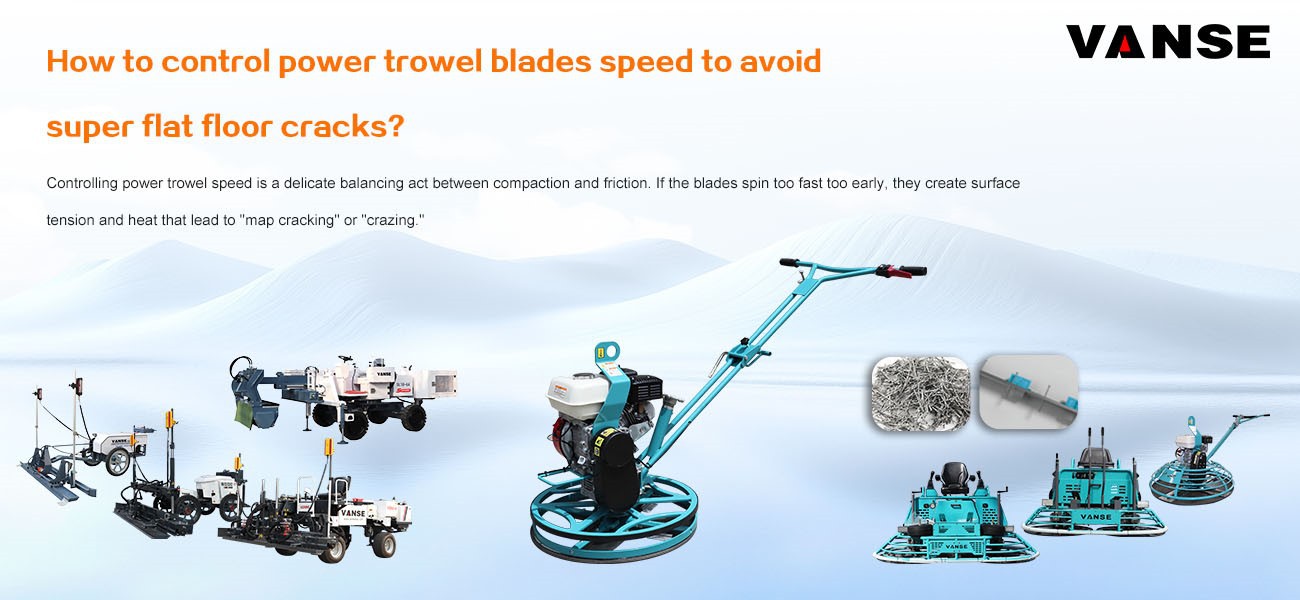
Controlling power trowel speed is a delicate balancing act between compaction and friction. If the blades spin too fast too early, they create surface tension and heat that lead to "map cracking" or "crazing."
To maintain an ultra-flat (FF) rating while preventing cracks, follow these speed and pitch protocols:
1. The Panning Phase (Low Speed, Zero Pitch)
The goal here is to break down the ridges left by the laser leveling and consolidate the surface without sealing it prematurely.
Speed Setting: Low to Medium (50–80 RPM). * Why: High speeds at this stage can create "rotational shear," where the top layer of concrete is moved faster than the base, causing delamination or plastic shrinkage cracks.
Technique: Use float pans (large metal disks) attached to the blades. Keep the blades completely flat. If you spin too fast with pans, you risk "throwing" the machine or creating a wavy surface that ruins your flatness.
2. The Initial Power Trowel (Medium Speed, Slight Pitch)
Once the bleed water has disappeared and the concrete can support the weight of the operator with only a 1/8" footprint, you move to the first "finishing" passes.
Speed Setting: Medium (80–110 RPM).
The "Crack Prevention" Fix: As you increase speed, you must slightly increase the pitch (angle) of the blades. This reduces the surface area of the blade in contact with the concrete, which lowers the friction-generated heat.
Observation: If you see the surface "tearing" or small "chicken-wire" cracks appearing, your RPM is too high for the current moisture content. Slow down immediately.
3. The Final Burnish (High Speed, High Pitch)
This is where you achieve that "mirror" finish. However, this is also the highest risk zone for "burnish cracks."
Speed Setting: High (120+ RPM).
Setting the Blades: Tilt the blades to a sharp angle. This puts maximum pressure on a small area to densify the surface.
The Danger: If the blades are spinning at high RPM on a surface that is getting too dry, the friction generates localized heat. This causes the top 1/16" of the slab to expand and then rapidly contract, leading to thermal cracking.
The Correction: If the concrete is "ringing" (making a high-pitched metallic sound) and looks scorched, ease off the throttle.
Summary of Speed VS Slab Maturity
| Stage | Blade Pitch | Recommended RPM | Goal |
| Floating (Panning) | Flat (0°) | 50 – 80 | Remove ridges; Consolidate |
| Initial Finish | Slight (5° – 10°) | 80 – 110 | Close the pores |
| Final Burnish | High (20°+) | 120 – 150 | Densify and shine |
Pro-Tip: The "Slab Moisture" Variable
The biggest mistake is staying at high RPM for too long on a "hot" (fast-setting) day. As the concrete loses moisture, it becomes more abrasive. Abrasive concrete + High RPM = Blistering and Cracking.
Quick Correction: If you notice the surface drying too fast for your machine speed, apply a finishing aid (evaporation retardant). This lubricates the blades and allows you to maintain higher speeds without tearing the surface.
Would you like me to explain how to coordinate the laser leveling passes with the trowel timing to ensure the edges don't dry out before the center? Contact us NOW
Note: The parameters provided in this document are for reference only and are not mandatory. Due to differences in technical characteristics between different brands and models of laser levelers, please consult the manufacturer for a suitable solution before actual operation. This reference document assumes no responsibility for any issues arising from failure to follow the manufacturer's instructions.
Thanks to All the Friends Who Support and Trust Shandong Vanse Machinery Technology Co., Ltd.
If you want to know more about Shandong Vanse Machinery Technology Co., Ltd. or have any questions, please feel free to contact us:
Our Factory
Shandong Vanse Machinery Technology Co., Ltd.








Share this article

About the Author: Shandong Vanse Machinery Technology Co., Ltd.
Shandong Vanse Machinery Technology Co., Ltd. is a high-tech manufacturer specializing in concrete construction machinery, including laser screeds and related equipment. The company integrates R&D, production, and global sales, with products exported to over 60 countries and widely used in infrastructure projects worldwide.
Previous Post
Next Post
Related Articles
You Might Also Like
Cooperate with laser leveling machine to ensure the quality of concrete floor engineering
In order to ensure the construction quality of concrete floor, more and more construction units now choose to use precision laser leveling machines to lay concrete floor. However, in the actual construction process, due to the inadequate cooperation of some enterprises in construction, or not strictly following the regulations to operate correctly, the quality of concrete floor construction is sometimes poor. In order to avoid such a situation from happening again, our company has made a detailed description of some matters related to the construction cooperation during the construction of the laser leveling machine. We hope that the relevant construction personnel will keep it in mind. ❖Wall line laying and leveling: Since the laser leveling machine cannot touch the wall, manual leveling is required within 200mm from the wall, so it is necessary to lay out the line as a reference for manual leveling. At the same time, set 2 to 3 leveling base points (ground design elevation, i.e. ±0.0) that are not disturbed during the construction period for the laser leveling machine to use at one time, and require good mutual visibility. Leveling point accuracy ±1mm. ❖Set templates (steel templates, the position is determined according to design requirements) around the columns to form separation seams. The elevation of the top surface of the template should be controlled within +0mm and -2mm to avoid affecting the flatness of the joints. ❖Installing construction joint formwork: Install the construction joint template along the range to be poured on the day (steel template is recommended), and the template should reserve holes with a spacing of 300mm for the insertion of the force transmission rod. The elevation of the top surface of the template should be controlled within +0mm and -2mm to avoid large deviations in the flatness of the joints of different bins. ❖Laser transmitter installation: It is planned to be installed on the column. The specific location should be set at a better location according to the amount of paving on the day. If it cannot be installed on the column, it should be installed on a special tripod. ❖In order to ensure the quality of concrete floor paving, each group needs to arrange 10 to 12 workers to cooperate to flatten the surface of the concrete spread on the ground so that the pile is slightly higher than the design elevation (about 20 to 30mm). At the same time, for the parts near the wall, exposed pipelines and the surrounding of the formwork, two workers are arranged to manually smooth the concrete material about 20~30cm away from the wall (formwork) (using a 2m scraper with an iron trowel). The workers responsible for smoothing the edges must be trained and skilled plasterers. These workers must obey the command and follow the arrangement to ensure the quality of construction. ❖ Since the thickness of the concrete reaches 200mm, and because of the installation of steel mesh, in order to ensure the compaction of the concrete, this project needs to arrange a vibrating rod to cooperate with the vibration. At the same time, in order to ensure that the protective layer of the steel mesh reaches the design requirement of thickness (70mm), it is necessary to arrange for manual lifting of the steel mesh and pad the support block in the range to be paved in advance. ❖ The width of the concrete material paved on the platform each time is required to be no more than 5m, and the length is based on the formwork boundary. The construction direction is from left to right (along the short side direction) and from front to back (along the long side direction). The recommended daily paving volume is 1200~1500㎡. Calculated based on 12 hours of working time per day, the feed rate is required to be 30 to 40m³. ❖Others: To ensure the flatness of the ground, special attention should be paid during the construction of the laser leveling machine: the slump of the concrete delivered to the platform each time must be consistent; the concrete feed rate must reach 40m. per hour or more, and the initial setting time of each batch of concrete must be consistent; the template elevation must be accurate and cannot be disturbed during construction; environmental coordination. The newly constructed concrete floor cannot be exposed to sunlight, wind, rain and other environments that are unfavorable to the curing of concrete. Special reminder: In order to make the laser leveling machine give full play to its inherent functions and ensure the construction quality and efficiency of the concrete floor, in addition to mastering the above-mentioned construction coordination precautions, there are many details that need to be paid attention to. Please look forward to the subsequent updates and sharing of this site.How to measure the compaction effect of concrete power trowel?
– Measurement tools and methods: Use a 2m ruler and a feeler gauge to measure the flatness of the concrete surface. Place the 2m ruler on the concrete surface and use the feeler gauge to measure the gap between the ruler and the ground. The smaller the gap, the higher the ground flatness and the better the compaction effect of the trowel. For example, in the construction of high-precision industrial plant floors, the flatness deviation is required to be within 2-3mm, which requires the trowel to have good compaction performance to meet this standard. – Industry standards and requirements of actual application scenarios: Different application scenarios have different requirements for flatness. For general outdoor road surfaces, the allowable flatness deviation may be 5-10mm; while for indoor high-end shopping malls, exhibition hall floors, etc., the requirements may be higher, and the deviation is usually 1-3mm. If the flatness of the ground after compaction by the trowel can meet the requirements of the corresponding scene, it means that the compaction effect is good. – Test method: The density can be indirectly reflected by surface hardness test. Use a rebound hammer to test the concrete surface. The higher the rebound value, the harder the concrete surface is and the higher its density may be. In addition, the core sampling method can also be used to observe the internal structure of the concrete core sample. If the core sample has small pores and a dense structure, it means that the compaction effect of the trowel machine is good. – Influence on concrete durability: Good density can improve the durability of concrete. A concrete surface with good compaction effect can effectively resist the erosion of external environmental factors (such as moisture, chemicals, etc.) and reduce the occurrence of cracks. For example, on the concrete surface of hydraulic structures, high density can prevent water penetration and extend the service life of the building. – Visual evaluation and standards: Observe the uniformity of the trowel marks on the concrete surface with the naked eye. Uniform trowel marks indicate that the pressure applied by the trowel machine to the ground during work is uniform and the compaction effect is good. If the surface is obviously uneven, wavy, or partially troweled, it means that there is a problem in the compaction process. – Correlation with compaction quality: The uniformity of the trowel marks reflects the stability and uniformity of the contact between the trowel blade and the ground during the compaction process. Stable and uniform contact can ensure that the concrete particles are evenly distributed under pressure, thereby improving the compaction quality. For example, in the construction of a large area of parking lot floor, uniform trowel marks can make the ground look smoother and more beautiful, and also mean a good compaction effect. – Laboratory testing and field evaluation: In the laboratory, standard concrete test blocks can be made, one part is compacted by the trowel machine, and the other part is not treated, and their compressive strength is tested under the same curing conditions. On site, it can be evaluated by testing the actual bearing capacity of the concrete structure. If the strength growth of the concrete compacted by the trowel machine meets the expected design requirements, or even exceeds that of the untreated concrete, it means that the compaction effect of the trowel machine helps to improve the strength of the concrete. – Importance to building structure safety: Concrete strength is an important indicator of building structure safety. Good compaction effect can make the internal structure of concrete denser, effectively improve the strength of concrete, and thus ensure the safety of the building structure. For example, in the concrete construction of key parts such as the foundation, beams and columns of a building, the compaction effect of the trowel plays a vital role in the long-term stability of the structure.Can a concrete laser leveling machine handle slopes? Which settings work best?
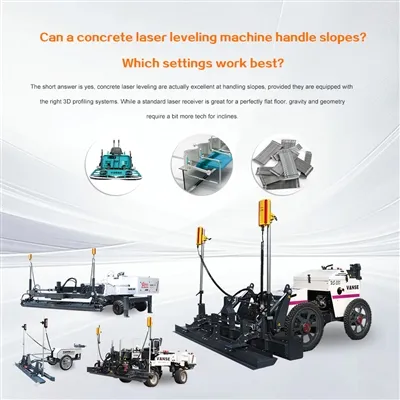
The short answer is yes, concrete laser leveling are actually excellent at handling slopes, provided they are equipped with the right 3D profiling systems. While a standard laser receiver is great for a perfectly flat floor, gravity and geometry require a bit more tech for inclines. Standard laser leveling uses a rotating laser transmitter on a tripod and receivers on the machine. This creates a flat "plane" of light. Single/Dual Slopes (2D): If you are doing a simple parking lot ramp or a consistent drainage slope, you can physically tilt the laser transmitter on its tripod to a specific percentage (e.g., a 1% grade). The machine will then follow that tilted plane.Complex Contours (3D): For complex curbs, valleys, or multi-directional slopes, the machine uses 3D Profiling Systems (often involving a Total Station or GPS). This allows the leveling to automatically adjust the head height based on its exact coordinate position on a digital map. To get the best finish on a slope, you can't just "set it and forget it." You need to account for the way wet concrete behaves under gravity. On a slope, concrete tends to "slump" or migrate downward. Setting: Keep the auger speed high enough to move excess material but not so fast that it creates a "wave" of concrete that pulls away from the high side. The vibrator is what settles the aggregate and brings the "cream" to the top. Setting: On steep slopes, lower the vibration frequency slightly. Over-vibrating on an incline can cause the concrete to fluidize too much, leading it to slide down the hill before it sets (slumping). Best Practice: Generally, you want to pull the machine up the slope or work across the fall. Pulling downhill can lead to "shingling," where the leveling head pushes too much material in front of it, resulting in an uneven thickness. If your machine has slope compensation software, ensure it is toggled on. This adjusts the hydraulic response time to ensure the leveling head reacts instantly to changes in elevation without "hunting" or bouncing, which happens more often on uneven grades. Factor Standard Flat Setting Slope Setting Laser Mode Horizontal / Level Grade / Manual Slope Vibration High / Normal Reduced (to prevent slump) Travel Speed Faster Slower & More Consistent Concrete Slump 4" – 5" 3" – 4" (Lower is better for slopes) Note: The parameters provided in this document are for reference only and are not mandatory. Due to differences in technical characteristics between different brands and models of laser levelers, please consult the manufacturer for a suitable solution before actual operation. This reference document assumes no responsibility for any issues arising from failure to follow the manufacturer's instructions.