Technical Knowledge
How to evaluate the effect of debugging and calibration of concrete laser leveling machine?
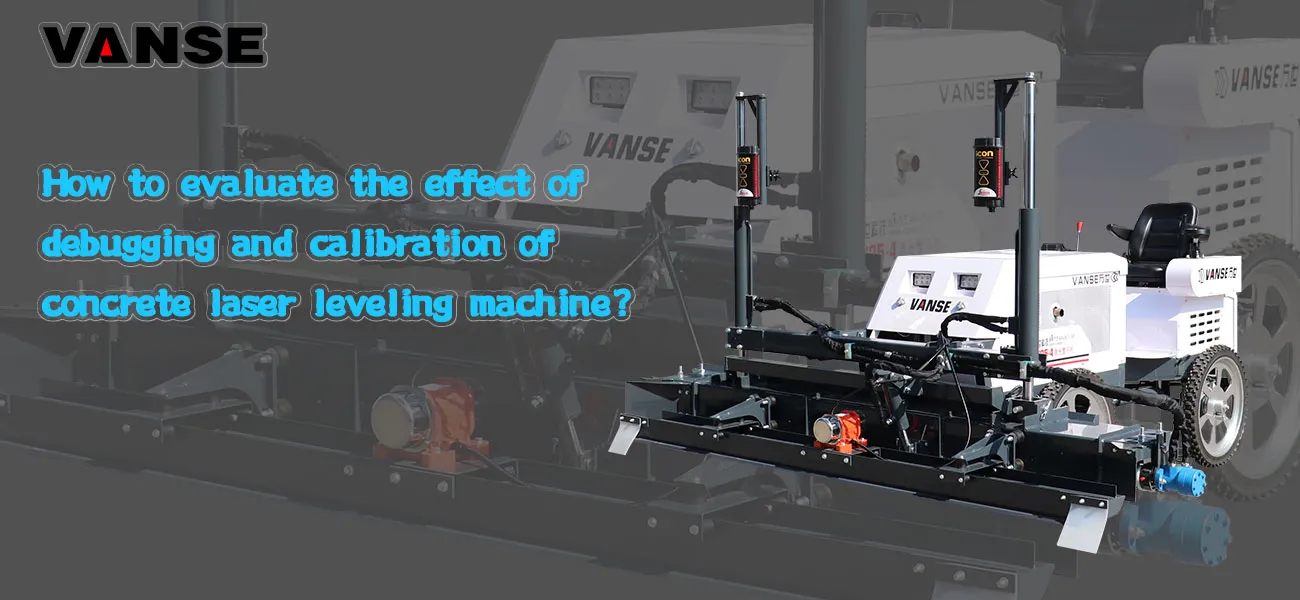
Evaluating the commissioning and calibration of a concrete laser leveling is a systematic process, with the core criteria being "efficient construction" and "high-quality finished products." A successfully commissioned and calibrated machine should perform exceptionally well during construction, ultimately delivering a concrete surface that meets or exceeds expectations.
The following are detailed dimensions and methods for evaluating its effectiveness, which can be viewed from both process indicators and outcome indicators:
1. Process indicators: performance during construction after commissioning and calibration
These indicators focus on whether the machine is stable, efficient and reliable during operation.
Benchmark establishment stability
Evaluation method:
Check whether the laser transmitter is securely mounted and whether its automatic leveling function is sensitive and accurate. Move the receiver within the effective range and observe whether the signal strength and data on the control panel are stable and without jumps.
Good results:
The laser transmitter is stable, and the signal covers the entire construction area without blind spots. The receiver can quickly capture and lock the signal at any position, and the device responds promptly.
Machine response and execution accuracy
Evaluation method:
Manual test:
Without pouring concrete, start the leveling machine and observe whether the lifting and lowering action of the scraper (or mixing cage) is completely synchronized with the control command (manual raising/lowering), linear, and without delay.
Automatic test:
Place the leveling machine in a test area with a set elevation (such as a hardened floor), turn on the automatic mode, and the machine should automatically adjust the scraper according to the laser signal and maintain it at the designed height without any abnormal up and down fluctuations or "chasing" phenomenon (over-adjustment).
Good results:
The hydraulic or electric actuator moves smoothly, accurately, and without shock. The system corrects height deviations quickly and gently, without oscillation, demonstrating a good control algorithm.
Construction continuity and efficiency
Evaluation method:
Observe the performance during the actual pouring process. Does the operator need frequent manual intervention? Can the machine perform the leveling operation continuously?
Good results:
The construction process is smooth, and the leveling machine can "follow" the concrete pouring progress and continue to work, greatly reducing the downtime and waiting caused by equipment debugging problems, and significantly improving production efficiency.
2. Result indicators: Final concrete floor quality
This is the most direct and reliable indicator for evaluating the effectiveness of commissioning and calibration. The quality of the final poured concrete floor must be verified by actual measured data.
Flatness
Evaluation tools: Use rulers and feeler gauges for routine testing. For more professional evaluation, use a floor flatness tester to measure F₃₀ and F₄₀ value.
Good results:
General standard:
Use a 2-meter ruler to check, the gap should not be larger than 3-5mm.
High standards: meet or even exceed the design requirements of F₃₀/F₄₀Values (e.g., F₃₀ ≥ 90%, F₄₀ ≥ 70%). This is the core value of the laser leveling machine.
Levelness
Evaluation tools:
level or electronic level.
Good results:
The elevation of all points on large-area floors is consistent with the design elevation, with a very small error (usually required to be within ±3mm to ±5mm). Large areas are free of water accumulation.
Surface quality
Evaluation method: visual inspection.
Good results:
The surface is dense and uniform, without obvious scraper marks, aggregate separation, honeycomb surface or cracks. The slurry is evenly mixed, providing a good foundation for the subsequent finishing process.
3. Comprehensive Evaluation and Summary
A successful commissioning and calibration should bring the following comprehensive benefits:
| Evaluation Dimensions | Good debugging and calibration results | Debugging poor calibration results |
| Flatness/levelness | Very high, data meets standards and is uniform and consistent | Uneven, large data fluctuations, and local deviations |
| Construction efficiency | High, continuous operation, less manual intervention | Low, frequent shutdowns for adjustments, relying on workers' experience |
| Operation difficulty | Low, easy for operators to control, low labor intensity | High, the operator needs to make manual corrections constantly, which is stressful |
| Material saving | Precise control of concrete paving thickness, saving materials | Uneven thickness may cause material waste |
| Post-Processing | Good surface quality and small finishing workload | Many surface defects, requiring additional repair work |
| Equipment loss | Smooth operation, little wear on hydraulic system, scraper and other components | Frequent abnormal movements increase equipment wear |
How to conduct acceptance evaluation systematically?
No-load test:
After completing all hardware and software settings, perform a no-load operation test to check whether all actions are normal.
Simulation test:
Set a known elevation on hardened ground and let the machine run automatically to verify its accuracy in positioning and maintaining the elevation.
Small area trial pouring:
Select a small area (such as 10m x 10m) for actual concrete pouring and leveling, which is the most critical step.
Actual measurement:
After the trial pouring area is completely solidified (or measured promptly after initial setting, taking care to protect the surface), use tools such as a ruler and a level to conduct comprehensive measurements and collect data.
Analysis and Adjustment:
Determine the effect based on the measured data. If it does not meet the standard, analyze whether it is a mechanical failure, laser system error, or parameter setting problem, make fine adjustments, and repeat the test until the effect is satisfactory.
Large-area construction monitoring:
During formal large-area construction, it is still necessary to regularly review the laser transmitter benchmark and the machine's zero point to ensure long-term working stability.
In short, the evaluation of the debugging and calibration effect of the concrete laser leveling machine must not be based on feelings alone, but must rely on "data". The ultimate evaluation standard is whether it can efficiently and stably produce concrete floors with flatness, levelness and surface quality that meet the design requirements without frequent human intervention.
Click the below to jump immediately!!!


Thanks to All the Friends Who Support and Trust Shandong Vanse Machinery Technology Co., Ltd.
If you want to know more about Shandong Vanse Machinery Technology Co., Ltd. or have any questions, please feel free to contact us:
Our Factory
Shandong Vanse Machinery Technology Co., Ltd.








Share this article

About the Author: Shandong Vanse Machinery Technology Co., Ltd.
Shandong Vanse Machinery Technology Co., Ltd. is a high-tech manufacturer specializing in concrete construction machinery, including laser screeds and related equipment. The company integrates R&D, production, and global sales, with products exported to over 60 countries and widely used in infrastructure projects worldwide.
Previous Post
Next Post
Related Articles
You Might Also Like
Concrete Laser Leveling Machine Application Fields
The concrete laser leveling is an efficient construction equipment that is widely used in modern construction sites. It has a wide range of applications and can be used in many fields, such as industrial plants, workshops, automated three-dimensional warehouses, electronic appliances, food materials, pharmaceutical large-scale warehouse supermarkets, logistics centers, exhibition centers, docks, container yards, cargo yards, Airport runways, aprons, parking lots, squares, residential grounds, municipal roads, etc. In industrial plants and workshops, concrete laser levelings can lay flatter floors for production lines, facilitate the movement of equipment, machines and personnel, and improve production efficiency and product quality. In automated three-dimensional warehouses, this equipment can provide a flat floor for the storage and transportation of goods, improving the operational efficiency of the warehouse and the safety of goods. In the fields of electronic appliances and food materials, concrete laser leveling machines can provide flat floors for production workshops and warehouses to ensure product quality and safety. In the pharmaceutical field, this equipment can provide a dust-free, flat floor for pharmaceutical production and storage, ensuring the quality and safety of pharmaceuticals. In large warehouse supermarkets and logistics centers, concrete laser leveling machines can provide a flat floor for the storage and transportation of goods, improve the turnover efficiency of goods and reduce damage to goods. In the exhibition center, this equipment can provide a flat floor for the exhibition hall to ensure the smooth progress of the exhibition. In terminals and container yards, concrete laser levelings can provide a flat surface for the transportation of goods and equipment, improve terminal operation efficiency and reduce damage to goods. In airport runways, this equipment can provide a flat surface for aircraft to take off and land, ensuring the safety of aircraft and the comfort of passengers. In parking lots and squares, concrete laser levelings can provide vehicles with a smooth driving surface, reduce vehicle wear and noise, and improve driving safety and comfort. In residential grounds and municipal pavements, this equipment can provide residents with smooth and beautiful roads and public facilities, improving residents' quality of life and the image of the city. In general, the concrete laser leveling machine is an efficient, accurate, and flexible sensor device that is used in many fields such as construction, transportation, and T industries. It has injected new impetus into the development of various industries and promoted the construction industry. development of the industry. With the continuous development of new technologies, concrete laser levelings have unlimited development potential and will become an indispensable and important equipment in the construction industry. In addition to the application areas mentioned above, concrete laser levelings can also be used in other places where ground leveling is required. For example, in the construction of garden landscapes, the equipment can provide flat ground for garden roads and squares: in the construction of sports venues, the equipment can provide flat, non-slip ground for sports venues; in the agricultural field, the equipment can provide flat, non-slip ground for farmland. and greenhouses provide a flat ground to improve crop growth efficiency and yield. In addition, concrete laser levelinging machines can also be used in some special environments. For example, in cold areas, the equipment can work normally in low-temperature environments to facilitate winter construction; in desert areas, the equipment can adapt to construction in harsh environmental conditions such as sandstorms; in marine environments, the equipment can be used Construction of offshore platforms and docks In short, the application fields of concrete laser leveling machines are very wide and can be used in various places and special environmental conditions that require smoothing of the ground. With the continuous advancement of technology and the continuous expansion of application fields, the application prospects of concrete laser leveling machines will become even broader.Is the concrete laser leveling machine easy to use? Is it worth buying?
The concrete laser leveling has been officially on the market for 8 years so far, and the quality technology has become mature and stable. There are fewer and fewer young people working in the construction and flooring industry. A project requires at least 20 people. According to the minimum wage standard of 150 yuan/person per day, the daily personnel expense is 3,000 yuan, and the average age of the personnel is 50 years old. Above, work efficiency cannot be guaranteed. In addition, formwork and channel steel need to be supported, which is a considerable expense. It takes up to eight people to complete a job with a laser leveling machine. The daily salary cost is 1,200 yuan, which saves 600,000 yuan a year. The money saved can be used to buy a luxury car. Today's laser leveling machines are becoming more and more intelligent, and the operation is very simple and can be learned in a while. The ground error made by the laser leveling machine is also small and easily reaches the standard. The results produced by the laser leveling machine will quickly make you famous, and many people will come to you to work for you. You can also rent out your machine to make some extra money if it is idle. In the future, you don't have to worry if you encounter projects that require fast construction deadlines and small error requirements. I can do 300 square meters in one hour, and I guarantee that it will be completed on time, and the work will be done beautifully and you will be waiting for payment. Nowadays, the configuration of laser leveling machines is becoming more and more perfect, and there are many configurations for you to choose from. Some are suitable for sloping, some are suitable for workshop floors, some are suitable for pig farms, some are suitable for residential floor steel mesh, and some are suitable for basement garages. Yes, you can also customize it according to your actual situation. VANSE Laser Leveling Machine has been in the industry for so many years and has been constantly researching and innovating. The technology is getting better and better, and the machines are getting better and better to use. Every new laser leveling machine developed is sought after by the market. Small laser leveling machines, large laser leveling machines, and heavy-duty concrete telescopic arm leveling machines are all mature. With stable production experience, the quality of laser leveling machines has been recognized and affirmed by customers. VANSE's after-sales service is also well-known in the industry. VANSE always puts the interests of customers first. Any needs for laser leveling machines will be solved as soon as possible, which is something other companies cannot do. When choosing a laser leveling machine, don't we just look at the quality and after-sales service? 13 years of production and sales experience are enough to prove the quality of the machine, and the good after-sales reputation and word-of-mouth from old customers are enough to prove our after-sales service. And we can provide you with professional construction plans based on our many years of experience.Maintenance and Troubleshooting of Concrete Laser Leveling Machines
As high-precision construction equipment, the maintenance and troubleshooting of concrete laser Leveling machines are crucial for ensuring floor flatness. Based on the operating standards of leading industry brands such as Vanse, the following is a detailed maintenance schedule and troubleshooting guide: Cycle Key Inspection Items Specific Procedures: After each construction session Full Machine Cleaning The machine body, leveling head, and vibrating plate must be thoroughly rinsed with a high-pressure water gun before the concrete hardens; concrete adhesion is strictly prohibited. Daily (before commencement) Hydraulics and Lubrication Check hydraulic oil level, engine oil level, and coolant level. Check if all moving joints require grease. Weekly Laser System Check the stability of the laser transmitter tripod and the accuracy of the handheld receiver; clean the laser receiver lens (with a soft cloth). Monthly (50-100 hours) Fastening and Filtration Tighten the chassis and leveling head bolts; check/clean the air filter; check for leaks in the hydraulic lines. Quarterly (300 hours) Oil Change Change the engine oil and filter (replace within the first 50 hours of operation for new machines); check the hydraulic oil quality (whether it has emulsified). Symptom: The automatic lifting and lowering of the leveling head malfunctions, and the display alarm indicates no laser signal. Troubleshooting Steps: External Interference: Check if there are vehicles, pillars, or construction workers obstructing the laser transmitter. Dirty Receiver: Check if there are concrete droplets on the laser receiver window mounted on the machine body. Wipe it with a non-woven cloth. Excessive Vibration: Check if the laser transmitter tripod is placed on a stable surface to avoid interference from nearby heavy vehicles. Battery Power: Check if the transmitter's power is reduced due to low battery power. Symptom: After the machine passes over the surface, wavy lines or significant height deviations appear. Troubleshooting Steps: Elevation Verification: Recalibrate the reference elevations of the laser transmitter and handheld receiver. Leveling Head Angle: Check if the vibrating plate angle has shifted due to impact; it needs to be adjusted back to the standard horizontal position. Leveling Head Angle: Check if the vibrating plate angle has shifted due to impact; it needs to be adjusted back to the standard horizontal position. Concrete Slump: Check the concrete's consistency. If the concrete is too dry, the machine vibration will not adequately lift the slurry; if it is too thin, it is prone to collapse. Symptoms: Slow machine movement, sluggish steering, or slow lifting and lowering of the leveling head. Troubleshooting Steps: Insufficient Hydraulic Oil: Check the hydraulic oil level in the tank and replenish to the standard mark. Clogged Filter: A clogged hydraulic return filter can cause excessive back pressure and requires replacement. Loose Belt: Check if the hydraulic pump belt driven by the engine is slipping. Symptoms: The starter motor makes noise but the engine fails to start, or the engine suddenly shuts off during operation. Troubleshooting Steps: Fuel System: Check the fuel tank for water and ensure the fuel filter is not clogged with low-quality diesel fuel. Electrical Issues: Check the battery terminals for looseness or corrosion/oxidation. Waterproofing and Moisture Prevention: The laser transmitter and receiver are high-precision electronic components and must be stored in the original manufacturer's moisture-proof box. Operation with Malfunctions Strictly Prohibited: If abnormal vibration frequency of the leveling head is detected, the machine should be stopped immediately. Otherwise, it will lead to uneven floor compaction and extremely high rework costs. Vanse Machinery Recommendation: For this brand of machine, it is recommended to contact the manufacturer for laser system calibration every year to ensure that the construction accuracy is within one ten-thousandth of an error. Note: The parameters provided in this document are for reference only and are not mandatory. Due to differences in technical characteristics between different brands and models of laser levelers, please consult the manufacturer for a suitable solution before actual operation. This reference document assumes no responsibility for any issues arising from failure to follow the manufacturer's instructions.