Technical Knowledge
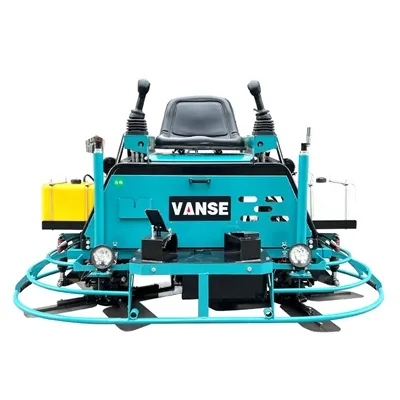
What are the common faults and solutions of riding power trowel machines?

Common faults and solutions of ride-on trowels are as follows:
Engine cannot start
Cause of fault
Fuel problem: Insufficient fuel or poor fuel quality may cause the engine to fail to start. For example, using fuel containing impurities or too much water will affect the combustion process.
Spark plug failure:
The spark plug is worn or seriously carbonized, and cannot produce a strong enough spark to ignite the mixture. This is prone to happen to the spark plug after long-term use or working in harsh environments.
Air filter blockage:
Air cannot enter the engine smoothly, causing the mixture ratio to be unbalanced, affecting combustion. In a dusty construction environment, the air filter is easily blocked.
Starter motor failure:
The starter motor is damaged and cannot drive the engine crankshaft to rotate, so it cannot start. Motor brush wear, winding short circuit, etc. may cause failures.
Solution
Check the fuel:
Make sure there is enough fuel and use qualified fuel. If you suspect there is a problem with the fuel, you can replace it with new fuel.
Check and replace spark plugs:
Check the status of spark plugs regularly, clean carbon deposits or replace worn spark plugs. Generally speaking, the service life of spark plugs varies according to the frequency of use and working conditions, and they need to be checked about every 100-200 hours of working time.
Clean or replace air filter:
Clean the air filter regularly according to the dust conditions in the working environment. If the blockage is serious, replace the new filter in time.
Check the starter motor:
If the starter motor is faulty, it needs to be repaired or replaced by a professional.
Abnormal vibration of the trowel machine
Cause of failure
Improper installation of the trowel or spatula:
The trowel or spatula is not installed firmly, which will cause looseness and abnormal vibration during operation. It may be that the mounting screws are not tightened, or the spatula is displaced by impact during use.
Bearing damage:
The bearings of the trowel machine may wear or be damaged after long-term use, causing abnormal vibration of the machine. For example, the bearings may be damaged by lack of lubrication or excessive load.
Engine is unstable:
The engine vibrates when it is working, which will be transmitted to the working parts of the trowel machine, causing abnormal overall vibration. This may be caused by reasons such as engine throttle failure and nozzle blockage.
Solution
Check and reinstall the trowel and spatula:
Carefully check the installation of the trowel and spatula before use, and ensure that the screws are tightened and the spatula is evenly arranged. If the spatula is found to be damaged or deformed, it should be replaced in time.
Replace the bearing:
When the bearing is suspected to be damaged, it is necessary to disassemble the relevant parts to check the bearing status. If the bearing is damaged, it should be replaced with a bearing of the same model as the original, and ensure that it is installed correctly, and add an appropriate amount of grease.
Check the engine stability:
Perform a comprehensive inspection of the engine, including the opening of the throttle, the injection of the nozzle, etc. Professional diagnostic tools can be used to detect the working parameters of the engine, and corresponding repairs and adjustments can be made according to the test results.
Unsatisfactory trowel effect
Cause of failure
Trowel wear:
After long-term use, the blade of the trowel will wear and become less sharp, affecting the trowel effect. For example, when smoothing a concrete surface with a higher hardness, the trowel will wear out faster.
Improper machine travel speed:
If the travel speed of the ride-on trowel is too fast or too slow, the ideal smoothing effect cannot be achieved. If the speed is too fast, the trowel will act on each part for a short time and cannot smooth the surface; if the speed is too slow, it will affect work efficiency.
Excessive unevenness of the concrete surface:
If the unevenness of the concrete surface itself exceeds the processing range of the trowel, such as large protrusions or depressions, it is also difficult to obtain a good smoothing effect.
Solution
Replace the trowel:
Check the wear of the trowel regularly, and replace it with a new one in time when the trowel is worn to a certain extent. Generally speaking, the trowel needs to be replaced if the blade wears more than 2-3 mm.
Adjust the machine travel speed:
According to the state of the concrete and the requirements for smoothing, reasonably adjust the travel speed of the trowel. In the initial smoothing stage, you can slow down the speed appropriately to ensure that the trowel can fully act on the concrete surface; in the fine smoothing stage, you can speed up appropriately.
Pre-treat the concrete surface:
Before using the trowel, preliminarily treat the concrete surface, such as using a scraper or other tools to roughly flatten the surface so that the unevenness is within the effective working range of the trowel.
Machine driving problems
Cause of failure
Tire damage:
Punctured, severely worn or insufficient tire pressure will affect the driving stability and normal driving of the trowel. At the construction site, sharp objects can easily puncture tires.
Steering system failure:
Damage or wear of steering system components such as steering shafts and knuckles will cause the trowel to turn inflexibly or lose control. For example, a loose connection at the steering shaft will cause inaccurate steering operations.
Transmission system failure:
Broken or loose transmission chains or belts, or problems with the gearbox will affect the power transmission of the trowel and cause abnormal driving.
Solution
Check and repair tires:
Regularly check the tire pressure and wear, and repair or replace tires in time if they are damaged. Keep the tire pressure within the specified range. Generally, the tire pressure of a riding trowel is about 2-3 atmospheres.
Check and repair the steering system:
Check the steering system, tighten loose parts, and replace worn parts. For example, if the steering knuckle is severely worn, it should be replaced with a new one, and the steering clearance should be adjusted.
Check the transmission system:
Check the tightness of the transmission chain or belt, and adjust or replace it if necessary. For problems with the gearbox, such as difficulty in shifting gears, abnormal noises, etc., professional maintenance personnel are required to inspect and repair.
Thanks to All the Friends Who Support and Trust Shandong Vanse Machinery Technology Co., Ltd.
If you want to know more about Shandong Vanse Machinery Technology Co., Ltd. or have any questions, please feel free to contact us:
Our Factory
Shandong Vanse Machinery Technology Co., Ltd.








Share this article

About the Author: Shandong Vanse Machinery Technology Co., Ltd.
Shandong Vanse Machinery Technology Co., Ltd. is a high-tech manufacturer specializing in concrete construction machinery, including laser screeds and related equipment. The company integrates R&D, production, and global sales, with products exported to over 60 countries and widely used in infrastructure projects worldwide.
Previous Post
Next Post
Related Articles
You Might Also Like
Concrete cutting machine used are
(Also known as hydraulic wall saw cutting machine), electric wall saw cutting machine, hand chain sawing machine, road cutting machine, large-scale road cutting machine, diamond drilling cutting equipment, ultra-high pressure Water cutting machine (also known as high pressure water gun cutting machine: due to the cost and construction of expensive, the current market has not been widely used) and other equipment for cutting concrete construction.What is the impact of the compaction effect of the concrete power trowel on the durability of the ground?
– Principle: Good compaction makes the concrete surface denser. When the internal pores of concrete are reduced and the particles are more tightly bound, the ground can better resist wear when subjected to external forces such as friction, pedestrians walking or vehicles driving. For example, in places such as factory workshops or parking lots, fully compacted concrete floors can effectively reduce the damage caused by friction of vehicle tires and scratches of cargo handling equipment. – Comparative case: In two similar parking lot floors, one is well compacted by a trowel and the other is poorly compacted. After a period of use, the poorly compacted floor may show sanding and surface peeling, while the well-compacted floor still maintains good integrity and has significantly lower wear. – Principle: Concrete with good compaction has low internal porosity, forming a relatively continuous structure that can effectively prevent the penetration of moisture, chemicals, etc. Moisture is one of the key factors affecting the durability of concrete, which may cause problems such as steel corrosion and concrete freeze-thaw damage. For example, on the concrete surface of hydraulic structures, good compaction can prevent water from penetrating and protect the internal concrete structure from water erosion. – Experimental data support: Through experimental tests, concrete specimens with low porosity (such as less than 8%) after compaction have a significantly higher impermeability grade (such as reaching P8 or above) than specimens with high porosity. This means that concrete with good compaction effect can better resist the invasion of external moisture, thereby improving the durability of the ground. – Principle: During the solidification process, fully compacted concrete can reduce the possibility of cracks due to uneven shrinkage due to more uniform internal stress distribution. Concrete will shrink in volume during the hardening process. If the internal structure is uneven, cracks are likely to form in weak parts. For example, in large-area concrete floor construction, good compaction can make the strength and stiffness of each part of the concrete closer, reducing the risk of cracks due to shrinkage differences. – Actual application scenarios: In the floor panels of buildings or road pavements, poorly compacted concrete is more likely to crack early, which will become channels for moisture and harmful chemicals to enter the concrete, accelerating the damage of the concrete. Well-compacted ground can maintain the integrity of the structure and extend its service life. – Principle: The dense concrete structure can prevent the intrusion of chemicals (such as acid rain, industrial wastewater, deicing salt, etc.). When the pores on the concrete surface are reduced, it is difficult for chemicals to penetrate into the interior, thereby reducing the damage to the concrete caused by chemical reactions. For example, on roads using deicing salt in winter, concrete pavements with good compaction can reduce the penetration of chloride ions in the deicing salt and reduce the risk of corrosion to the steel bars inside the concrete. – Long-term effect observation: In environments with more exposure to chemicals such as chemical parks, long-term observations of ground durability have found that well-compacted concrete floors can maintain good performance over many years of use, while poorly compacted floors may experience surface corrosion and peeling in a relatively short period of time.What is the principle of leveling machine
The principle of the leveling machine is mainly to use laser control technology, closed-loop control technology and high-precision hydraulic system, and then use the computer to adjust the control, so that the scraper and vibration instrument of the leveling head can complete most of the procedures in the project, realizing one-time Through this, the computer…