Technical Knowledge
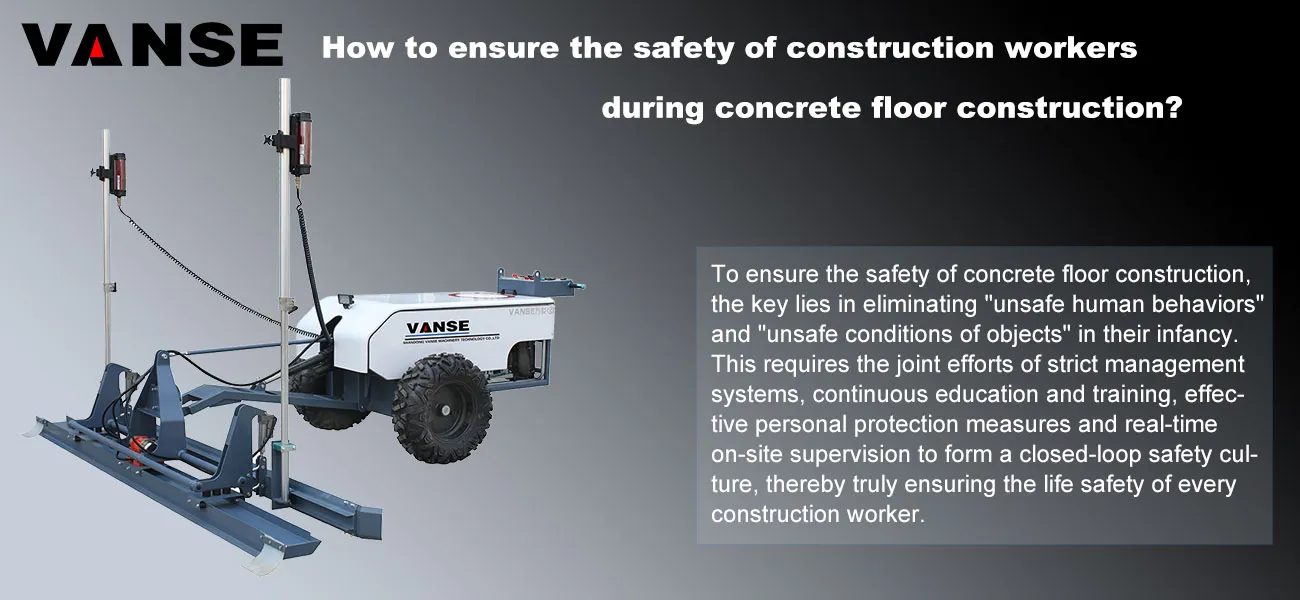
How to ensure the safety of construction workers during concrete floor construction?
To ensure the safety of personnel during the construction of concrete floors, we need to establish a comprehensive safety protection system that covers management and execution, as well as individuals and the environment. The following are specific and operational measures, which are divided into three levels: core safety principles, specific safety measures, and the safety management system.
I. Core Security Principles
Prevention first: The core of all safety work is to identify risks in advance and eliminate them, rather than to remedy them afterwards.
Full participation: Safety is not only the responsibility of safety officers. From project managers to operators, everyone is responsible for their own and others' safety.
Continuous education: Through uninterrupted training and safety briefings, internalize safety norms into everyone's behavioral habits.
Ⅱ. Specific Safety Measures (Classified by Risk Type)
1. Personal safety protection (the last line of defense)
This is a direct barrier to protect workers and must be mandatory.
Head:
Wear a qualified safety helmet correctly and fasten the chin strap.
Feet:
Wear safety shoes (work shoes) that are resistant to impact, puncture and slip. Concrete workers are advised to wear high-top rubber boots to prevent cement corrosion.
Eyes:
When performing stirring, pumping, cutting or grinding operations, protective glasses or face masks must be worn.
Breathing:
When dust is generated during the handling, mixing, dry spreading and cutting and grinding of cement, a dust mask (such as N95 level or higher) must be worn.
Hands:
Wear chemical-resistant gloves (such as rubber or latex gloves) to prevent burns from cement and alkaline substances.
At heights and edges: When working near the edge of floor slabs or openings, a full-body safety belt must be fastened.
2. Construction machinery and electrical safety
Mixer/Vibration equipment
Before use, check whether the electrical circuits, insulation and protective covers are in good condition.
It is strictly forbidden to insert hands or tools into the cylinder during operation.
When cleaning or conducting maintenance, power must be cut off and a "Do Not Close" warning sign hung. A dedicated person should be assigned for supervision.
Polishing machine/grinding machine
Check whether the blade/grinding disc is installed firmly and whether the cable is damaged.
When operating, hold your hands tightly to maintain your balance and prevent the machine from losing control and "jumping" to hurt people.
The cables should be managed overhead to prevent them from being caught in machinery or run over by vehicles.
Large-scale equipment such as laser screeds
Operators need to undergo professional training.
Clear all obstacles along the equipment's movement path and set up a warning area to prevent people from approaching.
Electrical safety
All electric tools must be connected to the power supply through a leakage protection device (RCD).
Cables must not be dragged on the ground or immersed in water. It is strictl
y prohibited to use aged or damaged cables.
Non-professional electricians are strictly prohibited from wiring or conducting maintenance.
3. Safe on-site working environment
Opening and edge protection: All reserved openings, staircase entrances, and elevator shaft openings must be covered with firm covers or equipped with guardrails, and safety warning signs must be hung.
Material stacking and handling
Cement, sand, gravel and other materials should be neatly stacked, with a height not exceeding the specified limit and kept away from the slope.
When manually moving heavy objects, use the correct posture (bend your knees and keep your back straight), and have two or more people cooperate to carry them to prevent sprains and injuries from being hit.
Cross-operation management
Arrange the processes reasonably and minimize vertical cross operations as much as possible.
When it is unavoidable, a solid safety isolation layer (such as a protective shed) must be set up, and a dedicated person should be assigned to coordinate and direct.
Lighting and ventilation
When working at night or underground, ensure that the working surface is well-lit and leaves no dark corners.
When conducting construction in enclosed Spaces such as basements, it is essential to ensure forced ventilation to prevent the accumulation of harmful gases and oxygen deficiency.
4. Protection against chemicals and hazardous substances
When using chemicals such as concrete curing agents, release agents, and epoxy resins, it is necessary to read the Material Safety Data Sheet (MSDS).
According to the MSDS requirements, wear the corresponding protective equipment (such as gas masks, chemical protective gloves, and goggles).
Ensure good ventilation in the operation area.
Ⅲ. Safety Management System (Fundamental Guarantee
1. Before construction: Planning and Education (Briefing)
Safety and technical Briefing:
Before the start of each day's work or the beginning of each new process, the team leader must provide a detailed explanation to all workers about the day's work content, potential hazards, preventive measures and emergency methods, and have all personnel sign for confirmation.
Equipment inspection:
Before starting work every day, the operator conducts a routine inspection of the machinery and equipment used to ensure they are in a safe condition.
2. During construction: Supervision and execution
Appoint a full-time safety officer:
The safety officer continuously patrols the site, promptly identifying and correcting unsafe behaviors (such as not wearing a safety helmet, operating in violation of regulations, etc.).
Set up warning zones:
In the operation areas of large equipment such as laser screed machines and pump trucks, clearly demarcate dangerous zones with warning tapes, and irrelevant personnel are not allowed to enter.
Civilized construction:
Clean up debris, oil stains and standing water on the ground in a timely manner, keep the passageways unobstructed, and reduce the risk of slipping and tripping.
3. Emergency Preparedness
On-site first aid kits should be provided:
Ensure that all items in the first aid kit are complete and effective, and placed in a conspicuous and easily accessible location.
Clarify emergency procedures:
All personnel should be familiar with the initial rescue procedures and alarm methods in the event of accidents such as electric shock, mechanical injury, and falls from heights.
Conduct emergency drills:
Regularly organize simple emergency drills, such as fire evacuation and casualty transportation.
Summary of key points
To ensure the safety of concrete floor construction, the key lies in eliminating "unsafe human behaviors" and "unsafe conditions of objects" in their infancy. This requires the joint efforts of strict management systems, continuous education and training, effective personal protection measures and real-time on-site supervision to form a closed-loop safety culture, thereby truly ensuring the life safety of every construction worker.
Note:
The parameters provided in this document are for reference only and are not mandatory. Due to differences in technical characteristics between different brands and models of laser levelers, please consult the manufacturer for a suitable solution before actual operation. This reference document assumes no responsibility for any issues arising from failure to follow the manufacturer's instructions.
Thanks to All the Friends Who Support and Trust Shandong Vanse Machinery Technology Co., Ltd.
If you want to know more about Shandong Vanse Machinery Technology Co., Ltd. or have any questions, please feel free to contact us:
Our Factory
Shandong Vanse Machinery Technology Co., Ltd.








Share this article

About the Author: Shandong Vanse Machinery Technology Co., Ltd.
Shandong Vanse Machinery Technology Co., Ltd. is a high-tech manufacturer specializing in concrete construction machinery, including laser screeds and related equipment. The company integrates R&D, production, and global sales, with products exported to over 60 countries and widely used in infrastructure projects worldwide.
Previous Post
Next Post
Related Articles
You Might Also Like
Compared with traditional leveling machines, how much is the work efficiency improved by laser leveling machines?
Compared with traditional leveling machines, the improvement in work efficiency of laser leveling machines varies depending on the construction scenario, equipment model, construction process and other factors, and can usually be improved by 30%~50% or even higher. The following is a comparative analysis of the efficiency differences between the two from multiple dimensions: Comparison dimensions Traditional leveling machine Laser leveling machine Leveling basis Relies on manual wire drawing and leveling, with fixed elevation as the benchmark Based on the horizontal laser surface emitted by the laser transmitter, the leveling accuracy is automatically controlled in real time Power and operation mode Manually controls the scraper or roller, and adjusts the height based on experience Hydraulic drive + intelligent control system, automatic leveling and vibration compaction Construction coverage The width of a single operation is narrow (usually 1~3 meters), and it needs to be repeated back and forth The single operation width can reach 2~4 meters, or even wider, reducing the number of round trips Shandong Vanse Machinery Technology Co.,Ltd Construction speed: larger coverage area per unit time Traditional leveling machine: Frequent manual measurement of elevation and adjustment of equipment height are required, and the construction area per hour is about 100~200 square meters due to the limitation of manual operation accuracy. For example, when constructing in large areas (such as parking lots and factory floors), it is necessary to work back and forth multiple times, and it is easy to cause rework due to manual errors. Laser leveling machine: The laser system calibrates the height in real time, without frequent shutdown and measurement. The hydraulic system automatically adjusts the height of the leveling beam. It can construct 300~500 square meters per hour, and some large equipment can even reach more than 800 square meters. Taking a 10,000 square meter site as an example, traditional equipment takes about 50~100 hours, while laser equipment only takes 20~30 hours, and the efficiency is improved by 50%~100%. Precision control: reduce time spent on rework Traditional leveling machines: manual control errors are large (usually ±5~10 mm), prone to unevenness, requiring manual repair later, with a rework rate of about 10%~20%, and additional construction time. Laser leveling machines: laser positioning accuracy can reach within ±3 mm, with a high one-time molding pass rate and almost no need for rework. For example, when constructing industrial floors with high flatness requirements (such as warehouses and workshops), traditional equipment may be delayed by 2~3 days due to rework, while laser equipment can directly save this part of time. Labor costs: reduce labor dependence Traditional leveling machines: require multiple workers (such as surveyors, operators, and auxiliary workers), at least 3~5 people to collaborate, and require high worker experience. Laser leveling machines: only 1~2 operators are required (responsible for equipment control and laser system calibration), labor costs are reduced by 50%~70%, and efficiency fluctuations caused by labor fatigue are reduced. Adaptability to complex scenarios: shortening the time spent in special working conditions Traditional leveling machines: When working on slopes, curved surfaces or sites with large elevation differences, manual adjustments are required, which greatly reduces efficiency (may reduce by more than 30%). Laser leveling machines: can be programmed to adapt to a variety of terrains (such as slopes and curved surfaces), and the laser system automatically adjusts the elevation. The efficiency advantage is more obvious in complex scenarios, for example, the efficiency can be increased by 40%~60% when working on slopes. Shandong Vanse Machinery Technology Co.,Ltd Site scale: Small site (such as a few hundred square meters): The equipment debugging time of the laser leveling machine accounts for a high proportion, and the efficiency is improved by about 30%~40%. Large site (tens of thousands of square meters): The "scale effect" of laser equipment is significant, and the efficiency can be improved by more than 50%. Equipment model and configuration: Small laser leveling machine (such as hand-held): suitable for narrow areas, the efficiency is about 1.5~2 times that of traditional equipment. Large driving laser leveling machine: equipped with double vibrating device and wide leveling beam, the efficiency can reach 2~3 times that of traditional equipment. Construction process requirements: Ordinary floor (low flatness requirement): efficiency is improved by about 30%~40%. High-precision floor (such as ultra-flat floor): Laser equipment can meet the standard at one time, avoiding multiple leveling of traditional processes, and the efficiency is improved by more than 50%. Shandong Vanse Machinery Technology Co.,Ltd Case 1: Industrial plant floor construction For a 12,000 square meter plant, a traditional leveling machine was equipped with a team of 4 people and took 12 days to complete; the laser leveling machine was operated by only 2 people and completed in 6 days, with an efficiency increase of 50%, and the flatness error was reduced from ±8 mm to ±2 mm. Case 2: Municipal square construction A 5,000 square meter square contains a sloped terrain. Due to frequent measurement and adjustment, the traditional equipment can only construct 400 square meters per day; the laser leveling machine can only construct 800 square meters per day, with an efficiency increase of 100%, and the flatness of the slope transition meets the standard. Shandong Vanse Machinery Technology Co.,Ltd The laser leveling machine fundamentally reduces manual intervention and rework time through "automatic measurement + precise control + wide-width operation", and its advantages are particularly prominent in large-scale, high-precision construction scenarios. For projects that pursue construction period and quality, its efficiency improvement is not only reflected in time reduction, but also in the optimization of comprehensive costs by reducing manpower and reducing errors. If specific data is required, it can be further calculated based on the project scale and equipment model. Click the below to jump immediately!!! ARMOUR JOINT CONCRETE LEVELING MACHINE LIGHT TOWER POWER TROWEL SLIPFORM MACHINE STEEL FIBER TOPPING SPREADER TRACKED MINI DUMPERWhat is the principle and structure of concrete laser leveling machine?
The concrete laser leveler is a construction machine that uses modern laser technology and a computer control system to level the concrete surface with high precision. The emergence of this kind of machinery has changed the shortcomings of traditional concrete leveling methods, improved the quality and efficiency of concrete construction, and reduced manual labor intensity and construction costs. The following is a detailed introduction to the principle and structure of the concrete laser leveling. 1. Principle of concrete laser leveling machine The concrete laser leveling machine uses a laser interferometer for measurement, and the control system uses computer control to achieve high-precision concrete leveling by automatically controlling the leveling head of the laser leveling machine. Laser interferometer measurement principle Laser interferometer is an instrument that uses the interference phenomenon of laser beams to measure. In the concrete laser leveling machine, the laser interferometer divides the laser beam into two paths, one is the reference beam and the other is the measured beam. The reference beam passes through the standard reflector, and the measured beam passes through the movable reflector. The two beams meet in the interferometer, causing interference. By measuring and processing the interference phenomenon through the computer control system, the length change of the measured beam can be obtained, thereby achieving high-precision measurement of the concrete surface. Computer control system principles The computer control system of the concrete laser leveling machine is built based on the industrial control computer (IPC) and programmable logic controller (PLC). The IPC is responsible for the control, data acquisition, data processing and output of the entire system, while the PLC is responsible for executing underlying tasks such as motion control and switch control. In the concrete laser leveling machine, the computer control system mainly completes the following tasks: (1) Control and collect data from the laser interferometer, and calculate the elevation data of the concrete surface based on the measurement results. (2) Calculate the control instructions of the leveling head based on the elevation data to realize the automatic leveling function. (3) Manual control and adjustment of the position and angle of the flattening head are achieved through the operation interface and remote control. 2. Structure of concrete laser leveling machine The concrete laser leveling machine mainly consists of a bracket, a laser interferometer, a computer control system, a leveling head, etc.: Bracket The bracket of the concrete laser leveling machine is welded with high-strength steel to support the structure of the entire machine. It is also equipped with components such as a laser interferometer and a computer control system. The bracket generally consists of four columns, two of which are used to support the laser interferometer and the other column is used to install the computer control system. The columns are connected by high-strength bolts, forming the basic structure of the entire machine. Laser Interferometer The laser interferometer of the concrete laser leveling machine is a high-precision measuring instrument used to achieve high-precision measurement of the concrete surface. Laser interferometer consists of laser, beam splitter, reflector, photodetector, etc. The laser generates a laser beam, and the beam splitter divides the laser beam into two paths, one is the reference beam and the other is the measured beam. The two beams of light meet again after being reflected by the reflector, causing interference. The photodetector measures and processes the interference phenomenon to obtain the length change of the measured beam, thereby achieving high-precision measurement of the concrete surface. Computer control system The computer control system of the concrete laser leveling machine is built based on the industrial control computer (IPC) and programmable logic controller (PLC). The IPC is responsible for the control, data acquisition, data processing and output of the entire system, while the PLC is responsible for executing underlying tasks such as motion control and switch control. The computer control system also includes components such as an operating interface and a remote control. The operator can control and adjust the machine through the operating interface or remote control. Flat head The leveling head of the concrete laser leveling machine is a key component used to achieve leveling of the concrete surface. Its structure consists of a support frame, an electric vibrator, a reducer, a scraper, etc. The support frame is used to support the electric vibrator and reducer. The electric vibrator generates vibration, and the reducer drives the scraper to perform rotating and smoothing operations. The flat head is installed under the bracket and connected with the bracket. The smoothing head can also adjust the distance between the scraper and the concrete surface by adjusting the height of the support frame to ensure the quality and effect of the smoothing operation. In short, the concrete laser leveling is an advanced construction machine that integrates modern laser technology, computer control system and mechanical structure. It has high-precision measurement and automatic leveling functions, which can greatly improve the efficiency and quality level of concrete construction. Its application will help improve the shortcomings of traditional construction methods and promote the progress and development of concrete construction technology.Laser leveling machine for concrete paving
WS740 concrete laser leveling machine: the apparatus guide by laser for concrete leveling. Laser leveling leveling machine could greatly improve the concrete smoothness and compaction. as well as prolong the service life of concrete floor. Walk-behind two wheels concrete laser leveling machine, mainly used in large area concrete construction, such as workshop, supermarket, warehouse, airport, playground and so on. This laser leveling can satisfy the construction requirement of large area and high flatness and levelness. As for laser leveling: A new concrete construction,while construct a large area of concrete floor,use laser leveling machine to vibrate new concrete,leveling and control the standard elevation from ground. Technical Description:First,set a fixed laser transmitter,the transmitter emits a laser beam rotation forming a laser control plane,using handheld receivers lever floor elevation guide to the leveling head of Tank concrete laser leveling machine,the automatic control system of leveling machine receiver laser signal (10 times/sec frequency) based on the laser leveling head sensed,then adjust the elevation automatic in real-time,because the laser emitter after the set is fixed,so it can make sure does not produce a cumulative error while a large area of ground construction.