Technical Knowledge
How to choose the appropriate laser receiver according to different construction environments?
According to different construction environments and conditions, the following factors need to be considered when selecting a suitable laser receiver:
1. Construction accuracy requirements:
Different construction projects have different requirements for flatness. If high-precision construction effects are required, a laser receiver with higher sensitivity should be selected to better capture the laser signal and reduce errors.
2. Construction environment:
Consider whether there are obstructions, reflectors or other interference factors in the construction environment. If these factors exist, a laser receiver with strong anti-interference ability should be selected to ensure signal stability and accuracy.
3. Construction scope and speed:
Evaluate the size of the construction scope and the speed of construction. If the construction scope is large or the construction speed is fast, a laser receiver with a wider reception range should be selected to cover a wider area.
4. Working conditions:
Consider the temperature, humidity, air pressure and other conditions of the construction environment. These conditions may affect the performance and stability of the laser receiver. Choose a suitable laser receiver based on actual working conditions to ensure its normal operation and long service life.
5. Budget and cost:
Choose a suitable laser receiver based on budget and cost considerations. The prices of laser receivers of different brands and models vary greatly, and trade-offs need to be made based on actual needs and budget.
6. Compatibility and scalability:
Consider the compatibility and scalability of the laser receiver with other devices. If you need to integrate the laser receiver with other devices such as control systems and sensors, you should ensure that they have good compatibility and scalability.
7. After-sales service and technical support:
Understand the supplier's after-sales service and technical support. Choose a supplier with good after-sales service and technical support so that you can receive timely technical support and maintenance services during use.
To sum up, there are many factors to consider when choosing a suitable laser receiver, including construction accuracy requirements, construction environment, construction scope and speed, working conditions, budget and cost, compatibility and scalability, as well as after-sales service and technical support, etc. It is recommended to conduct sufficient market research and comparison before selection, and communicate with suppliers to ensure that a suitable laser receiver is selected and meets actual construction needs.


Thanks to All the Friends Who Support and Trust Shandong Vanse Machinery Technology Co., Ltd.
If you want to know more about Shandong Vanse Machinery Technology Co., Ltd. or have any questions, please feel free to contact us:
Our Factory
Shandong Vanse Machinery Technology Co., Ltd.
Share this article

About the Author: Shandong Vanse Machinery Technology Co., Ltd.
Shandong Vanse Machinery Technology Co., Ltd. is a high-tech manufacturer specializing in concrete construction machinery, including laser screeds and related equipment. The company integrates R&D, production, and global sales, with products exported to over 60 countries and widely used in infrastructure projects worldwide.
Previous Post
Next Post
Related Articles
You Might Also Like
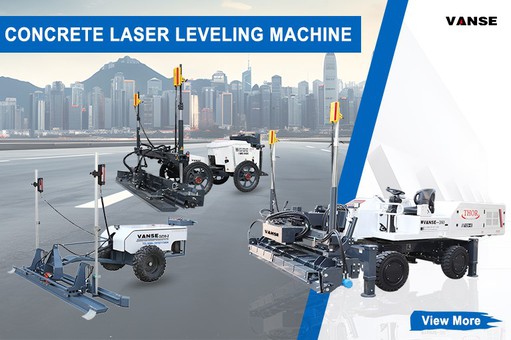
What are the key points to keep in mind when using a concrete laser leveling machine?
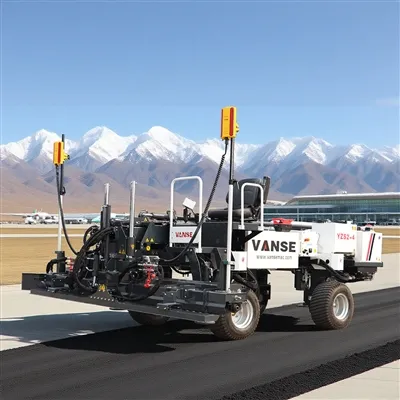
The key points to pay attention to when using a concrete laser leveler are crucial, as they directly determine the flatness, quality, and service life of the floor. The following is a detailed summary of the key points to pay attention to in each step, from pre-construction preparation to post-construction maintenance: This phase is the foundation for a smooth construction process. Inadequate preparation will lead to numerous subsequent problems. Base treatment is key: Strength and Density: The base layer (usually crushed stone or stabilized layer) must be compacted to meet the specified bearing capacity requirements (usually ≥1.5 MPa) to prevent cracking caused by base subsidence. Elevation and Flatness: The base layer elevation must be strictly controlled to allow sufficient thickness for the surface concrete. Flatness should not be too poor, otherwise excessive concrete consumption will occur. Cleanliness and Moisture: The base layer surface must be thoroughly cleaned and free of loose dust, oil, and debris. Before pouring concrete, it should be thoroughly moistened with water, but no visible water should be allowed. This is to prevent the base layer from absorbing moisture from the concrete, which could lead to plastic shrinkage and cracking. Precise Formwork Installation: The top elevation of the formwork must align with the designed floor elevation, which is one of the benchmarks for laser leveling. The formwork must be securely supported to prevent displacement or deformation caused by the leveling's movement and concrete compression. The formwork is typically constructed of channel steel, which must possess sufficient rigidity and straightness. Laser transmitter installation and calibration: Location Selection: The transmitter should be mounted in the center or at a high point within the construction area to ensure signal coverage across the entire work surface and avoid signal blind spots. Secure Installation: The transmitter tripod must be securely mounted on solid ground, away from sources of vibration, and monitored during construction to prevent movement. Precise Calibration: The height and level of the laser transmitter must be precisely calibrated according to the design elevation. This is the "brain" of the entire automated leveling system; any error can lead to a complete breakdown. Repeated verification is essential. Equipment Inspection and Debugging: Check the leveling's hydraulic system, engine, scraper, vibrator, and other components for proper operation. Install and inspect the laser receiver, sensor, and control panel to ensure they can properly receive and process laser signals. As the saying goes, "A good cook cannot cook without rice." The quality of the concrete itself is crucial. Mix Design: Commercial concrete should be used, with a strength generally not lower than C25. Slump should be strictly controlled, generally recommended to be between 120mm and 140mm. Excessive slump can lead to segregation, significant shrinkage, and low strength; too little slump can result in poor fluidity and difficulty leveling. Aggregate Selection: The maximum aggregate particle size should be moderate (generally ≤25mm), with good gradation and a standard mud content. Transportation and Placement: The time from unloading to completion of placement should be short to prevent initial setting of the concrete. Segregation should be prevented during transportation. This is the core process and directly demonstrates the advantages of the laser leveling. Concrete pouring and initial paving: Discharge should be even, avoiding concentrated unloading to form large piles to prevent aggregate segregation. Preliminary paving can be performed using small equipment or manually, with the height slightly above the designed elevation (the virtual paving height). Key Points for Laser leveling Operation: Travel Direction: Typically, the paving is performed at a constant speed along the longitudinal direction. Coordination between the scraper and vibrating plate: The scraper is responsible for scraping away excess concrete and providing initial leveling; the vibrating plate uses high-frequency vibration to compact and fine-tune the concrete. The leveling's travel speed must be carefully controlled to ensure sufficient vibration time to achieve a compacting effect, but avoid excessive vibration that may cause concrete segregation. Real-time Adjustment: The operator must closely monitor the data on the control panel. The laser receiver monitors the elevation in real time and automatically adjusts the scraper's height via the hydraulic system, achieving unmanned, automatic leveling. The operator's primary responsibilities are to control movement and monitor equipment status. Critical Process Connection – Gun-Smoothing: After the laser leveling completes an area, but before the concrete begins to set (when a person steps on it and the concrete sinks approximately 3-5mm), gun-smoothing should be performed immediately using a double-disc ride-on trowel. Purpose: Removes minor blade marks left by the laser leveling, smoothes any excess cement slurry, seals surface pores, and prepares for subsequent finishing. This step is crucial to the final surface quality. Laser leveling only completes the "leveling" process. To achieve a high-strength, wear-resistant floor, finishing and maintenance are essential. Finishing (Slurry Calendering): After the concrete has initially set but before final set (when slight footprints remain), use a double or triple trowel with metal discs for rough grinding. Once the surface has further hardened and no visible water is visible, replace the trowel blade and perform a smooth finish. The frequency and timing of smoothing must be carefully controlled. Excessive or premature smoothing can cause surface bleeding and peeling. Smoothing further densifies the surface, improving wear resistance and impermeability. Slotting (Seam Cutting): Timing is critical: The concrete must reach a certain strength (usually 6-10 MPa compressive strength) but still be able to be cut smoothly by the cutter without causing edge cracking. This is generally done within 24-48 hours after pouring (the time varies depending on the temperature). Function: Guides concrete shrinkage cracks to develop in predetermined, uniform locations, avoiding random, irregular cracking. Joint Depth: Typically 1/4-1/3 of the slab thickness. Spacing: Generally determined by the concrete mix ratio and slab thickness, typically 24-36 times the slab thickness. Curing: Curing should begin immediately after the concrete has fully set (after finishing is complete). Recommended Method: Spraying a curing agent or covering with plastic sheeting. The curing agent should be evenly applied to form a dense film; the film should be tightly sealed to prevent evaporation. Time: Curing should last no less than 7 days, with the first 3 days being crucial. Purpose: Provide sufficient moisture for cement hydration to prevent rapid surface water loss, which can lead to cracking and reduced strength. A solid and level base: A weak foundation is destabilizing. Precise laser calibration: This is the system benchmark, and no mistakes can be made. Concrete slump control: Materials are fundamental, and 120-140mm is the optimal range. Timing of leveling and blasting: Mechanized, streamlined operations, seamlessly linked. Timing of finishing and slitting: Rely on experience; applying too early or too late can lead to problems. Timely and adequate curing: The final step that determines ultimate strength and cracking. Strict control of each of these steps can fully leverage the technical advantages of laser levelings to create high-strength, high-flatness, crack-free, high-quality concrete floors. Note: The parameters provided in this document are for reference only and are not mandatory. Due to differences in technical characteristics between different brands and models of laser levelers, please consult the manufacturer for a suitable solution before actual operation. This reference document assumes no responsibility for any issues arising from failure to follow the manufacturer's instructions.What is the principle of leveling machine
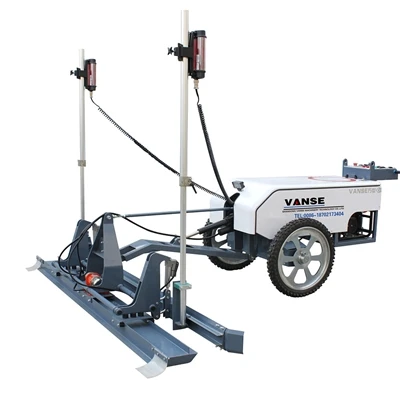
The principle of the leveling machine is mainly to use laser control technology, closed-loop control technology and high-precision hydraulic system, and then use the computer to adjust the control, so that the scraper and vibration instrument of the leveling head can complete most of the procedures in the project, realizing one-time Through this, the computer…Collaborative Use Techniques of Concrete Laser Leveling Machines and High-frequency Vibrators
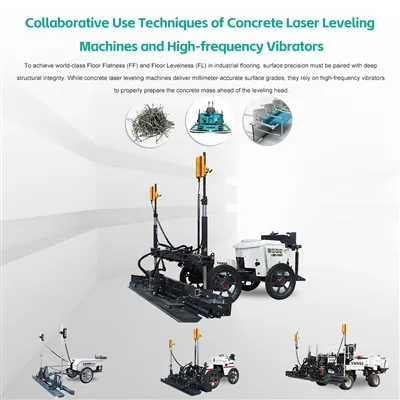
To achieve world-class Floor Flatness (FF) and Floor Levelness (FL) in industrial flooring, surface precision must be paired with deep structural integrity. While concrete laser leveling machines deliver millimeter-accurate surface grades, they rely on high-frequency vibrators to properly prepare the concrete mass ahead of the leveling head. Understanding the collaborative techniques between these two systems is the secret to eliminating air voids, preventing honeycombing, and delivering a flawless, ultra-flat slab. Before diving into techniques, it is essential to understand how these tools interact within the concrete matrix: High-Frequency Vibrators: Operating typically between 10,000 to 12,000 vibrations per minute (VPM), these tools fluidize the concrete. They break the friction between aggregates, forcing entrapped air to the surface and ensuring the concrete tightly wraps around rebar and armor joints. Concrete Laser Leveling Machines: Following immediately behind, the laser leveling utilizes its automated auger to cut the concrete to the exact elevation, while its vibrating leveling board seals and smooths the freshly consolidated surface. For optimal results, the operation of the vibrators and the laser leveling must be perfectly synchronized in a continuous, flowing rhythm. The "Lead and Follow" Pacing: Vibrator operators must maintain a consistent distance just ahead of the laser leveling's plow or auger. If the vibrators are too far ahead, the fluidized concrete may begin to stiffen before the leveling arrives. If they are too close, they risk bumping the leveling head, disrupting the laser receivers and altering the floor's precision. A standard buffer zone of 1 to 2 meters is highly recommended. Managing Specialized Mixes: When pouring heavy-duty slabs reinforced with steel fibers, this collaboration becomes critical. The high-frequency vibrator ensures the steel fibers are evenly distributed throughout the slab rather than clumping. Crucially, the vibration helps drive the rigid fibers slightly below the surface, allowing the trailing laser leveling to glide over the top, leaving a smooth, fiber-free "cream" finish that is safe for equipment tires. Grid Pattern Insertion: Operators using poker (internal) vibrators should insert the head vertically at regular intervals (typically 12 to 18 inches apart), holding it in place for 5 to 15 seconds until the surface takes on a sheen and large air bubbles stop surfacing. Dragging the vibrator horizontally can cause aggregate segregation and should be strictly avoided. Edge and Obstacle Consolidation: Laser leveling excel in open areas, but edges, corners, and areas around structural columns require special attention. Vibrator operators must thoroughly consolidate the concrete against formwork and armor joints before the laser leveling makes its pass, ensuring there are no weak spots or voids at the most vulnerable points of the floor. When contractors master the combined use of these tools, the structural and aesthetic results are undeniable: Maximum Compressive Strength: Removing entrapped air increases the density of the concrete, directly boosting its load-bearing capacity for VNA forklifts and automated logistics. Reduced Shrinkage Cracking: A uniformly consolidated slab dries and cures more evenly, minimizing the internal tensile stresses that lead to unpredictable surface cracks. Flawless Surface Integrity: Proper vibration prevents aggregate shadowing and surface blistering, allowing the laser leveling to achieve pristine FF/FL metrics on the first pass. The construction of a premium ultra-flat floor is a highly choreographed process. By training your crew to seamlessly integrate the deep consolidation power of high-frequency vibrators with the unmatched surface accuracy of concrete laser leveling machines, you guarantee a durable, high-performance slab that meets the strictest international standards. Note: The parameters provided in this document are for reference only and are not mandatory. Due to differences in technical characteristics between different brands and models of laser levelers, please consult the manufacturer for a suitable solution before actual operation. This reference document assumes no responsibility for any issues arising from failure to follow the manufacturer's instructions.