Technical Knowledge
What are the key points to keep in mind when using a concrete laser leveling machine?
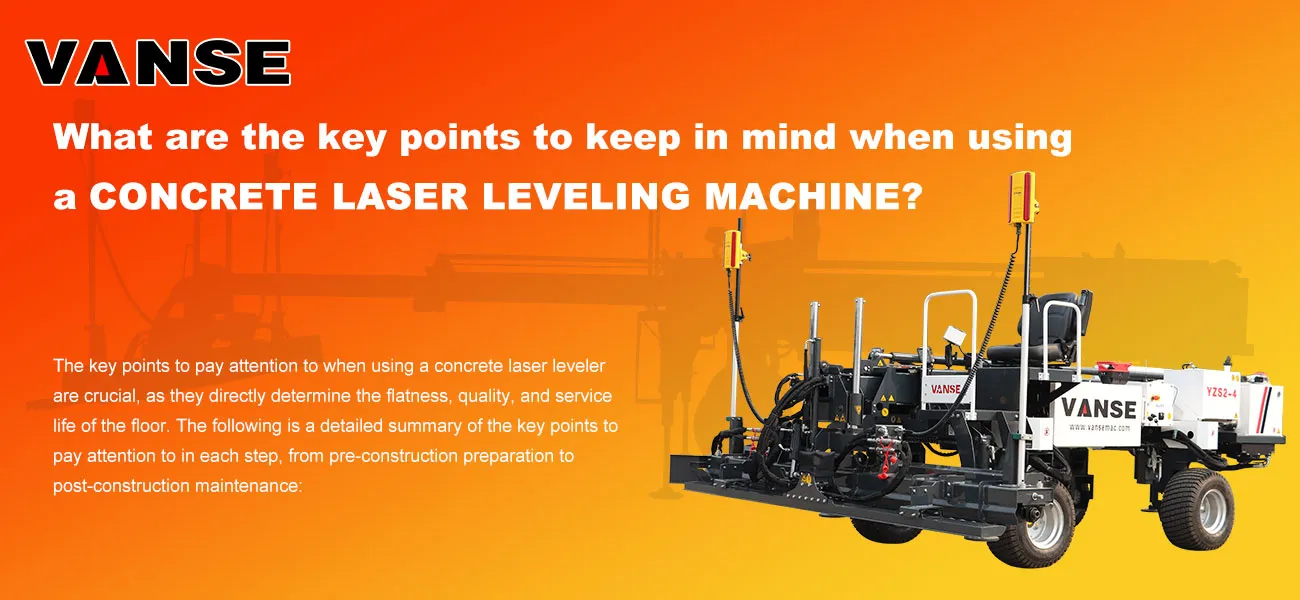
The key points to pay attention to when using a concrete laser leveler are crucial, as they directly determine the flatness, quality, and service life of the floor. The following is a detailed summary of the key points to pay attention to in each step, from pre-construction preparation to post-construction maintenance:
1. Pre-construction Preparation
This phase is the foundation for a smooth construction process. Inadequate preparation will lead to numerous subsequent problems.
Base treatment is key:
Strength and Density: The base layer (usually crushed stone or stabilized layer) must be compacted to meet the specified bearing capacity requirements (usually ≥1.5 MPa) to prevent cracking caused by base subsidence.
Elevation and Flatness: The base layer elevation must be strictly controlled to allow sufficient thickness for the surface concrete. Flatness should not be too poor, otherwise excessive concrete consumption will occur.
Cleanliness and Moisture: The base layer surface must be thoroughly cleaned and free of loose dust, oil, and debris. Before pouring concrete, it should be thoroughly moistened with water, but no visible water should be allowed. This is to prevent the base layer from absorbing moisture from the concrete, which could lead to plastic shrinkage and cracking.
Precise Formwork Installation:
The top elevation of the formwork must align with the designed floor elevation, which is one of the benchmarks for laser leveling.
The formwork must be securely supported to prevent displacement or deformation caused by the leveling's movement and concrete compression.
The formwork is typically constructed of channel steel, which must possess sufficient rigidity and straightness.
Laser transmitter installation and calibration:
Location Selection: The transmitter should be mounted in the center or at a high point within the construction area to ensure signal coverage across the entire work surface and avoid signal blind spots.
Secure Installation: The transmitter tripod must be securely mounted on solid ground, away from sources of vibration, and monitored during construction to prevent movement.
Precise Calibration: The height and level of the laser transmitter must be precisely calibrated according to the design elevation. This is the "brain" of the entire automated leveling system; any error can lead to a complete breakdown. Repeated verification is essential.
Equipment Inspection and Debugging:
Check the leveling's hydraulic system, engine, scraper, vibrator, and other components for proper operation.
Install and inspect the laser receiver, sensor, and control panel to ensure they can properly receive and process laser signals.
2. Concrete Material Requirements
As the saying goes, "A good cook cannot cook without rice." The quality of the concrete itself is crucial.
Mix Design: Commercial concrete should be used, with a strength generally not lower than C25. Slump should be strictly controlled, generally recommended to be between 120mm and 140mm. Excessive slump can lead to segregation, significant shrinkage, and low strength; too little slump can result in poor fluidity and difficulty leveling.
Aggregate Selection: The maximum aggregate particle size should be moderate (generally ≤25mm), with good gradation and a standard mud content.
Transportation and Placement: The time from unloading to completion of placement should be short to prevent initial setting of the concrete. Segregation should be prevented during transportation.
3. Construction Process Control
This is the core process and directly demonstrates the advantages of the laser leveling.
Concrete pouring and initial paving:
Discharge should be even, avoiding concentrated unloading to form large piles to prevent aggregate segregation.
Preliminary paving can be performed using small equipment or manually, with the height slightly above the designed elevation (the virtual paving height).
Key Points for Laser leveling Operation:
Travel Direction: Typically, the paving is performed at a constant speed along the longitudinal direction.
Coordination between the scraper and vibrating plate: The scraper is responsible for scraping away excess concrete and providing initial leveling; the vibrating plate uses high-frequency vibration to compact and fine-tune the concrete. The leveling's travel speed must be carefully controlled to ensure sufficient vibration time to achieve a compacting effect, but avoid excessive vibration that may cause concrete segregation.
Real-time Adjustment: The operator must closely monitor the data on the control panel. The laser receiver monitors the elevation in real time and automatically adjusts the scraper's height via the hydraulic system, achieving unmanned, automatic leveling. The operator's primary responsibilities are to control movement and monitor equipment status.
Critical Process Connection – Gun-Smoothing:
After the laser leveling completes an area, but before the concrete begins to set (when a person steps on it and the concrete sinks approximately 3-5mm), gun-smoothing should be performed immediately using a double-disc ride-on trowel.
Purpose: Removes minor blade marks left by the laser leveling, smoothes any excess cement slurry, seals surface pores, and prepares for subsequent finishing. This step is crucial to the final surface quality.
4. Post-Smoothing and Maintenance
Laser leveling only completes the "leveling" process. To achieve a high-strength, wear-resistant floor, finishing and maintenance are essential.
Finishing (Slurry Calendering):
After the concrete has initially set but before final set (when slight footprints remain), use a double or triple trowel with metal discs for rough grinding.
Once the surface has further hardened and no visible water is visible, replace the trowel blade and perform a smooth finish. The frequency and timing of smoothing must be carefully controlled. Excessive or premature smoothing can cause surface bleeding and peeling.
Smoothing further densifies the surface, improving wear resistance and impermeability.
Slotting (Seam Cutting):
Timing is critical: The concrete must reach a certain strength (usually 6-10 MPa compressive strength) but still be able to be cut smoothly by the cutter without causing edge cracking. This is generally done within 24-48 hours after pouring (the time varies depending on the temperature).
Function: Guides concrete shrinkage cracks to develop in predetermined, uniform locations, avoiding random, irregular cracking.
Joint Depth: Typically 1/4-1/3 of the slab thickness.
Spacing: Generally determined by the concrete mix ratio and slab thickness, typically 24-36 times the slab thickness.
Curing:
Curing should begin immediately after the concrete has fully set (after finishing is complete).
Recommended Method: Spraying a curing agent or covering with plastic sheeting. The curing agent should be evenly applied to form a dense film; the film should be tightly sealed to prevent evaporation.
Time: Curing should last no less than 7 days, with the first 3 days being crucial.
Purpose: Provide sufficient moisture for cement hydration to prevent rapid surface water loss, which can lead to cracking and reduced strength.
Summary: Key Points
A solid and level base: A weak foundation is destabilizing.
Precise laser calibration: This is the system benchmark, and no mistakes can be made.
Concrete slump control: Materials are fundamental, and 120-140mm is the optimal range.
Timing of leveling and blasting: Mechanized, streamlined operations, seamlessly linked.
Timing of finishing and slitting: Rely on experience; applying too early or too late can lead to problems.
Timely and adequate curing: The final step that determines ultimate strength and cracking.
Strict control of each of these steps can fully leverage the technical advantages of laser levelings to create high-strength, high-flatness, crack-free, high-quality concrete floors.
Note:
The parameters provided in this document are for reference only and are not mandatory. Due to differences in technical characteristics between different brands and models of laser levelers, please consult the manufacturer for a suitable solution before actual operation. This reference document assumes no responsibility for any issues arising from failure to follow the manufacturer's instructions.
Thanks to All the Friends Who Support and Trust Shandong Vanse Machinery Technology Co., Ltd.
If you want to know more about Shandong Vanse Machinery Technology Co., Ltd. or have any questions, please feel free to contact us:
Our Factory
Shandong Vanse Machinery Technology Co., Ltd.








Share this article

About the Author: Shandong Vanse Machinery Technology Co., Ltd.
Shandong Vanse Machinery Technology Co., Ltd. is a high-tech manufacturer specializing in concrete construction machinery, including laser screeds and related equipment. The company integrates R&D, production, and global sales, with products exported to over 60 countries and widely used in infrastructure projects worldwide.
Previous Post
Next Post
Related Articles
You Might Also Like
What is the significance of laying double-layer steel mesh during concrete pavement construction?
Concrete has strong compressive resistance but weak tensile resistance. The double-layer steel mesh significantly improves the tensile resistance of the pavement through the synergistic effect of the upper and lower layers of steel bars, reducing the risk of cracking caused by load or temperature stress. The double-layer steel mesh can evenly disperse the concentrated load to a larger area, reduce local stress concentration, and extend the service life of the pavement. When concrete shrinks or bends, the steel mesh can restrain the development of cracks and prevent cracks from penetrating the entire pavement structure. For pavements that frequently bear dynamic loads (such as heavy vehicle rolling), double-layer steel mesh can enhance the fatigue resistance of the structure and delay aging and damage. Airport runways, port terminals, highways and other pavements that need to bear high loads. In areas with a high risk of uneven foundation settlement, double-layer steel mesh can reduce structural cracking caused by foundation deformation. In high temperature or severe cold areas, steel mesh can help resist temperature stress; in humid environments, double-layer arrangement can increase the thickness of the protective layer and improve corrosion resistance. Usually, the upper steel bar is located 5~10cm below the top of the road surface, and the lower steel bar is close to the bottom. The middle is fixed by a bracket or a horse stool to ensure the thickness of the protective layer (generally 3~5cm). The diameter and spacing of the steel bar need to be determined according to the design load calculation. The common specifications are φ8~φ16mm and the spacing is 15~30cm. The steel mesh is connected by binding or welding to ensure integrity; the steel bars can be increased or reinforced in local weak areas. Double-layer steel mesh may affect the fluidity of concrete. The slump needs to be strictly controlled, and vibration compaction should be ensured to avoid voids. Lay the bottom steel mesh first, and then lay the upper steel mesh after the concrete is poured (or pour in two times). The specific needs to be adjusted according to the design requirements. Perform maintenance in time after construction to prevent steel corrosion and concrete shrinkage and cracking. Through reasonable design and construction, the double-layer steel mesh can significantly improve the comprehensive performance of concrete pavement, especially suitable for projects with high requirements for durability and safety.What safety precautions should be taken when maintaining the concrete laser leveling machine?
As an important construction equipment in the modern construction industry, the maintenance of a concrete laser leveling machine is of great significance to ensure the normal operation of the equipment and extend its service life. However, in the process of maintenance, we must attach great importance to safety issues to ensure the safety of operators and the integrity of the equipment. This article will discuss in detail the safety precautions that need to be taken when maintaining a concrete laser leveling machine, mainly including safety preparations for the leveling machine shutdown, cleaning up debris in the work area, checking maintenance and operation sequence, following safety operation specifications, maintenance parts replacement precautions, personal protective equipment wearing, and emergency response plans. 01 Safety preparations for leveling machine shutdown Before performing maintenance, first ensure that the concrete laser leveling machine has been completely shut down and all operating switches have been placed in the "off" or "stop" position. This can effectively prevent safety accidents caused by misoperation or accidental start-up of the equipment. At the same time, the power supply of the leveling machine must be cut off to prevent the current from causing electric shock to the maintenance personnel. If the equipment is equipped with a battery or other energy storage device, it must also be ensured to be in a safe state. In addition, for possible hydraulic and pneumatic systems, it is necessary to wait for a period of time after shutdown to ensure that the pressure in the system is completely released. Before releasing the pressure, do not disassemble any parts related to the pressure system to avoid injury caused by the spraying of high-pressure liquid or gas. 02 Clean up debris in the work area Before maintenance begins, the work area must be thoroughly cleaned and all items and tools not related to maintenance must be removed to prevent them from becoming a hidden danger of tripping or slipping. Pay special attention to cleaning the space under the equipment to ensure that maintenance personnel can safely approach and operate the key components of the equipment. At the same time, it is also necessary to ensure that the lighting in the work area is sufficient so that maintenance personnel can clearly see every detail and potential danger points. If maintenance is required at night or in a dimly lit environment, appropriate lighting equipment should be used. 03 Inspection, maintenance and operation sequence When maintaining the concrete laser leveling machine, the correct inspection and operation sequence should be followed. First, the overall condition of the equipment should be checked, including whether the appearance, structure, connectors, etc. are intact. Secondly, follow the guidance of the equipment maintenance manual to check the wear and damage of key components one by one, such as blades, bearings, belts, etc. During the operation, the principle of easy first, difficult second, external first, internal second should be followed. For complex maintenance tasks, such as disassembling and replacing parts, make sure to understand the structure and function of the relevant parts, and follow the correct disassembly and installation sequence. During the operation, appropriate tools and methods should be used to avoid using violence or improper operation to cause equipment damage or personal injury. 04 Follow safe operation specifications When performing maintenance, you must strictly follow the safety operation specifications. First, make sure you are familiar with the operation and maintenance manual of the equipment, and understand the performance, characteristics and safety requirements of the equipment. Secondly, before performing any operation, you should carefully read the relevant safety tips and warnings to ensure that you understand the possible risks and precautions. During the operation, you should stay focused and cautious, and avoid distraction or impatience. For uncertain operations or problems, you should consult experienced colleagues or professionals in time. At the same time, it is strictly forbidden to carry out activities unrelated to work during maintenance, such as smoking, eating, etc., to avoid fire or other safety accidents. 05 Precautions for replacement of maintenance parts During the maintenance process, some worn or damaged parts may need to be replaced. When replacing parts, make sure to use regular brand and model parts that match the equipment. Do not use inferior or substandard parts to avoid affecting the performance and safety of the equipment. Before replacing parts, make sure that the power of the equipment is turned off and take necessary safety measures, such as wearing protective glasses and gloves. When removing and installing parts, use appropriate tools and methods and follow the correct operating sequence. After replacing parts, check whether the equipment is firmly connected and whether the parts are installed correctly, and perform necessary trial runs and tests to ensure the normal operation of the equipment. 06 Wearing of personal protective equipment When maintaining the concrete laser leveling machine, the operator must wear appropriate personal protective equipment. This includes but is not limited to safety helmets, protective clothing glasses, earplugs, gloves and non-slip shoes. These equipment can effectively protect the operator's head, eyes, ears, hands and feet from injury. For example, a safety helmet can protect the head from falling objects or collisions; protective glasses can prevent splashing particles or liquids from entering the eyes; earplugs can reduce the damage to hearing caused by noise at the work site; gloves can prevent hands from being cut or burned by sharp edges or high-temperature parts; non-slip shoes can provide good grip to prevent slipping during operation. 07 Emergency Response Plan Although we have taken various safety measures to prevent accidents, some emergencies may still occur in actual operations. Therefore, it is crucial to formulate and implement emergency response plans. First, all maintenance personnel should be familiar with the safety operation manual of the equipment, understand possible emergencies and corresponding response measures. Secondly, the maintenance site should be equipped with necessary first aid equipment and medicines so that initial treatment can be carried out in time when injuries occur. In addition, a clear emergency evacuation and rescue plan should be formulated to ensure that personnel can be quickly organized to evacuate and notify professional rescue teams in the event of serious accidents such as fires and leaks. At the same time, maintenance personnel should regularly conduct emergency response training and drills to improve their ability and level to respond to emergencies. By simulating emergencies in actual scenarios, maintenance personnel can remain calm, take response measures quickly and accurately when real accidents occur, and minimize casualties and property losses. In addition to the safety matters mentioned above, it is also necessary to pay attention to the handling of some details and special situations. For example, during the maintenance process, if serious faults or damage are found in the equipment, the work should be stopped immediately and reported to professional maintenance personnel for processing. Do not disassemble or repair it privately. In addition, during the maintenance process, you should always be vigilant and pay attention to changes in the surrounding environment. If there are any abnormal situations, you should deal with them or evacuate in time. In addition, for the long-term maintenance and maintenance of concrete laser leveling machines, a complete set of systems and processes must be established. This includes regular comprehensive inspection and maintenance of the equipment, recording the operating status and maintenance history of the equipment, so as to promptly discover potential safety hazards and deal with them. At the same time, regular training and education of maintenance personnel are also required to improve their safety awareness and operating skills to ensure the normal operation and safe use of the equipment. In summary, the safety matters that need to be paid attention to when maintaining the concrete laser leveling machine cover the aspects of safety preparation for shutdown, cleaning up debris in the work area, checking maintenance and operation sequence, following safety operation specifications, precautions for replacement of maintenance parts, wearing of personal protective equipment, and emergency response plans. Only under the premise of strictly abiding by these safety matters can the smooth progress of maintenance work be ensured, and the safety of personnel and the integrity of equipment can be guaranteed. Therefore, we must attach great importance to the maintenance of concrete laser leveling machines and continuously improve our safety awareness and operating skills. It is worth noting that although this article elaborates on the safety issues when maintaining concrete laser leveling machines, various special situations and unknown risks may still be encountered in actual operations. Therefore, in actual work, maintenance personnel should remain vigilant and cautious, respond flexibly according to actual conditions, and consult and seek help from professionals in a timely manner. At the same time, companies should also strengthen the training and management of maintenance personnel, improve their safety awareness and response capabilities, and ensure the smooth progress of maintenance work and the sustainable development of the company.The necessity of choosing a laser leveling machine!
THE NECESSITY OF CHOOSING A LASER LEVELING MACHINE!!! The laser leveling machine uses laser to level the ground, which has higher accuracy and smaller ground error after paving. Moreover, the construction efficiency of this kind of equipment is basically more than three times that of manual work, and one piece of equipment can be done, saving labor investment and reducing capital cost investment. Definition of laser leveling machine: A device guided by a laser for leveling and leveling fresh concrete. A concrete construction method that uses a laser leveling machine to pave and level the newly poured concrete. Advantages of concrete laser leveling machine: 1. High construction quality The laser leveling machine can level the ground, which can significantly improve the flatness of the ground. For the ground constructed by the laser leveling machine and the traditional method, 22 points are detected (one point every 5mx4m), and the average flatness is 1.3mm and 4.1mm respectively. Laser leveling The leveling quality of equipment such as leveling machines is more than three times higher than that of traditional methods. The application of equipment such as laser leveling machines can realize large-scale construction, reduce a large number of construction joints, reduce the slump of concrete, ensure the strength of concrete, and make the ground integrity good and cracks are not easy to appear. 2. Fast construction speed The use of laser leveling machines and other equipment to construct large concrete slabs improves the work efficiency by 3 times compared with the traditional beam vibrator method and saves 30%. The construction area per hour is more than 300㎡, and the daily workload can be completed from 3000㎡ to 5000㎡. Work efficiency is greatly improved. Of course, high-quality and efficient large-area overall floor construction requires not only a high-quality and reliable laser leveler, but also a fast and convenient spreader. Somero STS-11M spreader equipment eliminates a series of defects that affect the final aesthetics and quality of the floor, such as uneven spread, dust pollution, footprints, and color differences caused by traditional wear-resistant aggregate spreader, and truly achieves high efficiency. Wear-resistant aggregate one-time mechanized distribution. 3. Save manpower and improve industrial efficiency 1)Integrated leveling head: It is composed of scraper, vibrator, vibrating plate, stirring cage and other components. It integrates multiple processes such as stirring, leveling, vibrating, and vibrating, and is completed by the machine at one time. Improve efficiency and save labor. 2)The high-frequency vibrator with 4000 times per minute and the uniform high-frequency vibration of the leveling head vibrating plate make the concrete floor dense and can avoid ground cracks caused by stress concentration caused by deformation. It can effectively solve the problems of hollowing, shelling, cracking and inequality on the ground. 3)The leveling head can maintain the level of the construction under the double transformation of the undulating foundation and the slope of the ground. 4)The laser measurement and control system automatically controls the elevation: the design elevation of the top surface of the floor is automatically controlled by the laser machine computer, which can ensure very high ground flatness, and can directly achieve accurate leveling on the concrete layer, and the ground flatness is not affected by the vibration of the construction formwork Influence, there is no need to support the formwork in the middle, reduce the input of artificial materials, reduce the construction procedure, and speed up the construction progress. Finally, it should be noted that if you want to use a concrete laser leveling machine, you must choose a professional concrete laser leveling machine brand equipment and pay attention to the method of use. Without professional training, the construction efficiency may not be able to keep up, and the effect will be poor. Big discount.