Technical Knowledge
Cost-benefit analysis of using power trowels VS manual polishing for commercial concrete floors
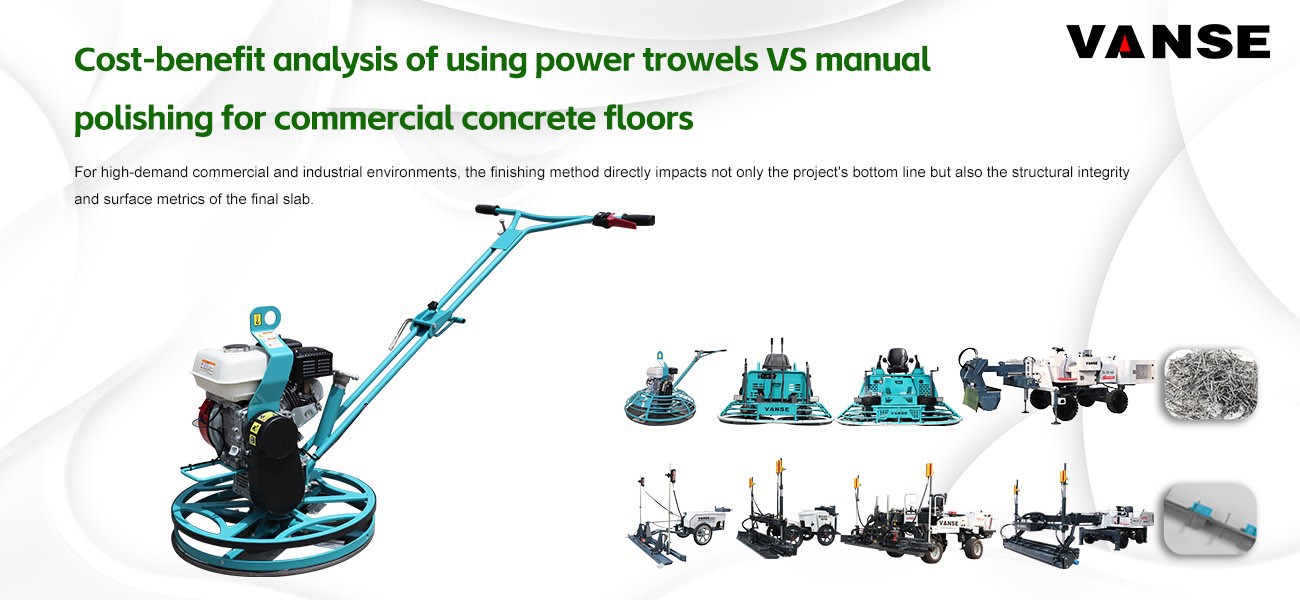
Here is a comprehensive cost-benefit analysis comparing the use of power trowels (both ride-on and walk-behind) against manual finishing and polishing for commercial concrete floors.
For high-demand commercial and industrial environments, the finishing method directly impacts not only the project's bottom line but also the structural integrity and surface metrics of the final slab.
1. Capital Expenditure (CapEx) vs. Operational Expenditure (OpEx)
Manual Polishing: * Costs: Requires minimal upfront capital. Hand trowels, floats, and basic low-speed floor buffers represent a negligible equipment investment.
Benefits/Drawbacks: The savings in equipment are rapidly eclipsed by labor costs (OpEx). Manual finishing requires a large crew of skilled finishers to cover a commercial-sized pour before the concrete sets. In regions like North America, Europe, or Australia where skilled labor rates are at a premium, this operational cost scales linearly and aggressively with the square footage of the project.
Power Trowels:
Costs: Involves a moderate to high initial capital investment, particularly for advanced, multi-blade ride-on trowels powered by reliable, heavy-duty engines.
Benefits/Drawbacks: The primary benefit is a drastic reduction in OpEx. A single operator on a ride-on power trowel can finish thousands of square meters in a fraction of the time it takes a manual crew. The labor savings generated on just a few large-scale warehouse or logistics center projects typically deliver a full return on investment (ROI) for the machinery.
2. Quality Metrics: Floor Flatness (FF) and Floor Levelness (FL)
Manual Polishing: * Human application is inherently inconsistent. Changes in operator fatigue, pressure, and technique make it virtually impossible to achieve the high FF/FL numbers required for modern commercial applications, such as high-bay warehouses where even minor undulations can disrupt forklift operations.
Power Trowels: * Mechanized troweling provides uniform pressure and consistent blade pitch across the entire slab. When paired with concrete laser leveling leveling beforehand, power trowels ensure the slab maintains strict FF (Flatness) and FL (Levelness) tolerances. This precision is increasingly demanded by global e-commerce and logistics clients who require perfectly flat floors for automated sorting systems and racking.
3. Surface Durability, Density, and Compaction
Manual Polishing:
Manual pressure is insufficient to deeply compress the concrete surface. The resulting finish may look smooth initially but often lacks the deep compaction needed to prevent long-term wear, dusting, or delamination under heavy commercial traffic.
Power Trowels:
The heavy mechanical weight of the equipment, combined with the high-speed rotation of the float pans and finishing blades, creates a "burnished" finish. This aggressive mechanical compaction forces the aggregate down and brings the cement paste to the surface, significantly increasing the concrete’s surface density and wear resistance. A denser floor lowers long-term maintenance costs for the end-user and extends the lifecycle of the facility.
4. Speed, Efficiency, and Project Turnaround
Manual Polishing:
Pours are limited by the size of the finishing crew. If the weather changes rapidly or the concrete accelerates its curing time, a manual crew can easily be outpaced, leading to cold joints or poorly finished sections that require expensive remediation grinding later.
Power Trowels:
Power trowels mitigate the risk of the concrete "getting away" from the contractor. They allow for massive daily pours (often exceeding 2,000–3,000 square meters per day). Faster project turnaround allows general contractors to move on to the next phase of construction sooner, optimizing the overall build schedule.
Conclusion and Final Verdict
While manual finishing remains necessary for edge work, tight corners, and small residential spaces, it is fundamentally non-viable for modern commercial floors.
The integration of Power Trowels is a necessity for commercial concrete contractors. The higher initial equipment cost is thoroughly justified by the elimination of extensive labor hours, the mitigation of risk during large pours, and the ability to definitively meet the strict, high-tolerance FF/FL specifications demanded by today's international construction market.
Note: The parameters provided in this document are for reference only and are not mandatory. Due to differences in technical characteristics between different brands and models of laser levelers, please consult the manufacturer for a suitable solution before actual operation. This reference document assumes no responsibility for any issues arising from failure to follow the manufacturer's instructions.
Thanks to All the Friends Who Support and Trust Shandong Vanse Machinery Technology Co., Ltd.
If you want to know more about Shandong Vanse Machinery Technology Co., Ltd. or have any questions, please feel free to contact us:
Our Factory
Shandong Vanse Machinery Technology Co., Ltd.








Share this article

About the Author: Shandong Vanse Machinery Technology Co., Ltd.
Shandong Vanse Machinery Technology Co., Ltd. is a high-tech manufacturer specializing in concrete construction machinery, including laser screeds and related equipment. The company integrates R&D, production, and global sales, with products exported to over 60 countries and widely used in infrastructure projects worldwide.
Previous Post
Next Post
Related Articles
You Might Also Like
The advantages of concrete laser leveling machine
Concrete laser leveling machines, also known as laser leveling, are a transformative technology in the construction industry for placing and finishing large, flat concrete slabs. Their advantages are significant compared to traditional manual methods. Here are the key advantages, broken down into categories: Extreme Flatness and Levelness: Laser leveling can achieve tolerances of FF/FL 50 or higher (standard for warehouse floors) and can even reach FF/FL 100 for super-flat floors (e.g., high-rack distribution centers). Manual methods struggle to consistently achieve this. Eliminates Human Error: The machine is guided by a rotating laser plane, ensuring the entire slab is perfectly level to the established grade. This removes the variability and guesswork of manual rodding and screeching. Reduced Curling and Cracking: By delivering immediate, precise consolidation and leveling, they minimize the risk of surface water pooling and create a more uniform slab, which reduces the potential for stress-related cracking and edge curling. Rapid Placement: A single laser leveling can replace 10-20 skilled laborers with hand leveling. It can place and level 150-200+ cubic meters of concrete per hour (depending on the model and site conditions). Earlier Access for Follow-on Trades: Because the slab is placed faster and cures more uniformly, follow-up work like framing or racking installation can often begin sooner, compressing the overall project schedule. Continuous Operation: It can work non-stop as long as concrete is being delivered, preventing costly delays and concrete set-up issues. Reduced Labor Dependency and Cost: It requires a much smaller crew (typically 1 operator and 2-3 helpers for finishing). This is a huge advantage in markets with skilled labor shortages. Lower Long-Term Life-Cycle Costs: The superior flatness reduces wear and tear on forklifts and other equipment, lowers fuel consumption for material handling, and minimizes future maintenance costs for floor toppings or coatings. Optimized Concrete Usage: By precisely controlling the grade, it minimizes over-pouring of concrete, leading to direct material savings. Mechanization of Hard Labor: It automates the most physically demanding tasks of spreading, consolidating, and striking off heavy, wet concrete. Reduced Repetitive Stress Injuries: Less manual raking and screeching means fewer strains, sprains, and long-term injuries for the crew. Improved Site Organization: The faster, more organized process creates a cleaner, less congested work area. High-Frequency Vibration: The leveling head uses rapid vibration to thoroughly consolidate the concrete, removing air pockets and bringing fines to the surface. This results in a denser, more durable surface with higher compressive strength. Ideal Surface for Finishing: The laser-leveled surface is perfectly struck off, providing a uniform starting point for finishers with ride-on trowels, leading to a higher quality finish with less effort. Large Industrial Slabs: Warehouses, distribution centers, manufacturing plants. Super-Flat Floors: High-rack storage, robotic fulfillment centers. Big Box Retail: Large stores with minimal floor joints. Parking Decks and Pavements: Where drainage and flatness are critical. High Initial Investment: The machines are expensive to purchase, making them more suitable for rental or for large contracting firms. Setup and Technical Knowledge: Requires proper laser setup and a trained operator. Less Maneuverable in Tight Spaces: Best suited for open areas over 1,000 sq. meters. For very small, complex rooms, traditional methods may still be used. The concrete laser leveling machine is a powerhouse of precision, speed, and efficiency. Its primary advantages are delivering a vastly superior floor flatness at a much faster rate, with less labor and greater long-term value, making it the indispensable standard for modern commercial and industrial concrete flooring. Note: The parameters provided in this document are for reference only and are not mandatory. Due to differences in technical characteristics between different brands and models of laser levelers, please consult the manufacturer for a suitable solution before actual operation. This reference document assumes no responsibility for any issues arising from failure to follow the manufacturer's instructions.In what scenarios are concrete laser levelings widely used?
Concrete laser levelings are widely used in a variety of scenarios, mainly including the following aspects: 1. Industrial plants and workshops: These places often require large-area, high-precision concrete floors, such as large industrial plants, workshops and automated three-dimensional warehouses. Laser leveling machines can quickly and accurately complete the leveling work of these floors. 2. Electronic appliances and clean workshops: For places such as electronic appliances and clean workshops that require a highly clean environment, laser leveling machines also play an important role because they can provide precise floor flatness and meet cleanliness requirements. 3. Large warehouse supermarkets, logistics centers and exhibition centers: These places also require large areas of concrete floors and high flatness to ensure smooth transportation of goods and safe walking of personnel. 4. Outdoor floors: Outdoor places such as docks, container yards, freight yards, airport runways, aprons, parking lots, squares, residential floors, municipal roads and other outdoor places also require high-quality concrete floors. In these places, laser leveling machines can achieve high-quality leveling of outdoor floors through its high-precision measurement and control technology. In summary, concrete laser leveling machines are widely used in various fields because of their efficient and accurate leveling effects. Places that require high-quality concrete floors.Small laser leveling machine pouring and leveling construction and control matters
The liquid crystal surface on the body of the small laser leveler also needs to be cleaned. You can use organic resin or special cleaning cloth for lenses to wipe the dirt. If there is too much dirt, you can use lens cleaning fluid to remove it. The small laser leveler is a device that uses laser as the reference plane, adopts an original imported receiving and transmitting system, and controls the leveling head in real time to achieve high-precision and rapid leveling of concrete. I believe that friends in the industry circle have a certain understanding of the small laser leveler, so how to maintain the small laser leveler after normal use? The manufacturer of the small laser leveler will explain to you the best way to maintain the small laser leveler after use. 1. The liquid crystal surface on the body of the small laser leveler also needs to be cleaned. You can use organic resin or special cleaning cloth for lenses to wipe the dirt. If there is too much dirt, you can use lens cleaning fluid to remove it. 2. There will be a lot of dust and mud on the small laser leveler after construction. First, wipe the dust off the small laser leveler, and wipe the dirt and oil stains with thin paper or cotton cloth. 3. If the laser signal is lost during the construction of the small laser leveling machine, the machine needs to be restarted, and the interval time needs to be more than ten seconds. 4. If there are too many stains, you can soak a soft cloth in water diluted with a neutral detergent, wring it out and wash it. The small laser leveling machine manufacturer reminds everyone not to use volatile oil, thinner, gasoline and other chemicals for cleaning and wiping. 1. Preparation work ①. After the base layer is processed, the small laser leveling machine is debugged, and a fixed reference leveling point is made according to the original leveling point; non-woven fabrics are laid, side molds are supported, and laser transmitters are set up. According to the original leveling point, the ground elevation is introduced into the small laser leveling machine. Small laser leveling machine manufacturer ②. Concrete transportation Commercial concrete is used. The tank truck transports the commercial concrete to the garage entrance and exit, and then it is transported to the construction site with a three-wheel dump truck. ③. Check the elevation of the floor using a handheld laser receiver, introduce the elevation into the small laser leveler, and adjust the reference point on the leveler (±0.00). 2. Concrete pouring Pouring steps: ①. After the formwork is supported, clean the warehouse one day in advance before pouring concrete, rinse and soak with water. When pouring is approaching, drain the open water and sweep the cement slurry or interface agent. At this time, it is strictly forbidden to have obvious water accumulation. If there is, it must be removed resolutely before paving concrete. Small laser leveling machine manufacturer ②. After the concrete is put down, it is initially flattened. The flattening height should be 3 cm higher than the elevation. Then use a small laser leveler to level it. For the corners that cannot be leveled, you can use a gasoline leveling ruler or manually scrape it flat. ③. When pouring the warehouse near the wall, wait until the leveler passes by, and then use a scraper to scrape it flat in time. And so on. ④. For areas where concrete mixer trucks cannot be driven to the site, tractors are also used to transport concrete. After pouring, wait for the concrete to initially set before starting the floor finishing construction. 3. Receiver signal adjustment during construction The laser signal (frequency of 10 times/second) received by the small and medium-sized laser leveling machine receiver automatically adjusts the elevation in real time to ensure that the construction elevation is always within the set standard. Because the laser transmitter is fixed after setting, it can ensure that there is no cumulative error in the construction of large areas of ground. During construction, the operator uses a handheld laser receiver to detect the ground after the machine construction, and once again ensures that the flatness error is within the controllable range.