Technical Knowledge
Efficiency Advantages of Spreaders in Dry-Spread Hardener Floor Construction
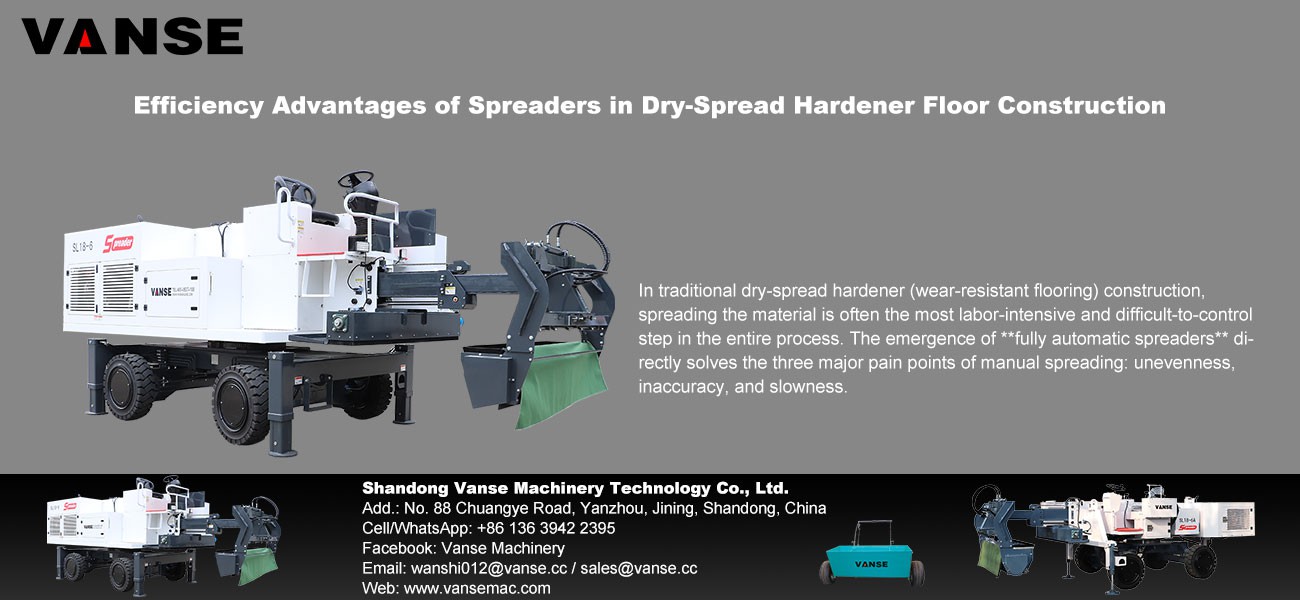
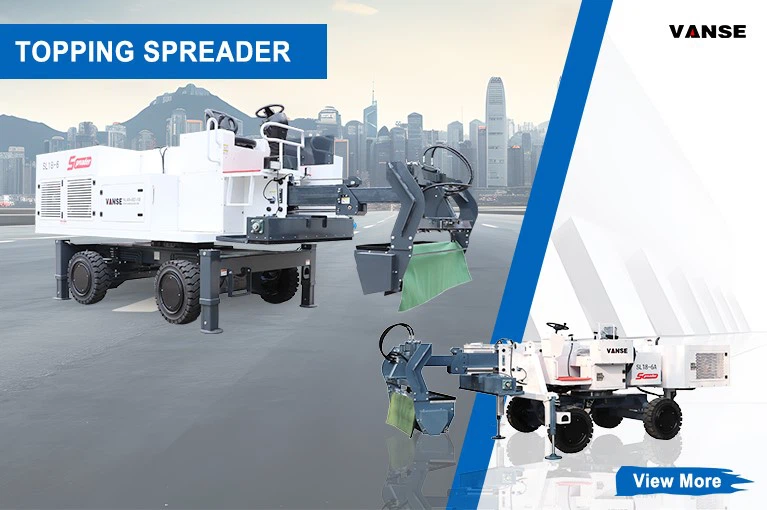
In traditional dry-spread hardener (wear-resistant flooring) construction, spreading the material is often the most labor-intensive and difficult-to-control step in the entire process. The emergence of **fully automatic spreaders** directly solves the three major pain points of manual spreading: unevenness, inaccuracy, and slowness.
The following is an analysis of the core efficiency advantages of spreaders in ultra-large area floor construction:
1. Extremely High Precision Spreading and Material Savings
Manual material spreading typically involves shoveling or manually pushing materials, which easily leads to material accumulation or missed areas.
Quantitative Spreading: Automatic spreading machines can be computer-controlled, achieving precise spreading with an error of less than ±5% per square meter. For example, if the design requirement is 5 kg/m², the machine can maintain a constant output throughout the process.
Reduced Material Waste: Compared to the dust and waste caused by manual spreading, automatic spreading machines can save approximately 10%-15% of material costs.
2. A Leap in Construction Efficiency
In the construction of large logistics centers, the time window is the lifeline.
Working Width and Speed: A large automatic material spreader typically has a working width of 2-4 meters, with adjustable travel speed. A single machine can achieve a daily construction capacity of 3000-5000 square meters, which is unattainable by traditional manual labor teams.
Simultaneous Paving: Many advanced material spreaders can be mounted on the rear of laser screeds, enabling simultaneous "screing-spreading" and merging the two processes into one.
3. Significantly Improved Overall Ground Performance
Uneven Penetration Depth: The machine-applied material is extremely even, resulting in a tighter bond between the hardener and the concrete substrate. The absence of localized accumulation avoids color variations and peeling caused by uneven thickness later on.
Low Dust and Environmentally Friendly Construction: Modern automatic material spreaders often employ enclosed hoppers and near-ground distribution designs, greatly reducing on-site dust pollution. This not only protects worker health but also meets the construction requirements of precision factories.
Comparison of the efficiency of automated material spreading vs. manual material spreading
| Indicators | Manual spreading | Automatic material spreader | Efficiency Improvement/Benefits |
| Fabric uniformity | Poor (highly human error) | High efficiency (digitally controlled) | Quality Stability Improvement by 90% |
| Daily work area | 800-1000 ㎡ (work team) | 3000-5000 ㎡ | Efficiency Increase by 3-5 Times |
| Material utilization rate | High loss (dust/excessive thickness) | Precise and cost-effective | Cost Reduction by 10%+ |
| Labor intensity | Extremely high (heavy manual labor) | Low cost (requires only one operator) | Savings on Labor Costs by 60% |
4. Synergistic Effect with Nano-hardener Application
As you previously mentioned regarding nano-hardeners, if an automatic spreader is used to create a good base during the first dry-applied layer of abrasion-resistant material, the surface density will be very even. This provides a perfect substrate for the subsequent spraying of the nano-penetrating hardener, allowing the nanoparticles to penetrate deeper and react more fully, ultimately achieving a true "mirror-like" hardening effect.
Note: The parameters provided in this document are for reference only and are not mandatory. Due to differences in technical characteristics between different brands and models of laser levelers, please consult the manufacturer for a suitable solution before actual operation. This reference document assumes no responsibility for any issues arising from failure to follow the manufacturer's instructions.
Thanks to All the Friends Who Support and Trust Shandong Vanse Machinery Technology Co., Ltd.
If you want to know more about Shandong Vanse Machinery Technology Co., Ltd. or have any questions, please feel free to contact us:
Our Factory
Shandong Vanse Machinery Technology Co., Ltd.
Share this article

About the Author: Shandong Vanse Machinery Technology Co., Ltd.
Shandong Vanse Machinery Technology Co., Ltd. is a high-tech manufacturer specializing in concrete construction machinery, including laser screeds and related equipment. The company integrates R&D, production, and global sales, with products exported to over 60 countries and widely used in infrastructure projects worldwide.
Previous Post
Next Post
Related Articles
You Might Also Like
How does the construction technology and construction process of concrete laser leveling machine ensure construction quality?
The concrete laser leveling machine combines "precision control + standardized processes," from construction process design to full-process management and control, systematically addressing core quality issues such as concrete surface flatness, density, and thickness uniformity. Its quality assurance logic can be broken down into two components: process principle assurance and full-process management and control. The details are as follows: The quality advantage of the concrete laser leveling machine stems from its unique process design. Its core technology replaces traditional manual wire drawing with "laser reference positioning," combined with a "hydraulic-driven leveling mechanism" to achieve millimeter-level precision control. Key process details are as follows: Principle: A laser transmitter (rotatable 360°) establishes a horizontal reference plane. A laser receiver (mounted on the leveling frame) receives the signal in real time. If the machine deviates from the reference plane, the control system immediately activates the hydraulic cylinder to adjust the frame height, ensuring that the leveling mechanism always operates within the reference plane. Quality Assurance: This eliminates the "segmental errors" associated with traditional manual wire drawing (e.g., height differences caused by wire slack and line of sight deviation). The reference surface covers a range of up to 50 meters, with a global flatness error of ≤3mm/2m (far exceeding the 5-8mm/2m error of traditional methods). A laser transmitter can be used to preset slopes (0.1%-5%), enabling precise drainage slope construction and preventing subsequent water accumulation (e.g., drainage needs in garages, rooftops, and factory floors). Leveling Mechanism: Utilizes a "spiral blade + scraper" combination. The spiral blades first evenly spread the concrete (controlling the amount of concrete spread based on the preset thickness), followed by the scraper for preliminary leveling to prevent spot buildup or missed vibrations. Vibration System: The machine is equipped with a high-frequency vibrator (vibration frequency 2000-3000 times/minute), capable of vibrating to a depth of 150-300mm (adjusted based on concrete thickness). Compared to manual vibration: More uniform density: High-frequency vibration effectively removes air bubbles from the concrete, preventing honeycombing and rough surfaces, and can increase the concrete's compressive strength by 10%-15%. Preventing "over-vibration segregation": The control system automatically adjusts the vibration frequency to match the concrete slump (e.g., for a slump of 120-180mm, the frequency is set to 2500 times/minute), preventing aggregate sinking and mortar floating, which can cause surface sanding. The leveling machine utilizes "four-wheel drive + intelligent travel" technology. Its travel speed can be adjusted (0.5-1.5 m/min) based on the initial setting time of the concrete (typically 2-4 hours) and the construction area. This avoids: Traveling too fast, resulting in uneven distribution and incomplete leveling; Traveling too slowly, resulting in disturbance of the concrete after initial setting, causing cracks or peeling. For large-scale construction (such as factories and logistics warehouses), a "zoned skipping method" is used. A 100-150 mm wide "post-pouring strip" is reserved at the zone boundaries to prevent cracking caused by thermal stress. Quality cannot be fully guaranteed through process design alone. Standardized process control is required to cover key quality milestones throughout the construction cycle: Preparation Core Requirements Quality Impact Base preparation 1. The flatness tolerance of the base layer (e.g., subgrade, roadbed) must be ≤5mm/2m. Protrusions and depressions must be manually repaired. If the base layer is uneven, a laser leveling can control the surface layer, but this can lead to uneven concrete thickness (thin areas can cause cracking, while thick areas increase costs). A dry base layer can cause rapid water loss from the concrete surface, resulting in sanding. 2. The base layer surface must be moistened with water (moisture content 10%-15%) to prevent moisture absorption from the concrete and cracking. Laser system calibration 1. The laser transmitter must be mounted on a stable support (away from vibration sources such as rollers). Laser system deviation is a "hidden quality issue" that can cause the leveling layer to tilt (for example, a garage with a reversed drainage slope), leading to extremely high rework costs. 2. Use a 2m straightedge and a level to calibrate the laser reference surface to an accuracy of ≤1mm. Concrete mix control 1. Slump: 50-100mm (for dry, hard concrete to avoid run-off after leveling). Excessive slump: Concrete tends to segregate, resulting in sanding. Excessive slump: The leveling has difficulty leveling, resulting in poor vibration compaction and honeycombing. 2. Aggregate Grading: Coarse aggregate (5-25mm) should account for 60%-65%, and fine aggregate (0.3-5mm) should account for 30%-35%. Avoid excessive coarse aggregate, which can cause surface unevenness. Material Distribution Control: Concrete must be distributed directly to the construction site via a chute or pump. The distribution height should be 50-80mm above the intended surface layer (allowing for leveling margins) to prevent aggregate separation caused by manual shoveling. The leveling machine must be started within 30 minutes of distribution to prevent initial setting of the concrete (in summer, this time should be shortened to 20 minutes; shade cloth can be used to delay initial setting). leveling Machine Operating Specifications: The operator must monitor the laser receiver indicator light (green: normal, red: deviation from the reference). If a red light appears, immediately stop the machine and inspect the laser system (for obstructions or transmitter offset). For every 100 square meters of surface area leveled, use a 2-meter ruler to randomly check 3-5 points. The flatness deviation must be ≤3mm. If it exceeds this standard, immediately adjust the laser reference or machine parameters. Surface Finishing: After laser leveling, wait for the concrete surface to initially set (no noticeable indentation when pressed with a finger, approximately 1-2 hours). Then, use an electric trowel to apply finishing (1-2 passes) to eliminate surface bubbles and scratches and improve surface smoothness (to prevent later sanding). When finishing, avoid staying in one spot for too long to prevent "smear marks" on the surface. Stage 3: Post-construction Curing (to prevent later quality defects) Cover Curing: Within 1-2 hours after finishing, cover the concrete with geotextile or plastic film to ensure the surface is moist (avoid direct sunlight or strong winds). During high summer temperatures, water the geotextile every 2-3 hours to keep it moist. During low winter temperatures, cover with insulation (when ambient temperature is ≤5°C, use floor heating or hot air curing to prevent freezing damage). Curation Cycle: The curing period for ordinary concrete (C30-C40) is ≥ 7 days; the curing period for high-strength concrete (C50 and above) is ≥ 14 days. During the curing period, personnel and vehicles (especially heavy vehicles) are prohibited from passing through to avoid surface indentations or cracks. Joint cutting and caulking: After 3-5 days of curing, use a joint cutter to cut shrinkage joints (spaced 6-8 meters apart and 1/3-1/4 the concrete thickness) to prevent irregular cracking caused by thermal stress. Within 24 hours of cutting, fill the joints with polyurethane sealant to prevent rainwater from seeping into the base layer, which could cause hollowing and peeling of the surface layer. Even if the process is strictly followed, unexpected quality issues may still occur and require prompt attention: Cause: Dry base layer, poor curing, and delayed crack cutting. Solution: If the crack width is ≤ 0.3mm, fill with epoxy resin. If the crack width is > 0.3mm, cut a 10mm wide and 20mm deep groove, fill with sealant, and re-finish. Cause: Laser system offset, uneven distribution of concrete. Solution: If the concrete has not initially set (within 1 hour of pouring), recalibrate the laser system and perform a second leveling. If it has already set, manually remove any raised areas with an angle grinder and then level with repair mortar. Cause: Improper concrete mix (excessive fine aggregate) and inadequate curing. Solution: Apply a "concrete sealer and hardener" to the surface (penetration depth 3-5mm) to increase surface hardness (Mohs hardness up to 6-7) and prevent sanding. The quality assurance principle for concrete laser leveling machines is "precision technology + standardized processes." In terms of technology, laser positioning eliminates manual errors, and high-frequency vibration ensures compaction, reducing quality defects at the root. In terms of process, pre-calibration, in-process testing, and post-process maintenance form a closed-loop quality loop, avoiding late-stage rework caused by "hidden issues" (such as laser offset and insufficient curing). Only by combining these two methods can a high-quality concrete surface layer with high flatness, excellent density, and no cracks or sanding be achieved. Note: The parameters provided in this document are for reference only and are not mandatory. Due to differences in technical characteristics between different brands and models of laser levelers, please consult the manufacturer for a suitable solution before actual operation. This reference document assumes no responsibility for any issues arising from failure to follow the manufacturer's instructions.Is the operation of the ride-on concrete laser leveling difficult?
Overall, the operation difficulty of the ride-on concrete laser leveling is of the type that is "easy to get started with but requires practice to master". For experienced mechanical operators, mastering basic operations is not difficult. However, to achieve the level of efficient and high-quality construction, systematic training and a certain accumulation of on-site experience are required. Now let's break down its operational difficulty in detail from different perspectives: High degree of automation: This is the core reason. The main job of the operator is no longer to manually control the flatness and elevation of the ground, but rather: Management boundary: Control the movement of machines within the boundaries of the construction area. Control speed: Adjust the forward/backward speed and make fine adjustments according to the concrete paving situation (such as more or less material). Observation and monitoring: Monitor whether the laser signal is normal, whether the machine is operating well, and the supply situation of concrete. The true "leveling" work is automatically completed by the machine: the laser receiver captures the laser plane signal, the control system calculates the height of the scraper in real time, and automatically adjusts it through the hydraulic system to ensure that it always remains at the set elevation. The operation controls are intuitive: The controls in the cab are usually simple and clear, mainly including Steering wheel or joystick: used to control the direction of travel (forward, backward, turning). Throttle/Speed control: Controls the driving speed. Scraper lifting control: Used when starting construction and leaving the construction area. Emergency stop switch: For use in emergency situations. Some advanced models may also have vibrator intensity adjustment, etc To truly complete construction independently and with high quality, operators need to master the following knowledge and skills, which require learning and practice: The installation of the laser emitter: This is the source of precision. The operator must know how to correctly select the position, level the laser emitter, and set the correct slope (if necessary). If the setup is unstable, everything will be lost. Calibration and inspection of the machine: Before starting work every day, it is necessary to check whether the laser receiver, control system and hydraulic system are working properly in accordance with the regulations and carry out necessary calibrations. This is directly related to the construction accuracy. The judgment of concrete properties: It is necessary to know how to judge the slump (dryness and thinness) of concrete. The concrete is too dry, causing high resistance for the machine's movement and making it prone to leaving marks. If it is too thin, it will affect the final strength and make it difficult to level. The machine speed and vibration frequency need to be adjusted according to the actual situation. The cultivation of "material sense" : This is the core experience. The operator needs to learn to observe the amount of concrete ahead and plan the walking path in advance to ensure that there is an appropriate amount of concrete in front of the scraper, neither too much nor too little. Excessive materials need to be removed with manual assistance, while insufficient materials need to be replenished in a timely manner.Dealing with unexpected situations: For instance, sudden loss of laser signals (blocked by people or equipment), foreign objects on the ground, interruption of concrete supply, etc., all require operators to handle them calmly and correctly. Planning of walking routes: How to plan the leveling sequence to be the most efficient and avoid repeated rolling on the already leveled area.Coordination with other trades: The coordination and cooperation with personnel such as concrete mixer trucks, pump trucks, formwork support workers, and riveters are of vital importance. Manufacturer training (most recommended) : When purchasing new equipment, the brand usually provides very detailed and systematic operation and maintenance training. This is the fastest and most formal way to learn. Master-apprentice: In construction teams, learning from experienced master workers is the most common way. One can start with auxiliary work and gradually get the hang of it. Watch teaching videos: Nowadays, there are many operation videos released by brands and construction teams online, which can help you understand the operation process and skills intuitively. Read the instruction manual: The operation manual and maintenance manual of the equipment contain all the basic knowledge and safety regulations. They must be read carefully. For beginners: If they have operating experience with other construction machinery (such as excavators and loaders), the transition will be very fast. If not, through 1-2 weeks of systematic study and on-board practice, one can fully master the basic operations and start independently completing some floor construction tasks with relatively low requirements. For experienced masters: Their value does not lie in "being able to drive", but in their ability to handle all kinds of complex working conditions, ensuring that they can deliver extremely flat floors in any situation, and with the highest efficiency and the least material consumption. So, if you are considering taking up this profession, there is no need to worry too much about its operational difficulty. It is a technical job that requires the accumulation of experience through learning and practice, but it is by no means unattainable. Once mastered, it becomes a very valuable skill. Note: The parameters provided in this document are for reference only and are not mandatory. Due to differences in technical characteristics between different brands and models of laser levelers, please consult the manufacturer for a suitable solution before actual operation. This reference document assumes no responsibility for any issues arising from failure to follow the manufacturer's instructions.How to select concrete base materials to ensure the long-term flatness of super flat floors constructed with laser leveling and power trowels
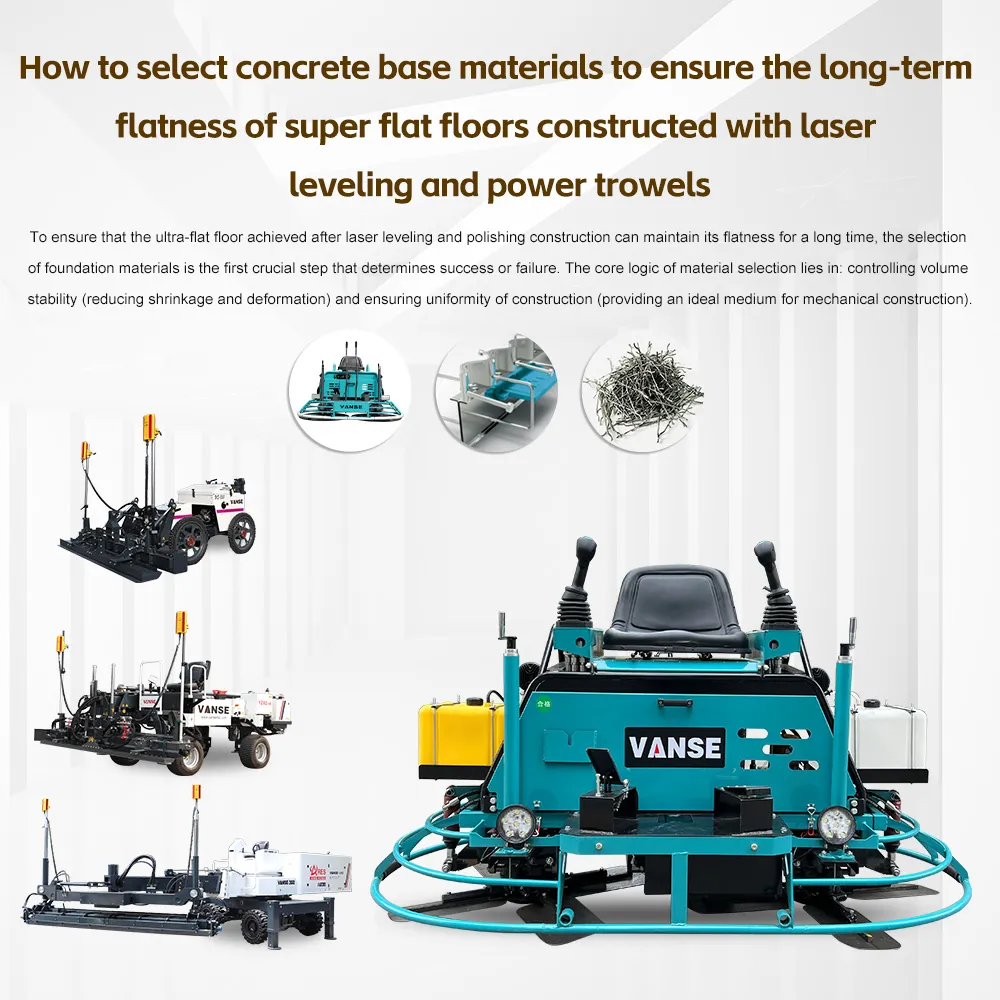
To ensure that the ultra-flat floor achieved after laser leveling and polishing construction can maintain its flatness for a long time, the selection of foundation materials is the first crucial step that determines success or failure. The core logic of material selection lies in: controlling volume stability (reducing shrinkage and deformation) and ensuring uniformity of construction (providing an ideal medium for mechanical construction). The following are the key material selection points summarized based on engineering practice and technical specifications: The design of the concrete mix ratio directly determines the shrinkage rate and crack resistance of the hardened floor, which is the fundamental factor for long-term flatness. Material category Key indicators / recommended requirements The mechanism of the long-term flatness effect Cement Ordinary Portland cement; in the same area and of the same batch number It reduces the surface color difference and internal stress unevenness caused by the chemical shrinkage difference of cement, and lowers the risk of warping. Water-cement ratio ≤0.48 Strictly controlling the water-cement ratio is the fundamental means to reduce the dry shrinkage rate of concrete. The larger the water-cement ratio, the more severe the shrinkage, and the more likely it is to crack and deform in the later stage. Slump For pumping: 100-140mm Provide stable operation for the laser leveling machine. If the slump fluctuates too much, it will make it difficult for the machine to level properly, resulting in local height errors. For non-pumping: 30-35mm Aggregate Sand: Grade II grading, strictly control the clay content A good gradation forms a stable framework structure, reducing the amount of cement paste and thereby lowering shrinkage. High clay content can damage the adhesion between cement and aggregates, causing cracks. Gravel: Continuous grading, maximum particle size ≤ 2/3 of the plate thickness The maximum particle size of the aggregate Recommendation: ≤25mm Excessive particle size will be lifted by the machine during the leveling and polishing processes, thereby damaging the surface flatness and appearance. For high-standard ultra-flat floors, ordinary concrete alone is often insufficient. Functional materials need to be introduced to enhance the overall performance. Steel fibers Concentration reference: 15kg/m³ (determined based on design load) Significantly enhances the tensile and flexural strength of concrete, effectively prevents the expansion of micro-cracks, and prevents plate warping. Compared to steel mesh, steel fiber concrete is more suitable for continuous operation by laser leveling machines, with higher efficiency. Synthetic fibers Macroscopic polypropylene fibers, etc. Mainly controls early plastic shrinkage cracks, reduces surface micro-cracks caused by excessive early water loss, laying a foundation for later flatness. Wear-resistant aggregate Metal or non-metallic aggregates (such as diamond powder, aluminum oxide, etc.) Sprayed on the concrete surface, after being compacted by a trowel, it forms a high-density, high-maintenance surface layer. This "armor" can resist wear and uneven settlement caused by long-term rolling by forklifts. Sealing curing agent Lithium-based or sodium-based liquid hardeners Penetrates into the concrete interior, reacts with calcium hydroxide to form hard calcium silicate, permanently sealing the capillary pores. It can greatly enhance surface hardness, density and impact resistance, preventing damage to flatness caused by later dusting and sanding. If the foundation is unstable, the floor will deteriorate. All the selection of upper materials is based on a stable foundation. Foundation treatment: It is necessary to ensure that the compaction degree meets the design requirements (such as the ground endurance K value is greater than 0.06 N/mm³). Uneven settlement is the fatal flaw that leads to floor cracking and loss of flatness. Base layer design: Usually, a C15 concrete base layer is set up, and a PE moisture-proof membrane is laid to block the upward movement of capillary water and prevent interlayer separation or expansion deformation caused by water vapor. Reinforced mesh (if applicable): For non-steel fiber concrete, the reinforced mesh needs to be configured according to the design to control shrinkage. However, it should be noted that the construction efficiency of the reinforced mesh is lower than that of steel fibers. To achieve long-term flatness of the super-level flooring, the selection of materials should follow the principle of "combining hardness and softness, and advancing steadily while maintaining stability": The foundation must be stable: Use concrete with a low water-cement ratio and high-quality graded aggregates as the base to ensure volume stability. The framework must be strong: Enhance the crack resistance by using steel fibers or steel mesh sheets to counteract shrinkage stress. The surface layer must be resilient: Create a high-strength and durable surface with wear-resistant aggregates and seal curing agents to resist usage wear. What is the specific grade requirement for the flooring flatness in your project (for example, does it need to meet free passage or VNA narrow aisle shelving)? This directly relates to whether steel fiber concrete is needed and the amount of wear-resistant aggregates. Please tell me these details so that I can further optimize the material plan for you. Contact us NOW Note: The parameters provided in this document are for reference only and are not mandatory. Due to differences in technical characteristics between different brands and models of laser levelers, please consult the manufacturer for a suitable solution before actual operation. This reference document assumes no responsibility for any issues arising from failure to follow the manufacturer's instructions.