Technical Knowledge
How does the concrete laser leveling machine improve the flatness of the floor?
March 20, 2024


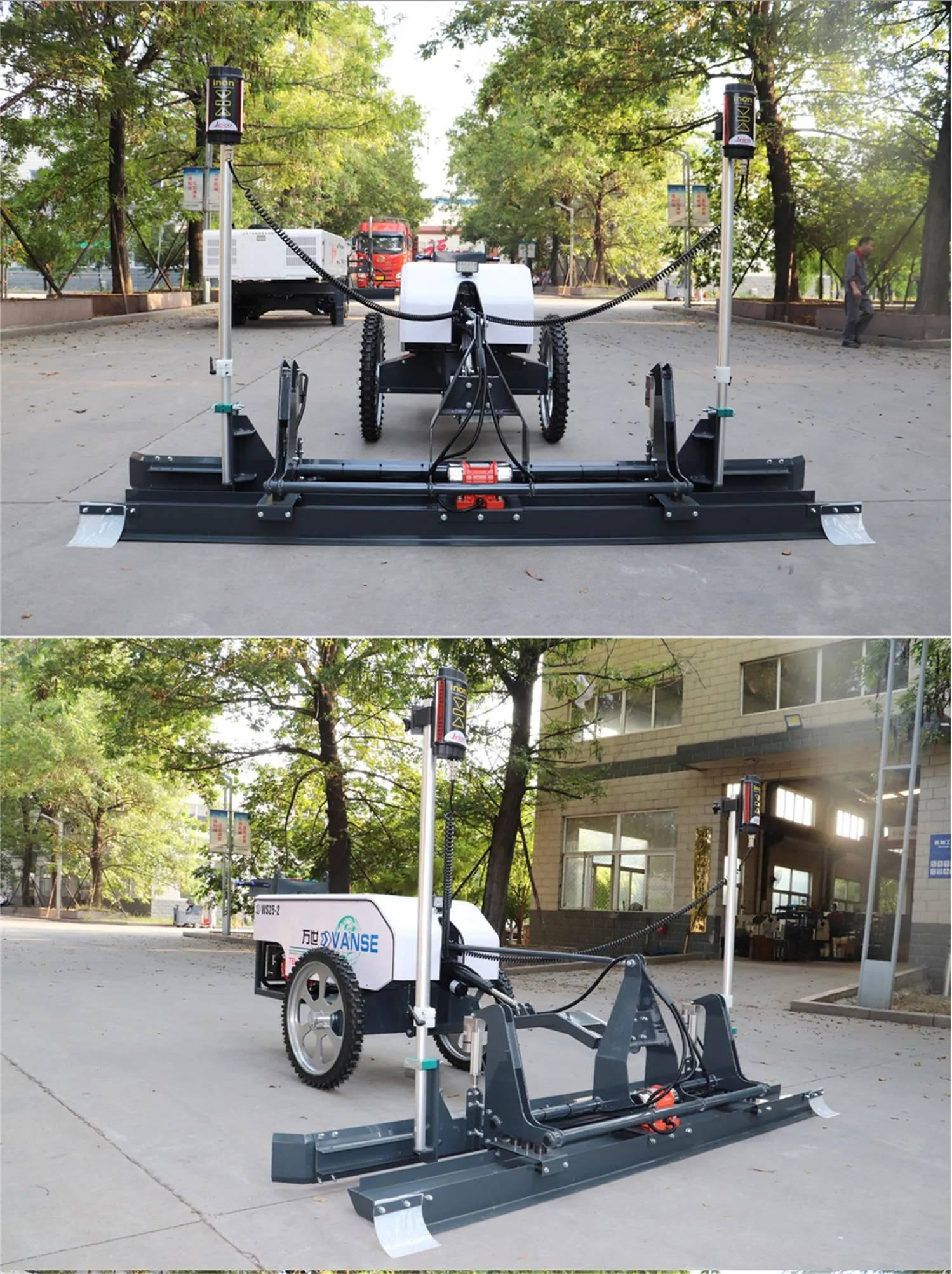
The main methods for using a concrete laser screed to improve the flatness of the floor include the following steps:
1. Laser positioning:
First, the laser leveling machine uses a laser rangefinder for positioning. This is a critical step in ensuring a smooth floor, as the laser rangefinder provides precise horizontal and vertical reference lines. Regular inspection and calibration of the laser rangefinder is an important measure to ensure its accuracy.
2. Preliminary leveling of concrete:
After the concrete is laid, the initial leveling work is carried out first. The purpose of preliminary leveling is to make the concrete surface basically reach the preset elevation and prepare for subsequent fine leveling work. The concrete surface after initial leveling should be higher than the preset elevation to facilitate subsequent leveling work.
3. Laser leveling:
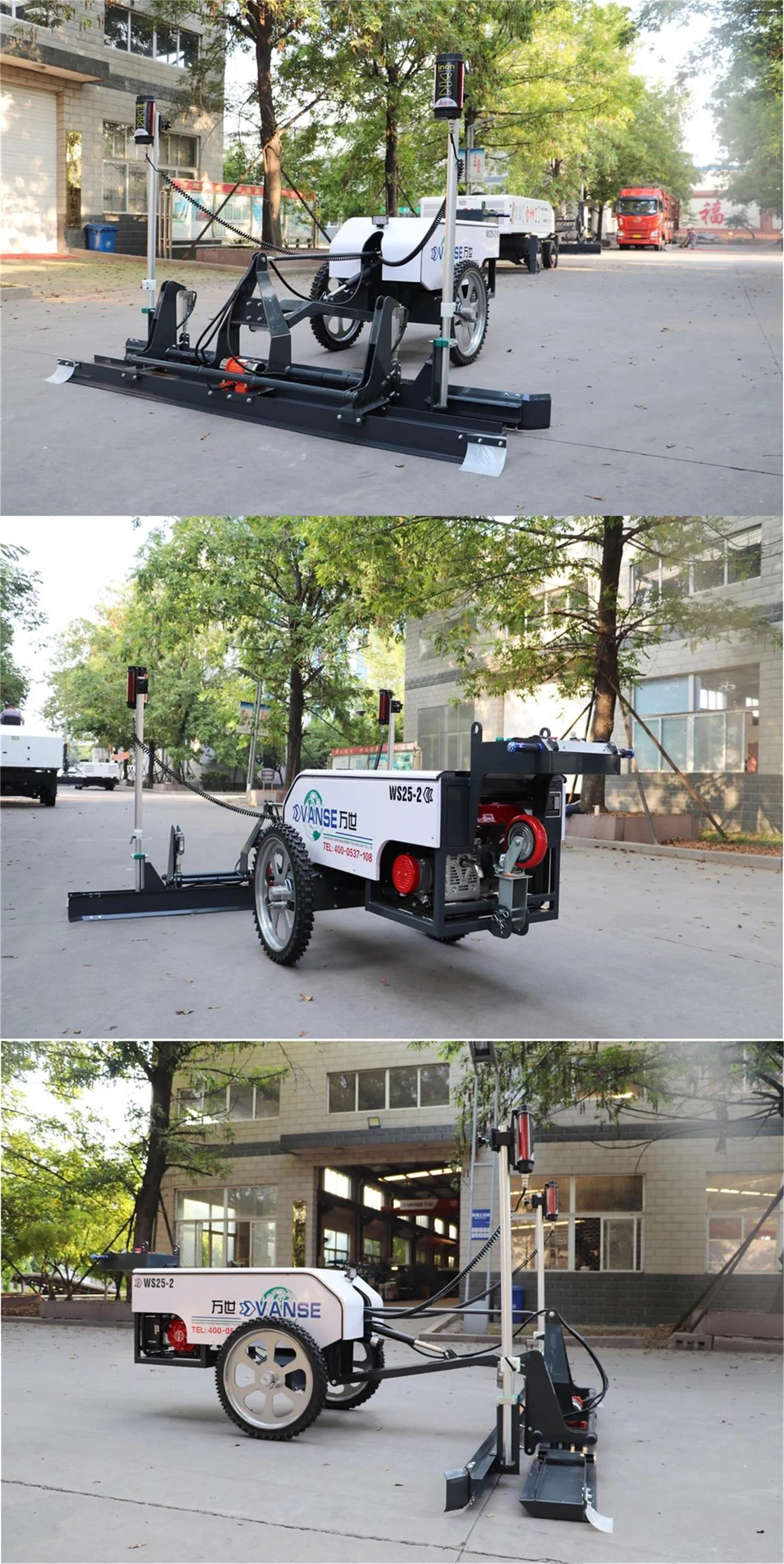
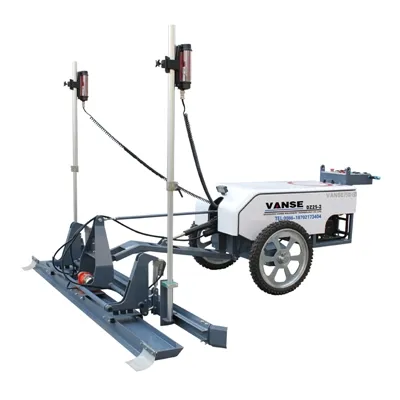
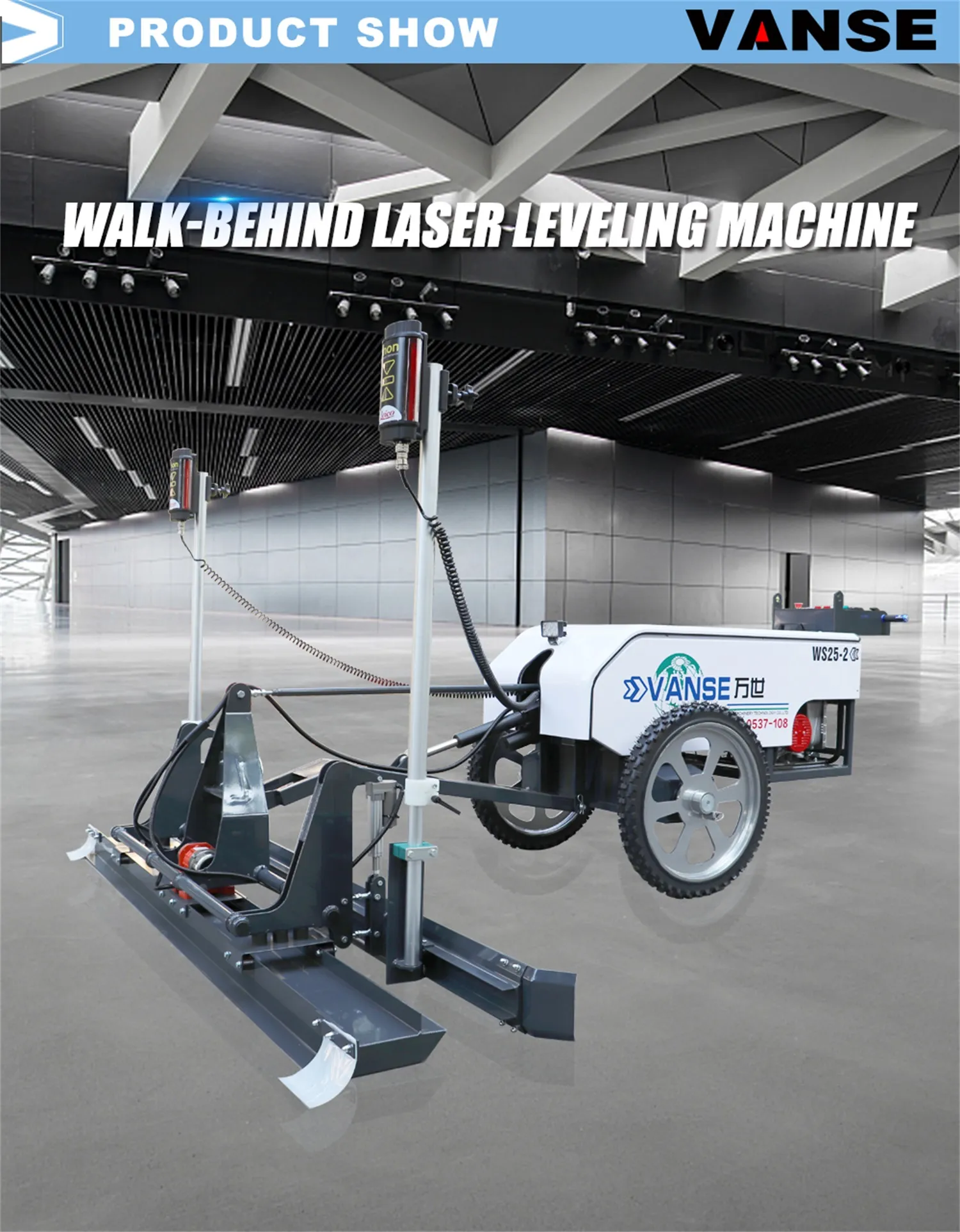
After the initial leveling, use a concrete laser leveling machine to perform fine leveling work. The screed works according to the reference line provided by the laser distance finder, ensuring that the concrete surface exactly matches the reference line. During this process, the leveler works at a constant speed to avoid uneven floors caused by being too fast or too slow.
4. Regular inspection and adjustment:
During the construction process, the flatness of the floor needs to be checked regularly. If any unevenness is found, adjustments need to be made in time. This can be accomplished by adjusting the speed and height of the leveler. At the same time, a certain amount of expansion joints should be reserved every day to cope with possible downtime during the leveling process.
5. Maintenance after construction:
After the construction is completed, it is also very important to perform proper maintenance on the floor. Maintenance measures include covering with plastic film in the early stage and covering with non-woven fabric after cutting to prevent cracking and other problems caused by the floor drying too quickly.
In general, improving floor smoothness relies on accurate laser positioning, proper concrete primary leveling, accurate laser leveling, regular inspections and adjustments, and proper post-construction maintenance. These steps require professional operators to ensure the flatness and construction quality of the floor.


Thanks to All the Friends Who Support and Trust Shandong Vanse Machinery Technology Co., Ltd.
If you want to know more about Shandong Vanse Machinery Technology Co., Ltd. or have any questions, please feel free to contact us:
Our Factory
Shandong Vanse Machinery Technology Co., Ltd.


About the Author: Shandong Vanse Machinery Technology Co., Ltd.

Shandong Vanse Machinery Technology Co., Ltd. is a high-tech manufacturer specializing in concrete construction machinery, including laser screeds and related equipment. The company integrates R&D, production, and global sales, with products exported to over 60 countries and widely used in infrastructure projects worldwide.

Shandong Vanse Machinery
Leading manufacturer specializing in high-performance concrete laser screeds, telescopic arm flatwork handlers, and mechanical ride-on power trowels.
Post overview
Main PRODUCT Categories
Need Machine Guidance?
Speak directly with Shandong Vanse field specialists for tailored equipment quotes and site planning.
Contact Us TodayRelated Articles
You Might Also Like
February 7, 2025
How to ensure the working efficiency of the concrete laser leveling machine while reducing the possibility of spatter?
– Reasonable scraper speed: The scraper speed of the concrete laser leveler has an important influence on the flow and splash of concrete. Too fast speed will cause the concrete to generate a large inertial force under the push of the scraper, which is easy to cause splashing. In general, the scraper speed should be controlled within a suitable range according to the slump of the concrete and the actual situation of the construction site. For example, when the slump is 12-18cm, the forward speed of the scraper can be set at 0.5-1m/s. This speed enables the concrete to move forward smoothly under the action of the scraper and reduce the splashing caused by too fast speed. – Appropriate scraper angle: The scraper angle will also affect the movement state of the concrete. If the scraper angle is too large, the concrete will be lifted excessively, increasing the risk of splashing. Usually, the scraper angle can be fine-tuned according to the thickness and fluidity of the concrete, generally kept between 10-30 degrees. Such an angle can make the concrete evenly spread under the action of the scraper and avoid the concrete being thrown up unnecessarily. – Vibration frequency and amplitude adjustment: The vibration system of the laser leveler is used to make the concrete more compact, but if the vibration frequency is too high or the amplitude is too large, it will cause the particles inside the concrete to move violently, resulting in splashing. For ordinary concrete construction, the vibration frequency can be set between 50-100Hz and the amplitude between 3-8mm. By appropriately reducing the vibration frequency and amplitude, the splashing phenomenon can be reduced while ensuring the density of the concrete. – Vibration depth control: The vibration depth should be adjusted according to the thickness of the concrete. If the vibration depth is too deep, the concrete near the bottom may surge upward under the action of the vibration force, causing splashing. Generally, the vibration depth is about 2/3 of the concrete thickness. For example, when the concrete thickness is 20cm, the vibration depth can be controlled at about 13-14cm. – Suitable slump range: The slump of concrete is one of the key factors affecting splashing. If the slump is too large, the concrete will be too fluid and easy to splash under the action of the leveler. Generally, in the construction of laser levelers, the slump should be controlled between 12 and 18 cm. Concrete within this range has good fluidity, which is convenient for leveler operation and can effectively reduce the possibility of splashing. During the concrete mixing process, the amount of water should be strictly controlled according to the mix ratio to ensure that the slump meets the requirements. – On-site slump detection and adjustment: At the construction site, slump detection tools such as slump cones should be equipped. During the concrete pouring process, the slump should be tested regularly, and each truck of concrete should be tested at least once. If the slump is found to be unsatisfactory, it should be adjusted in time. For example, if the slump is too large, some dry materials (such as a mixture of cement and sand) can be added appropriately for adjustment; if the slump is too small, an appropriate amount of water reducer or water can be added for adjustment. – Selection of suitable admixtures: Adding admixtures to concrete can improve its performance. For reducing splashing, admixtures with thickening effects can be selected. Thickening admixtures can increase the cohesiveness of concrete, making it difficult for concrete to disperse under the operation of the leveling machine, thereby reducing the possibility of splashing. At the same time, pay attention to the dosage of admixtures and add them according to the product instructions and test results to avoid abnormal concrete performance due to excessive admixtures. – Compatibility of admixtures with other materials: Ensure that the admixtures have good compatibility with other concrete materials such as cement, sand, and stone. If the compatibility is not good, it may cause segregation and bleeding of concrete, increasing the risk of splashing. Before using new admixtures, a trial mix test should be carried out to observe the working performance and stability of the concrete. – Layered pouring: For thicker concrete layers, layered pouring can be used. The thickness of each layer of concrete should not exceed 30-40cm. After each layer of concrete is poured, it is first vibrated with a vibrating rod, and then leveled with a laser leveling machine. This layered construction method can make the concrete better compacted in each layer and reduce splashing caused by the excessive overall thickness of the concrete during the leveling process. – Partition pouring: For large-scale concrete construction sites, they can be divided into several small areas for pouring. Reasonable construction joints are set between each area. This can avoid splashing of concrete under the long-distance push of the leveling machine during large-scale construction. At the same time, partition pouring also facilitates the control of concrete supply and construction progress. – Construction from edge to center: In terms of construction sequence, you can start from the edge of the construction site and gradually move toward the center. In this way, when the leveling machine is working, the concrete has a relatively stable boundary, which can reduce the splashing of concrete to the surrounding area. For example, when constructing the floor of a factory building, first pour and level the concrete along the wall of the factory building, and then construct to the middle area of the factory building. – Avoid repeated leveling: Try to minimize repeated leveling operations on the same area of concrete. Repeated leveling will cause the concrete to be stirred multiple times, increasing the possibility of splashing. During the leveling process, the operator should be proficient in the operation of the leveling machine to ensure that the leveling requirements can be met in one leveling.Read More
June 5, 2025
How do concrete laser leveling machines ensure high-precision leveling during operation?
In the field of construction, concrete laser leveling machine (concrete laser leveling machine or concrete laser leveler) has become a key equipment for improving the efficiency and quality of concrete construction. With the continuous advancement of global infrastructure construction and the growing demand for high-precision construction in the construction industry, the market size of concrete laser leveling machine continues to expand. According to market research reports, the global market size of concrete laser leveling machine is expected to reach US$1.76 billion in 2025, with an annual growth rate of approximately 11.4%. Its ability to achieve high-precision leveling mainly relies on the coordinated operation of the following key technologies and systems. The core of the concrete laser leveling machine is the laser transmitter, which can emit a high-precision rotating laser beam to build an absolutely horizontal reference plane above the construction area. This reference plane is like an invisible and precise "template", providing a constant elevation reference for subsequent leveling operations. For example, in the floor construction of large industrial plants, the laser transmitter is placed in the center of the construction site to ensure that the laser beam it emits can cover the entire construction area. The laser beam emitted by the laser transmitter is extremely accurate, and the deviation can usually be controlled at the millimeter level. For example, the laser accuracy of some high-end equipment can reach ±1mm, which lays a solid foundation for achieving high-precision leveling. The laser receiver equipped on the leveling machine is like the "eyes" of the equipment, always closely capturing the laser signal emitted by the laser transmitter. When the laser receiver receives the laser signal, it will immediately convert it into an electrical signal and quickly transmit it to the laser measurement and control system. During the construction process, the laser receiver always keeps real-time tracking of the laser signal, and can stably and accurately receive the signal even if the equipment moves on complex terrain. For example, when constructing on the uneven parking lot ground, the laser receiver can adjust the receiving angle in time according to the changes in the position of the equipment to ensure the continuity and accuracy of the signal, and provide reliable data support for the precise leveling of the equipment. The laser measurement and control system is like the "brain" of the concrete laser leveler, responsible for in-depth analysis and processing of the signals transmitted by the laser receiver. It will compare the real-time received laser signal with the pre-set reference elevation and accurately calculate the deviation between the two. This process is extremely fast and can usually be completed within milliseconds. For example, when the laser measurement and control system detects that the actual elevation is 5mm higher than the reference elevation, it will immediately generate the corresponding adjustment instructions to provide a basis for subsequent automatic adjustments. The system has powerful computing power and can process data from multiple measurement points at the same time, ensuring that the elevation deviation of each point in a large construction area can be captured in a timely and accurate manner. Based on the deviation information fed back by the laser measurement and control system, the computer control system of the concrete laser leveler will respond quickly and automatically adjust the height of the leveling head of the equipment accurately. The computer control system precisely adjusts the height of the scraper or leveling head to keep it consistent with the reference elevation by controlling the left and right linear actuators, such as hydraulic cylinders or electric push rods. This adjustment process is extremely accurate and efficient, and the computer control system can perform up to 10 real-time automatic elevation adjustments per second. Taking the ride-on concrete laser leveling machine as an example, when leveling a large area of the ground, the computer control system can independently control the height of the leveling heads on the left and right sides according to the elevation deviations at different locations to ensure that the ground can achieve high-precision flatness in both the longitudinal and transverse directions. For example, in the ground construction of a large logistics warehouse, the ground flatness reached a high-precision standard of ±2mm through the precise adjustment of the computer control system, far exceeding the accuracy level of traditional construction methods. The leveling head of the concrete laser leveling machine integrates a variety of functional components to work together to complete high-precision leveling operations. The scraper is located at the front end of the leveling head. Its function is to initially scrape off the concrete that is higher than the reference elevation and spread the concrete roughly to the designed height. Next, the spreading spiral auger will spread the concrete evenly to ensure that the concrete is evenly distributed in the construction area. The vibrator vibrates the concrete in a high-frequency vibration mode, making the particles inside the concrete more dense and improving the strength and flatness of the concrete. Finally, the leveling head finely trims the concrete surface to further eliminate the surface unevenness. For example, in the concrete construction of a certain airport runway, the scraper of the leveling head first scrapes the concrete flat, and after the spreading spiral spreads the concrete evenly, the vibrator vibrates at a frequency of more than 3,000 times/minute, which greatly improves the density of the concrete. After being trimmed by the leveling beam, the surface flatness of the runway finally reaches an extremely high standard, meeting the stringent requirements of aircraft takeoff and landing. Strong vibration is an important part of the concrete laser leveling machine to achieve high-precision leveling. The high-frequency vibration generated by the vibrator can make the aggregates in the concrete interlock with each other, expel the internal air, and greatly improve the density of the concrete. The dense concrete base provides a stable foundation for high-precision leveling of the surface, reducing the problem of surface unevenness caused by concrete settlement or non-compactness. At the same time, the fluidity of concrete increases during the vibration process, which helps the leveling head to better shape and level it. For example, in the floor construction of large shopping malls, the concrete density has increased by more than 20% through the efficient vibration of the concrete laser leveling machine, and the surface flatness has also been significantly improved, providing a high-quality base for subsequent floor decoration projects. The concrete laser leveling machine has a sturdy and stable frame structure that can effectively bear the weight of the equipment itself and various forces during the construction process. The frame is usually made of high-strength steel and has been optimized with good rigidity and deformation resistance. The walking mechanism ensures that the equipment moves smoothly in the construction site, and its design fully considers the passability and stability under different ground conditions. For example, some large concrete laser levelers are equipped with wide crawler walking devices, which increase the contact area with the ground and reduce the ground pressure. They can work stably even on soft ground, avoiding the decrease of leveling accuracy caused by equipment shaking or sinking. The operator controls the concrete laser leveler through a simple and precise control system. The control system can accurately receive the operator's instructions and convert them into actual actions of the equipment. At the same time, the equipment is also equipped with a variety of sensors, such as inclination sensors, displacement sensors, etc., to monitor the operating status of the equipment in real time and feedback the information to the operator. For example, the inclination sensor can monitor the inclination angle of the equipment in real time during the operation process. Once the angle deviation is found to exceed the allowable range, it will immediately send an alarm to the operator and automatically adjust the equipment posture through the control system to ensure that the leveling operation is always carried out in a high-precision state. Click the below to jump immediately!!! ARMOUR JOINT CONCRETE LEVELING MACHINE LIGHT TOWER POWER TROWEL SLIPFORM MACHINE STEEL FIBER TOPPING SPREADER TRACKED MINI DUMPERRead More
October 20, 2023
How safe are concrete laser leveling machine?
The safety of concrete laser leveling machines is an important issue, involving the safety of operators and the equipment itself. Here is a 2,000-word analysis of the safety of concrete laser levelings: 1. Operation safety Operator training The operation of a concrete laser leveling requires professional skills and knowledge, so operators must receive sufficient training to understand how to operate the equipment, safe operating procedures, and measures to deal with emergencies. Operation of equipment by untrained personnel may result in equipment damage or personal injury. Operating environment The concrete laser leveling should be used in a dry, dust-free environment and avoid operation in humid, dusty or high-temperature environments. These environmental factors can cause equipment failure or affect the accuracy of the equipment. Equipment inspection and maintenance Before operation, you should check whether the concrete laser leveling machine is in good working condition, such as whether the laser is working normally, whether the control system is normal, whether the cables and plugs are damaged, etc. Any malfunction may cause the equipment to malfunction or cause danger. Wear personal protective equipment When operating a concrete laser leveling, the operator should wear appropriate personal protective equipment, such as protective glasses, gloves, etc., to prevent laser radiation, high temperature or mechanical damage. 2. Equipment safety Laser radiation Concrete laser levelings use lasers, so operators should have knowledge about laser radiation. Laser radiation may cause permanent damage to the eyes, so protective eyewear should be worn when using it. Additionally, lasers should use appropriate filters or diaphragms to reduce radiation intensity. High temperature The use of concrete laser leveling machines in high-temperature environments may cause the equipment to overheat, thus affecting the performance and service life of the equipment. Therefore, use of the device in high temperature environments should be avoided. Mechanical injury The concrete laser leveling may cause mechanical damage during operation, such as blade breakage, blade flying out, etc. Therefore, operators should wear personal protective equipment such as gloves and ensure that the equipment remains stable during operation. Power safety Concrete laser levelings use electrical power, so the power cord should be kept safe. The power cord should be kept away from areas with high temperature, moisture and mechanical damage, and the integrity of the power cord should be checked regularly. In addition, when using power supplies, you should ensure that the power sockets and cables comply with relevant standards and avoid overloading or short circuits. 3. Safety regulations and measures Safe operating procedures The safe operating procedures for concrete laser levelings should clearly stipulate operating steps, precautions and measures to deal with emergencies. Operators should fully understand and comply with these procedures. Safety signs and warning labels Clear safety signs and warning labels should be posted on the concrete laser leveling machine to remind operators to pay attention to safety matters. These identifications and labels should include the equipment's maximum operating range, maximum load, warning signs, etc. Safe isolation measures When operating a concrete laser leveling, appropriate safety isolation measures should be taken, such as the use of guardrails, protective nets, etc., to prevent non-operators from entering the work area and ensure the safety of the operator and other personnel. Emergency stop button The concrete laser leveling should be equipped with an emergency stop button to quickly stop the operation of the equipment in an emergency. Buttons should be located within easy reach and have clear markings and warning labels. Regular inspection and maintenance In order to ensure the safe performance of the concrete laser leveling, the equipment should be inspected and maintained regularly. This includes checking whether the mechanical components, electrical components, control systems and lasers of the equipment are working properly, as well as taking necessary maintenance measures, such as cleaning the equipment, lubricating components, etc. In addition, the accuracy and calibration parameters of the equipment should be checked regularly to ensure the accuracy and reliability of the equipment. 4. Summary The safety of the concrete laser leveling is an important issue, and the safety of the operator and the equipment itself needs to be fully considered. In order to ensure safety performance, a series of safety measures should be taken, including safety inspections before operation, wearing personal protective equipment, safety regulations and measures, etc. In addition, operators should receive adequate training to understand the performance and use of equipment, as well as measures to deal with emergencies. Only by comprehensively considering and taking appropriate safety measures can the safety performance and effectiveness of the concrete laser leveling machine be ensured.Read More