Technical Knowledge
How does a concrete laser screed machine achieve efficient concrete vibration and compaction?
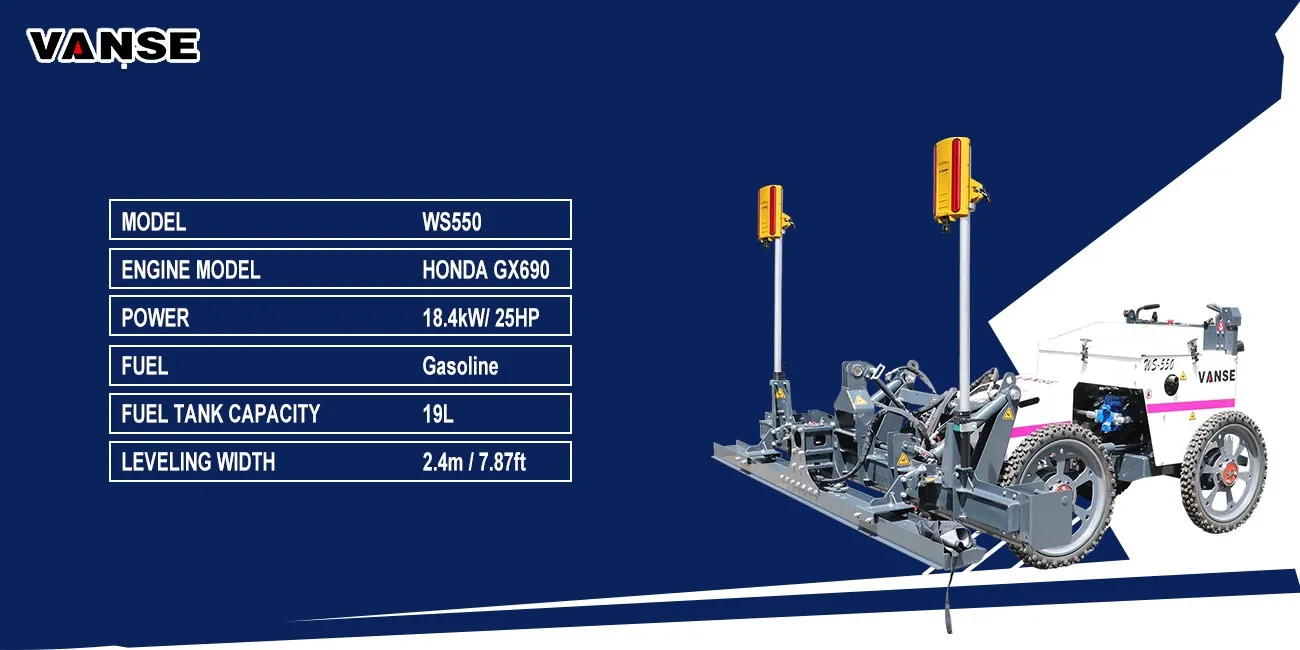
Concrete laser leveling machines achieve efficient concrete compaction through vibration, primarily through the coordinated design of their integrated vibrating system and levelinging process. The core principle is to ensure that the concrete reaches a dense state before initial setting through high-frequency vibration energy transmission, combined with precise laser positioning control. This is achieved as follows:
Energy transmission by the high-frequency vibrating device
The machine's base is typically equipped with multiple vibrating rods (or blades), which are driven by hydraulics or motors to generate high-frequency vibrations (typically 2,000-5,000 vibrations per minute) . This high-frequency vibration rapidly transmits to the unset concrete, forcing out air bubbles and realigning aggregate particles, filling gaps and reducing defects such as honeycombing and rough surfaces.
Precise control of vibration depth and range
The vibrating device can be adjusted in depth (typically 0-300mm) based on the concrete thickness, ensuring that the vibration energy reaches the bottom of the concrete, avoiding excessive vibration of the surface layer while leaving deeper layers undercompacted. The vibration range matches the paving width of the leveling machine, operating synchronously with the machine's movement, achieving an integrated "paving-vibration-leveling" process and reducing efficiency losses caused by time-to-step intervals.
Cooperation with Laser Leveling
The laser system provides a horizontal reference, ensuring the surface flatness of the vibrated concrete meets requirements. During the vibration process, the machine's hydraulic leveling mechanism adjusts the height of the vibrator in real time to avoid uneven surface fluctuations caused by uneven vibration force, ensuring both density and paving the way for subsequent leveling.
Parameter Adjustment to Adapt to Different Concrete Properties
For concretes with different slumps (such as dry hard concrete and plastic concrete), the control system adjusts the vibration frequency and amplitude: Concrete with a lower slump requires a higher frequency to break down friction between aggregates; concrete with a higher slump requires a lower frequency to avoid segregation caused by excessive vibration.
In summary, its high efficiency is reflected in its concentrated vibration energy, matching operating range, and seamless integration with the leveling process. Furthermore, its adjustable parameters adapt to diverse construction requirements, ultimately ensuring both concrete density and surface accuracy.
Thanks to All the Friends Who Support and Trust Shandong Vanse Machinery Technology Co., Ltd.
If you want to know more about Shandong Vanse Machinery Technology Co., Ltd. or have any questions, please feel free to contact us:
Our Factory
Shandong Vanse Machinery Technology Co., Ltd.








Share this article

About the Author: Shandong Vanse Machinery Technology Co., Ltd.
Shandong Vanse Machinery Technology Co., Ltd. is a high-tech manufacturer specializing in concrete construction machinery, including laser screeds and related equipment. The company integrates R&D, production, and global sales, with products exported to over 60 countries and widely used in infrastructure projects worldwide.
Previous Post
Next Post
Related Articles
You Might Also Like
How to repair the cracking problem of emery floor caused by long-term wear?
How to repair the cracking problem of emery floor caused by long-term wear? Emery floor is widely used in industrial plants, warehouses, parking lots and other places because of its wear resistance, pressure resistance and anti-slip properties. However, as time goes by, the surface of the floor will inevitably be worn, especially in high-traffic areas, where cracking problems often occur. This not only affects the aesthetics of the floor, but may also cause safety hazards and affect the use effect. Therefore, it is very important to repair the cracking problem of emery floor. ★ Problem Analysis and Causes ★ There are many reasons for the cracking of emery floor, among which long-term wear is one of the main factors. During the use of the floor, due to the frequent exchanges of vehicles, personnel, goods, etc., the surface of the floor is constantly rubbed and hit, causing the surface material to gradually wear and thin. When the wear reaches a certain extent, the structural strength and stability of the floor will be affected, resulting in cracking. In addition, factors such as floor construction quality, material quality, and use environment may also affect the wear resistance and cracking of the floor. For example, poor construction quality may lead to uneven floor surface, prone to wear and cracking; harsh use environment, such as frequent contact with chemicals or high temperature, will also accelerate the damage and aging of the floor. ★ Preparation before repair ★ Before repairing the cracking problem of diamond sand floor, you need to make adequate preparations. This includes the following aspects: 1. On-site investigation and evaluation: Conduct a comprehensive investigation and evaluation of the cracking of the floor to determine the scope, degree and cause of the cracking. At the same time, understand the use and environment of the floor to provide a basis for subsequent repair work. 2. Material preparation: According to the results of the on-site investigation and the repair plan, prepare the required repair materials, such as repair agents, curing agents, coatings, etc. Ensure that the quality of the materials meets the requirements and has good wear resistance and pressure resistance. 3. Tool and equipment preparation: Prepare the tools and equipment required during the repair process, such as grinders, vacuum cleaners, roller brushes, etc. Ensure that these tools and equipment can be used normally to improve the efficiency of repair. ★ Crack Repair Plan ★ For the cracking problem of diamond sand floor, the following repair plan can be adopted: 1. Cleaning and grinding: First, use a vacuum cleaner to clean the debris and dust in the cracked area to ensure that the surface is clean. Then, use a grinder to grind the cracked area to remove the loose layer and uneven parts of the surface to improve the adhesion of the repair material. 2. Filling the profile joint: For larger profile joints, special repair agents can be used to fill them. The choice of repair agent should be determined according to the material and use environment of the floor to ensure that it has good adhesion and good abrasiveness. When filling, apply the repair agent evenly in the crack to ensure that the filling is complete and flat. 3. Overall coating reinforcement: In order to enhance the overall strength and flatness of the floor, a layer of reinforcement coating can be applied to the entire floor surface. The choice of reinforcement coating should be determined according to the material and use requirements of the floor. You can choose a coating with wear-resistant, anti-slip and other functions. When applying, ensure that the coating is uniform and without omissions, and pay attention to avoid bubbling, cracking and other phenomena. ★ Curing and strengthening treatment ★ In order to improve the wear resistance and stability of the repaired floor, the floor can be cured and strengthened. Curing agent is a substance that can react chemically with the floor material to improve the hardness and wear resistance of the floor. After the repair work is completed, a layer of curing agent can be applied to form a hard and wear-resistant protective layer on the floor surface. Curing and strengthening treatment can further enhance the bearing capacity and service life of the floor. ★ Subsequent care and maintenance ★ After the repair work is completed, subsequent care and maintenance are equally important. Here are some suggestions: 1. Regular cleaning: Regularly use a vacuum cleaner or mop to clean the floor surface to avoid the accumulation of debris and dust. For stains that are difficult to clean, such as oil stains, professional cleaning agents can be used for treatment 2. Avoid heavy impact: When using the floor, avoid heavy objects directly hitting or scratching the floor surface to avoid damage to the floor. For high-traffic areas, protective pads can be set up or protective facilities can be installed to reduce wear. 3. Regular inspection and repair: Regularly check the cracking and wear of the floor, and deal with problems in a timely manner once they are found. For minor wear and cracking, you can use repair materials to repair; for larger problems, you can contact a professional team for repair. ★ Preventive measures ★ In order to avoid the problem of cracking of diamond sand floor again, the following are some preventive measures: 1. Improve the construction quality: During the construction process, strictly follow the construction specifications to ensure the flatness and construction quality of the floor. Pay special attention to the control of key links such as base treatment, material mixing ratio, and construction thickness) 2. Select high-quality materials: When selecting floor materials, you should pay attention to its performance in terms of wear resistance, pressure resistance, and stability. Give priority to brand products with reliable quality and stable performance, and avoid using inferior materials. 3. Reasonably plan the use environment: Reasonably plan the use environment according to the use needs and environmental characteristics of the floor. For example, set up a buffer zone in a high-traffic area or take other measures to reduce wear; take protective measures in areas susceptible to chemical invasion, etc. 4. Strengthen daily maintenance: Clean and maintain the floor regularly, and deal with minor wear and cracking problems in a timely manner. At the same time, strengthen daily inspections and maintenance work to ensure that the floor is in good use. In summary, repairing the cracking problem of diamond sand floor caused by long-term wear needs to start from multiple aspects. First, analyze and evaluate the problem to find out the cause and scope of the cracking; then, make preparations before repair, including the preparation of materials, tools and equipment; then, use appropriate repair solutions to treat the cracked area; finally, perform curing and strengthening treatment to improve the wear resistance and stability of the floor. After the repair is completed, it is also necessary to pay attention to subsequent maintenance and maintenance work, as well as take preventive measures to avoid similar problems from happening again. In the process of repairing the cracking problem of diamond sand floor, we also need to pay attention to the following points: First, safety is always the primary consideration. Before the repair work begins, ensure that the safety warning signs in the work area are in place to prevent unrelated personnel from entering the construction area. At the same time, construction personnel should wear appropriate safety protection equipment, such as gloves, masks, safety shoes, etc., to ensure safety during the construction process. Secondly, pay attention to the control of the construction environment. During the repair work, the construction area should be kept dry and clean as much as possible to avoid the influence of moisture and debris on the repair effect. At the same time, it is also crucial to control the construction temperature and humidity. Appropriate construction conditions should be selected according to the requirements of the floor material and curing agent. In addition, after the repair work is completed, a comprehensive inspection should be carried out to ensure that the repair area is consistent with the flatness and color of the surrounding floor. For the slight differences that exist, appropriate grinding and adjustment can be carried out to achieve an overall beautiful effect. Finally, the implementation of preventive measures is also crucial. In addition to improving the construction quality and selecting high-quality materials, the daily maintenance and management of the floor should be strengthened. Clean and maintain the floor regularly, and deal with the wear and cracking problems that occur in a timely manner. At the same time, for high-traffic areas or areas susceptible to chemical erosion, enhanced measures can be taken to improve the wear resistance and stability of the floor. In short, repairing the cracking problem of the diamond floor caused by long-term wear is a complex and meticulous task. Only by starting from multiple aspects such as problem analysis, pre-repair preparation, repair plan, curing and strengthening treatment, subsequent care and maintenance, and preventive measures can the quality and effect of the repair work be ensured. At the same time, paying attention to safe construction and environmental protection are also important aspects that cannot be ignored. Through scientific repair methods and effective preventive measures, we can extend the service life of emery floors, improve the use effect, and provide strong protection for the safety and beauty of various places. However, for non-professionals, it may be difficult and risky to repair emery floors. Therefore, in actual operation, it is recommended to seek the help of a professional floor repair service team. They have rich experience and professional skills, can formulate appropriate repair plans according to specific circumstances, and ensure the quality and safety of construction. At the same time, they can also provide follow-up maintenance and maintenance suggestions to help users better manage and maintain the floor. In summary, the repair of emery floors requires comprehensive consideration of multiple aspects, from problem analysis to the implementation of preventive measures. Through scientific methods and professional team support, we can effectively solve the problem of cracking of emery floors and improve the performance and life of the floor. At the same time, strengthening daily maintenance and maintenance work is also the key to ensure the long-term and stable operation of the floor. Through continuous efforts and attention, we can let the emery floor continue to play its important role in various places and provide a safe and comfortable environment for people's life and work. The above is a comprehensive analysis and solution on how to repair the cracking problem of emery floors caused by long-term wear. I hope that these contents can provide you with useful references and inspirations, helping you to better solve the problem of floor cracking and improve the use effect and service life of the floor. At the same time, it is also recommended that you pay attention to safety, environmental protection and efficiency in actual operation to ensure the smooth progress of the repair work and achieve good results.What is the difference between a concrete laser leveling and a paver?
Concrete laser levelings and pavers are two different mechanical equipment with different functions and application fields. Here are their main differences: ※Working principle The concrete laser leveling machine uses laser measurement technology to emit a laser beam through a laser transmitter. The laser receiver receives the reflected laser signal and calculates the distance and direction of the leveling machine's movement, thereby accurately controlling the leveling machine's traveling route and direction. height to achieve the purpose of leveling the concrete surface. A concrete paver is a mechanically or hydraulically driven mixing device that mixes the concrete evenly and then spreads the concrete onto the working surface through a conveyor belt or scraper. It relies on the mixing device and the conveying device to complete the concrete laying operation. ※Application fields Concrete laser leveling machines are mainly used for leveling operations in large-area concrete projects, such as highways, bridges, parking lots, etc. It has the advantages of high precision, high efficiency, automation, etc., and can complete the leveling work of a large number of concrete surfaces in a short time. Concrete pavers are mainly used for laying concrete projects. It can lay various concrete structures, such as floors, walls, floors, etc. ※Operation method Concrete laser levelings usually use automated control systems that can be operated via a computer or remote control. The operator only needs to set relevant parameters and routes, and the leveling machine can automatically perform leveling operations. Concrete pavers are relatively simple to operate. Operators need to master the operating skills of mechanical equipment and the process requirements of concrete mixing, and complete the concrete laying operation by controlling the mixing device and conveying device. ※Processing quality Due to the use of laser measurement technology, the concrete laser leveling machine can complete large-area leveling operations in a short time and can achieve high precision and flatness. It can control the flatness error of the concrete surface within a small range and improve the quality and service life of the concrete surface. The quality of concrete paver processing depends primarily on the skill and experience of the operator. If the operator has rich experience and high skill level, he can achieve better laying results. However, if the operator's technical level is not high or unskilled, it may lead to uneven or uneven laying, affecting the processing quality and service life. ※Processing efficiency The processing efficiency of concrete laser leveling machines is usually high. It can achieve automated control and high-precision measurement to complete the leveling operations of a large number of concrete surfaces in a short time. At the same time, due to the use of laser measurement technology, it can avoid errors and delays in traditional measurement methods. The processing efficiency of concrete pavers is relatively low. It requires operators to manually control the parameters and time of the mixing device and conveying device, thus requiring more time and manpower to complete large-area concrete projects. ※Maintenance and care Maintenance and maintenance of a concrete laser leveling is relatively simple. It requires regular inspection of the cleanliness and accuracy of the laser transmitter and receiver, as well as routine lubrication and maintenance of the machine. At the same time, regular cleaning and maintenance of the machine is also required to maintain the normal operation and service life of the machine. Concrete pavers are relatively complex to maintain and maintain. It requires regular inspection of the working status of the mixing device, conveying device and engine, as well as regular lubrication and maintenance of the machine. At the same time, the equipment also needs to be cleaned and maintained regularly to extend the service life of the machine. To sum up, although concrete laser levelings and pavers are used for the treatment and paving of concrete surfaces, their working principles, application fields, operating methods, processing quality, processing efficiency and maintenance are all different. Certain differences. When choosing to use it, you need to choose appropriate mechanical equipment according to the actual situation to meet the construction requirements.Construction quality control and management of concrete laser leveling machine
The construction quality control and management of concrete laser leveling mainly involves the following aspects: 1. Equipment selection and calibration First of all, choosing a qualified concrete laser leveler is the basis for ensuring construction quality. It is necessary to ensure that the selected equipment can meet various requirements of construction, including accuracy, stability, durability, etc. After the equipment arrives at the construction site, it must be carefully unpacked and inspected to ensure that all parts are intact, and preliminary debugging and calibration must be carried out in accordance with the instructions. 2. Operator training Operating a concrete laser leveling requires professional skills and experience, so operators must be rigorously trained. The training content includes the basic principles of equipment, operating procedures, safety precautions, fault diagnosis and troubleshooting, etc. Only operators who have been trained and obtained certificates can perform actual operations. 3. Construction process quality control Pre-construction quality control: This includes inspection of the construction environment to ensure it is dry, ventilated and dust-free. At the same time, concrete raw materials must be strictly controlled to ensure that their quality meets construction requirements. Quality control during construction: This is mainly to control the operation process of the concrete laser leveling machine. Operators are required to strictly abide by operating procedures and carry out construction according to preset parameters. At the same time, a dedicated person must supervise the construction process to ensure correct operation. Post-construction quality control: After the construction is completed, the concrete surface should be inspected for quality, including surface flatness, smoothness, etc. Any areas that do not meet the requirements must be dealt with promptly and leveled again. 4. Acceptance standards Acceptance standards are an important basis for measuring construction quality. For concrete laser leveling machine construction, the acceptance criteria mainly include the following aspects: Concrete surface flatness: This is the most basic acceptance standard, which requires that the concrete surface has no obvious undulations and the overall flatness meets the design requirements. Concrete surface finish: Good finish can reduce friction on the concrete surface and improve performance. The concrete surface is required to be smooth and flawless during acceptance. Construction accuracy: For high-precision construction projects, the accuracy of the concrete laser leveler must meet the design requirements. During acceptance, the construction accuracy should be measured to see whether it meets the design standards. Equipment stability: The stability of the equipment must be checked during acceptance, including the operation stability and working status stability of the equipment. Equipment reliability: During acceptance, the reliability of the equipment should be checked to see whether the equipment is prone to failure and whether each component of the equipment can operate stably. Economy: The economy of using the concrete laser leveling is also an important acceptance criterion. Economical use mainly refers to whether the energy, material and other costs consumed by the equipment during the construction process are reasonable. During acceptance, the economics of the equipment should be evaluated to see whether it meets the requirements of economic benefits. Safety: During acceptance, the safety of the equipment must also be checked, including whether the safety protection measures of the equipment are complete and whether the operators have safety awareness. In addition, it should be ensured that the noise and vibration of the equipment are within an acceptable range and will not affect the surrounding environment and personnel. Environmental protection: The environmental performance of the equipment must also be considered during acceptance. Concrete laser levelings may produce pollution such as dust and noise during the construction process. Therefore, it is necessary to ensure that environmental factors are considered during the design process of the equipment to minimize environmental pollution. 5. Quality inspection and maintenance During and after the construction process, the concrete laser leveling machine should be regularly inspected and maintained for quality. Quality inspection mainly includes inspection of the equipment's operating status, working accuracy, concrete quality, etc. Maintenance mainly includes daily maintenance, regular inspection and repair of the equipment. 6. Recording and archiving During the construction process, various construction parameters, operating procedures, problems and solutions should be recorded. These records can provide a basis for acceptance and quality inspection, and are also an important reference for equipment maintenance and improvement. Records should be organized into files and properly preserved for subsequent review and reference. In summary, the construction quality control and management of concrete laser leveling machines need to be comprehensively considered and implemented from multiple aspects such as equipment selection, personnel training, construction process control, acceptance standard formulation, quality inspection and maintenance, and record archiving. Only in this way can the construction quality of the concrete laser leveling be ensured and the overall quality and efficiency of the project improved.