Technical Knowledge
What operations should be avoided when using a concrete laser leveler to vibrate and compact concrete?
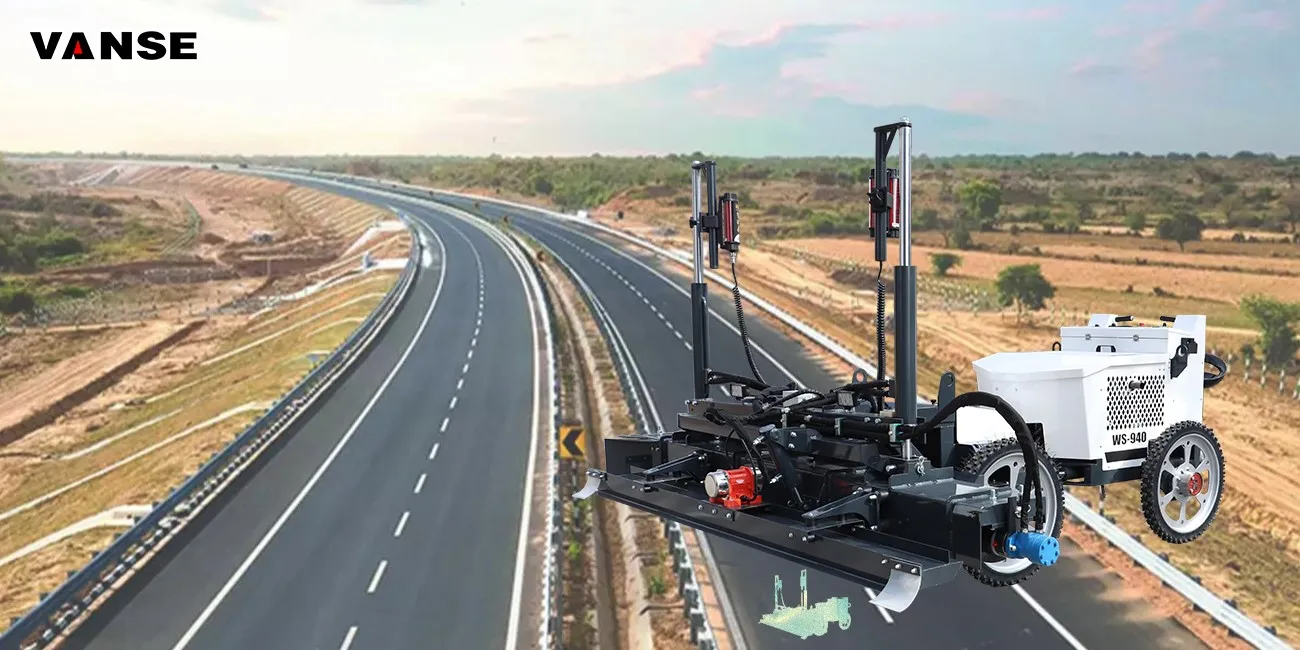
Improper operation of a concrete laser leveling machine during compaction can lead to problems such as segregation, uneven surfaces, and insufficient density. The following key practices should be avoided:
1. Avoid improper vibration parameter settings
Over-vibration:
Excessive vibration frequency (exceeding the equipment's recommended range, such as over 5,000 vibrations per minute) or prolonged vibration time can cause aggregate to sink and mortar to float, resulting in segregation (gravel concentrates at the bottom and excessive laitance on the surface), impacting structural strength and durability.
Insufficient vibration:
Excessive vibration frequency or insufficient vibration depth (failure to reach the bottom of the concrete) can prevent internal bubbles from being expelled and gaps between aggregates from being filled, leading to honeycombs and voids, and reduced density.
Parameters not adapted to concrete characteristics:
Parameters not adjusted according to concrete slump (e.g., using a low frequency for dry, hard concrete and a high frequency for plastic concrete) can result in either inadequate vibration or segregation.
2. Avoid overlapping or missing areas in the vibration operation
Repeatedly vibrating the same area:
Repeatedly vibrating the same location will damage the concrete's initial structure and exacerbate segregation, especially when performed on concrete in the initial setting stage. This can cause sanding and cracking of the surface.
Missed edges or corners:
The vibrator fails to reach areas such as the edge of the formwork or areas with dense rebar. These areas are prone to honeycombing due to insufficient vibration energy and require manual assisted vibration (such as using an inserted vibrator). However, this should avoid interfering with the laser leveling machine.
3. Avoid improper coordination with leveling operations
Mismatching vibration and travel speed:
If the machine travels too fast, the vibrator will stay in a specific area too short, failing to achieve adequate compaction. If the machine travels too slowly, excessive vibration may cause segregation, impacting construction efficiency.
Failure to promptly level after vibration:
After vibration, the concrete surface will fluctuate due to vibration. If this is not promptly leveled using the laser leveling system, the surface will exceed the required flatness, requiring additional repairs and increasing costs.
4. Avoid operating in unsuitable concrete conditions
Forced vibration when the concrete slump exceeds the specified value: Concrete with a large slump (e.g., over 200mm) is inherently fluid and can easily segregate due to excessive vibration. Concrete with a small slump (e.g., less than 50mm) has difficulty transmitting energy through vibration, which can lead to insufficient density. Therefore, the concrete mix proportions should be adjusted before construction.
Vibrating after initial setting: After initial setting (loss of plasticity), vibration can damage the existing structural framework, causing surface cracking and reduced strength. Vibration timing must be strictly controlled and synchronized with the concrete pouring rhythm.
5. Avoid improper equipment use and maintenance
Continuing to use a vibrator when the vibrator is worn or stuck: Wear on the vibrator blades will attenuate the vibration energy, while sticking can cause localized severe impact, resulting in localized concrete segregation or surface damage. Regularly inspect the equipment. Failure to adjust the vibration depth based on the construction thickness: Too shallow a vibration depth (less than 2/3 of the concrete thickness) can result in a loose, deeper layer; too deep a vibration depth (contacting the formwork or base) can damage the formwork due to vibration impact or introduce impurities into the base, affecting concrete quality.
By avoiding these practices, the laser leveling can ensure efficient concrete compaction during the vibration process while maintaining surface accuracy and structural strength, reducing subsequent repair costs.
Click the below to jump immediately!!!

ARMOUR JOINT

CONCRETE LASER LEVELING MACHINE

LIGHT TOWER

POWER TROWEL

SLIPFORM MACHINE

STEEL FIBER

TOPPING SPREADER

Thanks to All the Friends Who Support and Trust Shandong Vanse Machinery Technology Co., Ltd.
If you want to know more about Shandong Vanse Machinery Technology Co., Ltd. or have any questions, please feel free to contact us:
Our Factory
Shandong Vanse Machinery Technology Co., Ltd.








Share this article

About the Author: Shandong Vanse Machinery Technology Co., Ltd.
Shandong Vanse Machinery Technology Co., Ltd. is a high-tech manufacturer specializing in concrete construction machinery, including laser screeds and related equipment. The company integrates R&D, production, and global sales, with products exported to over 60 countries and widely used in infrastructure projects worldwide.
Previous Post
Next Post
Related Articles
You Might Also Like
What materials are suitable for concrete laser leveling machines?
Concrete laser leveling: suitable materials and applications ★1★ Introduction to compact soil laser leveling machine The concrete laser leveling is a high-efficiency, high-precision concrete construction equipment that is widely used in the construction of floors, roads, bridges and other fields. This equipment achieves high-precision positioning and leveling through laser technology, which can greatly improve the quality and efficiency of concrete construction. ★2★ Concrete material properties Concrete is a composite material widely used in construction projects. It is mainly composed of aggregates, cement, water and other additives. The hardening process of concrete involves factors such as hydration reaction and temperature changes, and it requires a certain amount of time and appropriate maintenance to reach the design strength. Due to the diversity of concrete materials, different types and proportions of mixers have different characteristics and application ranges. ★3★ Working principle of concrete laser leveling machine The working principle of the compacted soil laser leveling machine mainly uses laser technology for high-precision positioning and measurement. By installing a laser transmitter and receiver on the equipment, the concrete laser leveling can form a laser beam in the construction area, and monitor and control the height and level of the laser beam in real time through sensors and control systems. During the leveling process, the equipment will automatically adjust the walking track and concrete paving thickness to ensure the flatness and compactness of the floor. ★4★ Applicable material range of concrete laser leveling machine Concrete laser leveling machines are suitable for many types of concrete materials, including but not limited to the following: 1. Ordinary concrete: suitable for concrete construction in general construction projects, such as floors, roads, etc. 2. High-strength concrete: suitable for structures with high strength requirements, such as bridges, high-rise buildings, etc. 3. Durable concrete: Suitable for projects with high durability requirements, such as nuclear power plants, tunnels, etc. 4. Special function concrete: such as thermal insulation concrete, refractory concrete, etc., suitable for projects with specific functions. It should be noted that for different types of concrete materials, appropriate mix design and construction process adjustments need to be carried out according to their characteristics and requirements to ensure Construction Quality. ★5★ Application of concrete laser leveling machine in different scenarios The application of concrete laser leveling machines in different scenarios includes the following aspects: 1. Floor construction: Suitable for floor construction in industrial plants, warehouses, parking lots, shopping malls, etc., which can improve the flatness and durability of the floor. 2. Road construction: It is suitable for the construction of urban roads, highway bridges and other road projects. It can improve the smoothness and durability of the road and reduce maintenance costs. 3. Bridge construction: It is suitable for construction on the surface of bridges, which can improve the flatness and durability of the bridge and extend the service life of the bridge. 4. Airport runway construction: Suitable for the construction of airport runways, it can improve the flatness and durability of the runway and ensure flight safety. 5. Special projects: Suitable for the construction of special projects with extremely high safety requirements such as nuclear power plants, tunnels, and oil depots. ★6★ Advantages and limitations of concrete laser leveling machine The advantages of the compacted soil laser leveler mainly include high precision, high efficiency, and high degree of automation, which can greatly improve construction quality and efficiency, and reduce labor costs and material waste. However, there are also some limitations to the compacted soil laser leveling, such as the higher skill level requirements for operators, additional processing and adjustments that may be required for construction with complex shapes and special requirements, and in addition, the purchase and maintenance costs of the equipment. It also requires reasonable economic considerations. ★7★ Operation and maintenance of concrete laser leveling machine Operating a concrete laser leveling requires professional training and practical experience. Operators need to master the performance and working principles of the equipment and strictly abide by operating procedures and safety regulations. During use, the equipment must be inspected and maintained regularly to ensure the normal operation and service life of the equipment. At the same time, for different types of concrete materials and construction scenarios, corresponding adjustments and treatments are required to ensure construction quality. ★8★ Market Prospects and Investment Value Analysis With the continuous expansion of the scale of construction projects and the continuous improvement of construction requirements, the market demand for concrete laser leveling machines is also gradually increasing. In the next few years, with the continuous advancement of technology and the expansion of application fields, there is still a lot of room for improvement in the accuracy, efficiency and service life of concrete laser levelings. Therefore, for investors with a long-term perspective, concrete laser leveling machines are a potential investment area. However, it should be noted that the investment cost of equipment is relatively high, and adequate preparation and planning are required economically. At the same time, market competition is becoming increasingly fierce, and it is necessary to strengthen technological innovation and service quality improvement to maintain competitive advantages.What are the specific details of regular inspection and maintenance of consumables for concrete laser leveling machines?
Regular inspection and maintenance of consumables of concrete laser leveling machine is the corePrevent wear and failure of key componentsTo avoid sudden failures during construction that affect flatness and efficiency, it is necessary to execute the work in order of priority based on "wearing parts – precision parts – auxiliary systems". For core consumables that are in direct contact with concrete and wear the fastest, focus on checking the "amount of wear" and "tightening status". Consumables Category Check content Maintenance Action Judgment criteria Leveling scraper/blade 1. Check whether the cutting edge has any notches or curling 1. Use a scraper to clean the remaining concrete to avoid corrosion 1. If the blade wear is greater than 3mm, it needs to be polished; if the chip is greater than 5mm, it needs to be replaced. 2. Whether the surface concrete residue is hardened 2. If the bolts are loose, tighten them with a torque wrench according to the standard torque. 2. The bolts have no thread slippage and no obvious displacement 3. Are the fixing bolts loose? Laser receiver 1. Check if there is dust or concrete slurry attached to the lens 1. Use a clean soft cloth to wipe the lens. Do not use high-pressure water to directly clean the lens. 1. The lens is free of scratches and obstructions 2. Check whether the connecting wire is damaged or the connector is loose. 2. Damaged cables must be replaced immediately to avoid signal interruption 2. The indicator light flashes normally when receiving laser signal Travel wheels/tracks 1. Is the tire pressure normal (pneumatic tire) 1. Fill the tire pressure according to the instructions (usually 0.8-1.2bar) 1. Track teeth wear > 1/3 and need to be replaced 2. Check whether the track shoe has cracks or tooth wear 2. Add lithium-based grease when the bearing makes abnormal noise 2. No deviation or lag when walking 3. Is there any abnormal noise from the wheel bearing? For the transmission, hydraulic, and lubrication system consumables that support the operation of the equipment, focus on checking the "oil status" and "component aging." Hydraulic oil filter: Observe whether there are metal debris and impurities on the surface of the filter element. If the filter element is blocked and the indicator light is on, it needs to be replaced immediately (to avoid impurities from wearing the hydraulic pump). Hydraulic oil pipe/seal ring: Check whether the oil pipe has bulges or leakage, and whether the sealing ring is deformed or aged. If leakage is found, the corresponding parts should be replaced in time to prevent hydraulic oil loss and insufficient power. Travel motor bearings, scraper drive shaftFor rotating parts, add the specified type of grease (usually 2# lithium-based grease) according to the instructions. The amount of grease added each time should be based on a small amount that overflows from the gap to avoid overheating of the parts due to excessive grease. If it is an electric model, check whether the battery terminals are oxidized or loose. Sand the oxide layer with sandpaper and apply Vaseline to prevent rust. When the battery power is less than 20%, it needs to be charged in time to avoid deep discharge that affects the battery life. For consumables that have a long lifespan but need to be replaced regularly, focus on "performance degradation". Laser transmitter: Check whether the brightness of the laser tube is attenuated (compare with the light spot intensity of a new machine). If the light spot is blurred or the range is shortened, the laser tube needs to be replaced (it is recommended to use original accessories to avoid model mismatch affecting accuracy). Filter elements (air/fuel): The fuel filter and air filter need to be replaced as a whole to avoid blockage after long-term use, which may lead to insufficient engine fuel supply and poor air intake. After replacement, start the machine and run it at idle speed for 5 minutes to check for leaks. Wear parts backup: Reserve 1-2 sets of wearing parts (such as scraper blades, seals, and filter elements) in advance to avoid a shortage of spare parts in the event of a sudden failure, which would affect the construction progress. The core of the maintenance of consumables of concrete laser leveling machine is "High frequency to check wear, medium frequency to maintain operation, low frequency to replace aging parts". Records must be kept for each inspection (such as wear amount, replacement time), and the cycle and parameters specified in the equipment manual must be strictly followed to maximize the life of consumables and ensure construction accuracy.Laser leveling machine operation steps and slope adjustment?
•••▶★◀••• Introduction As an indispensable construction equipment in the modern construction industry, the laser leveler's efficient and accurate leveling capabilities provide a strong guarantee for the construction of large-area concrete floors. Correct operation of the laser leveler and reasonable adjustment of the slope can not only ensure Improve construction quality, improve construction efficiency and reduce costs. This article aims to introduce in detail the operating steps and slope adjustment methods of the laser leveling machine, with a view to providing clear and practical operating guidelines for relevant construction personnel. •••▶★◀••• Equipment inspection and preparation Before operating the laser leveling machine, a comprehensive equipment inspection and preparation must be carried out. Specific steps are as follows: 1. Check the appearance of the equipment to ensure that the leveler has no obvious damage, deformation or rust. 2. Check the power system, including engine, battery, etc., to ensure that it is in good condition and has sufficient fuel or power. 3. Check the laser system, including laser transmitter, receiver, etc., to ensure that they are intact and working properly 4. Check the walking system of the leveler, including tires, tracks, etc., to ensure smooth walking and no jamming. 5. Check the control system, including the operation panel, sensors, etc., to ensure that its functions are normal and the display is accurate. After completing the above inspection, the operator should be familiar with the various function keys and operation panel of the leveling machine to ensure that they can operate it skillfully. •••▶★◀••• Laser system calibration The leveling accuracy of a laser leveler depends largely on the calibration of the laser system. The specific steps for laser system calibration are as follows: 1. Set a reference point in the construction area to ensure that the reference point is stable and at the same height. 2. Install the laser transmitter on the reference point, adjust the level of the transmitter, and ensure that the laser beam is projected vertically downward. 3. Turn on the laser transmitter and place the laser receiver on the ground to be leveled to ensure that the receiver can accurately receive the laser signal. 4. According to the data displayed by the receiver, adjust the parameters of the laser system to ensure that the laser beam is consistent with the actual ground height. After completing the laser system calibration, a test should be conducted to ensure that the leveler can accurately level according to the guidance of the laser beam. •••▶★◀••• Set leveling parameters Before officially starting the leveling operation, the leveling parameters need to be set according to the construction requirements. The specific steps for setting leveling parameters are as follows: 1. According to the construction drawings or design requirements, determine the flatness, levelness and other indicators of the ground. 2. Set the leveling speed, lifting range and other parameters of the leveling machine according to the ground indicators. 3. Set the vibration frequency, spatula angle and other parameters of the leveler according to the construction environment. After completing the parameter setting, a trial run should be carried out to ensure that the leveling machine can perform leveling operations according to the set parameters. •••▶★◀••• Start leveling operation After equipment inspection, laser system calibration and parameter setting are completed, leveling operations can begin. The specific steps are as follows: 1. Turn on the leveler and drive the leveler to the ground to be leveled. 2. According to the guidance of the laser system, operate the leveling machine to perform leveling operations. During the leveling process, the operator should promptly adjust the speed and lifting range of the leveling machine according to the actual situation to ensure the leveling quality. 3. During the leveling process, attention should be paid to the operating status and leveling effect of the leveling machine. If any abnormality is found, the machine should be stopped in time for inspection and treatment. After the leveling operation is completed, the leveling machine should be closed and necessary cleaning and maintenance should be carried out. Work. •••▶★◀••• Adjust the slope If the slope needs to be adjusted, this can be achieved by adjusting the lifting device of the leveling machine. The specific steps to adjust the slope are as follows: 1. Set up slope control points in the construction area to ensure that the control points are stable and highly accurate. 2. Install the slope sensor on the leveling machine and calibrate its sensitivity. 3. Determine the slope requirements of the ground according to construction drawings or design requirements. 4. Operate the leveling machine to the slope adjustment area. According to the instructions of the slope sensor, adjust the lifting device of the leveling machine so that the ground reaches the preset slope. During the slope adjustment process, attention should be paid to maintaining the stability and stability of the leveling machine. Level the quality to avoid obvious waves or unevenness. •••▶★◀••• Monitoring and Adjustment During the leveling operation, the leveling quality should be monitored and adjusted in real time. The specific steps are as follows: 1. Use a laser receiver or other measurement tools to measure the leveled ground in real time to ensure that the leveling quality meets the requirements. 2. According to the measurement results, timely adjust the parameters and operating methods of the leveling machine to improve the leveling quality. 3. During the leveling operation, attention should be paid to observing the operating status of the leveling machine and changes in the surrounding environment to ensure the safety and continuity of the leveling operation. 8. End operation and maintenance After the leveling operation is completed, necessary equipment cleaning and maintenance work should be carried out. Specific steps are as follows: 1. Turn off the leveler and clean the dust and debris on the surface of the leveler. 2. Check all components and systems of the leveler to ensure they are intact and functioning properly. 3. Lubricate and maintain the lubricating parts of the leveling machine to ensure that the equipment can operate normally the next time it is used. 4. Park the leveler in a dry and ventilated place, and take necessary protective measures to prevent the equipment from getting damp or damaged. •••▶★◀••• Safety precautions When operating a laser leveling machine, the following safety precautions must be strictly observed to ensure the safety of the operator and the normal operation of the equipment: 1. Operator training: Ensure that all operators have received professional training and are familiar with the operating instructions and safety procedures of the leveling machine. 2. Wear protective equipment: When working near the leveling machine, operators should wear personal protective equipment that meets regulations, such as hard hats, protective glasses, protective shoes, etc. 3. Regular inspection and maintenance: Regular inspection and maintenance of the leveling machine to ensure that the equipment is in good working condition. In particular, important components such as laser systems and power systems should be inspected and calibrated regularly. 4. Pay attention to the surrounding environment: When operating the leveling machine, you should pay attention to changes in the surrounding environment, such as terrain, obstacles, other construction personnel, etc. Avoid operating the leveling on unstable or dangerous ground. 5. Overloading is prohibited: The leveler should operate within the specified load range and must not be overloaded. Overloading may cause equipment damage or cause safety accidents. 6. Observe the operating procedures: When operating the leveling machine, the operating procedures should be strictly followed, and the operating sequence or equipment parameters should not be changed at will. 7. Stop the machine to deal with abnormal situations: During the leveling operation, if any abnormality or malfunction is found in the equipment, the machine should be stopped immediately and professionals should be sought for inspection and repair. Do not disassemble or repair the equipment without authorization. 8. Keep away from power sources and water sources: The leveler should be placed away from power sources and water sources to prevent electrical failure or equipment damage. 9. Prevent dust and noise hazards: The leveling machine may produce dust and noise during operation. Operators should wear corresponding protective equipment, such as dust-proof mouthpieces, earplugs, etc. 10. Obey safety warning signs: When operating the leveling machine, pay special attention to the safety warning signs and prompt information on the equipment, and operate as required. •••▶★◀••• Summary As an important piece of equipment in modern building construction, the laser leveling machine's operation steps and slope adjustment methods are of great significance to ensure construction quality and improve construction efficiency. This article introduces in detail the operating steps and slope adjustment methods of the laser leveling machine, and emphasizes the importance of safety precautions. It is hoped that this article can provide useful reference and guidance for relevant construction personnel to ensure the safe and efficient operation of laser leveling machines. At the same time, it is also recommended that construction units strengthen the training and management of operators, improve the skill level and safety awareness of operators, and jointly promote the healthy development of the construction industry.