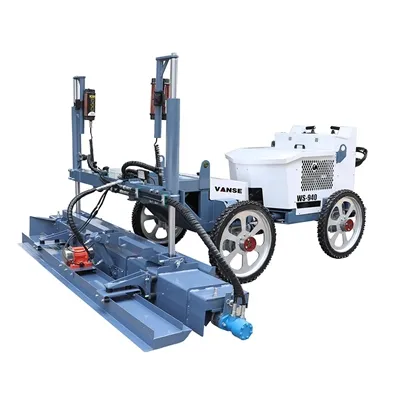
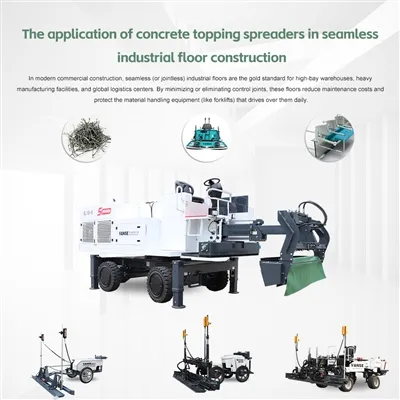
Do you know the leveling process of laser leveling machine? For how to do a good job in floor engineering, the selection of materials and construction technology are equally important. Laser leveling machine is also the key point that needs to be grasped in the construction process. Industrial plants have high requirements on the flatness of the ground level and surface resistance. Manual construction is difficult to grasp and control, and it is difficult to achieve standardized construction. The following articles are how to construct laser leveling machines and precautions, and how to avoid construction errors.
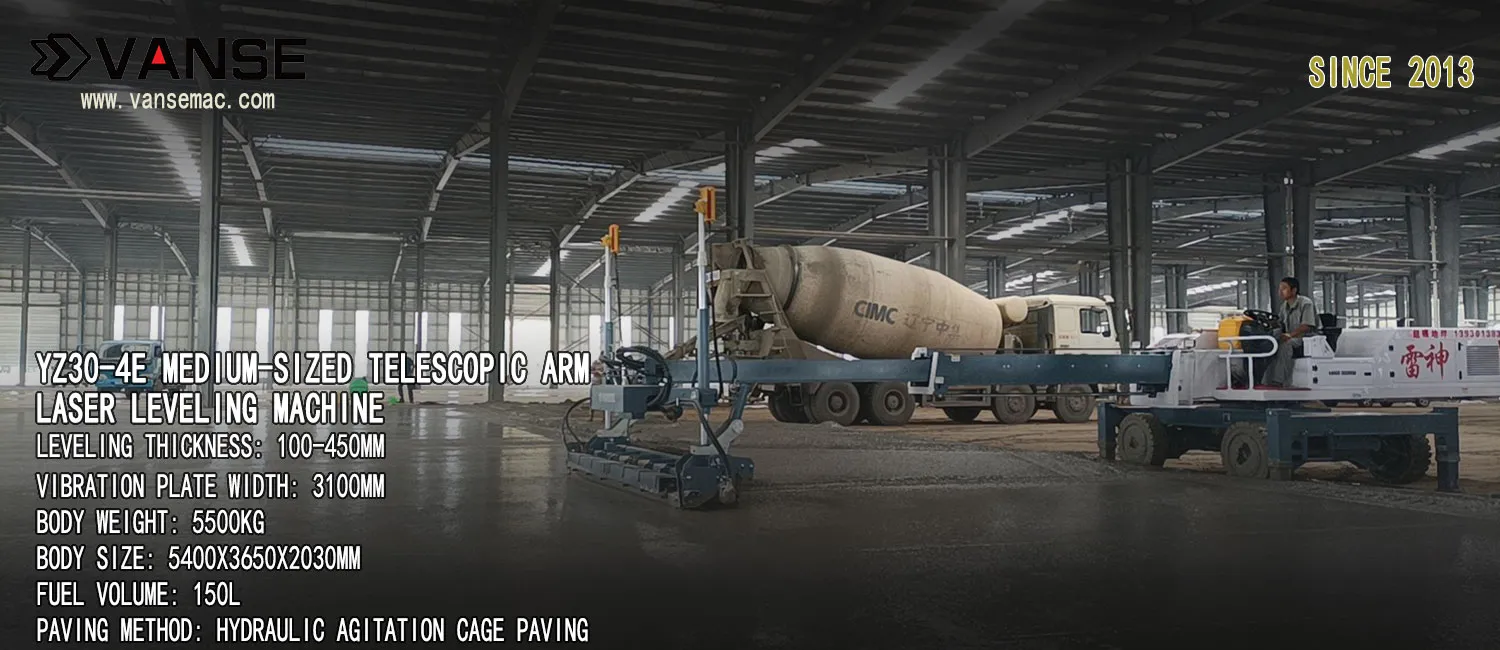
How does a concrete laser leveling machine work? 2
1
Preparation
The construction of the floor project needs to be fully prepared. From laying the base and steel mesh – setting the dowel bar – placing the buffer zone – concrete mixing, every step is carefully grasped the details.
(1) After the base layer is processed, the equipment of the laser paver is debugged, and the original benchmark point is used as the fixed reference level point; the non-woven fabric is laid, the side formwork is supported, the laser transmitter is erected, and the ground level is introduced into the laser leveling machine according to the original benchmark point. (2) Commercial concrete is used for transporting concrete, and the commercial concrete is transported to the entrance and exit of the garage by tank truck, and then transported to the construction site by a three-wheel dump truck. (3) Scale calibration Use a hand-held laser receiver to check the floor elevation, introduce the elevation into the laser paver, and adjust the reference point (±0.00) on the leveling machine.
2
Concrete paving + laser leveling
The concrete mixed in the mixing station is pumped and paved on the gravel base. The paving speed of the laser leveling machine should be appropriate, and the paving can be quickly assisted by manual paving.
3
Initial grinding and broken pulp
About 3-4 hours after the concrete is paved by the laser leveler, the best time is when there are no clear footprints after the master. Use a single-disc or double-disc trowel, install a rubbing disc, and rub it repeatedly during the initial setting of the concrete until the concrete slurry is released. Use a single-disc and double-disc trowel, install a smoothing disc, and rub it repeatedly when the concrete bleeds and initially sets until the concrete slurry is released.
4
Throw wear-resistant aggregate
It is recommended to throw the specified amount of wear-resistant material evenly on the concrete surface just after the grout is broken, and the places that lose water quickly near the formwork, columns, doorways, walls, and pits should be thrown first. Depending on the specific conditions, special materials can be thrown in more than two times. 2/3 of the amount of the first throwing; the remaining 1/3 of the second throwing; the time interval between the two spreading of aggregate should not be too long.
5
compact aggregate, smooth
After the aggregate is sprinkled once, after the aggregate absorbs the coagulated water, the aggregate is polished and compacted with a trowel, and then the aggregate is sprinkled for the second time, and the compacted aggregate is polished with a trowel. The amount of wear-resistant aggregate is not less than 5kg/㎡. During the grinding and compacting process, a ruler can be used to assist scraping. If it is not smooth, adjust the distribution of aggregates and grind again. The number of grinding times of the laser leveling machine can be operated by construction personnel according to specific conditions. The corners are scraped manually. The front and back grinding directions are criss-crossed, and the flatness is checked with a ruler after the grinding is completed.
6
Concrete finishing
Depending on the hardening of the concrete, perform at least three trowel operations without discs after the surface has faded. The operation speed and angle of the trowel should be adjusted according to the hardening of the concrete. It is recommended to adjust the angle of the blade at the beginning of each finishing to avoid damage to the floor.
7
Conservation
After scientifically completing the laser leveling machine construction process, it takes more than 28 days to maintain the floor. After the construction is completed, sprinkle water for maintenance, and lay geotextiles to reduce water evaporation and keep the wear-resistant floor after construction in water.
8
Eight construction steps: cutting expansion joints
Cut the expansion joints after the concrete has been watered and cured for 24 hours. Because the interval between the wall pillars is about 7 meters, which meets the requirements of the expansion joint gap, the expansion joints are mainly distributed according to the structure of the wall pillars, forming a layout of 7m*7m; the depth is about 6-7cm, and the gap is about 5mm.
POINTS FOR ATTENTION
First of all, it is necessary to ensure that all parts of the laser leveling machine are connected in good condition without any looseness to prevent problems during the operation;
Add enough lubricating oil to the laser leveling machine in advance to improve the flexibility of the controller so as to improve work efficiency;
The surface insulation part of the cable must be complete, and a little bit of damage must be treated with caution until it is completely intact. This will not only ensure the safety of construction personnel, but also the safety of passers-by.
After turning on the power, you need to check the direction of rotation of the motor. If there is an error, change the wire immediately to avoid bigger problems during work.
The personnel who operate the laser leveling machine must undergo professional training. During the operation, such elements as not tilting and not holding too tightly must be mastered to avoid careless accidents.
During the construction process, the laser leveling machine needs dense soil, which can be compacted repeatedly on the spot without moving back and forth, so that even if the result is the same, more energy will be spent on moving, which is uneconomical;
About the Author: Shandong Vanse Machinery Technology Co., Ltd.


Shandong Vanse Machinery Technology Co., Ltd. is a high-tech manufacturer specializing in concrete construction machinery, including laser screeds and related equipment. The company integrates R&D, production, and global sales, with products exported to over 60 countries and widely used in infrastructure projects worldwide.

How to select concrete base materials to ensure the long-term flatness of super flat floors constructed with laser leveling and power trowels
To ensure that the ultra-flat floor achieved after laser leveling and polishing construction can maintain its flatness for a long time, the selection of foundation materials is the first crucial step that determines success or failure. The core logic of material selection lies in: controlling volume stability (reducing shrinkage and deformation) and ensuring uniformity of construction (providing an ideal medium for mechanical construction). The following are the key material selection points summarized based on engineering practice and technical specifications: The design of the concrete mix ratio directly determines the shrinkage rate and crack resistance of the hardened floor, which is the fundamental factor for long-term flatness. Material category Key indicators / recommended requirements The mechanism of the long-term flatness effect Cement Ordinary Portland cement; in the same area and of the same batch number It reduces the surface color difference and internal stress unevenness caused by the chemical shrinkage difference of cement, and lowers the risk of warping. Water-cement ratio ≤0.48 Strictly controlling the water-cement ratio is the fundamental means to reduce the dry shrinkage rate of concrete. The larger the water-cement ratio, the more severe the shrinkage, and the more likely it is to crack and deform in the later stage. Slump For pumping: 100-140mm Provide stable operation for the laser leveling machine. If the slump fluctuates too much, it will make it difficult for the machine to level properly, resulting in local height errors. For non-pumping: 30-35mm Aggregate Sand: Grade II grading, strictly control the clay content A good gradation forms a stable framework structure, reducing the amount of cement paste and thereby lowering shrinkage. High clay content can damage the adhesion between cement and aggregates, causing cracks. Gravel: Continuous grading, maximum particle size ≤ 2/3 of the plate thickness The maximum particle size of the aggregate Recommendation: ≤25mm Excessive particle size will be lifted by the machine during the leveling and polishing processes, thereby damaging the surface flatness and appearance. For high-standard ultra-flat floors, ordinary concrete alone is often insufficient. Functional materials need to be introduced to enhance the overall performance. Steel fibers Concentration reference: 15kg/m³ (determined based on design load) Significantly enhances the tensile and flexural strength of concrete, effectively prevents the expansion of micro-cracks, and prevents plate warping. Compared to steel mesh, steel fiber concrete is more suitable for continuous operation by laser leveling machines, with higher efficiency. Synthetic fibers Macroscopic polypropylene fibers, etc. Mainly controls early plastic shrinkage cracks, reduces surface micro-cracks caused by excessive early water loss, laying a foundation for later flatness. Wear-resistant aggregate Metal or non-metallic aggregates (such as diamond powder, aluminum oxide, etc.) Sprayed on the concrete surface, after being compacted by a trowel, it forms a high-density, high-maintenance surface layer. This "armor" can resist wear and uneven settlement caused by long-term rolling by forklifts. Sealing curing agent Lithium-based or sodium-based liquid hardeners Penetrates into the concrete interior, reacts with calcium hydroxide to form hard calcium silicate, permanently sealing the capillary pores. It can greatly enhance surface hardness, density and impact resistance, preventing damage to flatness caused by later dusting and sanding. If the foundation is unstable, the floor will deteriorate. All the selection of upper materials is based on a stable foundation. Foundation treatment: It is necessary to ensure that the compaction degree meets the design requirements (such as the ground endurance K value is greater than 0.06 N/mm³). Uneven settlement is the fatal flaw that leads to floor cracking and loss of flatness. Base layer design: Usually, a C15 concrete base layer is set up, and a PE moisture-proof membrane is laid to block the upward movement of capillary water and prevent interlayer separation or expansion deformation caused by water vapor. Reinforced mesh (if applicable): For non-steel fiber concrete, the reinforced mesh needs to be configured according to the design to control shrinkage. However, it should be noted that the construction efficiency of the reinforced mesh is lower than that of steel fibers. To achieve long-term flatness of the super-level flooring, the selection of materials should follow the principle of "combining hardness and softness, and advancing steadily while maintaining stability": The foundation must be stable: Use concrete with a low water-cement ratio and high-quality graded aggregates as the base to ensure volume stability. The framework must be strong: Enhance the crack resistance by using steel fibers or steel mesh sheets to counteract shrinkage stress. The surface layer must be resilient: Create a high-strength and durable surface with wear-resistant aggregates and seal curing agents to resist usage wear. What is the specific grade requirement for the flooring flatness in your project (for example, does it need to meet free passage or VNA narrow aisle shelving)? This directly relates to whether steel fiber concrete is needed and the amount of wear-resistant aggregates. Please tell me these details so that I can further optimize the material plan for you. Contact us NOW Note: The parameters provided in this document are for reference only and are not mandatory. Due to differences in technical characteristics between different brands and models of laser levelers, please consult the manufacturer for a suitable solution before actual operation. This reference document assumes no responsibility for any issues arising from failure to follow the manufacturer's instructions.
Read More
June 10, 2025
Quality testing method for concrete pavement
Concrete pavement occupies a vital position in modern transportation infrastructure, and its quality is directly related to the service life, driving safety and comfort of the road. In order to ensure the quality of concrete pavement, comprehensive and scientific quality inspection is indispensable. With the continuous advancement of science and technology, advanced equipment such as concrete laser leveling machine is increasingly widely used in concrete construction, which also puts forward higher requirements for quality inspection methods. The following will introduce the quality inspection method for concrete pavement in detail. As the key cementing material of concrete, the quality of cement has a profound impact on the performance of concrete. When testing cement, the following aspects should be paid attention to: Strength: According to relevant standards, the 3-day and 28-day compressive and flexural strength of cement is measured through cement mortar strength test to ensure that it meets the design requirements. For example, for 42.5-grade ordinary silicate cement commonly used in road engineering, the 28-day compressive strength should not be less than 42.5MPa. Set time: Use a setting time meter to detect the initial and final setting time of cement. Generally speaking, the initial setting time of ordinary Portland cement shall not be earlier than 45 minutes, and the final setting time shall not be later than 10 hours, so as to ensure that the concrete has sufficient operation time during the construction process and can harden in time. Stability: The boiling method is used to test the stability of cement to ensure that the volume change of cement during the hardening process is uniform, without abnormal phenomena such as cracking, so as to avoid quality problems such as cracks in the concrete pavement due to poor cement stability. Aggregates include coarse aggregates (such as crushed stone and pebbles) and fine aggregates (such as natural sand and machine-made sand). The key points of quality inspection are as follows: Particle grading: The particle grading of aggregates is determined by screening tests to ensure that it meets the requirements of relevant standards. Good particle grading can make the aggregates compactly stacked in concrete, reduce the amount of cement used, and improve the strength and durability of concrete. For example, the maximum particle size of coarse aggregates is usually no more than 1/3 of the thickness of the concrete slab, and should meet the requirements of continuous grading. Mud content and mud block content: Excessive mud and mud block content will reduce the bonding force between aggregate and cement paste, affecting the strength and durability of concrete. The mud and mud block content of aggregates are determined by the water washing method. Generally, the mud content of coarse aggregates is required to be no more than 1%, and the mud block content is no more than 0.5%; the mud content of fine aggregates is required to be no more than 3%, and the mud block content is no more than 1%. Robustness: The sodium sulfate solution immersion method is used to test the robustness of aggregates and evaluate their durability under the influence of climate and environmental changes. Aggregates with good robustness can effectively resist the erosion of external factors and extend the service life of concrete pavements. Admixtures can significantly improve the performance of concrete and need to be strictly tested before use: Water reduction rate: The water reduction rate is an important indicator for measuring the performance of water reducers. By comparing the water consumption of concrete mixtures with and without admixtures, the water reduction rate is calculated to ensure that it meets the requirements of the product manual. Generally, the water reduction rate of high-efficiency water reducers should not be less than 15%. Setting time difference: Detect the effect of admixtures on the setting time of concrete. The initial setting time difference and the final setting time difference should meet the construction requirements to avoid abnormal setting time of concrete due to admixtures, which will affect the construction progress and quality. Compressive strength ratio: Determine the compressive strength ratio of concrete with admixtures and benchmark concrete at different ages, evaluate the effect of admixtures on the strength development of concrete, and ensure that admixtures will not reduce the final strength of concrete. The water used for concrete mixing and curing should meet relevant standards and should not contain harmful substances that affect the performance of concrete. The test items include pH value, insoluble matter, soluble matter, chloride, sulfate, etc. For example, it is generally required that the pH value of water used for concrete is not less than 4, and the chloride content (measured in Cl⁻) does not exceed 500mg/L (reinforced concrete) or 1000mg/L (plain concrete). Slump is an important indicator for measuring the fluidity of concrete mixture. At the construction site, a slump cone is used for testing. The concrete mixture is loaded into the slump cone in three layers, and each layer is rammed 25 times. Then the slump cone is lifted vertically to measure the height difference between the cone height and the highest point of the concrete specimen after collapse, which is the slump value. According to the construction requirements, the appropriate slump can ensure the uniformity and density of the concrete during the paving process. For example, when concrete laser leveling machine is used for concrete paving, the slump is generally controlled at 30-50mm to ensure that the concrete can be paved smoothly and can achieve good flatness under the action of the laser leveling machine. For dry and hard concrete mixtures, a Vebe consistency meter is required to detect its Vebe consistency. This indicator reflects the consistency of the concrete mixture under vibration. During the test, the concrete mixture is loaded into the slump cone, and then the slump cone is placed in the container of the Vebe consistency meter. After lifting the slump cone, the vibration table is turned on and the stopwatch is started at the same time. When the concrete surface changes from uneven to flat, the stopwatch is stopped. The recorded time is the Vebe consistency value. The Vebe consistency value should meet the design and construction requirements. Generally, the Vebe consistency of dry hard concrete is between 10-30s. The air content has an important influence on the frost resistance and durability of concrete. The air content of the concrete mixture is tested using an air content meter. The appropriate amount of air content can form tiny bubbles inside the concrete, relieve the stress caused by the freeze-thaw cycle, and improve the frost resistance of the concrete. Generally, the air content of the concrete is required to be controlled between 3% and 5%, and the specific value is determined according to the environment and design requirements of the project. The temperature of the concrete mixture has a significant impact on its performance and construction quality. In a high temperature environment, if the temperature of the concrete mixture is too high, it will accelerate the cement hydration reaction, resulting in too fast slump loss and even false setting; in a low temperature environment, if the temperature of the concrete mixture is too low, it will delay the cement hydration reaction and affect the strength growth of the concrete. Use a thermometer to measure the temperature of the concrete mixture at the mixing site and the pouring site. According to the ambient temperature and construction requirements, take corresponding temperature control measures, such as cooling the raw materials in high temperatures in summer and heating and insulating the concrete in low temperatures in winter. Flatness: The flatness of the base directly affects the thickness uniformity and driving comfort of the concrete pavement. Use a 3m ruler or a flatness meter to detect the flatness of the base surface, and the allowable deviation is generally not more than 10mm. For parts that do not meet the flatness requirements, they should be trimmed to ensure that the base surface is flat, providing a good foundation for the construction of the concrete pavement. Compactness: Insufficient compaction of the base will cause road subsidence and other diseases. The compaction degree of the base layer is tested by sand filling method, water filling method or ring knife method to ensure that it meets the design requirements. For example, for lime-stabilized soil base layer, the compaction degree is generally required to be not less than 95%. Strength: The strength of the base layer is the key to ensuring the bearing capacity of the pavement structure. The strength of the base layer is tested by making specimens for unconfined compressive strength test through on-site core sampling. The strength of the base layer should meet the design requirements to ensure that it can withstand the vehicle load transmitted from the concrete pavement. Casting thickness: During the concrete pouring process, the pouring thickness of the concrete is regularly tested using a steel chisel or other measuring tools to ensure that it meets the design requirements. The thickness deviation of the concrete slab is generally controlled within the range of +10mm, -5mm. Insufficient thickness will affect the bearing capacity and service life of the pavement, while excessive thickness will cause material waste. Vibration quality: Vibration is a key link to ensure the compactness of concrete. The vibration effect can be judged by observing the surface condition of the concrete, such as whether there is slurry overflow and bubble discharge. At the same time, an inserted vibrator can be used to detect the density of the concrete inside to ensure uniform vibration without missing vibration or over-vibration. For concrete pavements constructed with a concrete laser leveling machine, it is necessary to ensure that the concrete has been initially vibrated and compacted before the laser leveling machine is operated to ensure that the laser leveling machine can play a better role and achieve high-precision flatness control. Rebar arrangement (if any): For reinforced concrete pavements, check whether the type, specification, quantity, spacing, position of the steel bars, and the connection method and anchorage length of the steel bars meet the design requirements. Improper steel bar arrangement will affect the structural performance of the concrete pavement, such as bearing capacity and crack resistance. At the construction site, a steel ruler is used to measure the spacing and position of the steel bars, observe the connection and anchorage of the steel bars, and ensure that the quality of the steel bar project meets the standards. 3m ruler method: This is a commonly used road surface flatness detection method. Place a 3m ruler along the longitudinal direction of the road surface and measure the maximum gap between the ruler and the road surface to assess the road surface flatness. Measure 2 locations every 200m, and measure 10 feet continuously at each location. Judge whether the road surface flatness meets the requirements based on the gap value. Generally, the allowable deviation is no more than 5mm. Continuous flatness meter method: This method can continuously measure the road surface flatness, with high detection efficiency and more accurate results. The continuous flatness meter travels along the road surface, collects the elevation data of the road surface through sensors, and calculates the flatness index (such as the International Roughness Index IRI). After the concrete pavement construction is completed, this method can be used to conduct a comprehensive inspection of the road surface to provide detailed data for road surface quality assessment. For roads constructed with concrete laser leveling machines, the continuous flatness meter test results can intuitively reflect the construction effect of the laser leveling machine. The IRI value should generally be controlled within a certain range, such as no more than 2.0m/km, to ensure that the road surface has good driving comfort. Vehicle-mounted bump accumulation meter method: The bumpiness of the road surface is measured by the bumpiness of the vehicle when it is driving on the road. The vertical vibration acceleration of the vehicle is measured by a sensor installed on the vehicle, and the bump accumulation value (VBI) is converted. This method has a fast detection speed and is suitable for rapid detection of large-area road surface flatness. When conducting quality inspection on concrete pavement, the road surface flatness condition can be evaluated according to the VBI value, and verified with other detection methods to fully grasp the road surface quality. Structural depth: The structural depth reflects the macro texture depth of the road surface and has an important impact on the road surface skid resistance. The road surface structural depth is detected by sand spreading method or laser structural depth meter. The sand spreading method is to spread a certain amount of standard sand on the road surface, flatten the sand into a circle with a push plate, measure the coverage area of the sand, and calculate the structural depth value. The laser structural depth meter uses laser scanning technology to quickly measure the road surface structural depth. Generally, the structural depth of cement concrete pavement is required to be between 0.7 and 1.1mm to ensure that the road surface still has sufficient skid resistance under adverse conditions such as moisture. Friction coefficient: The friction coefficient is a direct indicator of the road surface skid resistance. Use a pendulum friction meter or a dynamic friction coefficient tester to detect the road surface friction coefficient. The pendulum friction meter measures the friction force of the pendulum sliding on the road surface when it swings freely from a certain height, and calculates the friction coefficient of the road surface (BPN value). The dynamic friction coefficient tester simulates the friction between the tire and the road surface during vehicle driving and measures the friction coefficient in real time. According to different road grades and usage requirements, the road friction coefficient should reach the corresponding standard value. For example, the BPN value of general urban roads should not be less than 45 to ensure driving safety. Core drilling method: The core drilling method is the most direct and reliable method to detect the strength of concrete pavement. After the concrete pavement is hardened, a core drill is used to drill a core sample on the pavement. The diameter of the core sample is generally not less than 100mm and not less than 3 times the maximum particle size of the aggregate. After the core sample is processed into a standard test piece, a compressive strength test is carried out, and the strength of the concrete pavement is evaluated based on the test results. The core drilling position should be representative, and at least 1 core sample should be drilled every 3km for each lane. The compressive strength of the core sample should meet the design requirements. For example, for a concrete pavement with a design strength grade of C30, the average compressive strength of the core sample should not be less than 30MPa, and the minimum value should not be less than 25.5MPa. Rebound method: The rebound method is a non-destructive detection method. The rebound value of the concrete surface is detected by a rebound hammer. The strength of the concrete is estimated based on the correlation between the rebound value and the concrete strength. When using the rebound method, the measurement areas should be evenly arranged on the pavement. The area of each measurement area should not be greater than 0.04m², and the number of measurement areas should not be less than 10. At the same time, the influence of the carbonization depth of concrete on the rebound value should be considered and necessary corrections should be made. The detection results of the rebound method have certain limitations. It is generally used as an auxiliary detection method of the core drilling method for the preliminary evaluation of the strength of large-area concrete pavements. Ultrasonic rebound comprehensive method: This method combines the advantages of the ultrasonic method and the rebound method. By measuring the ultrasonic sound velocity and rebound value of concrete, the strength of concrete is comprehensively estimated. Ultrasonic sound velocity reflects the density and uniformity of concrete, and the rebound value reflects the hardness of concrete surface. The combination of the two can more accurately evaluate the strength of concrete. The ultrasonic rebound comprehensive method is suitable for batch testing of concrete pavement strength. The accuracy of the test results is relatively high, but the operation is relatively complex and requires professional testing equipment and technicians. Core drilling method: The drilled core sample can not only be used for strength testing, but also can intuitively measure the thickness of the concrete pavement. Use a caliper to measure the thickness of the core sample with an accuracy of 0.1mm. Drill sample cores at 2 locations on the left and right within every 100m of pavement paving width to test the thickness of the board. The pavement thickness deviation should meet the design requirements, and the general allowable deviation is +10mm, -5mm. Radar detection method: Use ground penetrating radar to emit high-frequency electromagnetic waves to the pavement, and detect the thickness of the concrete pavement based on the reflection characteristics of the electromagnetic waves at the interface of different media (such as concrete and base). The radar detection method has the advantages of fast, non-destructive, and continuous detection, and can obtain thickness data of large-area pavements in a short time. However, this method requires professional radar equipment and data analysis software, and the detection results are greatly affected by factors such as the material properties and water content of the pavement structure layer, and calibration and verification are required before use. Appearance inspection: Observe the surface of the concrete pavement with the naked eye to check whether there are cracks. Record the location, direction, length, width and other information of the cracks. For cracks with smaller width, a crack observation instrument can be used to measure and accurately measure the crack width. Generally, cracks with a width of no more than 0.2mm are considered to be small cracks and can be closed on the surface; cracks with a width of more than 0.2mm need to analyze the cause and take corresponding repair measures, such as grouting repair. Non-destructive testing technology: In addition to appearance inspection, non-destructive testing equipment such as ultrasonic flaw detectors and infrared thermal imagers can also be used to detect whether there are cracks inside the concrete pavement. The ultrasonic flaw detector transmits and receives ultrasonic waves, and judges whether there are defects and cracks inside according to the reflection and refraction characteristics of ultrasonic waves when propagating inside the concrete. The infrared thermal imager uses the difference in temperature distribution on the surface of the object to detect internal defects. When there are cracks inside the concrete, a corresponding temperature abnormality area will be formed on the surface, which can be intuitively displayed through infrared thermal images. Non-destructive testing technology can detect hidden cracks inside the pavement, provide a basis for timely prevention and control measures, and ensure the integrity and safety of the pavement structure.
Read More
July 9, 2024
How to maximize the leveling efficiency of the laser leveler while ensuring flatness?
In concrete construction, the use of laser leveling machines has greatly improved construction efficiency and ground flatness. However, while ensuring flatness, how to maximize the leveling efficiency of the laser leveling machine is a challenge that the construction team needs to face. The following is a detailed analysis of this issue. Introduction As an advanced construction equipment, the high efficiency and high precision of the laser leveling machine have brought revolutionary changes to building construction. This article will explore how to maximize the working efficiency of the laser leveling machine while ensuring construction quality. 1. Preparation before construction Sufficient pre-construction preparation is the basis for improving the efficiency of the laser leveling machine: – **Equipment inspection**: Ensure that all components of the laser leveling machine are in good condition, especially the laser system and control system. – **Construction plan**: Develop a detailed construction plan according to the project requirements, including concrete mix ratio, pouring thickness and leveling process. – **Operator training**: Ensure that the operator is familiar with the equipment operation and construction process, and understands how to balance efficiency and flatness. 2. Quality control of construction materials The quality of construction materials directly affects the leveling efficiency of the laser leveler: – **Concrete ratio**: Strictly control the ratio of concrete to ensure its fluidity and plasticity, and reduce the working pressure of the laser leveler. – **Raw material quality**: Select high-quality cement, aggregates and additives to avoid affecting construction efficiency due to material problems. 3. Quality monitoring during construction Quality monitoring during construction is the key to ensuring flatness and improving efficiency: – **Laser system monitoring**: Real-time monitoring of the stability of the laser system to ensure the accuracy of the laser plane. – **Flatness detection**: Regularly use professional equipment to detect the flatness of the concrete surface and adjust the working parameters of the laser leveler in time. 4. Laser leveler operating skills Skilled operating skills can improve the leveling efficiency of the laser leveler: – **Equipment adjustment**: Adjust the height and speed of the leveler according to the actual situation of the concrete to achieve the best leveling effect. – **Operation continuity**: Maintain the continuity of operation to avoid inconsistent flatness or reduced efficiency due to operation interruptions. 5. Control of construction environment A good construction environment helps improve the leveling efficiency of the laser leveling machine: – **Environmental factor control**: Control the temperature, humidity and light conditions of the construction site to ensure a suitable construction environment for concrete. – **Construction site layout**: Rationally plan the construction site layout to reduce the time for equipment movement and material transportation. 6. Post-construction maintenance management Reasonable maintenance management is crucial to ensure construction results and improve efficiency: – **Timely covering**: Cover the concrete surface in time after construction to prevent moisture from evaporating too quickly. – **Curing time**: Ensure sufficient curing time to fully harden the concrete and avoid affecting the flatness due to improper curing. 7. Recording and analysis of construction data Detailed recording and analysis of construction data helps to continuously improve construction efficiency: – **Data recording**: Record various parameters during the construction process, such as concrete temperature, pouring speed, leveling speed, etc. – **Data analysis**: Analyze the data, find out the factors that affect construction efficiency, and formulate improvement measures. 8. Maintenance and upgrading of construction machinery Regular maintenance and timely upgrading of construction machinery are the guarantee for maintaining construction efficiency: – **Regular maintenance**: Develop equipment maintenance plans to ensure that the equipment is in good condition. – **Technology upgrade**: Pay attention to the development of industry technology, upgrade the equipment technology in a timely manner, and improve its work efficiency. 9. Prevention and control of construction risks Preventing and controlling construction risks can reduce construction interruptions and improve efficiency: – **Risk assessment**: Conduct construction risk assessments regularly to identify potential risk factors. – **Emergency plan**: Develop emergency plans to ensure that risks can be responded to quickly when they occur. 10. Technological innovation and application Technological innovation is an important way to improve the leveling efficiency of laser leveling machines: – **New process exploration**: Continuously explore and experiment with new construction processes to improve construction efficiency. – **Technology integration**: Integrate the latest technologies, such as intelligent control systems, to improve the level of construction intelligence. 11. Conclusion To maximize the leveling efficiency of the laser leveler while ensuring flatness requires comprehensive consideration of multiple aspects, including preparation before construction, quality control of construction materials, quality monitoring during construction, operation skills of the laser leveler, control of the construction environment, maintenance management after construction, recording and analysis of construction data, maintenance and upgrading of construction machinery, prevention and control of construction risks, and technological innovation and application. Through the implementation of these measures, construction efficiency can be effectively improved while ensuring construction quality.
Read More
Online now. Replies personally on WhatsAppFionaCustomer specialist
Hi! I am here to help you find the right solution for your project.
You can share your product, capacity, or project needs. Our specialist will help you work out the next step.
Would you like a quick answer? Tap below to speak directly with our specialist on WhatsApp.