Technical Knowledge
Can a push power trowel be used in small indoor scenes?

Hand-push trowels can be used for small indoor scenes, but the following aspects need to be considered before use:
1. Applicability
Site area and shape
– Hand-push trowels are suitable for indoor scenes with relatively small areas. If the indoor space is relatively open and regular in shape, such as warehouses, large exhibition halls, etc., hand-push trowels can play a good role. It can be easily pushed on the flat ground to smooth the concrete and other floor materials.
– However, if the indoor space is narrow and there are many obstacles or corners, the use of hand-push trowels may be restricted. Because its size and operation method determine that it is difficult to turn and operate in a small space.
Floor materials and conditions
– For common indoor concrete, cement mortar and other floor materials, hand-push trowels can effectively smooth and compact the surface to make the floor smoother and smoother. It can handle newly poured floors and help remove surface defects such as bubbles and protruding pebbles.
– However, if the floor material is special, such as wooden floors, epoxy floors, etc., which are relatively fragile or require extremely high surface accuracy, the hand-push trowel may not be suitable. Because its working principle is to operate through a rotating trowel blade, it may cause damage to these special floors.
2. Convenience of operation
Operation difficulty
– The hand-push trowel is relatively simple to operate, and general operators can get started after simple training. It is pushed forward by manpower, and the direction and speed can be adjusted at any time according to the ground conditions during operation. For example, near the wall or pillar, you can slow down and operate carefully to avoid collision.
– However, long-term use of the hand-push trowel requires certain arm and waist strength, and the operator may be more tired.
Mobile flexibility
– The hand-push trowel is small in size and is easier to move in indoor scenes. In indoor areas without large equipment access channels, it can be transported to the work site through small doorways or elevators.
– However, compared with large driving trowels, its movement speed is slower, and work efficiency will be affected to a certain extent.
3. Safety and environmental factors
Safety risks
– The hand-push trowel has a high speed. If the operator is not careful during operation, clothing, hair, etc. may be drawn into the machine, causing safety accidents. Therefore, the operator needs to wear appropriate work clothes and protective equipment, such as safety helmets, gloves, etc.
– In addition, since the operation is indoors, the ground may be slippery, so be careful to prevent slipping when pushing the trowel.
Noise and dust
– The hand-push trowel will generate certain noise and dust when working. In small indoor scenes, the noise may interfere with the surrounding environment, so try to choose the right time to operate to avoid affecting others.
– For dust problems, you can reduce its impact on indoor air quality by equipping a dust collection device or strengthening ventilation.
Thanks to All the Friends Who Support and Trust Shandong Vanse Machinery Technology Co., Ltd.
If you want to know more about Shandong Vanse Machinery Technology Co., Ltd. or have any questions, please feel free to contact us:
Our Factory
Shandong Vanse Machinery Technology Co., Ltd.








Share this article

About the Author: Shandong Vanse Machinery Technology Co., Ltd.
Shandong Vanse Machinery Technology Co., Ltd. is a high-tech manufacturer specializing in concrete construction machinery, including laser screeds and related equipment. The company integrates R&D, production, and global sales, with products exported to over 60 countries and widely used in infrastructure projects worldwide.
Previous Post
Next Post
Related Articles
You Might Also Like
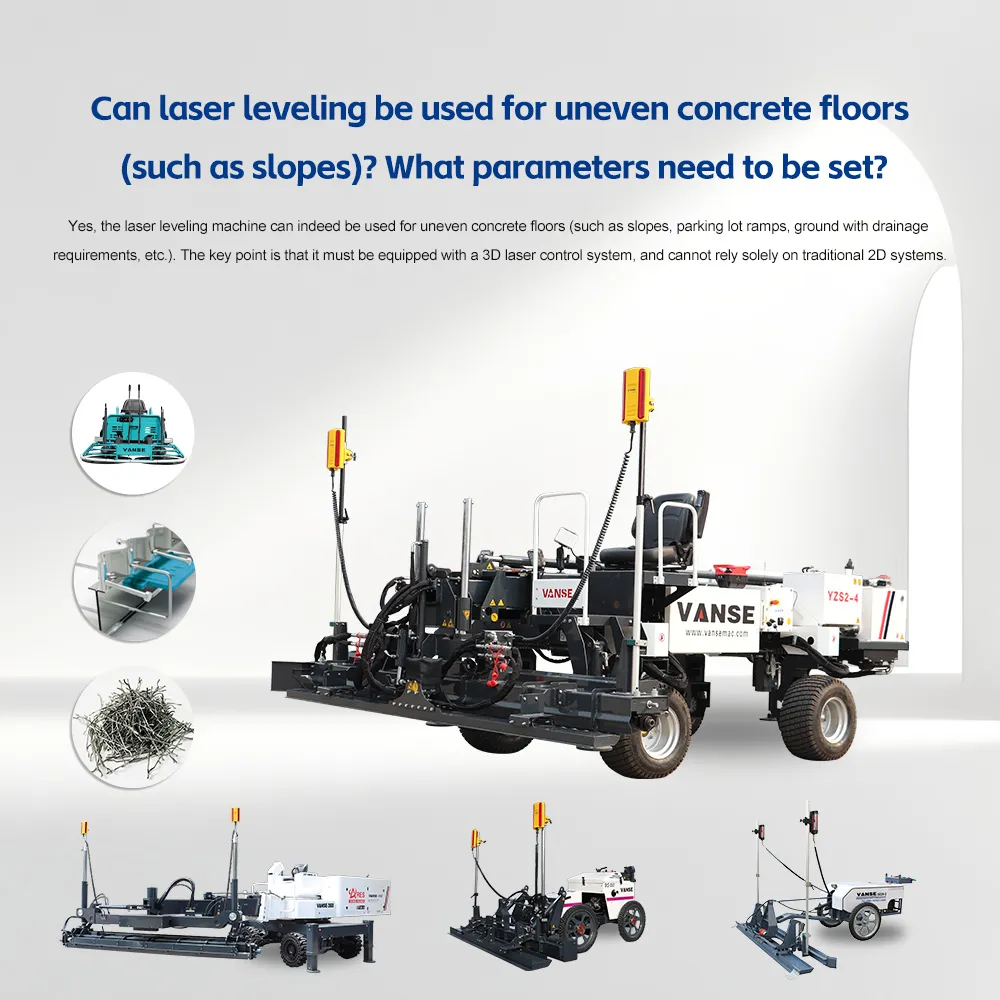
Can laser leveling be used for uneven concrete floors (such as slopes)? What parameters need to be set?
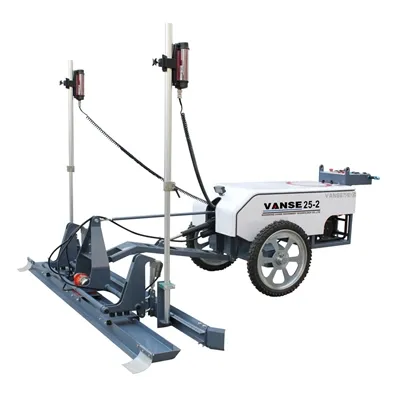
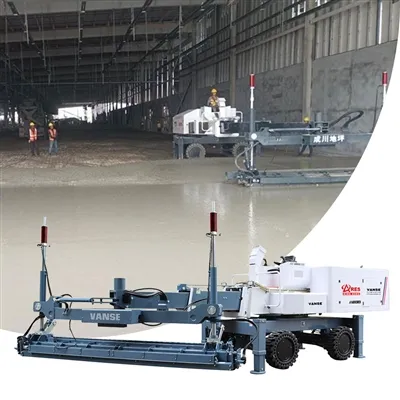
Yes, the laser leveling machine can indeed be used for uneven concrete floors (such as slopes, parking lot ramps, ground with drainage requirements, etc.). The key point is that it must be equipped with a 3D laser control system, and cannot rely solely on traditional 2D systems. According to the information provided on the Vanse Machinery website, the YZ30-4E model clearly indicates "Sloping ground" in the "Special project" section, and states that "with the 3D laser system, it can precisely level ground with drainage slopes (such as parking lot ramps)". This provides a direct basis for your question. To achieve precise leveling of the slope, the following key parameters need to be set, which are usually accomplished through the control panel of the 3D system or the accompanying software: Parameter Categories Specific settings: Function and Description 1. Slope Direction and Ratio Set the slope values for the X-axis (horizontal) and Y-axis (vertical). Usually expressed as percentages (%) or angles. For example, set a slope from point A to point B, with a 1 cm drop per meter (i.e., 1% slope). This is the core data that defines the shape of the slope, informing the machine about the direction and angle at which the ground slopes. 2. Elevation Reference Point Input the absolute elevation of at least one known point on the slope as the reference for the entire slope calculation. The 3D system will use this as a starting point, combined with the slope parameters, to automatically calculate the target elevation of any point on the slope. 3. Import of 3D Digital Model For complex slopes (such as bidirectional slopes, curved surfaces), directly import the 3D design drawings from the design institute (in formats like DXF, DWG). This is the most efficient and accurate method. The machine can "understand" the design intent and automatically guide the leveling head operation. 4. Settings of Laser Emitter Set the laser emitter to slope mode (instead of horizontal mode), and adjust the prism or tilt sensor inside the emitter head according to the input slope parameters. Ensure that the laser plane emitted is itself an accurate slope, providing the machine with the correct reference benchmark. Apart from parameter settings, there are also specific requirements during the construction process: Equipment selection: It is preferable to use telescopic arm type or large seated laser leveling machines (such as the YZ series and WS series from Vanse). These types of equipment have good stability and provide a good field of vision for the operator, making them more suitable for safe and precise operation on slopes. Construction from low to high: The sequence of concrete pouring and leveling should start from the lowest point at the bottom of the slope and progress towards the top. This allows the use of the self-weight and fluidity of the concrete to facilitate the control of elevation and density. Controlling concrete slump: Slope construction has higher requirements for the fluidity of the concrete. If the slump is too large, the concrete will flow downward after vibration, making it difficult to form; if it is too small, it will be difficult to level. Generally, the slump should be reduced appropriately compared to flat construction (for example, controlled at 12 ± 2 cm), and adhesives may be needed to enhance the concrete's anti-flowing ability. Strengthening formwork support: The formwork at the bottom of the slope needs to withstand greater lateral pressure and must be reinforced and supported to prevent the formwork from shifting during pouring, resulting in distorted slope. Manual assistance: At the top, edges, or blind spots where machines cannot operate, manual replenishment and assistance for leveling are necessary to ensure the overall slope is consistent and coherent. Using a laser leveling machine equipped with a 3D system for slope construction, the accuracy and efficiency are far superior to traditional methods. The key lies in digitally transmitting the design intent to the machine (through slope parameters or 3D models), and having experienced operators adjust it flexibly during the construction process. If your project has specific slope requirements (such as one-way or two-way slope? What is the slope percentage?), please let me know. I can help you further analyze the parameter settings or details of equipment selection. Contact us NOW Note: The parameters provided in this document are for reference only and are not mandatory. Due to differences in technical characteristics between different brands and models of laser levelers, please consult the manufacturer for a suitable solution before actual operation. This reference document assumes no responsibility for any issues arising from failure to follow the manufacturer's instructions.How to reduce the construction cost of the concrete laser leveling machine in special environment?
As an efficient construction equipment, the concrete laser screed can provide high-quality ground leveling services in various environments. However, construction in special environments often requires additional cost investment to cope with these challenges. This article will explore strategies to reduce construction costs in these environments. Before construction, it is first necessary to identify and evaluate the possible impact of special environments on construction: – **Environmental factor analysis: Analyze the climate, terrain, geology and other conditions in special environments. – **Risk assessment: Assess the risks that these factors may bring to construction costs, progress and safety. According to the characteristics of special environments, the equipment is adapted: – **Protective measures: Add necessary protective measures to the equipment, such as rain protection, sand protection, corrosion protection, etc. – **Performance adjustment: Adjust the performance of the equipment to adapt to the construction requirements in special environments. For special environments, optimize the construction plan to reduce costs: – **Construction method selection: Select the construction method that best suits the special environment to reduce construction difficulty and cost. – **Construction process adjustment: Adjust the construction process according to environmental characteristics to improve construction efficiency. Select suitable construction materials and optimize transportation methods: – **Material adaptability: Select concrete materials that adapt to special environments to reduce material loss. – **Transportation method: Optimize material transportation methods to reduce transportation costs and time. Conduct operation training for construction personnel in special environments and strengthen management: – **Professional training: Conduct operation training for operators in special environments to improve operation skills. – **Personnel management: Strengthen personnel management and improve teamwork efficiency. Strengthen equipment maintenance and care to reduce failure rates: – **Regular maintenance: In special environments, equipment is more likely to fail and requires more frequent maintenance. – **On-site maintenance: Improve on-site maintenance capabilities and respond quickly to equipment failures. During the construction process, monitor costs in real time and take control measures: – **Cost monitoring: monitor construction costs in real time and promptly identify the risk of cost overruns. – **Cost control measures: take effective cost control measures, such as optimizing resource allocation and reducing waste. Ensure construction safety and reduce additional costs caused by safety accidents: – **Safety measures: take necessary safety measures, such as safety training, on-site monitoring, etc. – **Environmental protection: comply with environmental protection regulations and avoid costs caused by environmental problems. Provide post-construction service and support to reduce later maintenance costs: – **After-sales service: provide timely after-sales service to solve problems that may arise after construction. – **Technical support: provide technical support to help customers with equipment maintenance and troubleshooting. Use technological innovation to reduce construction costs in special environments: – **New technology application: explore and apply new technologies, such as automation and intelligent construction technology. – **R&D investment: increase R&D investment to develop construction equipment and processes that adapt to special environments. Reducing the construction cost of concrete laser leveling machines in special environments requires comprehensive consideration of multiple aspects, including environmental identification and assessment, equipment adaptability modification, construction plan optimization, construction material selection and transportation, construction personnel training and management, construction equipment maintenance and care, cost control during construction, construction safety and environmental protection, post-construction services and support, and technological innovation and application. Through the implementation of these measures, construction costs can be effectively reduced while ensuring construction quality and safety.What are the differences in construction technology between concrete pavements with large slump and concrete pavements with small slump?
Concrete with large slump: The mixing time needs to be appropriately increased, generally 30-60 seconds longer than concrete with small slump, to ensure that the concrete is mixed evenly, so that the excess water is fully mixed with cement and other materials to avoid segregation. At the same time, the amount of water should be strictly controlled and accurately measured, because the amount of water has a greater impact on the slump. Concrete with small slump: When mixing, pay attention to controlling the mixing force and time to avoid excessive mixing that causes the concrete to be too dry and hard, and lose good workability. Generally, the mixing time is relatively short, so that all materials can be evenly mixed. Concrete with large slump: Prevent concrete from segregation and water evaporation during transportation. The mixer truck should maintain a uniform speed, avoid sudden braking and sharp turns, and reduce the shaking of the concrete in the tank. At the same time, the tank body can be covered with a sunshade to prevent direct sunlight from causing water to evaporate too quickly and affect the slump. Concrete with small slump: During transportation, care should be taken to prevent excessive loss of concrete slump. If the transportation time is long, some plastic preservation measures can be considered, such as adding an appropriate amount of retarder. However, attention should be paid to the amount of retarder added to avoid affecting the setting time and strength of the concrete. Concrete with large slump: The pouring speed should not be too fast and should be controlled within a certain range, such as the pouring volume per minute should not exceed 1-1.5 cubic meters to avoid rapid flow and accumulation of concrete in the formwork, resulting in loose vibration or segregation. At the same time, it is necessary to avoid excessive free fall height of concrete. When it exceeds 2m, auxiliary tools such as string barrels and chutes need to be used. Concrete with small slump: Due to its poor fluidity, some auxiliary measures are needed during pouring to ensure that the concrete can fill every corner of the formwork. For example, artificial auxiliary spreading can be used to evenly distribute the concrete in the formwork to avoid concrete accumulation or local vacancies. Concrete with large slump: It is advisable to use a low-frequency vibrator, and the vibration frequency is generally 2000-3000 times/minute. Avoid using a high-frequency vibrator to cause over-vibration of the concrete. The vibration time should not be too long. The vibration time at each point should be controlled within 20-30 seconds, and the concrete surface no longer sinks significantly, no bubbles appear, and cement slurry appears on the surface. Concrete with small slump: It is usually necessary to use a high-frequency vibrator, and the vibration frequency is generally 3000-5000 times/minute to improve the fluidity and density of the concrete. The vibration time should be appropriately extended, and the vibration time at each point may take 30-40 seconds to ensure that the concrete is vibrated and dense, but it is also necessary to prevent excessive slurry on the concrete surface due to over-vibration. Concrete with large slump: When finishing, wait for the surface moisture to evaporate properly before proceeding, generally 1-2 hours after the concrete pouring is completed. The specific time is determined according to the site environment and the concrete coagulation. Usually 2-3 times of plastering are required to eliminate moisture and defects on the surface. Plastic film, geotextile, etc. should be used to cover the surface immediately during curing to prevent the water from evaporating too quickly and causing the surface to lose water and crack. The curing time is generally not less than 14 days. Concrete with small slump: Plastering can be done in time after the concrete surface is slightly dry, generally about 0.5-1 hour after pouring. Due to its low moisture content and fast surface drying, fewer plastering times may be required, but attention should be paid to the plastering quality to ensure that the surface is flat and smooth. It should also be covered and moisturized in time during curing. The curing time is generally not less than 7 days, but if the environment is dry or the temperature is high, the curing time should be appropriately extended.