Technical Knowledge
When using the gasoline power trowel, what types of blades should be selected based on the different hardness levels of the concrete?
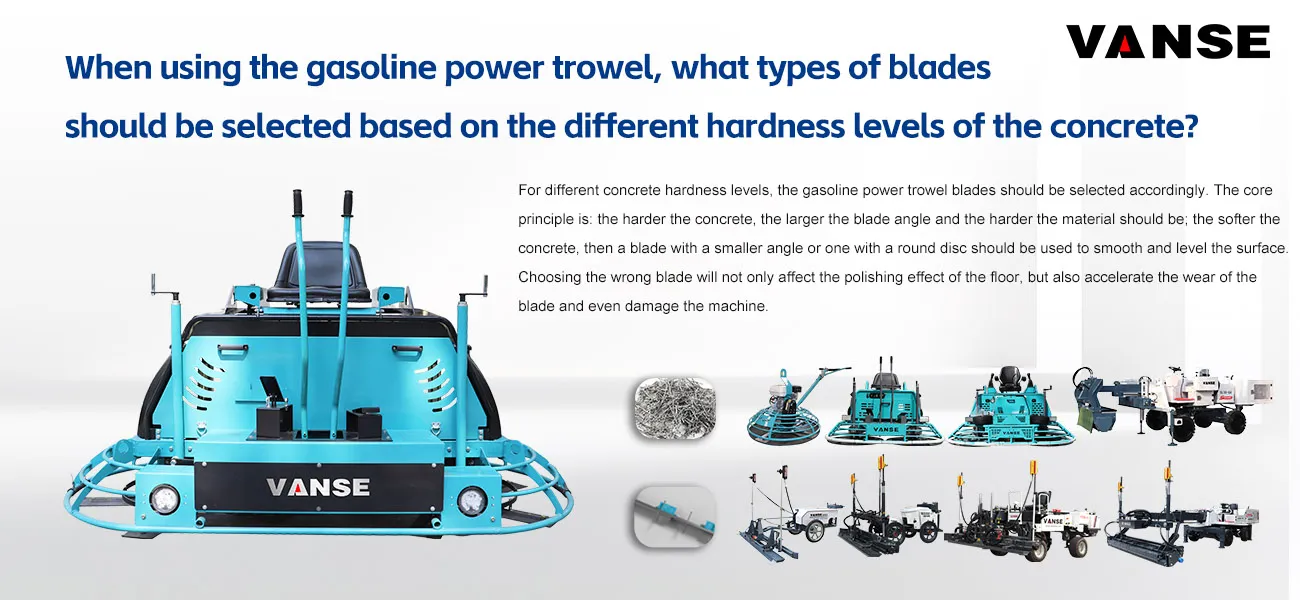
For different concrete hardness levels, the gasoline power trowel blades should be selected accordingly. The core principle is: the harder the concrete, the larger the blade angle and the harder the material should be; the softer the concrete, then a blade with a smaller angle or one with a round disc should be used to smooth and level the surface. Choosing the wrong blade will not only affect the polishing effect of the floor, but also accelerate the wear of the blade and even damage the machine.
🔪 Knife Blade Type and Concrete Hardness Matching Guide
According to the hardening process of concrete from initial setting to final setting, it is generally divided into three stages, and different types of blades need to be selected for each stage:
| Construction stage | Concrete hardness state | Recommended blade types | Key parameters/materials | Functions and Effects |
| First stage: Mixing and leveling | Immediately after pouring, the concrete is soft and has high fluidity. | Disc-shaped polishing blade (requires installing the disc onto the blade) | The diameter of the disc is usually greater than the length of the blade. | Compaction, levelling and initial leveling. The disc can prevent the blade from cutting too deeply, lift the surface slurry and provide an initial levelness for the ground. |
| Second stage: Smoothing | After the concrete begins to set, the surface starts to harden. When stepping on it, there are slight footprints (about 1-3mm deep). | Regular polishing blade | Material: 65 manganese steel or high manganese steel; thickness: approximately 2mm; blade size: common lengths such as 345mm, 355mm, etc. | Level the ground and remove the disc marks. At this point, the disc should be removed and the blade used for the operation. The blade angle should be adjusted to be smaller (about 0 – 10 degrees), mainly for leveling purposes. |
| Third stage: Finishing | Before the concrete fully sets, the surface becomes hard. When stepping on it, there are almost no footprints. | Fine-tuning/finishing blade | Alloy steel with a harder material and a smoother surface; or used old blades (because the edges have been smoothed out more smoothly). | Make the ground smooth, wear-resistant and dense. The blade angle should be increased (about 10 – 15 degrees) to increase the pressure on the ground and repeatedly press to create a smooth surface. |
💡 Key Points for Choosing a Knife
The material of the blade determines its lifespan: The search results repeatedly mention that high-quality blades are usually made of 46# high manganese steel or 65 manganese steel, with a thickness of approximately 2mm. This material combines hardness and toughness, being able to withstand intense friction with concrete while also being less prone to breaking. Poor-quality blades, on the other hand, are prone to uneven polishing due to insufficient strength.
The blade angle can be adjusted: The tilt angle of the blade on an gasoline power trowel is usually adjustable between 0 and 15 degrees. The greater the angle, the deeper the blade cuts into the concrete, exerting greater pressure on the ground, and is suitable for the harder polishing stage; the smaller the angle, the softer it is, and is suitable for the initial smoothing stage. This is a key mechanical parameter for controlling the polishing effect.
Replace worn-out blades in time: When the blade wears down to 30mm on one side, it can be considered to switch to the other side to achieve the effect of two blades. If the wear is severe and causes imbalance, a new blade must be replaced; otherwise, it will cause the machine to shake and affect the flatness of the ground.
🛠️ Practical operation suggestions
Soft ground requires hard tools, while hard ground needs soft tools is a misconception: Please remember, the softer the concrete, the more you should use round discs or small-angle blades (to avoid cutting); the harder the concrete, the more you should use large-angle sharp blades (to increase friction).
Combination of new and old blades: Experienced workers will keep a pair of worn-out but still suitable old blades specifically for the final polishing process, because their edges are smoother and rounder, and are less likely to leave marks.
Safety and maintenance: When replacing blades or cleaning residual concrete, make sure the machine has been turned off and the blades have completely stopped rotating. After each use, clean the cement slurry on the blades promptly and apply grease for rust prevention.
I hope this guide can help you choose the right blades at different construction stages. If you can tell me approximately which stage of hardening your current concrete is in, or if you encounter specific ground effect problems (such as knife marks, lack of shine), I can help you further analyze and adjust the plan. Contact us NOW
Note: The parameters provided in this document are for reference only and are not mandatory. Due to differences in technical characteristics between different brands and models of laser levelers, please consult the manufacturer for a suitable solution before actual operation. This reference document assumes no responsibility for any issues arising from failure to follow the manufacturer's instructions.
Thanks to All the Friends Who Support and Trust Shandong Vanse Machinery Technology Co., Ltd.
If you want to know more about Shandong Vanse Machinery Technology Co., Ltd. or have any questions, please feel free to contact us:
Our Factory
Shandong Vanse Machinery Technology Co., Ltd.








Share this article

About the Author: Shandong Vanse Machinery Technology Co., Ltd.
Shandong Vanse Machinery Technology Co., Ltd. is a high-tech manufacturer specializing in concrete construction machinery, including laser screeds and related equipment. The company integrates R&D, production, and global sales, with products exported to over 60 countries and widely used in infrastructure projects worldwide.
Previous Post
Next Post
Related Articles
You Might Also Like
How to make laser leveling machine parts last longer?
As a brand-new floor construction equipment, the laser leveling/ leveling machine has been widely concerned by the industry due to its excellent construction efficiency and construction accuracy once it has entered the market, and has been more and more used in warehouses, basements, parking lots, Large-area concrete floors such as industrial plants are under construction. Like other construction machinery, the laser leveling/ leveling machine is also a whole composed of many parts, and the construction environment is relatively complicated, so it is easier to wear than the parts of general machinery during long-term work. In order to prolong the effective life of the laser leveling/ leveling machine, the following is a brief introduction to the main components of its components and the skills of use and maintenance. —-THE CORE COMPONENTS AND FUNCTIONS OF LASER LEVELING/ leveling MACHINE— ➤Drive Train: mainly composed of transmission, universal joint, drive shaft and drive axle; ➤Driving System: composed of frame/axle/suspension/wheels, etc. The function is to support the quality of the whole vehicle and ensure the driving of the laser leveling machine; ➤Steering system: composed of steering wheel, steering gear, steering knuckle, steering knuckle arm, tie rod, straight tie rod, etc., the function is steering; ➤Hydraulic brake: The hydraulic brake device is composed of brake pedal, brake pump, wheel cylinder, drum brake and oil pipe and other parts; ➤Transmission: It is composed of transmission housing, transmission cover, first shaft, second shaft, intermediate shaft, reverse gear shaft, gears, bearings, operating mechanism and other parts, used for changing speed and output torque of laser leveling machine; ➤Leaf Spring and Shock Absorber: The role of the leaf spring is to maintain an elastic connection between the frame and body and the wheels or axles. The function of the shock absorber is to ease the vibration when the laser leveling machine is subjected to shock; ➤Starter: The function is to convert electrical energy into mechanical energy, drive the crankshaft to rotate, and start the engine. If the continuous starting time is too long, it will cause a large amount of battery discharge and the starter coil will overheat and smoke, which will easily damage the laser leveling machine parts; ➤Battery: The role of the battery is to supply electricity to the starter, and to supply power to the engine ignition system and other electrical equipment when the engine is started or running at low speed. When the engine is running at high speed, the generator generates enough electricity, and the battery can store excess electricity; ➤Motor: The motor is the power device of the laser leveling machine. Its main function is to generate driving torque as a power source for electrical appliances or various machinery. Its main function is to convert mechanical energy into electrical energy. At present, it is more commonly used to use heat energy, water energy, etc. to drive the rotor of the generator to generate electricity. —USE AND MAINTENANCE OF CORE COMPONENTS OF LASER LEVELING MACHINE— ➤Change lubricating oil regularly: Regularly replace the lubricating oil to ensure that all parts of the machine are well lubricated and reduce the wear of the parts; ➤Clean the whole machine and parts regularly: Keep regular cleaning of the whole and each part, and fasten loose parts in time to prevent parts from being worn or lost due to looseness; ➤Pay attention to the working load of each component during the running-in period: Pay attention to the workload of each component during the running-in period. Generally, the workload during the running-in period should not exceed 80% of the rated workload, and an appropriate workload should be deployed to prevent damage caused by the long-term continuous operation of the laser leveler. The occurrence of overheating; ➤Start the leveling engine every half a month: Start the leveling engine once every half a month, charge the battery, and run all hydraulic actuators at the same time, such as rotating hydraulic motors, telescopic cylinders, etc. Do not remove the battery from the machine to prevent damage to the controller caused by long-term parking of the equipment Symptoms of missing internal software programs; ➤Start the leveling regularly: Start the leveling machine regularly and turn on all hydraulic functions on the machine, so that the hydraulic drive components work regularly to prevent the related seals from being damaged due to long-term parking, and metal components such as cylinder rods from rusting and other failures. Shrink all the cylinder rods into the hydraulic cylinder chamber to better protect the surface of the cylinder rods. Reasonable use and regular maintenance of various parts are effective ways to prolong the service life of the laser leveling machine and improve the economic efficiency of the operation. It is suggested that before using the leveling machine, one should be fully familiar with the composition and function of each component of the machine, master the correct operation method, and strengthen daily maintenance and maintenance.How to improve the construction quality of concrete laser leveling machine?
Improving the construction quality of concrete laser leveling machines is one of the key factors to ensure the overall quality of construction projects. Concrete laser leveling machines use laser technology to control the flatness and precision of the ground, but to achieve high-quality construction results, multiple factors need to be considered comprehensively. The following is a detailed analysis of how to improve the construction quality of concrete laser leveling machines. Introduction In the field of construction, concrete laser leveling machines are widely used in ground leveling operations due to their high efficiency and high precision. However, the improvement of construction quality depends not only on the equipment itself, but also requires strict construction management and operation procedures. 1. Preparation before construction Sufficient pre-construction preparation is the basis for improving construction quality: – **Equipment inspection: Ensure that the laser leveling machine is in the best working condition, including the laser system, control system and mechanical components. – **Construction plan formulation: Develop a detailed construction plan according to the project requirements, including concrete mix ratio, pouring thickness and leveling process. – **Operator training: Ensure that the operator is familiar with the equipment operation and construction process, and understands the key points of quality control. 2. Quality control of construction materials The quality of construction materials directly affects the final construction quality: – **Concrete ratio: strictly control the ratio of concrete to ensure that it meets the design requirements. – **Raw material quality: select high-quality cement, aggregates and additives to avoid material problems affecting the construction quality. 3. Quality monitoring during construction Quality monitoring during construction is the key to ensuring construction quality: – **Laser system monitoring: real-time monitoring of the stability of the laser system to ensure the accuracy of the laser plane. – **Flatness detection: regularly use professional equipment to detect the flatness of the concrete surface and adjust the working parameters of the leveling machine in time. 4. Accurate operation of construction equipment Accurate operation is a direct means to improve construction quality: – **Equipment adjustment: adjust the height and speed of the leveling machine in time according to the actual situation of the concrete and the construction environment. – **Operation continuity: maintain the continuity of operation to avoid inconsistent flatness due to interruptions in operation. 5. Control of construction environment A good construction environment is an external condition to ensure construction quality: – **Environmental factor control: Control the temperature, humidity and light conditions of the construction site to avoid adverse factors affecting the coagulation and hardening of concrete. – **Construction site management: Reasonably arrange the layout of the construction site to ensure the smooth construction process. 6. Maintenance management after construction Reasonable maintenance management is crucial to ensure construction quality: – **Timely covering: Cover the concrete surface in time after construction to prevent moisture from evaporating too quickly. – **Curing time: Ensure sufficient curing time to fully harden the concrete. 7. Recording and analysis of construction data Detailed recording and analysis of construction data will help to continuously improve construction quality: – **Data recording: Record various parameters during the construction process, such as concrete temperature, pouring speed, leveling speed, etc. – **Data analysis: Analyze data, find out factors that affect construction quality, and continuously optimize construction plans. 8. Acceptance standards for construction quality Establish strict acceptance standards for construction quality: – **Acceptance process: Establish a standardized acceptance process to ensure that each construction link meets quality requirements. – **Acceptance tools: Use professional tools for quality acceptance, such as flatness measuring instruments, strength testers, etc. 9. Problem solving during construction Quickly identify and solve problems during construction: – **Problem identification: Quickly identify problems that occur during construction, such as concrete segregation, surface bubbles, etc. – **Problem handling: Take appropriate measures to deal with the problem according to the nature of the problem, such as re-leveling, repairing, etc. 10. Technological innovation and application Technological innovation is an important way to improve construction quality: – **New process exploration: Continuously explore and experiment with new construction processes to improve construction efficiency and quality. – **Technology integration: Integrate the latest technologies, such as intelligent control systems, to improve the level of construction intelligence. 11. Conclusion Improving the construction quality of concrete laser leveling machines is a systematic project, which requires comprehensive consideration and management from multiple aspects such as pre-construction preparation, quality control of construction materials, quality monitoring during construction, precise operation of construction equipment, control of construction environment, maintenance management after construction, recording and analysis of construction data, acceptance standards for construction quality, problem solving during construction, and technological innovation and application. Through the implementation of these measures, the construction quality of concrete floors can be effectively improved to meet the construction quality and use requirements.From Ground Up: Your Complete Guide to Professional Concrete Slab Preparation & Pouring
Whether you're planning a sturdy new patio, a warehouse floor, or any concrete project, success is truly built from the ground up. A flawless finish begins long before the concrete truck arrives. At Vanse Machinery, with over a decade of expertise in concrete equipment, we understand that proper ground preparation is the most critical, yet often overlooked, step. This comprehensive guide will walk you through the essential stages of prepping for a concrete slab and introduce how modern robotic concrete pumps and laser-guided equipment can elevate your project's quality and efficiency. A concrete slab is only as strong and stable as the base it rests on. Skipping or rushing through preparation is a direct path to future cracks, sinking, and expensive repairs. Here is your essential checklist for how to prep ground for concrete slab: Site Clearing & Excavation: Remove all vegetation, topsoil, rocks, and debris. Excavate to the required depth, accounting for the slab thickness and the sub-base material. Sub-Grade Compaction: Compact the native soil thoroughly. A well-compacted sub-grade prevents settling. For optimal support, consider using a laser leveling machine to ensure a perfectly flat and uniform base before adding gravel. Installing the Sub-Base: Add a 4-6 inch layer of compactible gravel or crushed stone. This layer provides drainage, prevents frost heave, and offers a stable platform. Use a plate compactor in layers to achieve maximum density. Formwork & Reinforcement: Build sturdy wooden or metal forms to define the slab's edges. Install any necessary reinforcement, such as rebar or welded wire mesh, and support it with chairs to keep it centered in the slab. Final Checks & Moisture Barrier: Verify all dimensions, levels, and slopes. On indoor projects or where moisture is a concern, lay a vapor barrier over the sub-base before pouring. While meticulous manual preparation is vital, the actual pouring and finishing phases are where modern concrete pouring equipment makes a transformative difference. This is the core of Vanse's expertise. For Unmatched Flatness: Laser Leveling Technology After the concrete is placed, achieving a perfectly level surface is paramount. Vanse's Boom Laser Leveling Machines (like the YZ30-4E) automate this process. They use a rotating laser transmitter and a mobile receiver to automatically control the Leveling head's height, producing a super-flat floor with far greater speed and accuracy than manual methods. This technology is essential for large-scale industrial floors, warehouses, and commercial spaces. Beyond Basic Pumps: The Power of Robotic Placement The keyword robotic concrete pump points to the future of placement. Vanse's advanced machinery embodies this concept. Our truck-mounted concrete boom pumps allow for precise, remote-controlled placement of concrete directly into the forms, even in hard-to-reach areas. This minimizes labor, reduces material segregation, and significantly speeds up the concrete pouring process for patios, foundations, and elevated slabs. From Pour to Polish: The Complete Equipment Ecosystem A perfect slab requires more than just pouring. Vanse provides the full suite of equipment: Spreaders & Distributors: For evenly placing and roughly leveling the concrete mass. Power Trowels: Ride-on and walk-behind models (like the VS836) for creating a dense, smooth, professional-grade finish. Cutting Machines: To create precise control joints (like those made with the VS-HM500), which guide where the concrete should crack as it cures, preventing unsightly random cracks When you research cement slab preparation, you're seeking reliable, proven solutions. This aligns perfectly with Google's E-E-A-T (Experience, Expertise, Authoritativeness, Trustworthiness) framework, which Vanse exemplifies: Experience & Expertise: Founded in 2013, Vanse is a national high-tech enterprise with deep, specialized knowledge in concrete equipment R&D and manufacturing. Our solutions are born from real-world application. Authoritativeness: We have successfully partnered with major global firms like JD Logistics, CATL, and China State Construction Engineering Corporation (CSCEC), a testament to the reliability and performance of our equipment on demanding projects. Trustworthiness: Our global reach-exporting to over 80 countries including the USA, Germany, Australia, and Saudi Arabia-and established overseas branches demonstrate a commitment to quality and international standards that contractors worldwide trust. Preparing for a concrete slab is a systematic process that blends fundamental best practices with cutting-edge technology. By following a thorough concrete pre pour checklist for ground preparation and leveraging precision equipment like laser Levelings and advanced pumps for the pour, you ensure a result that is structurally sound, aesthetically pleasing, and built to last. For contractors and project managers looking to invest in efficiency and quality, exploring Vanse's range of concrete pouring equipment is the logical next step. Our team is ready to help you select the right machinery to make your next patio, floor, or slab project your most successful one yet. Note: The parameters provided in this document are for reference only and are not mandatory. Due to differences in technical characteristics between different brands and models of laser levelers, please consult the manufacturer for a suitable solution before actual operation. This reference document assumes no responsibility for any issues arising from failure to follow the manufacturer's instructions.