Technical Knowledge
In what scenarios is the concrete laser leveling not applicable?
Concrete laser levelings may not be suitable or have limitations in the following scenarios:
1. The principle of laser leveling machine in small spaces or irregular terrain or the operation of very irregular terrain may be limited.
Because laser leveling machines require enough space to expand and move, conventional laser leveling machines may not be effective in very small spaces or in places with complex and varied terrain.
2. Short-time construction:
For emergency situations where construction needs to be completed in a short time, a laser leveler may not be the best choice. Because the laser leveling machine takes a certain amount of time to measure and position the construction area, the leveling process may need to be repeated multiple times to obtain a high-precision leveling effect.
3. Large-scale projects or large-area construction:
For large-scale projects or large-area construction areas, laser leveling machines may not be suitable. In this case, a larger or more powerful laser leveling equipment may be needed to meet the demand.
4. Complex shapes or specific requirements:
For construction that requires complex shapes or special requirements, the laser leveler may not be able to meet the requirements. Because laser leveling machines are mainly used to level the ground, other professional equipment and processes may be required for specific shapes or special requirements.
5. Maintenance and repairs:
For projects that have already been built or sites that require regular maintenance and repairs, a laser leveler may not be the best choice. Because laser levelings are primarily used for new project construction or large-scale levelinging projects, for small-scale repair or maintenance work, using traditional tools and methods may be more suitable.
Although the above scenario may not be applicable to laser leveling machines, you can still consider whether to use laser leveling machines or other methods for construction based on actual conditions. In practical applications, the construction unit should comprehensively consider factors such as the specific requirements of the project, construction conditions, budget, and construction period to select the most suitable construction methods and equipment.


Thanks to All the Friends Who Support and Trust Shandong Vanse Machinery Technology Co., Ltd.
If you want to know more about Shandong Vanse Machinery Technology Co., Ltd. or have any questions, please feel free to contact us:
Our Factory
Shandong Vanse Machinery Technology Co., Ltd.








Share this article

About the Author: Shandong Vanse Machinery Technology Co., Ltd.
Shandong Vanse Machinery Technology Co., Ltd. is a high-tech manufacturer specializing in concrete construction machinery, including laser screeds and related equipment. The company integrates R&D, production, and global sales, with products exported to over 60 countries and widely used in infrastructure projects worldwide.
Previous Post
Next Post
Related Articles
You Might Also Like
Precision Setting Techniques for Concrete Laser Leveling Machines in Super-Flat Floor Construction
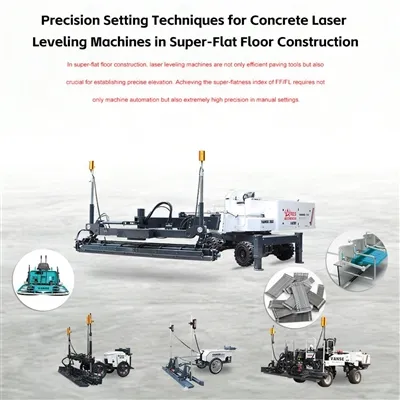
In super-flat floor construction, laser leveling machines are not only efficient paving tools but also crucial for establishing precise elevation. Achieving the super-flatness index of FF/FL requires not only machine automation but also extremely high precision in manual settings. The following are precision setting and operation techniques for laser leveling machines to achieve super-flatness: Avoid interference sources: The transmitter must be installed outside the concrete paving area and away from crane vibrations, passing vehicles, and airflow interference (the support structure needs to be reinforced in windy conditions). Height coverage: Ensure that the transmitter's signal plane covers the entire work area and is not obstructed by on-site columns or equipment. Dual transmitter verification: For extra-large areas, it is recommended to set up two transmitters for mutual verification to ensure that signal attenuation or drift during long-distance transmission is detected in a timely manner. Before the start of each shift, the physical elevation of the top of the formwork must be compared with the signal elevation of the laser transmitter using the same handheld laser receiver rod. Error limit: The error between the measured elevation of the formwork and the laser signal elevation must be controlled within ±1 mm. Technique: Adjust the sensitivity of the hydraulic sensor based on the concrete slump. If the concrete is stiffer, the sensitivity should be appropriately reduced to prevent the leveling head from frequently bouncing due to resistance; if the concrete is thinner, increase the sensitivity to ensure immediate correction of small height differences. Screw Feeder Setting: The lower edge of the screw feeder should be slightly higher than the design elevation (approximately 3-5 mm), using the rear vibrating beam to compact the material to the design position. Material Excess: Always maintain a suitable amount (approximately 2-5 cm) of concrete accumulation in front of the leveling head. Too little material will result in "empty scraping," and too much material will create pushing waves. Operation: Each paving pass should overlap the previously completed pass by 200-300 mm. Technique: Set the hydraulic control on the overlapping side to "manual" and the non-overlapping side to "automatic". This allows the screed to use the completed pavement as a reference, ensuring consistent elevation at the joint and eliminating noticeable "joint ridges". At the end of each paving pass (when the machine retracts its arm), the travel speed should be slightly reduced to prevent the suction created when the screed lifts from pulling up the concrete and causing low spots at the edges. Factors Factors affecting accuracy Troubleshooting Techniques: Wind speed Wind can cause the laser beam to shake. Use windproof supports or add a filtering function to the laser receiver. Concrete slump The consistency (dryness/wetness) of each batch of material varies. Assign a dedicated person to monitor at the discharge point and strictly prohibit spreading material with a slump error exceeding ±20 mm. Tire pressure The amount of tire deflection changes. Check the tire pressure of the leveling machine before starting work each day to ensure symmetry and consistent pressure on both sides. The **first pass with a long-handled straightedge (Highway Straightedge)** after the laser Leveling is completed is crucial: Operation: While the concrete is still plastic, the operator should use an aluminum alloy straightedge of more than 3 meters in length, following the Leveling machine and performing reciprocating leveling perpendicular to the paving direction. Purpose: To eliminate the small marks left by the laser Leveling when changing lines or turning. Note: The parameters provided in this document are for reference only and are not mandatory. Due to differences in technical characteristics between different brands and models of laser levelers, please consult the manufacturer for a suitable solution before actual operation. This reference document assumes no responsibility for any issues arising from failure to follow the manufacturer's instructions.How does a concrete laser leveling machine work?
How does a laser leveling work? Do you know the leveling process of laser leveling machine? For how to do a good job in floor engineering, the selection of materials and construction technology are equally important. Laser leveling machine is also the key point that needs to be grasped in the construction process. Industrial plants have high requirements on the flatness of the ground level and surface resistance. Manual construction is difficult to grasp and control, and it is difficult to achieve standardized construction. The following articles are how to construct laser leveling machines and precautions, and how to avoid construction errors. 1 The construction of the floor project needs to be fully prepared. From laying the base and steel mesh – setting the dowel bar – placing the buffer zone – concrete mixing, every step is carefully grasped the details. (1) After the base layer is processed, the equipment of the laser paver is debugged, and the original benchmark point is used as the fixed reference level point; the non-woven fabric is laid, the side formwork is supported, the laser transmitter is erected, and the ground level is introduced into the laser leveling machine according to the original benchmark point. (2) Commercial concrete is used for transporting concrete, and the commercial concrete is transported to the entrance and exit of the garage by tank truck, and then transported to the construction site by a three-wheel dump truck. (3) Scale calibration Use a hand-held laser receiver to check the floor elevation, introduce the elevation into the laser paver, and adjust the reference point (±0.00) on the leveling machine. 2 The concrete mixed in the mixing station is pumped and paved on the gravel base. The paving speed of the laser leveling machine should be appropriate, and the paving can be quickly assisted by manual paving. 3 About 3-4 hours after the concrete is paved by the laser leveler, the best time is when there are no clear footprints after the master. Use a single-disc or double-disc trowel, install a rubbing disc, and rub it repeatedly during the initial setting of the concrete until the concrete slurry is released. Use a single-disc and double-disc trowel, install a smoothing disc, and rub it repeatedly when the concrete bleeds and initially sets until the concrete slurry is released. 4 It is recommended to throw the specified amount of wear-resistant material evenly on the concrete surface just after the grout is broken, and the places that lose water quickly near the formwork, columns, doorways, walls, and pits should be thrown first. Depending on the specific conditions, special materials can be thrown in more than two times. 2/3 of the amount of the first throwing; the remaining 1/3 of the second throwing; the time interval between the two spreading of aggregate should not be too long. 5 After the aggregate is sprinkled once, after the aggregate absorbs the coagulated water, the aggregate is polished and compacted with a trowel, and then the aggregate is sprinkled for the second time, and the compacted aggregate is polished with a trowel. The amount of wear-resistant aggregate is not less than 5kg/㎡. During the grinding and compacting process, a ruler can be used to assist scraping. If it is not smooth, adjust the distribution of aggregates and grind again. The number of grinding times of the laser leveling machine can be operated by construction personnel according to specific conditions. The corners are scraped manually. The front and back grinding directions are criss-crossed, and the flatness is checked with a ruler after the grinding is completed. 6 Depending on the hardening of the concrete, perform at least three trowel operations without discs after the surface has faded. The operation speed and angle of the trowel should be adjusted according to the hardening of the concrete. It is recommended to adjust the angle of the blade at the beginning of each finishing to avoid damage to the floor. 7 After scientifically completing the laser leveling machine construction process, it takes more than 28 days to maintain the floor. After the construction is completed, sprinkle water for maintenance, and lay geotextiles to reduce water evaporation and keep the wear-resistant floor after construction in water. 8 Cut the expansion joints after the concrete has been watered and cured for 24 hours. Because the interval between the wall pillars is about 7 meters, which meets the requirements of the expansion joint gap, the expansion joints are mainly distributed according to the structure of the wall pillars, forming a layout of 7m*7m; the depth is about 6-7cm, and the gap is about 5mm.Special technical measures for safety protection in concrete pouring construction
Objective: To prevent safety accidents such as collapse, falls from heights, mechanical injuries, and electric shock during concrete pouring construction, ensure the safety of construction workers' lives and equipment and property, and standardize operation procedures, this special measure is formulated in accordance with regulations and standards such as the "Code for Safety Inspection of Construction Sites" (JGJ59) and the "Code for Construction of Concrete Structures" (GB50666). Scope of application: This measure is applicable to various concrete pouring operations in building construction, municipal engineering, Bridges, tunnels, etc., including the pouring construction of different parts such as foundations, main structures, and secondary structures. Before construction, a special construction plan should be prepared, clearly specifying the pouring sequence, material distribution method, machinery selection and safety protection requirements. It should be implemented after approval by the technical supervisor. Conduct three-level safety briefings for all personnel involved in the operation: project-level briefing on the overall safety risks of the construction, team-level briefing on the operation norms of the positions, and on-site briefing on the potential hazards of specific operation points (such as edges, openings, and high-voltage line locations). The briefings must be signed for confirmation and archived. Inspect the surrounding environment of the pouring area: Clear the debris on the work surface, and confirm that 1.2-meter-high guardrails have been set up at the edges (such as foundation pits, floor slab edges) and openings (with 20cm high toe boards at the bottom of the guardrails and an additional horizontal bar in the middle). The guardrails should be painted with red and white warning paint and hung with close-mesh safety nets. Check the load on the working surface: Verify the bearing capacity of the formwork support system to ensure that the concrete stacking height does not exceed the specification requirements (the stacking height during floor slab pouring is ≤100mm), and prevent the support from collapsing due to overloading. Check for electrical safety: Confirm that the distribution box meets the requirements of "one machine, one switch, one leakage protection, and one protection". The cables in the pouring area should be overhead or run through pipes for protection to prevent damage from being crushed. When working in a humid environment, the lighting voltage should be 36V or lower, which is a safe voltage. Concrete conveying equipment (pump trucks, ground pumps, placing machines) : Check whether the braking system, hydraulic system and pipe joints of the equipment are in good condition. The outriggers of the pump truck need to be supported on a solid ground (with steel plates or square timbers as pads), and confirm that the outriggers are fully extended and the ground bearing capacity meets the requirements. Protective supplies: Personal protective equipment such as safety helmets, anti-slip shoes, insulating gloves, and dust masks should be provided. When working at heights, safety belts (high hanging and low use) and operation platforms (fully covered with scaffolding boards and surrounded by guardrails) should be prepared. Backup emergency supplies (such as first aid kits, fire extinguishing equipment, and warning tapes). High-altitude work protection: When the pouring height is ≥2 meters, an operation platform or scaffolding must be used. It is strictly prohibited to stand on formwork or steel bars for work. Workers should fasten their safety belts, and the hooks of the safety belts should be hung on solid structural components. It is strictly prohibited to walk on unfixed components. Edge operation protection: When pouring foundation pits, slopes and other edge parts, set up warning areas and prohibit non-operation personnel from entering. Workers should maintain a safety distance of no less than 1 meter from the edge of the edge. Anti-slip scaffolding boards should be laid if necessary. Dust-proof and heat-proof protection: During summer pouring, shading measures should be taken to prevent personnel from suffering from heatstroke. When pouring in winter, when hot water is used to mix concrete, it is necessary to prevent steam scalding. Workers should wear anti-scalding gloves. When there is a lot of cement dust, wear dust masks and set up spray dust suppression equipment on site. Operation precautions for pump trucks and material distribution machines: No one is allowed to stand within the rotation radius of the material distribution rod of the pump truck. Before operation, make sure there are no high-voltage lines or obstacles within the rotation range. The placing machine should be firmly fixed. Before use, check whether the outriggers and the rotating mechanism are locked. It is strictly forbidden to carry out pouring operations when the placing machine is in motion. Vibrator usage protection: The operator of the vibrator should wear insulating shoes and insulating gloves. The cable of the vibrating rod should be protected from damage. It is strictly forbidden to drag the cable. When vibrating, avoid touching the steel bars and formwork to prevent the vibration rods from bouncing and injuring people. When the vibrator is not in use, cut off the power supply and place it in a dry area. Concrete transportation protection: When transporting concrete by tanker, the driver must abide by traffic rules. No one is allowed to stand under the unloading port of the tanker. The ground pump conveying pipeline is firmly fixed. Check the sealing condition of the pipeline joints to prevent concrete leakage and spraying from injuring people. When replacing the pipeline, first turn off the power of the ground pump, release the pressure, and then disassemble it. During the pouring process, dedicated personnel should be assigned to monitor the formwork support system, with a focus on checking the verticality of the vertical rods, the spacing of the horizontal rods, and the setting of the sweeping rods. If any deformation of the vertical rods or loosening of the horizontal rods is found, the pouring should be immediately halted, and personnel should be organized to evacuate. Work can resume only after the reinforcement and rectification are completed. The pouring sequence follows the principle of "symmetrical pouring and layered pouring" to avoid instability of the support system due to excessive local loads. The thickness of the layered pouring shall be carried out in accordance with the specifications (generally ≤500mm), and it is strictly prohibited to pour the formwork in a centralized manner at one time to avoid deformation. Regular maintenance and servicing of concrete conveying equipment, vibrators and other machinery should be carried out. The operating status of the equipment should be recorded. If any fault is found, the machine should be stopped immediately for repair. It is strictly prohibited to operate with faults. Mechanical operators must be certified and familiar with the equipment operation procedures. Unlicensed personnel are strictly prohibited from operating. When the pump truck is in operation, a dedicated person should be assigned for command. The command personnel should use standard signals (flag language or walkie-talkies) to avoid communication errors with the driver. When the fabricating machine is moving, it should proceed slowly to prevent collision with structural components or personnel. On-site electricity usage should be operated by professional electricians. It is strictly prohibited for non-electricians to connect or disconnect wires. The distribution box in the pouring area is locked and a warning sign saying "Beware of Electric Shock" is posted. There are no debris within 1.5 meters around the distribution box. When working in rainy weather, cover the distribution box and electrical equipment, and check the grounding resistance (grounding resistance ≤4Ω) to prevent leakage accidents. After the operation is completed, cut off the power supply of all equipment, organize the cables, and avoid crushing or soaking them. Collapse accident handling: In the event of a collapse of the formwork support, immediately stop the operation, organize personnel to evacuate to a safe area, and prohibit blind rescue. Call the 120 emergency number and at the same time use excavators, jacks and other equipment to clear the collapsed objects and rescue the trapped people to prevent secondary collapse. Handling of falls from heights and mechanical injuries: In the event of a person's fall or mechanical injury, immediately stop the operation, transfer the injured person to a safe area, check the injured person's consciousness and breathing. If fractures or bleeding occur, take temporary immobilization and hemostasis measures, and call 120 for medical treatment. In the event of an electric shock accident, cut off the power supply first, then rescue the injured person to prevent the rescuers from getting electrocuted. Fire accident handling: In case of fire caused by electrical faults or flammable materials burning, immediately cut off the power supply, use on-site fire extinguishing equipment to put out the fire, evacuate people to a safe area, call 119 to report the fire, and at the same time clear flammable materials around to prevent the fire from spreading. Daily inspection: Before each day's work, the team conducts a pre-shift safety inspection, with a focus on personal protective equipment, equipment status, and protective facilities. The project organizes safety inspections every week to identify potential hazards and issue rectification notices, and follows up on the rectification progress. Special acceptance: Before pouring, a special acceptance shall be conducted on the formwork support system, operation platform and electrical equipment. Only after the acceptance is qualified and signed for confirmation can the pouring operation begin. If the acceptance is not qualified, construction is strictly prohibited until the rectification meets the standards. Safety education and training should be provided to newly arrived workers. Only after passing the assessment can they take up their posts. Regularly organize special training on concrete pouring safety, explaining accident cases, operation norms, and emergency skills to enhance personnel's safety awareness. Special operation personnel (such as pump truck drivers, electricians, and scaffolders) must hold relevant certificates to work. Those with expired certificates or those that have not undergone annual review are prohibited from engaging in related operations. Regularly organize refresher training for special operation personnel to update their safety knowledge. Instructions for Use: This plan is a general template. Before the specific implementation of each project, it should be refined and supplemented according to the characteristics of the project (such as super-high, super-heavy, large-span structures, etc.), especially the control measures for major hazard sources.