Technical Knowledge
Don’t be impulsive when buying a laser leveler! First check whether the vehicle meets the design requirements
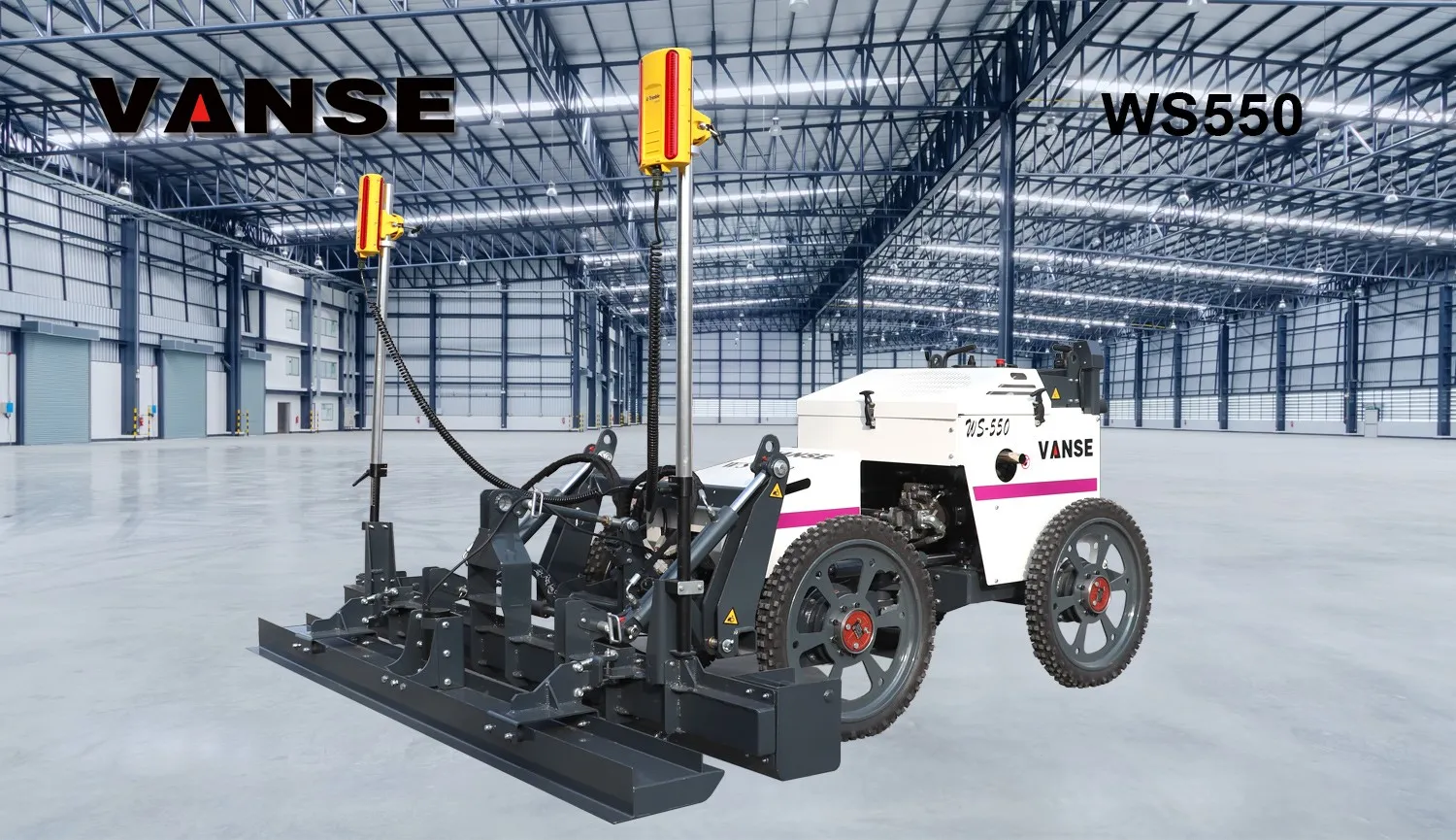
In recent years, with the continuous improvement of modern industry and commerce's requirements for floor decoration, laser leveling machines have been used more and more widely, and have been widely recognized and favored by customers with their significant technical advantages. However, when actually purchasing a laser leveling machine, in addition to the price, its use effect and the quality of accessories also need to be fully considered, such as the leveling machine's car. So, what requirements should the laser leveling machine produced by regular manufacturers meet in the design of the car? Specifically, there are the following points.
First of all, it is necessary to look at the structure and material of the concrete laser leveling machine car. The car structure and the body material directly affect the body strength. At present, there are some models on the market, and the top cover and other parts are still made of fiberglass materials, which have weak anti-collision ability. At present, there are excavator cars with all-steel frame structure and 1mm thick high-strength steel plate on the market. In addition, equipped with high-horsepower engine compression braking technology, it can effectively reduce the wear of brake pads and tires, prevent the brake system from overheating and causing brake failure, and brake safety and efficiency.
The second is the appearance color. This color should not be very dazzling and should give the operator of the laser leveling machine a visually comfortable feeling. We know that driving for a long time will make you very tired, so we must pay attention to the choice of the color of the car.
After looking at the appearance, we have to look at the inside. The so-called inside is the comfort of the laser leveling machine car. Among them, the seat is more important. One is that the driver sits for a long time, and the other is a kind of vision. The seat must be comfortable. Driving for a long time is very hard. It is very important to have a comfortable seat, which can relieve the driver's driving fatigue. And the visual sight is also very reasonable. Another thing is safety. Needless to say, everyone knows the importance of safety, especially in the concrete laser leveling machine. The set of equipment used by the driver must ensure safety. This requires us to pay special attention to these points when choosing a high-quality car.
Of course, in order to better extend the service life of the laser leveling machine car, in addition to strengthening the design quality, regular maintenance should be carried out during actual use. For example, pay attention to avoid sharp objects such as key chains and iron buttons on clothes from touching the seat to prevent scratches on the leather surface. If you want to clean it, first wipe off the dust with a semi-dry rag to keep the seat dry and clean. If it is a leather seat, you can use a transparent soap with good decontamination and low corrosiveness: first soak a clean soft towel in warm water, then evenly apply the soap on the towel, gently wipe the seat, and ventilate to dry; ensure that the leather surface is clean, fluffy, and fresh as before.
In order to facilitate everyone to better understand and master, the basic design requirements of the laser leveling machine are briefly analyzed and discussed here. In order to produce leveling machine equipment that better meets customer needs and has higher work efficiency, it is also hoped that relevant R&D companies must strengthen the design of various parts of the leveling machine and improve the technology in a timely manner to better serve the construction.
Thanks to All the Friends Who Support and Trust Shandong Vanse Machinery Technology Co., Ltd.
If you want to know more about Shandong Vanse Machinery Technology Co., Ltd. or have any questions, please feel free to contact us:
Our Factory
Shandong Vanse Machinery Technology Co., Ltd.
Share this article

About the Author: Shandong Vanse Machinery Technology Co., Ltd.
Shandong Vanse Machinery Technology Co., Ltd. is a high-tech manufacturer specializing in concrete construction machinery, including laser screeds and related equipment. The company integrates R&D, production, and global sales, with products exported to over 60 countries and widely used in infrastructure projects worldwide.
Previous Post
Next Post
Related Articles
You Might Also Like
What level of (FF) Floor Flatness and (FL) Floor Levelness can a concrete laser leveling machine guarantee
The concrete laser leveling machine, often called a Laser Leveling, can achieve significantly higher Floor Flatness (FF) and Floor Levelness (FL) numbers compared to traditional manual methods. While the maximum guaranteed level can depend on the specific machine, operator skill, slab preparation, and concrete mix, here is a general breakdown of the guaranteed capabilities and the high-end results that can be achieved: Laser Leveling routinely achieve floor tolerance specifications that fall into the "Flat" to "Very Flat" range, meeting or exceeding what is required for most industrial and commercial projects. FF/FL Classification FF (Flatness) Range FL (Levelness) Range Typical Application Laser Leveling Capability Moderately Flat FF 25 FL 20 General-purpose slab-on-grade Easily Exceeded Flat FF 35 FL 25 Standard warehouses, retail, offices Routine Minimum Very Flat FF 45 FL 35 Warehouses with high-lift forklifts (over 15-20 ft) Routinely Achieved Super Flat FF 50 and higher FL 40 and higher Robotics, Automated Guided Vehicles (AGVs), high-speed racks, TV studios, ice rinks High-End Capability Routine Performance: A good laser Leveling operation can routinely achieve FF 45 / FL 35 or better. Many industrial floors finished with a laser Leveling aim for and achieve FF 50+ / FL 40+. Accuracy (Deviation): Some manufacturers state a high-precision laser Leveling can achieve millimeter-level accuracy for leveling, or an overall flatness accuracy within about 3mm on industrial floors. Maximum Potential: With the latest technology (including 3D laser guidance systems) and meticulous finishing, projects have reported achieving FF 90+ / FL 85+, which is considered Super Flat and is necessary for advanced automated warehouse systems. The F-Number system (ASTM E1155) provides a standardized way to measure the quality of a concrete floor. FF (Floor Flatness): Measures the local bumpiness or waviness of the surface over a short distance (typically a 2-foot interval). This is controlled primarily by the finishing operations after the concrete is placed. Higher FF numbers mean a smoother surface. FL (Floor Levelness): Measures the conformity of the floor to the specified elevation or slope over a longer distance (typically a 10-foot interval). This is controlled mainly by the accuracy of the Leveling machine. Higher FL numbers mean a more level floor. Feature Impact on FF/FL Laser Guidance Ensures the Leveling head maintains a precise and consistent elevation across the entire slab, directly improving the FL (Levelness) number. Integrated Vibrator Provides consistent, high-frequency vibration and compaction across the full width of the Leveling head, reducing the surface defects and local variations that affect the FF (Flatness) number. Would you like me to find out the standard FF/FL requirements for a specific type of building, such as a warehouse or a sports facility? Note: The parameters provided in this document are for reference only and are not mandatory. Due to differences in technical characteristics between different brands and models of laser levelers, please consult the manufacturer for a suitable solution before actual operation. This reference document assumes no responsibility for any issues arising from failure to follow the manufacturer's instructions.Concrete laser leveling machine operator training
Concrete laser leveling machine operator training program ☞ Training objectives This training aims to ensure that operators fully master the operating skills of concrete laser levelings, understand safe operating procedures, improve work efficiency, and ensure construction quality. ☞ Training content 1. Equipment introduction and basic principles: Introduce the working principle, main components and functions of the concrete laser leveling. 2. Equipment installation and debugging: Instruct operators to install and debug equipment correctly to ensure normal operation of equipment. 3. Operation skills training: Make operators proficient in various operations of the equipment, including starting, running, stopping, etc. 4. Safe operating procedures: Emphasize safety awareness and ensure that operators understand and comply with safety regulations. 5. Daily care and maintenance: Teach how to perform daily maintenance and extend the service life of the equipment. 6. Common faults and troubleshooting methods: It is convenient for operators to master the identification and troubleshooting methods of common faults. ☞ Training methods 1. Theoretical teaching: Impart theoretical knowledge through explanations, illustrations, videos, etc. 2. Practical drills: Conduct practical drills in a safe environment to develop operational skills. 3. Case analysis: Analyze cases in actual projects to improve operators' problem-solving abilities. 4. Group discussion: Encourage operators to exchange experiences and make progress together. ☞ Training evaluation 1. Theoretical examination: Test the theoretical knowledge of the training to ensure that the operators master the basic theory. 2. Practical assessment: Evaluate the performance of operators in practical exercises to ensure that they have practical operational capabilities. 3. Case-solving ability assessment: Evaluate the operator's ability to solve practical problems. 4. Feedback survey: Collect operators' feedback on training to continuously improve the training plan. ☞ Training effect tracking 1. Post-training follow-up: Regularly visit operators who have completed training to understand the problems they encountered in actual work, and provide necessary help and guidance. 2. Operation specification inspection: Regularly check whether the actual operation of the operator meets the safety and specification requirements, and promptly correct operations that do not meet the requirements. 3. Equipment usage tracking: Monitor the actual use of the concrete laser leveling by operators, collect equipment operation data, and analyze equipment performance and efficiency in order to make necessary adjustments or replacements to the equipment. 4. Work quality evaluation: Regularly evaluate the operator's work quality, including the flatness of concrete leveling, work efficiency, etc., to ensure that the construction quality meets the project requirements. 5. Training effect evaluation: Regularly evaluate the training effect, including adjustments and improvements to training content, methods, evaluation standards, etc., to better meet actual needs and improve training quality. Through comprehensive consideration and implementation of the above five aspects, the work efficiency and construction quality of concrete laser leveling machine operators can be effectively improved, while ensuring the safe and stable operation of the equipment. In actual operation, the training program should be flexibly adjusted and optimized according to specific circumstances to achieve the best training effect.How to optimize the use environment of concrete laser leveling machine in the project?
In the field of construction, concrete laser levelers (concrete laser leveling machines or concrete laser levelers) have become key equipment for improving the efficiency and quality of concrete construction. With the continuous advancement of global infrastructure construction and the growing demand for high-precision construction in the construction industry, the market size of concrete laser levelers continues to expand. According to market research reports, the global market size of concrete laser levelers is expected to reach US$1.76 billion in 2025, with an annual growth rate of approximately 11.4%. In order to give full play to the effectiveness of concrete laser levelers and extend their service life, it is crucial to optimize the use environment. Before the operation of the concrete laser leveler, it is crucial to ensure that the construction site is clean and free of debris. Stones, wood, metal scraps and other debris in the site will not only hinder the normal operation of the equipment, but may also damage key components of the equipment, such as the leveling work head and walking tires. For example, if sharp stones remaining in the site are drawn into the walking mechanism of the laser leveler, it may cause the tires to be scratched and deviate, affecting the stability and walking accuracy of the equipment. At the same time, the construction site should be initially leveled so that the ground slope and undulation are within the range that the equipment can adapt to. Generally speaking, the concrete laser leveling machine is suitable for slopes within a certain range. If the site slope exceeds the specified range, it may cause the center of gravity of the equipment to be unstable, affect the leveling accuracy, and even cause safety accidents. In order to ensure the safety of construction personnel and equipment, a clear safety warning area should be set up around the concrete laser leveling machine operation area. Set up warning signs, such as "Construction site, no entry for idle people" and "Pay attention to equipment operation", and set up warning tapes to clearly divide the equipment operation range. Especially in construction sites where multiple types of work are cross-operated, prevent other personnel or equipment from mistakenly entering the operation path of the laser leveling machine to avoid collision accidents. For example, in the construction of basement floors in large commercial complexes, due to the complex construction space and frequent exchanges between personnel and equipment, a clear safety warning area can effectively reduce the probability of accidents. At the same time, arrange special personnel to be responsible for safety inspections to ensure the effectiveness of the warning area and promptly dissuade personnel and equipment from entering illegally. Response to high temperature environment: In high temperature environment, the engine of the concrete laser leveler is prone to overheating, resulting in power reduction and increased wear of parts. When the ambient temperature exceeds 35℃, the load of the engine cooling system increases significantly. At this time, the maintenance of the engine cooling system should be strengthened, and the coolant level should be checked before daily operation. If it is insufficient, add coolant that meets the specifications in time. Clean the dust and debris on the surface of the radiator regularly to ensure that the heat dissipation air duct is unobstructed. Compressed air or high-pressure water gun (pay attention to moderate water pressure to avoid damage to the radiator fins) can be used for cleaning. For example, when constructing in an open-air parking lot with high temperature in summer, if the engine temperature is found to be too high, the equipment should be immediately moved to a cool place to shut down and cool down, and never force operation under high temperature. At the same time, consider installing a sunshade for the equipment to reduce the impact of direct sunlight on the equipment and reduce heat accumulation in the engine compartment. Response to low temperature environment: In a low temperature environment (such as an ambient temperature below 5℃), the viscosity of the lubricating oil of the concrete laser leveler increases and the fluidity becomes poor, which will make it difficult to start the equipment and increase the wear of various moving parts. Therefore, before construction in a low-temperature environment, lubricating oil and hydraulic oil suitable for low-temperature working conditions should be replaced, such as using low-freezing point engine oil and hydraulic oil. Before starting the equipment, a preheating device can be used to preheat the engine, such as an electric heating water jacket, a fuel heater, etc., to improve the starting performance of the engine. At the same time, the battery of the equipment should be kept warm and protected, and a battery warming sleeve can be installed to prevent the battery from degrading due to low temperature and affecting the start of the equipment. For example, in the construction of industrial plant floors in the northern winter, taking good low-temperature protection measures for the equipment can ensure the normal operation of the concrete laser leveling machine and improve construction efficiency. High humidity environment protection: High humidity environment can easily cause the metal parts of the concrete laser leveling machine to rust and corrode, especially when constructing in coastal areas or rainy seasons. In order to cope with high humidity environments, the equipment should be parked in a dry place, and try to choose indoors or in a place with a rain shelter. If it is unavoidable to work in a humid environment, anti-rust oil can be applied to the surface of the equipment, especially parts that are prone to rust, such as the frame, chassis, and walking mechanism. Check the electrical circuits regularly to prevent short circuits caused by moisture. Use an insulation resistance tester to detect the insulation performance of the electrical circuits and deal with problems in a timely manner. For the battery of the equipment, keep it clean and dry, check the electrolyte level and density regularly, and add distilled water in time to ensure good battery performance. For example, if the laser leveling machine used for a long time in a high humidity environment does not pay attention to rust prevention, the frame may rust and reduce strength in a short time, affecting the safety and service life of the equipment. Moisture-proof measures: When the concrete laser leveling machine is idle, effective moisture-proof measures should be taken. Desiccant, such as quicklime, silica gel desiccant, etc., can be placed at the equipment parking place to absorb moisture in the surrounding air and reduce humidity. For key components of the equipment, such as laser transmitting and receiving devices, electrical control cabinets, etc., moisture-proof covers can be used for protection to prevent moisture intrusion. During construction in the rainy season, if the equipment is exposed to rain for a long time, the moisture on the surface of the equipment should be wiped dry with a dry cloth in time after the operation, and the equipment should be fully inspected to ensure that no moisture enters the equipment. For example, in the construction site in the rainy season in the south, doing a good job of moisture-proofing the equipment can effectively reduce equipment failures caused by moisture. Concrete laser leveling machines usually operate at construction sites with a lot of dust, and a large amount of dust can damage the key components of the equipment. To reduce the impact of dust, a high-efficiency air filter can be installed at the air inlet of the equipment to filter dust particles in the air and ensure that the air entering the engine and hydraulic system is clean. Clean the air filter regularly. Depending on the dust concentration at the construction site, generally clean or replace the filter element every 50-100 hours of work. At the same time, protect the laser transmitting and receiving devices of the equipment to prevent dust from adhering to the lens and affecting the transmission of the laser signal. A dust cover can be installed or the lens can be wiped regularly with a clean soft cloth. In addition, when the equipment is operating, try to avoid staying in areas with severe dust for a long time to reduce the erosion of dust on the equipment. For example, in the floor construction of a cement plant, the dust concentration is extremely high. Strengthening dust protection measures can effectively extend the service life of the concrete laser leveling machine. For electric concrete laser levelers, stable power supply is the key to the normal operation of the equipment. Before connecting to the power supply, check whether the power supply voltage meets the equipment requirements. The rated voltage fluctuation range of general equipment should be controlled within ±10%. If the voltage is too high or too low, it will affect the performance of the equipment motor and even burn the motor. You can use a voltmeter to regularly check the power supply voltage to ensure that the voltage is stable. At the same time, ensure that the capacity of the power supply line is sufficient to avoid safety accidents caused by voltage drop or line heating due to line overload. For temporary electricity use at the construction site, wiring should be carried out in accordance with relevant specifications, using a three-phase five-wire system and equipped with a leakage protector to ensure safe electricity use. For example, in the indoor floor construction of large shopping malls, if the power supply is unstable, the motor speed of the laser leveler may be uneven, affecting the leveling accuracy. Fuel-fired concrete laser levelers need to use high-quality fuel to ensure the normal operation of the engine. You should choose fuel that meets the equipment's required grades. For example, diesel engines generally use 0 or -10 diesel, and lower grades of diesel should be used in low temperature environments. Poor-quality fuel may contain impurities and moisture, which can cause the engine's fuel injectors to become clogged, combustion to be incomplete, reduce engine power, increase fuel consumption, and even damage the engine. Purchase fuel from regular gas stations and clean the fuel tank regularly to prevent impurities precipitated at the bottom of the tank from entering the fuel system. At the same time, before adding fuel to the equipment, you can use a fuel filter for secondary filtration to ensure fuel cleanliness. For example, in highway construction in remote areas, if non-standard fuel is used, the engine of the concrete laser leveler may frequently malfunction, affecting the construction progress. If conditions permit, the concrete laser leveler should be stored indoors as much as possible. Indoor storage can effectively prevent the equipment from being eroded by natural factors such as wind, sun, and rain, and reduce the risk of paint damage on the surface of the equipment and rust on metal parts. The indoor storage environment should be kept dry, well ventilated, and at a suitable temperature. The general temperature should be controlled between 5℃ – 35℃, and the relative humidity should be controlled between 40% – 70%. When storing indoors, the equipment can be parked on a dedicated bracket to avoid direct contact between the equipment and the ground, and to prevent the bottom parts from getting damp and rusting. At the same time, the equipment should be inspected and maintained regularly, such as checking the lubrication of the equipment, the connection of the electrical circuits, etc., to ensure that the equipment is in good standby condition. If the concrete laser leveling machine can only be stored outdoors, strict protective measures must be taken. First, build a rain shelter to ensure that the equipment is not directly exposed to rain. The material of the rain shelter should have good waterproof and sun-proof properties, such as color steel plates, canvas, etc. Cover the surface of the equipment with sun-proof and waterproof tarpaulin, and fix it firmly with ropes to prevent the tarpaulin from being blown away by the wind. At the same time, additional protection should be provided for key parts of the equipment, such as the engine, electrical control cabinet, laser transmitting and receiving devices, etc., which can be wrapped with a dedicated protective cover. During outdoor storage, the equipment should be inspected regularly, dust and debris on the surface of the equipment should be cleaned, and problems should be dealt with promptly. For example, in long-term outdoor construction sites, good storage protection of the equipment can effectively extend the service life of the equipment and reduce the occurrence of equipment failures. Click the below to jump immediately!!! ARMOUR JOINT CONCRETE LEVELING MACHINE LIGHT TOWER POWER TROWEL SLIPFORM MACHINE STEEL FIBER TOPPING SPREADER TRACKED MINI DUMPER