Technical Knowledge
What level of (FF) Floor Flatness and (FL) Floor Levelness can a concrete laser leveling machine guarantee
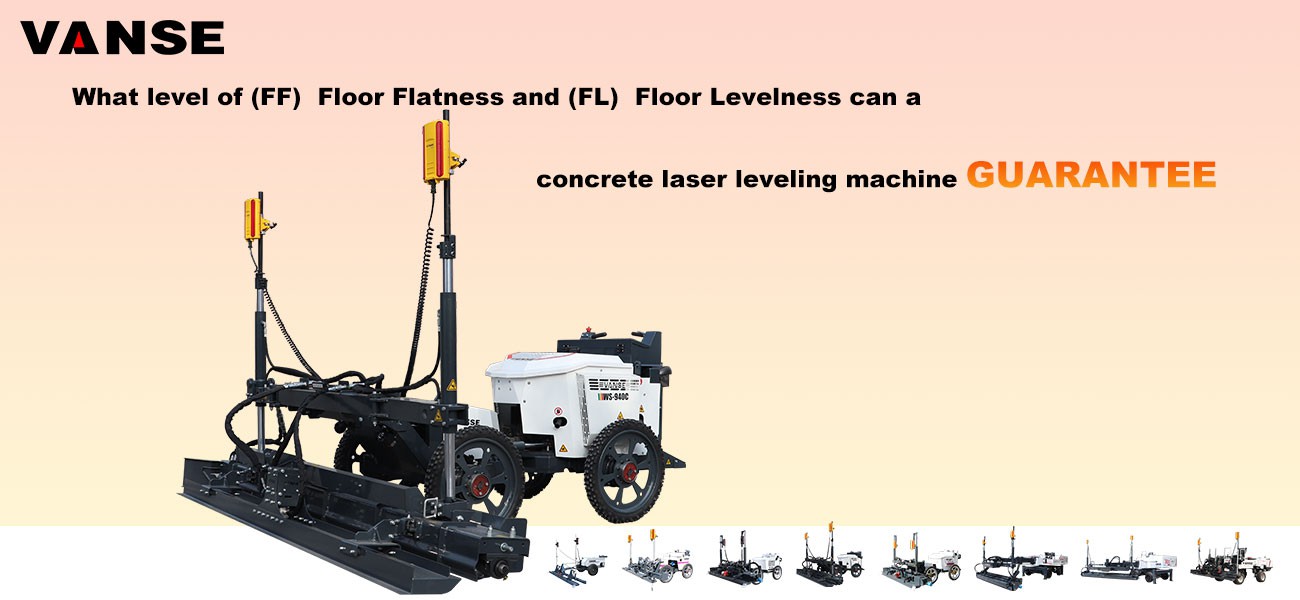
The concrete laser leveling machine, often called a Laser Leveling, can achieve significantly higher Floor Flatness (FF) and Floor Levelness (FL) numbers compared to traditional manual methods.
While the maximum guaranteed level can depend on the specific machine, operator skill, slab preparation, and concrete mix, here is a general breakdown of the guaranteed capabilities and the high-end results that can be achieved:
📏 Guaranteed FF and FL Levels
Laser Leveling routinely achieve floor tolerance specifications that fall into the "Flat" to "Very Flat" range, meeting or exceeding what is required for most industrial and commercial projects.
| FF/FL Classification | FF (Flatness) Range | FL (Levelness) Range | Typical Application | Laser Leveling Capability |
| Moderately Flat | FF 25 | FL 20 | General-purpose slab-on-grade | Easily Exceeded |
| Flat | FF 35 | FL 25 | Standard warehouses, retail, offices | Routine Minimum |
| Very Flat | FF 45 | FL 35 | Warehouses with high-lift forklifts (over 15-20 ft) | Routinely Achieved |
| Super Flat | FF 50 and higher | FL 40 and higher | Robotics, Automated Guided Vehicles (AGVs), high-speed racks, TV studios, ice rinks | High-End Capability |
Key Takeaways:
Routine Performance: A good laser Leveling operation can routinely achieve FF 45 / FL 35 or better. Many industrial floors finished with a laser Leveling aim for and achieve FF 50+ / FL 40+.
Accuracy (Deviation): Some manufacturers state a high-precision laser Leveling can achieve millimeter-level accuracy for leveling, or an overall flatness accuracy within about 3mm on industrial floors.
Maximum Potential: With the latest technology (including 3D laser guidance systems) and meticulous finishing, projects have reported achieving FF 90+ / FL 85+, which is considered Super Flat and is necessary for advanced automated warehouse systems.
💡 Understanding FF and FL
The F-Number system (ASTM E1155) provides a standardized way to measure the quality of a concrete floor.
FF (Floor Flatness): Measures the local bumpiness or waviness of the surface over a short distance (typically a 2-foot interval). This is controlled primarily by the finishing operations after the concrete is placed. Higher FF numbers mean a smoother surface.
FL (Floor Levelness): Measures the conformity of the floor to the specified elevation or slope over a longer distance (typically a 10-foot interval). This is controlled mainly by the accuracy of the Leveling machine. Higher FL numbers mean a more level floor.
| Feature | Impact on FF/FL |
| Laser Guidance | Ensures the Leveling head maintains a precise and consistent elevation across the entire slab, directly improving the FL (Levelness) number. |
| Integrated Vibrator | Provides consistent, high-frequency vibration and compaction across the full width of the Leveling head, reducing the surface defects and local variations that affect the FF (Flatness) number. |
Would you like me to find out the standard FF/FL requirements for a specific type of building, such as a warehouse or a sports facility?
Note: The parameters provided in this document are for reference only and are not mandatory. Due to differences in technical characteristics between different brands and models of laser levelers, please consult the manufacturer for a suitable solution before actual operation. This reference document assumes no responsibility for any issues arising from failure to follow the manufacturer's instructions.
Thanks to All the Friends Who Support and Trust Shandong Vanse Machinery Technology Co., Ltd.
If you want to know more about Shandong Vanse Machinery Technology Co., Ltd. or have any questions, please feel free to contact us:
Our Factory
Shandong Vanse Machinery Technology Co., Ltd.








Share this article

About the Author: Shandong Vanse Machinery Technology Co., Ltd.
Shandong Vanse Machinery Technology Co., Ltd. is a high-tech manufacturer specializing in concrete construction machinery, including laser screeds and related equipment. The company integrates R&D, production, and global sales, with products exported to over 60 countries and widely used in infrastructure projects worldwide.
Previous Post
Next Post
Related Articles
You Might Also Like
Just a few steps to teach you how to operate a ride-on trowel
The car-mounted trowel, which plays a dominant role in pavement engineering, has a wide range of applications and can be applied to many construction sites such as squares, airports, workshops, factories, parking lots, etc., and is deeply loved and welcomed by users. Using this equipment Finishing and smoothing the concrete floor can greatly reduce the labor intensity of workers, and the construction work becomes easier and more efficient. The road surface constructed by the ride-on trowel is smooth and flat, and the concrete surface has good compactness and wear resistance. Car trowel 1. Start the troweling machine and operate the handle; 2. Hold the joystick tightly to keep the body balanced; 3. When the troweling machine is working, be sure to hold the troweling machine steady, and adjust the direction in time when working on the floor. To prevent the machine from losing control; 4. First coarse grinding, then fine grinding. After the bottom grinding disc is roughly ground, remove the grinding disc when the ground is suitable for fine grinding, and finely grind with a spatula. Driving trowel The ride-on troweling machine has high working efficiency and good finishing effect, and can easily meet the engineering construction standards. This car troweling machine is easy to operate and calmly cope with different harsh working conditions. It is an indispensable good equipment in concrete troweling construction! Full hydraulic troweling machineWelfare! Four steps to clean the laser leveler
With the addition of concrete laser leveling machines in the construction industry and road construction, both quality and speed have been improved, and users have saved a lot of costs. However, in the face of high-frequency use, users cannot ignore the cleaning of the equipment. This step must not be sloppy. Let's take a look at the steps of cleaning the leveling machine! 1. The liquid crystal surface on the body of the laser leveling machine also needs to be cleaned. You can use organic resin or lens cleaning cloth to wipe the dirt. If there is too much dirt, you can use lens cleaning fluid to remove it. 2. There will be a lot of dust and mud on the laser leveling machine after construction. First, wipe the dust on the laser leveling machine clean, and wipe the dirt and oil stains with thin paper or cotton cloth. 3. If the laser signal is lost during the construction of the laser leveling machine, the machine needs to be restarted, and the interval time needs to be more than ten seconds. 4. If there are too many stains, you can soak a soft cloth in water diluted with a neutral detergent, wring it out and wash it. The best laser leveling machine manufacturers remind everyone not to use volatile oil, thinner, gasoline and other chemicals for cleaning and wiping. The laser leveling machine uses a scraper to take away the raised concrete and initially scrape it flat to reach the design elevation. The hydraulically driven vibration motor produces vibrations at a frequency of 4000 times/minute, driving the entire vibration plate to vibrate the concrete together. The laser paver does not need to pull a control line or support a side template to control the ground elevation. Instead, it is controlled in real time by the laser measurement and control system on the laser leveling machine. As long as the laser transmitter is not disturbed, no matter where the laser leveling machine moves, it can ensure that the overall elevation of the paved ground is not affected. The concrete floor laser leveling machine is a construction machine that spreads the mixed concrete along the roadbed according to the given thickness, width and road type requirements, and then completes the paving of the concrete road through vibration, leveling and polishing procedures. The working device of the concrete floor laser leveling machine generally consists of a distributor, a scraper, a vibrator (including a vibrator and a vibrator), a leveler, a trowel and other devices. At the same time, it also requires the organic coordination of the frame, the walking mechanism, the operating control system and some other auxiliary mechanisms. Some models integrate all the devices into one, and some are divided into two or more independent units.How to strengthen the concrete floor to control cracking
Most of the soil floor is not reinforced, or only nominal reinforcement measures are taken to control the crack width. Reinforcing steel bars placed at the top or top of the floor slab can limit the random crack width due to concrete shrinkage, temperature stress, foundation settlement, external loads, and other problems. This type of reinforcement is commonly referred to as shrinkage and temperature enhancement devices. Shrinkage and temperature enhancement are different from structural reinforcement. Structural reinforcement is usually placed at the bottom of the concrete slab to enhance the load bearing capacity of the floor slab. Most of the soil-bearing structural floors are provided with upper and lower reinforcements at the same time, while controlling the crack width and enhancing the bearing capacity. Due to the construction feasibility and cost of the double-layer reinforcement method, the soil-bearing structure floor is not as common as the non-structure floor. Basic principle If the concrete slab is laid on a high quality base and ensures good support, while using low shrinkage concrete material, the joint spacing is set at 4.5 m or less and installed correctly, there is generally no need for reinforcement. In general, there is almost no cracking at random or non-seam areas. If random cracks do occur, the crack width should also be kept small due to the small joint spacing and the low shrinkage of the concrete material, thus avoiding the problem of subsequent repair or maintenance. When concrete slabs are laid on low-quality bases with more problems, there is a risk of uneven support. When ordinary or high-shrinkage concrete materials or joint spacing exceeds 4.5 m, it is necessary to take reinforcement measures to limit the occurrence of Crack width. When the crack width develops and increases to about 0.9 mm, the load transfer effect of the aggregate locking disappears, causing vertical displacement cracking or "destruction" of the concrete slab. Once this happens, the edges of the crack are exposed, and blasting is likely to occur; and the concrete slab is subject to wheel compaction, especially when high-level forklifts with hard wheels are crushed. Once the blasting phenomenon begins, the crack width of the surface will increase, and the damage of the concrete slab along the crack will deteriorate rapidly. Shrinkage and temperature enhancement methods are required where shrinkage joints are not allowed on site and are not installed. Sometimes, this method is also known as continuous enhancement or seamless flooring, and a large number of closely spaced (90-180 cm) small cracks are allowed on the floor panel. Crack control method Generally, there are two methods for controlling the crack in the soil floor: (1) controlling the location of the crack by installing a shrinkage joint (the crack width cannot be controlled), (2) controlling the crack width by installing a reinforcement device (the crack position cannot be controlled). Using Method 1, we can control the cracking position of the concrete slab; the width of the shrink joint or the crack in the joint is largely controlled by the joint spacing and concrete shrinkage. As the seam spacing and concrete shrinkage increase, the seam width also increases. Similar to the crack, if the seam width is close to about 0.9 mm, the efficiency of locking and transferring the aggregate between the aggregates and avoiding vertical displacement between the seams is greatly reduced. In view of this, many designers use load-conducting designs such as force-transmitting rods, force-transmitting sheets, or continuity-enhancing devices at the shrink seam position to ensure good load transfer and limit vertical displacement between seams. Using Method 2, we allow random cracking of the concrete slab, but with reinforced steel or welded mesh to control the crack width. In general, this method is not used when setting a shrink seam. Cracking occurs randomly, forming numerous numerous intertwined small cracks. Due to the appearance considerations, this type of crack control method needs to communicate with the owner in advance. If your device has an accident, don't worry! When you choose Vanse equipment, you also choose to have peace of mind after-sales protection. We provide quality after-sales service for all customers 365 days a day. If you have any problems with your equipment, please feel free to contact us at any time. Remote telephone after-sales guidance is an efficient after-sales support method. Our after-sales service engineers will get in touch with you as soon as possible and help you to restore the normal operation of the equipment as soon as possible. Vanse Service, anywhere and anytime!!!