Technical Knowledge
Concrete laser leveling machine use tips
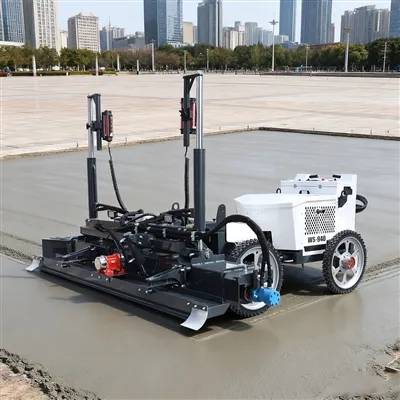
The correct use of laser leveling machine manufacturer analysis skills, with the vigorous development of the construction industry, road construction is more and more frequent, which highlights the important role of laser leveling machine. Leveling machine relies on hydraulic drive leveling head, with laser system and computer control system in automatic leveling at the same time to complete leveling work. Through this article we have a brief understanding of its use of techniques.
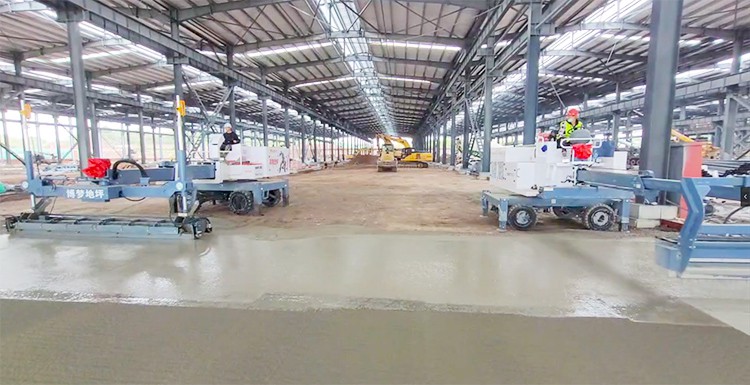
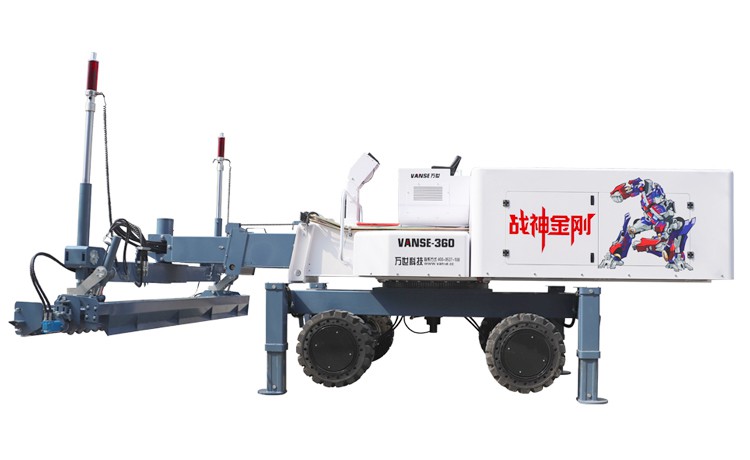
Traditional artificial pavement leveling technology has gradually faded out of people's vision. In this era of rapid development, pavement leveling machine has brought development prospects for road construction. Through man-machine cooperation, pavement leveling technology has reached a high level.
Manual coordination: When the leveling machine is in construction, the concrete sent to the platform needs workers to open and roughly flatten as soon as possible. In addition, the area around the template, wall, column, trench, equipment foundation, floor drain or pipeline and other equipment can not be levelled, need manual coordination for local leveling. Generally, 3-4 workers are needed to cooperate with the construction.
In the use of leveling machine, of course, it is necessary to have certain computer operation technology, but also have certain tips, after all, the full intelligent robot leveling machine has not come out, for you to explain the use of leveling machine tips.
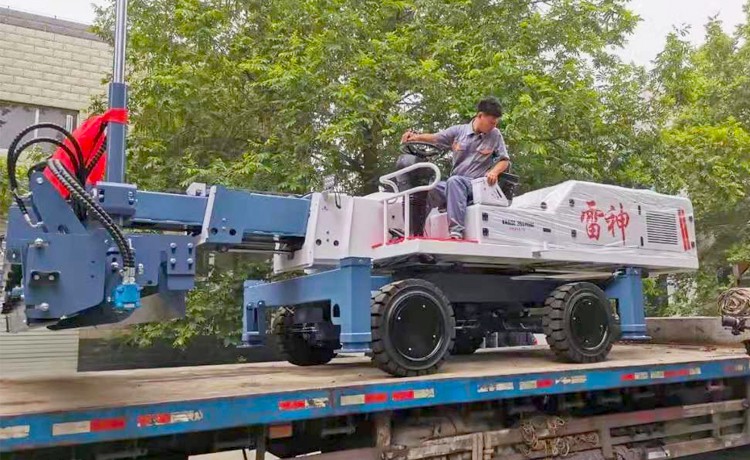
In order to ensure the level of the floor, the concrete delivered to the platform must have the same slump each time. Ensure that the concrete feed rate is 40 cubic meters per hour or above and the initial setting time of each batch of concrete must be the same. Ensure that the template elevation is accurate and not disturbed during construction. The environment matches. The newly constructed concrete floor should not be exposed to sunlight, wind, rain and other unfavorable environment for the health of concrete. In addition, the laser leveling machine construction at the same time, the site can not have welding machine operation, can not have reflective objects. The foundation must reach a certain hardness to ensure that the laser leveling machine does not collapse when working on the ground. The ground height points in the workshop must be evenly distributed, and there should be no error in levelness.
Thanks to All the Friends Who Support and Trust Shandong Vanse Machinery Technology Co., Ltd.
If you want to know more about Shandong Vanse Machinery Technology Co., Ltd. or have any questions, please feel free to contact us:
Our Factory
Shandong Vanse Machinery Technology Co., Ltd.








Share this article

About the Author: Shandong Vanse Machinery Technology Co., Ltd.
Shandong Vanse Machinery Technology Co., Ltd. is a high-tech manufacturer specializing in concrete construction machinery, including laser screeds and related equipment. The company integrates R&D, production, and global sales, with products exported to over 60 countries and widely used in infrastructure projects worldwide.
Previous Post
Next Post
Related Articles
You Might Also Like
The Purpose and Significance of Management and Maintenance of Concrete Laser Leveling Equipment
As core equipment for high-precision, high-efficiency floor leveling in modern construction, the management and maintenance of Concrete Laser Levelings not only impacts the stable performance of the equipment but also directly impacts project quality, construction costs, and enterprise competitiveness. The following analysis examines the purpose and significance of Concrete Laser Leveling management and maintenance: Laser Leveling machines achieve millimeter-level precision control through their laser transmitters and receivers. Issues such as calibration deviations, sensor failure, or mechanical wear can directly result in substandard floor flatness, leading to rework and quality disputes. Regular maintenance ensures that key components, such as the laser system, vibration motor, and travel mechanism, are in optimal condition, ensuring that construction accuracy meets design requirements. Concrete construction is a harsh environment, and equipment is susceptible to cement corrosion, mechanical vibration, and dust abrasion. Through scientific management (such as standardized operating procedures and maintenance records) and preventive maintenance (such as regular cleaning, lubrication, and replacement of wearing parts), unplanned downtime can be reduced, equipment degradation can be delayed, and repair costs and the frequency of replacements can be significantly reduced. Equipment failure or performance degradation can lead to construction interruptions and reduced efficiency. For example, loss of laser system signal may require recalibration, which is time-consuming and impacts progress. Routine inspections and rapid maintenance can minimize downtime, ensure continuous and efficient equipment operation, and contribute to on-time project delivery. Laser Leveling machines involve high-speed rotating parts, hydraulic systems, and overhead work (such as telescopic boom models). Improper maintenance can lead to mechanical failure, hydraulic leaks, or even casualties. Regularly inspecting safety devices (such as emergency stop buttons and protective covers), hydraulic lines, and electrical systems can eliminate potential safety hazards and protect both operators and equipment. Surface flatness is a core indicator of concrete construction quality, directly impacting subsequent floor laying, equipment installation, and building aesthetics. Precise maintenance of the laser transmitter, receiver, and screed head ensures surface flatness within ±2mm, meeting the requirements of high-standard industrial plants, logistics warehouses, and other scenarios, while avoiding customer complaints or claims due to quality issues. Reduce direct costs: Preventive maintenance costs are far lower than repair costs. For example, regularly changing hydraulic oil can prevent system downtime caused by oil line blockage, saving tens of thousands of yuan in repair costs. Improve equipment utilization: By optimizing maintenance plans, equipment idle time can be reduced, increasing output per unit time and indirectly increasing company revenue. Enhance market competitiveness: Stable and reliable equipment performance is key to earning customer trust, helping companies establish a professional image and expand into the high-end market. Standardized equipment management (such as establishing a maintenance database and applying IoT monitoring technology) can accumulate extensive operational data, providing a basis for optimized equipment design, fault prediction, and intelligent maintenance, driving the industry's development towards digitalization and refinement. Furthermore, a comprehensive maintenance system helps standardize construction standards and elevate the industry's overall technical capabilities. Extending equipment lifespan and reducing resource waste are key aspects of green construction. Reducing equipment scrap rates through scientific maintenance can reduce the consumption of raw materials such as metals and plastics, lower carbon emissions, and help the construction industry achieve its "dual carbon" goals. The management and maintenance of Concrete Laser Leveling machines is crucial for ensuring construction quality, controlling costs, improving efficiency, and ensuring safety. Companies should establish a full lifecycle management system that prioritizes prevention and prioritizes maintenance. Incorporating intelligent monitoring technologies, these systems enable real-time monitoring of equipment status and optimal allocation of maintenance resources. This will help companies gain an advantage in the fiercely competitive market and promote high-quality development in the industry. Note: The parameters provided in this document are for reference only and are not mandatory. Due to differences in technical characteristics between different brands and models of laser levelers, please consult the manufacturer for a suitable solution before actual operation. This reference document assumes no responsibility for any issues arising from failure to follow the manufacturer's instructions.Why is my concrete floor dusty after power troweling?
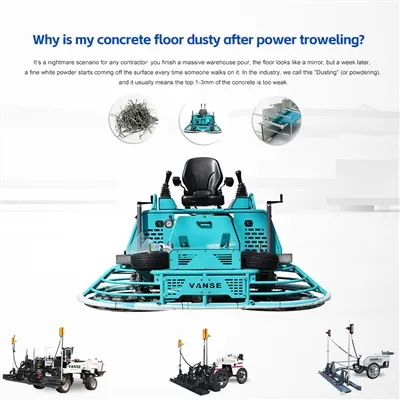
It's a nightmare scenario for any contractor: you finish a massive warehouse pour, the floor looks like a mirror, but a week later, a fine white powder starts coming off the surface every time someone walks on it. In the industry, we call this "Dusting" (or powdering), and it usually means the top 1-3mm of the concrete is too weak. If you're asking "Why is my floor dusty?" the answer usually lies in the relationship between your technique and your Power Trowel settings. Here's a breakdown of the common culprits and how the right gear can prevent it. This is the #1 cause. If you start your first pass while there is still a "sheen" of water on the slab, you are essentially mixing that extra water into the top layer of cement paste. This destroys the water-to-cement ratio at the surface, leaving it soft and chalky. The Pro Fix: You have to wait until the bleed water has evaporated. Vanse Insight: When you're using a high-performance machine like the Vanse VS836 series, you have the stability and weight (up to 380kg+) to wait for the perfect window. Because Vanse machines are so efficient, you don't need to rush the start; you can wait for the concrete to set properly and still finish the entire bay on time. It's tempting to keep running the machine to get that ultra-black, burnished look. However, if your blades are at too sharp an angle or your RPM is too high on a surface that has already begun to dry out, you can actually "burn" the life out of the cement paste. You're essentially grinding the surface instead of finishing it. The Pro Fix: Use precise pitch control and don't over-work the slab once it has reached its density. Vanse Insight: This is where Vanse's precision blade pitch system really shines. Whether you're using the walk-behind or the Ride-on Power Trowel, the adjustment is smooth and immediate. This allows you to dial back the aggression as the floor hardens, preventing that localized friction that leads to dusting. We've all seen it-a crew member spraying a little water on the floor because it's "closing up" too fast. This is a guaranteed way to get a dusty floor. That "finishing water" never integrates into the slab; it just sits on top and creates a weak, unbonded film. The Pro Fix: If the floor is getting away from you, you don't need water-you need more "horsepower." Vanse Insight: Instead of reaching for the hose, pros reach for a Vanse VS1046. With a 35HP BRIGGS & STRATTON engine, these machines have the raw torque to move stiff concrete and close the surface without needing to "wet it down." High torque equals a harder finish without the dust. If the environment is too hot or windy, the surface dries before the bottom of the slab. This creates a "crust" that is brittle. The Pro Fix: Use a curing compound or wet-cure the floor immediately after the final pass. Cause of Dusting Prevention Strategy Vanse Advantage Premature Finishing Stable, heavy-duty compaction at the right time. Balanced Rotor Design for smooth early-stage floating. Surface Friction Precise control of blade angle. Micro-adjustable Pitch Control on all models. Weak Surface Paste Avoiding "finishing water" through high efficiency. High-Torque Honda Engines to handle dry, stiff mixes. Uneven Surface Consistent pressure across the rotor. Heavy-duty Gearboxes that prevent "chatter" marks. A dusty floor is usually a sign that the surface was "abused" during the finishing stage. By combining the right timing with a professional-grade Power Trowel from Vanse Machinery ( www.vansemac.com ), you ensure that the cement paste is compacted and densified, not ground down into powder. If you're tired of "dusty floor" callbacks, it might be time to look at the precision and power that a Vanse machine brings to your job site. Don't just finish the floor-densify it. Note: The parameters provided in this document are for reference only and are not mandatory. Due to differences in technical characteristics between different brands and models of laser levelers, please consult the manufacturer for a suitable solution before actual operation. This reference document assumes no responsibility for any issues arising from failure to follow the manufacturer's instructions.Key points for purchasing second-hand power trowel and common methods to avoid pitfalls
Selecting a second-hand polishing machine is a job that requires a lot of experience and skills. It can help you obtain a practical device at a lower cost, but if you make a wrong judgment, the subsequent maintenance and delayed construction period may cause you to lose more than you gain. The following is a detailed list of key points for choosing a second-hand polishing machine and common methods to avoid pitfalls. We hope it can be of great help to you. Fuselage structure Chassis (grinding disc) : This is the most crucial part. Check if it is flat and free of deformation. Slight wear and tear is normal, but if the wear is severe, there are pits or obvious deformation, it will lead to poor polishing effect and higher replacement cost. Blade (scraper) : Check if there is still sufficient thickness. If the metal substrate has been worn out, it needs to be replaced immediately, and this cost should be included in the cost. Protective cover: Check for any damage or severe deformation, as this is related to operational safety. Overall framework: Check for any signs of welding, cracks or repairs, which could be a sign of severe impact or drop. Engine (heart) Brand: Give priority to well-known brands such as Honda, Kohler, Briggs & Stratton, etc. Spare parts are easy to find and maintenance is convenient. Appearance: Check for any cracks in the engine casing, especially in the base and radiator sections. Check for obvious oil stains or carbon deposits. This might be a sign of oil leakage or poor maintenance. Air filter: You can ask to remove the air filter to have a look. If the inside is very dirty or even soaked with oil, it indicates that the previous owner might not have paid much attention to maintenance. Engine oil: You can pull out the oil dipstick to check. If the engine oil is black, viscous or contains metal debris, it indicates that the engine wear may be relatively severe and the maintenance condition is poor. Transmission system Gearbox: Check if there are any signs of oil leakage on the gearbox housing. Rotate the drive shaft by hand to feel if it is smooth, and if there is any jamming or abnormal noise. Belt/chain: Open the protective cover and check if the belt has cracks, wear or looseness. Check if the chain is loose and free of oil and rust. Be sure to ask the seller to start the machine for testing! Startup performance Cold start is the most illustrative. Observe whether the rope pulling is smooth and whether the machine can start smoothly within one to three rope pulls. If it is difficult to start, there may be problems (such as carburetors, spark plugs, insufficient compression, etc.). Engine sound After starting, listen to the sounds of the engine idling and accelerating. The operation should be smooth. A regular "tap-tap" sound is normal (valve sound). If there are loud "clicking" sounds, knocking sounds or irregular noises, it indicates that there is severe wear inside. Transmission system sound Let the trowel run idle and listen for any abnormal "clattering" sounds from the gearbox and transmission parts. The voice should be even and deep. Vibration condition When the machine is running, it should be smooth and the vibration should be within a reasonable range. If the vibration is abnormally severe, it may be due to deformation of the chassis, unbalanced installation of the blades or problems with the engine base Purchase time and source: Inquire about the specific year and channel of purchase of the machine to determine its service life. Usage frequency and scenarios: Is it for occasional household use or long-term high-intensity use by professional teams? The latter naturally wears out more severely. Maintenance and repair history: This is of Paramount importance. Has there been any major overhaul? (Such as engine cylinder opening, gearbox replacement When was the last time the engine oil, air filter and spark plugs were changed? Have there been any accidents (such as tipping over or collision)? A reliable seller will tell the truth, while a evasive one needs to be on guard. If possible, conduct a brief load test (such as grinding it on the ground). Observe after the load is applied: Whether the engine is prone to stall and whether the power is sufficient. Check for any slippage or abnormal noise in the transmission system. Whether the machine moves smoothly and if it deviates. Trap description: Merchants thoroughly clean and paint the machines to make their appearance look as good as new, thereby covering up internal wear and tear and malfunctions. Avoidance methods Pay special attention to the screws and interfaces: It is very difficult for a refurbished machine to have no signs of any screws being turned. Check whether there are any signs of wear on the engine fixing screws, chassis screws, etc. Paint surface consistency: The original factory paint surface is usually uniform. If you find that the paint color of some parts does not match the overall color or the paint layer is too thick, it might be due to later spraying. Don't judge a machine by its appearance: Don't be deceived by a clean exterior. The key is to check its operating status and internal wear. Trap description: The machine was once sold after its chassis and frame were deformed due to a fall or collision. It was sold after simple repairs. Avoidance methods Check the flatness: Place the machine on a flat ground and observe from the side whether the chassis is fully in contact with the ground and if there is any warping. Check the welding points: Carefully inspect each connection point of the rack to see if there are any irregular or rough welding points in the later stage. Running test: During no-load operation, observe whether the machine is stable and if there is any regular swinging. This might be a sign of an uneven chassis. Trap description: Piecing together a complete machine with "good" parts from different scrapped machines, which has poor compatibility and stability. Avoidance methods Brand consistency: Check whether the brand, model and newness of the main components such as the engine and fuselage match. Assembly machines often give the impression of being "mismatched". Check the nameplate: Whether the information on the body nameplate (such as model and production date) is consistent with the seller's description. Poor comprehensive operation: When the assembly machine is in operation, various minor problems may occur frequently, making it feel "not smooth". Trap description: The machine performs okay when it is cold or unloaded, but once it is heated up or loaded, problems become apparent (such as insufficient power, severe abnormal noises, and engine stalling). Avoidance methods Persist in long-term testing: Let the machine run for 10 to 15 minutes and observe whether the state is stable after warming up. Load testing is required: This is the best way to verify the true state of the machine. Check the engine oil: After warming up the machine, stop it immediately and check the engine oil. If there are many small bubbles (emulsions) in the engine oil, it might be that the cylinder gasket is being washed away, which is a big problem. Before deciding to purchase, quickly check the following list: Inspection items Qualification standard Be cautious/give up Fuselage chassis Smooth, evenly worn, and without deformation Deformation, cracks, wear limit Engine Well-known brand, smooth start-up, stable operation, pure sound, no oil leakage Difficult to start, severe abnormal noise, oil leakage, and heavy smoke Transmission system The rotation is smooth without any abnormal noise, and the belt/chain is not aged There is abnormal noise, jamming and oil leakage Seller Description Be honest, answer all questions, and keep clear maintenance records Vague and evasive, concealing history Price In line with market conditions (approximately 30% to 50% of a new model) Far below the market price (" There's no such thing as a free lunch ") Test run situation The hot and cold units start well and operate stably under no-load or load conditions Any test is unqualified Final suggestion: If possible, bring along an experienced master craftsman or mechanic. Their experience can help you discover many problems that beginners fail to notice. When making a purchase, it is best to sign a simple written agreement with the seller, clearly stating the condition of the machine, and keep the payment voucher for unexpected needs. Remember, the primary principle when purchasing second-hand equipment is "It's better to miss out than to buy wrongly." Wish you could find a sturdy and durable good machine! Note: The parameters provided in this document are for reference only and are not mandatory. Due to differences in technical characteristics between different brands and models of laser levelers, please consult the manufacturer for a suitable solution before actual operation. This reference document assumes no responsibility for any issues arising from failure to follow the manufacturer's instructions.