Technical Knowledge
The advantages of laser leveling machine are revealed, don’t be convinced!
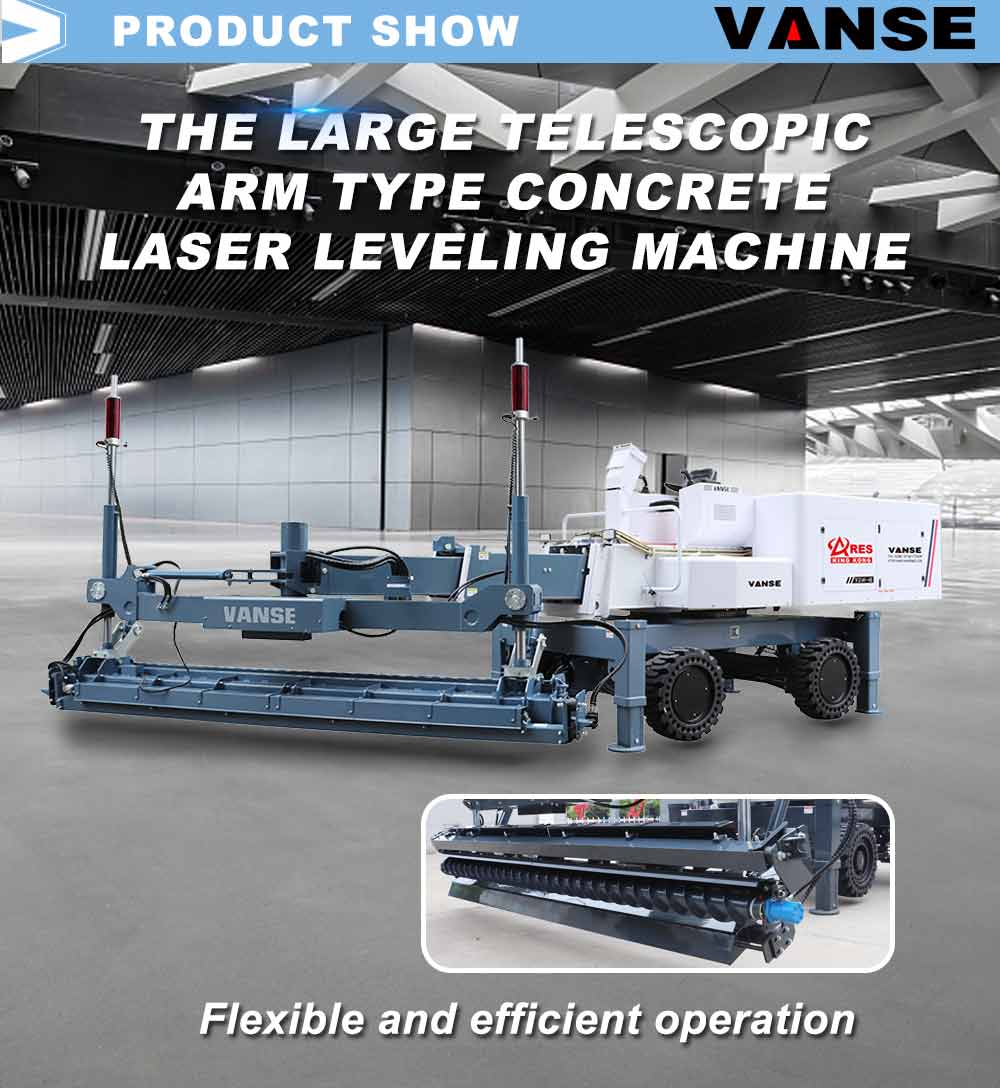
In the past, when creating super-flat ground, the traditional cement concrete paving and leveling method was generally used. Most of the time, the cement concrete was roughly leveled manually using shovels, rake and other tools, and then the cement concrete vibrating beams, roller bars and scrapers were used for repeated leveling. Leveling, except for the poor flatness in this method, completely relies on manual operation and consumes a lot of labor costs.
With the advancement of the times, laser leveling machines are becoming more and more common in super-flat floor construction. It is a device that uses laser as the reference plane and controls the leveling head in real time to achieve high-precision and rapid leveling of concrete. What exactly is it? What are the advantages that make it so popular?
1. Laser leveling machine reduces labor costs and doubles efficiency
Traditional construction techniques require a large number of people, and require support of formwork (channel steel), dotting, and paving, and require about 20 manpower. The total number of people using the concrete laser leveling machine is more than half that of the traditional process. It can be operated by a single person, and the daily construction area is also greatly increased, which greatly reduces the labor cost.
2. Laser leveling machine laser point alignment, high precision and low error
Traditional leveling technology requires support templates to control the elevation of the ground and pull control lines. The elevation error is large, and the levelness and smoothness of the entire floor cannot be guaranteed.
The use of laser point transmitters is suitable for one-time paving of large areas. There is a laser measurement and control system that controls the elevation in real time. No pulling wires are required for leveling, and there is no need for support and side plates in the middle to control the ground elevation. This avoids the elevation error caused by the vibration of the formwork (channel steel) during the construction process, and also reduces the elevation error caused by traditional manual block formwork.
3. The ground flatness and integrity are better
With traditional construction techniques, formwork is set up one day and watering is done the other day. The construction can only be carried out piece by piece. It has great limitations and cannot be operated continuously. Moreover, the integrity is not good and it is easy to cause accumulated errors in the construction joints.
The concrete laser leveling machine can pave a large area of floor in one go, with higher efficiency and integrity. The completion of the entire floor makes the ground more integrated, which is completely impossible with traditional construction.
4. The ground is denser and more uniform, which improves the overall construction quality.
The high-frequency vibrator per minute allows the leveling head vibrator to produce uniform high-frequency vibration, making the concrete floor denser and more uniform.
It is said that laser levelings are a means of reducing enterprise construction costs. In fact, these are not the only reasons why enterprises choose concrete laser levelings. As the requirements for ground smoothness and levelness in modern logistics, workshops, supermarkets, etc. continue to increase, laser leveling machines are becoming more and more widely used to ensure construction quality and improve work efficiency, so it is the best choice. Got it!
Thanks to All the Friends Who Support and Trust Shandong Vanse Machinery Technology Co., Ltd.
If you want to know more about Shandong Vanse Machinery Technology Co., Ltd. or have any questions, please feel free to contact us:
Our Factory
Shandong Vanse Machinery Technology Co., Ltd.








Share this article

About the Author: Shandong Vanse Machinery Technology Co., Ltd.
Shandong Vanse Machinery Technology Co., Ltd. is a high-tech manufacturer specializing in concrete construction machinery, including laser screeds and related equipment. The company integrates R&D, production, and global sales, with products exported to over 60 countries and widely used in infrastructure projects worldwide.
Previous Post
Next Post
Related Articles
You Might Also Like
How to troubleshoot the laser signal loss fault of the concrete laser leveling machine? Can I solve it myself or do I need to find professional maintenance personnel?
If the laser signal of the concrete laser leveling is lost, in most cases, you can first check it step by step by yourself. If the problem still cannot be solved after checking, you need to contact professional maintenance personnel. The core troubleshooting logic is "gradually locating from the signal source to the receiving end", first eliminating external interference and simple connection issues, and then determining hardware faults. Troubleshooting in the following order can solve over 80% of signal loss problems without the need for professional tools: Check the status of the laser emitter Confirm whether the transmitter is powered on and whether the power indicator light is on normally (if it is not on, check whether the power cord is plugged in tightly and whether the power adapter is damaged). Observe whether the transmitter is placed horizontally and whether the bottom leveling bubble is in the center (tilting will cause signal deviation, and manual leveling needs to be re-done or the automatic leveling function should be enabled). Investigate signal occlusion and interference Check if there are any obstacles such as steel bars, construction tools, personnel, etc. between the transmitter and the receiving probe of the leveling machine, and clear the straight area between the two. Stay away from other strong light sources or electromagnetic equipment, such as electric welding machines, large frequency converters, and powerful flashlights, as these devices can interfere with the laser signal. Check the connection of the receiving system Check whether the laser receiving probe on the leveling machine is loose or displaced, and whether there is dust or concrete slurry on the probe lens. Wipe the lens with a clean soft cloth. Check the connection cable between the probe and the main unit, and confirm whether the plug is tightly inserted and whether the cable is damaged (if the cable is damaged, it can be temporarily wrapped with insulating tape, and needs to be replaced later). Restart the device and restore factory Settings Turn off the power of the transmitter and the leveler, wait for 1 to 2 minutes, and then restart them. Some temporary signal disorders can be resolved by restarting. If restarting is ineffective, refer to the equipment manual and restore the laser control system to its factory Settings (Note: Record the commonly used parameters before restoring). Test the signal receiving range Move the leveler to a position close to the transmitter (such as within 3 to 5 meters) and observe whether the signal can be received. If it can receive at close range but not at long range, it might be due to insufficient power of the transmitter or a decrease in the sensitivity of the probe. Further hardware testing is required. If the signal is still lost after completing the above troubleshooting, it indicates a hardware fault. It is not recommended to disassemble it by yourself. Please contact the maintenance personnel Transmitter failure: For instance, if the laser tube of the transmitter burns out or the internal circuit board is damaged, it will be manifested as no laser being emitted after power-on, or the laser intensity significantly weakening. The receiving probe is damaged: The internal photosensitive element of the probe is faulty. Even without obstruction, it cannot receive signals. The sensitivity of the probe needs to be tested with a dedicated instrument. Host control system failure: The communication module between the host and the receiving system is damaged, which is manifested as a direct error "signal interruption" after the equipment is turned on. Professional personnel are required to inspect the circuit or replace the module. Note: The parameters provided in this document are for reference only and are not mandatory. Due to differences in technical characteristics between different brands and models of laser levelers, please consult the manufacturer for a suitable solution before actual operation. This reference document assumes no responsibility for any issues arising from failure to follow the manufacturer's instructions.Laser leveling machine operation steps and slope adjustment
Laser leveling machine operation steps and slope adjustment As an important piece of equipment in modern building construction, laser leveling machines are widely welcomed for their high precision and flatness. In actual operation, correct operating procedures and slope adjustment are crucial to ensure construction quality and efficiency. This article will introduce in detail the operating steps of the laser leveling machine and how to adjust the slope to help operators better master and use the equipment. ★Preparation before operation★ Before operating the laser leveling machine, adequate preparations need to be made. This includes the following aspects: 1. Inspect equipment: Conduct a comprehensive inspection of the leveling machine to ensure that all components are intact, especially key components such as the laser system, engine, and crawler tracks. If there is any problem, it should be repaired or replaced in time. 2. Familiar with the environment: Understand the environment and conditions of the construction site, including ground conditions, slope requirements, etc. This helps the operator better understand the use and adjustment of the leveling. 3. Safety preparation: Wear safety protective equipment, such as safety helmets, safety shoes, gloves, etc., and make sure there are no people or obstacles around the equipment to avoid accidents. ★Device startup★ After ensuring that all preparations are completed, the device can be started. Specific steps are as follows: 1. Turn on the power: Turn on the power switch of the leveling machine, and the equipment will enter standby mode. 2. Start the engine: Start the engine of the leveling machine correctly according to the requirements of the equipment manual. Under normal circumstances, you need to press the start button first, and then turn the key switch to the "ON" position 3. Check the instrument panel: Observe whether the indicators on the instrument panel are normal. If there are any abnormalities, deal with them in time. ★Leveling work★ After the equipment is started, the leveling operation can be started. The key to the leveling operation is to maintain the stability of the equipment and control the flatness. The specific steps are as follows: 1. Adjust the laser system: According to the construction requirements, adjust the emission angle and distance of the laser system to ensure that the laser line can be accurately projected onto the ground to be leveled. 2. Control the leveling speed: According to the ground conditions and flatness requirements, reasonably control the driving speed of the leveling machine. Generally speaking, the speed should not be too fast to avoid affecting the leveling effect. 3. Maintain stability: During the leveling process, the operator should maintain a stable mentality and actions, and avoid sharp turns, sudden braking, etc., so as not to affect the leveling effect and equipment life. ★Slope adjustment★ In leveling operations, slope adjustment is a very important operation. Correct slope adjustment ensures smooth ground and drainage performance. Specific steps are as follows: 1. Determine the slope requirements: According to the construction drawings and specification requirements, determine the slope requirements of the ground to be leveled. This includes both transverse and longitudinal slopes. 2. Adjust the laser system: Adjust the projection angle and position of the laser system according to the slope requirements. Generally, it is necessary to use the slope adjustment function of the laser system to achieve 3. Control the leveling speed: During the slope adjustment process, the driving speed of the leveling machine should be appropriately controlled to ensure the accuracy of the slope adjustment. 4. Real-time monitoring: During the leveling process, the operator should monitor the slope changes of the ground in real time, and adjust the laser system or leveling speed in time if necessary. ★Homework End★ After the leveling operation is completed, corresponding finishing work needs to be carried out. The specific steps are as follows: 1. Turn off the engine: Turn off the engine of the leveling machine and turn off the power switch. 2. Clean the equipment: Clean the dust and debris on the surface of the leveling machine and keep the equipment clean. 3. Check the equipment: Conduct a comprehensive inspection of the leveling machine and deal with any problems found in a timely manner: ★Notes★ When operating the laser leveling machine, you need to pay attention to the following aspects: 1. Safety first: Always pay attention to safety during operation and abide by operating procedures and safety requirements. 2. Familiar with the equipment: Operators should be familiar with the structure, performance and usage of the equipment to avoid equipment damage or personal injury due to misoperation. 3. Stay stable: Maintain a stable mentality and movements during the leveling process to avoid impatience and carelessness. 4. Reasonable adjustment: Reasonably adjust the parameters and settings of the leveling machine according to the ground conditions and construction requirements to achieve the best leveling effect. 5. Regular maintenance: Regularly maintain and maintain the leveling machine to ensure the normal operation and service life of the equipment. From the above introduction and analysis, it can be seen that the operation steps and slope adjustment of the laser leveling machine are complex and important tasks. Only by mastering the correct operating methods and precautions can construction quality and efficiency be ensured. Therefore, we hope that the majority of operators can carefully study and master the content introduced in this article and apply and practice it in actual work.Construction technical requirements of concrete laser leveling machine
Construction technical requirements of concrete laser leveling machine When we use the concrete laser leveling machine for construction, we need to understand some relevant technical requirements, such as the requirements for concrete or formwork, and the degree of coordination of various details, etc. There are also certain requirements. These problems need to be properly arranged before they can be directly adjusted Otherwise, there may be some problems during the construction process. 1. Requirements for concrete and formwork 01. Concrete must be produced, conveyed or pumped to the flooring project site by commercial concrete production plants. 02. Concrete specifications: C25~C30 concrete, the strength of which is not less than 25MPa in 28 days, according to the design requirements. 03. Water-cement ratio: no more than 0.5, no water can be added during the feeding process. 04. Cement: Use ordinary Portland cement with a grade of not less than 42.5. 05. Aggregate: Well-graded aggregate should be used. Crushed granite or pebbles are used as coarse aggregate, and the maximum diameter is not more than 25mm. The fine aggregate is clean river sand with a fineness modulus of 2.4-2.7. 06. Concrete mix ratio: the amount of cement is not less than 350Kg/m3. In order to avoid surface quality problems, the sand rate should be controlled at 35% to 40%. 07. Concrete slump: 14±2cm, maximum 16cm. 08. Setting time: The initial setting time should be controlled within 3-5 hours. In order to avoid the excessive deviation of the surface elevation affecting the joints, the formwork should be steel formwork. The height of the formwork should be controlled within +0 and -2mm, and the steel formwork should be within 1-1.2 meters from the surrounding walls. 2. Construction corporation requirements 1. The concrete feeding speed should be determined according to the ground thickness and pouring area to determine the minimum hourly feeding speed. For a floor with a thickness of 200 mm, if the width of one-time pouring reaches 40 meters, the minimum feeding speed should reach 40 cubic meters per hour, otherwise there will be cold joint problems, which will affect the quality of ground construction. 2. Manually coordinate the concrete sent to the platform, and workers need to remove it as soon as possible and roughly level it. In addition, the area around the formwork, the wall, the column, the trench, the equipment foundation, the floor drain or the surrounding of the pipeline and other equipment that cannot be leveled requires manual cooperation for local leveling. Generally, 3-4 workers are required to cooperate with the construction (provided by Party A). 3. Other precautions In order to ensure the flatness of the ground, attention should be paid to: 1) The slump of concrete sent to the platform must be consistent each time. 2) Ensure that the concrete feeding speed reaches 40 cubic meters per hour or above, and the initial setting time of each batch of concrete must be consistent. 3) Ensure that the formwork elevation is accurate and cannot be disturbed during construction. 4) Environmental cooperation. The concrete floor that has just been constructed cannot be exposed to sunlight, wind, rain, etc. that are unfavorable to concrete health. 4. Other requirements: A. In order to avoid random cracks in the floor, the cutting time of shrinkage joints should be carried out as early as possible (within 24 hours). B. At the same time as the construction of the laser leveling machine, there should be no electric welding machines on site, and no reflective objects (such as glass windows). C. The foundation must reach a certain hardness to ensure that the laser leveling machine does not collapse when working on the ground. D. The height of the ground in the factory building shall be calibrated by Party A, and the points must be evenly distributed, and there must be no error in the levelness. E. Pouring concrete must be operated according to the requirements of Party B's technicians.