Technical Knowledge
Common Causes of Hydraulic System Failures in Laser Leveling Machine and Maintenance Suggestions
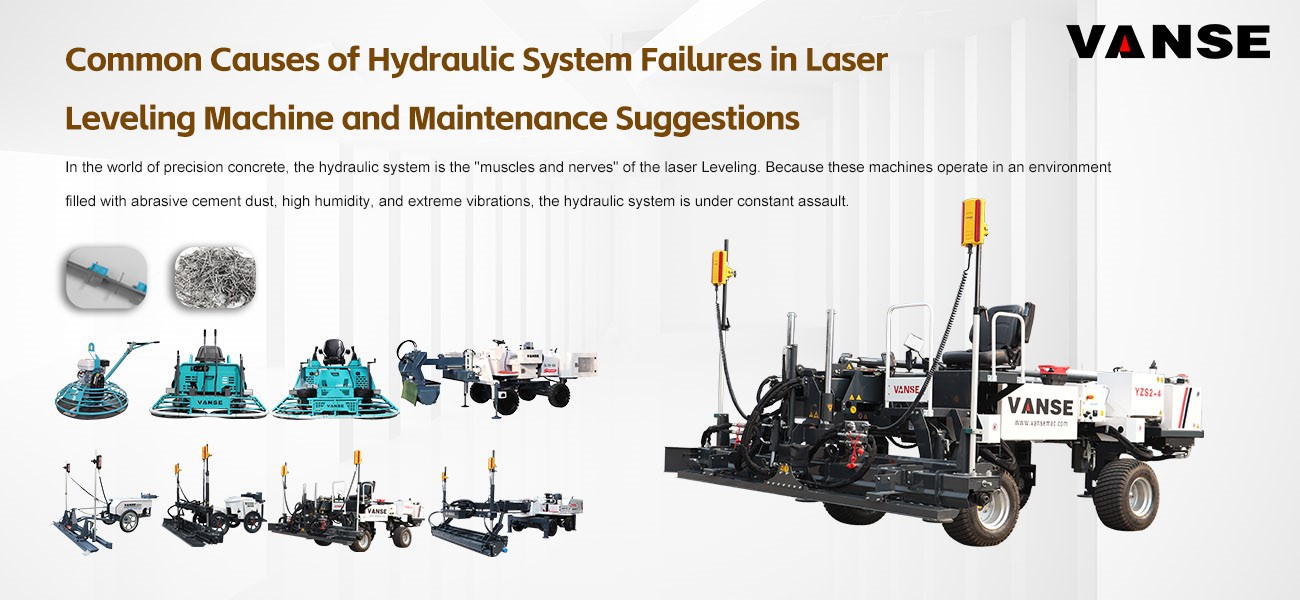
In the world of precision concrete, the hydraulic system is the "muscles and nerves" of the laser Leveling. Because these machines operate in an environment filled with abrasive cement dust, high humidity, and extreme vibrations, the hydraulic system is under constant assault.
When the hydraulics fail, the machine loses its ability to maintain the FL (Levelness) plane, often resulting in expensive "bad pours."
1. Common Causes of Failure
A. Contamination (The #1 Killer)
Concrete dust is essentially a collection of microscopic rocks. If even a tiny amount enters the hydraulic reservoir during a filter change or through a worn seal:
The Result: It acts as a grinding paste, scouring the internals of the proportional valves and the hydrostatic pumps.
Symptom: The Leveling head becomes "sluggish" or "stutters" instead of moving smoothly.
B. Overheating
Laser Levelings often work in non-climate-controlled warehouses or under direct sun.
The Cause: Clogged oil coolers (covered in dried concrete) or low fluid levels.
The Result: Hydraulic oil thins out (viscosity loss). Once the oil loses its lubricating properties, the pump begins to eat itself (cavitation).
C. Sensor/Solenoid Malfunction
Since the laser receivers talk to the hydraulic system via solenoid valves:
The Cause: Corroded electrical connectors or "sticky" valve spools.
The Result: The machine receives the laser signal but the "muscles" don't react, causing the Leveling head to dive or climb incorrectly.
D. Blown Hoses & Fitting Leaks
The constant vibration of the vibrator head and the telescopic boom creates mechanical fatigue.
The Cause: Hoses rubbing against the frame or "dry rot" from UV exposure.
2. Maintenance Suggestions & Prevention
To keep a laser Leveling running at peak precision, follow this tiered maintenance approach:
Daily (Before the Pour)
Check the "Breather" Cap: Ensure the reservoir breather is clean. If it's clogged with cement dust, the pump will pull a vacuum and fail.
Visual Hose Inspection: Look for "weeping" at the fittings. A small leak on the job site can quickly turn into a high-pressure geyser that ruins the fresh concrete.
Rod Cleaning: Wipe down the hydraulic cylinders with a clean cloth. Dried concrete on a cylinder rod will tear the seals the moment it retracts into the housing.
Weekly/Scheduled
Clean the Oil Cooler: Use compressed air or a soft brush to remove dust from the hydraulic heat exchanger. Do not use a high-pressure power washer, as it can bend the delicate cooling fins.
Electrical Contact Cleaner: Spray the connectors for the proportional valves to ensure the laser signal isn't being "lost in translation."
Long-Term (The "Deep" Maintenance)
Oil Analysis: Once a year, send a sample of your hydraulic oil to a lab. It’s cheaper than a $15,000 pump replacement. They can detect "wear metals" before the system actually fails.
Filter Schedule: Change hydraulic filters every 250–500 hours. Always use OEM high-efficiency filters; generic filters often lack the "micron rating" needed to protect sensitive laser-controlled valves.
3. Troubleshooting Table
| Symptom | Likely Hydraulic Culprit | Fix |
| Head won't stay level | Leaking cylinder seal (internal bypass) | Rebuild/Replace cylinder. |
| Leveling moves slowly | Clogged suction filter or failing pump | Change filters; check pump pressure. |
| Excessive Noise/Whining | Aeration or Cavitation | Check for air leaks in the intake line. |
| Hydraulic oil is milky | Water contamination | Flush system and replace oil immediately. |
Pro Tip: Always carry a "Spill Kit" and a spare set of the three most common hydraulic hoses on your support truck. A hydraulic failure in the middle of a 30-truck pour is a disaster; being able to swap a hose in 15 minutes saves the day.
Would you like me to create a "Troubleshooting Flowchart" for when the Leveling head fails to respond to the laser signal? Contact us NOW
Note: The parameters provided in this document are for reference only and are not mandatory. Due to differences in technical characteristics between different brands and models of laser levelers, please consult the manufacturer for a suitable solution before actual operation. This reference document assumes no responsibility for any issues arising from failure to follow the manufacturer's instructions.
Thanks to All the Friends Who Support and Trust Shandong Vanse Machinery Technology Co., Ltd.
If you want to know more about Shandong Vanse Machinery Technology Co., Ltd. or have any questions, please feel free to contact us:
Our Factory
Shandong Vanse Machinery Technology Co., Ltd.
Share this article

About the Author: Shandong Vanse Machinery Technology Co., Ltd.
Shandong Vanse Machinery Technology Co., Ltd. is a high-tech manufacturer specializing in concrete construction machinery, including laser screeds and related equipment. The company integrates R&D, production, and global sales, with products exported to over 60 countries and widely used in infrastructure projects worldwide.
Previous Post
Next Post
Related Articles
You Might Also Like
How durable is a concrete laser leveling machine?
The durability of a concrete laser leveling depends largely on its design and build quality. Generally speaking, a high-quality concrete laser leveling should have the following characteristics: ▶Strong and durable: The concrete laser leveling machine should be made of high-strength materials, such as high-quality steel and alloy materials, to ensure that the machine is not easily damaged during use. In addition, the leveling should have protection against wear and damage, such as wear-resistant coatings and anti-collision designs. ▶Reliable performance: Concrete laser leveling machines should have reliable laser transmitters and receivers to ensure that the machine can accurately measure and level the concrete surface. In addition, the leveling machine should have a reliable drive system and control system to ensure that the machine can operate stably and provide accurate leveling results. ▶Good maintenance: Maintenance of your concrete laser leveling is crucial to its durability. Check regularly whether all parts of the machine are working properly, including laser transmitters and receivers, drive systems, control systems, etc. In addition, machines should be cleaned and maintained regularly to prevent dust and other impurities from causing damage to machine parts. ▶Wide range of applications: Concrete laser leveling machine should be suitable for various types of concrete surface leveling operations, such as floors, ceilings and walls, etc. This means that machines should have flexible design and functionality that can adapt to different working environments and needs. ▶Long-lasting service life: The service life of a concrete laser leveling should be evaluated based on its design and manufacturing quality. Generally speaking, the service life of a high-quality concrete laser leveling machine should be more than 10 years, which requires the machine to maintain good performance and reliability during long-term use. Overall, the durability of a concrete laser leveling depends on the quality of its design and build, as well as its use and maintenance. Therefore, when choosing a concrete laser leveling machine, you should choose a well-known brand and reliable manufacturer to ensure the quality and service life of the machine. At the same time, operation and maintenance should be carried out in accordance with the operation and maintenance guidelines provided by the manufacturer during use to ensure that the machine maintains good performance and reliability.How to evaluate the application prospects of concrete laser leveling machine in the construction industry?
Concrete laser screed has broad application prospects in the construction industry. With the continuous improvement of the construction industry's requirements for construction quality and efficiency, and the continuous investment in infrastructure construction, its market demand is expected to grow further. The specific analysis is as follows: ⛴️ Significant technical advantages: The concrete laser screed adopts advanced laser technology, which can accurately control the leveling accuracy, can monitor and adjust in real time, ensure that the concrete surface is uniform and smooth, and can effectively solve the problems of hollowing, peeling, cracking, and inequality on the ground. It is particularly suitable for projects such as industrial floors and warehouse facilities that require high ground flatness. In addition, it has a high degree of automation and can be operated by a skilled technician. Compared with traditional manual leveling, it greatly improves work efficiency and reduces labor costs. ⛴️ Adapt to a variety of construction scenarios: The concrete laser screed has strong versatility. Whether it is a small residential project or a large commercial development project, it can be adjusted according to the specific requirements of the work. It can handle different types of concrete and adapt to various structural designs. It can be used in industrial plants, large shopping malls, airport runways, highways and other places. ⛴️ In line with environmental development trends: As sustainable development becomes an increasingly important consideration in the construction industry, concrete laser leveling machines help reduce the overall impact of construction projects on the environment by reducing the need for physical labor and waste of rework materials, meet the requirements of green building development, and are more likely to be recognized by the market. ⛴️ Technological innovation drives development: With the continuous advancement of science and technology, concrete laser leveling machines are also constantly innovating and upgrading. For example, the automatic leveling device for outriggers developed by Shandong Wanshi Machinery Technology Co., Ltd. can monitor the changes in ground height and adjust the position of outriggers in real time through high-precision sensors and intelligent control systems, further improving the accuracy and efficiency of construction. In the future, the integration of more advanced technologies will continuously improve its performance and make its application more extensive. ⛴️ Continued growth in market demand: The country's investment in infrastructure construction continues to increase, and the number of various construction projects has increased, and the demand for concrete leveling construction has also increased accordingly. At the same time, modern buildings have higher and higher requirements for ground quality, which is difficult to meet with traditional leveling methods. As a more advanced construction equipment, concrete laser leveling machines will usher in more market opportunities. However, concrete laser leveling machines also have limitations such as high equipment cost, high technical requirements for operators, and laser signals that are easily interfered with in complex environments. However, with the development of the industry and the maturity of technology, these problems are expected to be gradually improved, and its application prospects remain very broad. Click the below to jump immediately!!! ARMOUR JOINT CONCRETE LEVELING MACHINE LIGHT TOWER POWER TROWEL SLIPFORM MACHINE STEEL FIBER TOPPING SPREADER TRACKED MINI DUMPERHow should the emery floor be maintained before and after construction?
Emery floor is widely used in industrial plants, parking lots, warehouses and other places due to its high wear resistance, high strength, anti-slip and beautiful appearance. However, in order for the emery floor to achieve the expected use effect and life, in addition to high-quality materials and scientific construction technology, maintenance work before and after construction is also crucial. This article will conduct an in-depth discussion on the maintenance of diamond floor before and after construction, in order to provide valuable reference for relevant practitioners. 1. Foundation treatment before construction The foundation treatment before the construction of diamond floor is a key step to ensure the quality and service life of the floor. First, the base floor should be thoroughly cleaned to remove oil, dust, debris, etc., to ensure that the surface of the base is dry, flat and free of slurry. Secondly, the strength and density of the base should be checked. If there are defects such as cracks and potholes, they should be repaired and leveled in time. In addition, for the newly poured concrete base, the diamond floor should be fully maintained to sufficient strength before the construction of diamond floor. During the foundation treatment process, the following points should also be noted: First, ensure that the bonding performance between the base layer and the diamond floor material is good to avoid problems such as delamination and sanding; second, control the moisture content of the base layer to avoid excessive or low moisture content affecting the quality of the floor; third, for special base layers, such as renovation of old floors, appropriate treatment plans should be formulated according to specific circumstances. 2. Preparation of construction materials The construction materials of diamond floor mainly include diamond aggregate, cementitious materials, additives, etc. During the material preparation stage, it should be ensured that the selected materials meet the design requirements and have good wear resistance, compression resistance, anti-slip properties, etc. At the same time, strict quality inspections should be carried out on the materials to ensure that there are no impurities, no lumps, no expiration, etc. During the transportation and storage of materials, attention should be paid to moisture-proof, sun-proof, and anti-pollution measures to prevent the materials from being damp, lumped or polluted and affecting the use effect. In addition, during the material mixing process, the water-cement ratio and mixing time should be strictly controlled to ensure the uniformity and fluidity of the mixture. 3. Construction process control The construction process of diamond floor includes primer construction, diamond aggregate laying, compaction, maintenance and other steps. During the construction process, the construction specifications and process flow should be strictly followed to ensure quality control of each link. First, the primer construction should be uniform and without omission to enhance the adhesion between the base and the diamond floor. Secondly, when laying diamond aggregate, the laying thickness and uniformity should be controlled to avoid uneven thickness or hollowing. At the same time, compaction should be carried out in time after laying to improve the density and strength of the floor. Finally, during the maintenance stage, the maintenance time and method should be reasonably controlled according to the ambient temperature and humidity conditions to ensure that the floor is fully hardened and dried. 4. Initial maintenance and protection After the construction of diamond floor is completed, initial maintenance is an important link to ensure the quality of the floor and extend its service life. During the maintenance period, heavy objects should be avoided from rolling on the floor or scratching with sharp objects to avoid damage to the floor. At the same time, the floor surface should be kept clean and dry to prevent moisture and dirt from penetrating and affecting the quality of the floor. In the initial maintenance stage, some measures can also be taken to improve the performance and aesthetics of the floor. For example, applying a layer of transparent or colored coating on the floor surface can increase the gloss and wear resistance of the floor; setting angle steel or corner guard strips on the edge of the floor can prevent damage caused by the impact of equipment such as forklifts. 5. Long-term maintenance and care The long-term maintenance and care of diamond sand floor is the key to ensuring its performance and service life. In daily use, the floor surface should be cleaned regularly to remove oil, dust and other debris to keep the floor clean and beautiful. At the same time, avoid using corrosive substances such as strong acids and alkalis to clean the floor to avoid damage to the floor. For floor areas with wear, scratches and other problems, they should be repaired and renovated in time. When repairing, the repair material compatible with the original floor material should be selected, and the operation should be carried out in accordance with the construction specifications to ensure the quality of the repair. In addition, according to the use and wear of the floor, the overall renovation can be carried out regularly to restore the performance and aesthetics of the floor. 6. Problem Solving and Prevention During the use of diamond sand floor, some problems may occur, such as delamination, sanding, cracking, etc. For these problems, the causes should be analyzed in time and corresponding solutions should be taken. For example, for delamination problems, it may be caused by improper base treatment or poor material quality. Therefore, the base treatment and material quality control should be strengthened; for cracking problems, it may be caused by improper construction or changes in ambient temperature. Therefore, the construction process should be optimized and the ambient temperature should be controlled. At the same time, in order to prevent the occurrence of problems, daily inspections and maintenance should be strengthened. During inspections, attention should be paid to changes in the flatness, glossiness, wear resistance, etc. of the floor, and potential problems should be discovered and dealt with in a timely manner. During maintenance, a reasonable maintenance plan should be formulated according to the use and wear of the floor, and regular cleaning, repairs and renovations should be carried out. 7. Summary and Precautions In summary, the maintenance work before and after the construction of diamond sand floor is of great significance to ensure the quality and service life of the floor. In actual operation, attention should be paid to the basic treatment before construction, the preparation of construction materials and the control of construction process to ensure the quality of construction; at the same time, it is necessary to strengthen the initial maintenance and long-term maintenance and maintenance work, and timely discover and deal with problems; finally, through the implementation of problem solving and preventive measures, ensure that the diamond floor always maintains good performance and appearance. It should be noted that when carrying out the maintenance of diamond floor, relevant specifications and safety requirements should be followed to ensure the safety of operators. In addition, a reasonable maintenance plan should be formulated according to the specific use environment and requirements to ensure that the diamond floor can meet the needs of long-term use. When summarizing the key points of maintenance before and after the construction of diamond floor, we can summarize the following points: First, ensure that the base is properly treated, which is the basis for ensuring the quality of the floor. The flatness, strength, moisture content and other indicators of the base must meet the construction requirements, otherwise it will have an adverse effect on the subsequent use of the floor. Secondly, pay attention to the selection and quality control of materials. High-quality materials are the key to ensuring the performance and service life of the floor. When selecting materials, full consideration should be given to performance indicators such as wear resistance, compression resistance, and anti-slip properties, and the supplier should be ensured to have a good reputation and stable supply capacity. Furthermore, the control of the construction process is also crucial. During the construction process, operations should be carried out strictly in accordance with the construction specifications and process flow to ensure quality control at each link. In particular, the compaction and maintenance links are of great significance for improving the density and strength of the floor. In addition, daily maintenance and care work should not be ignored. Regular cleaning, inspection of the wear of the floor, and timely repair and renovation can effectively extend the service life of the floor. At the same time, the use of corrosive substances such as strong acids and alkalis to clean the floor should be avoided to avoid damage to the floor. Finally, it is equally important to prevent the occurrence of problems. By strengthening daily inspections, optimizing construction processes, and controlling ambient temperature, potential problems can be discovered and dealt with in a timely manner to avoid the expansion and deterioration of problems. To sum up, the maintenance work of diamond abrasive floor before and after construction is a systematic and complex task, which requires comprehensive consideration of multiple factors. By strengthening the work in grassroots treatment, material selection, construction process control, daily maintenance and care, as well as problem prevention, the quality and service life of diamond abrasive floor can be guaranteed to the greatest extent.