Technical Knowledge
Is Laser Leveling Machine Suitable for Fiber Reinforced Concrete (FRC) Mixing
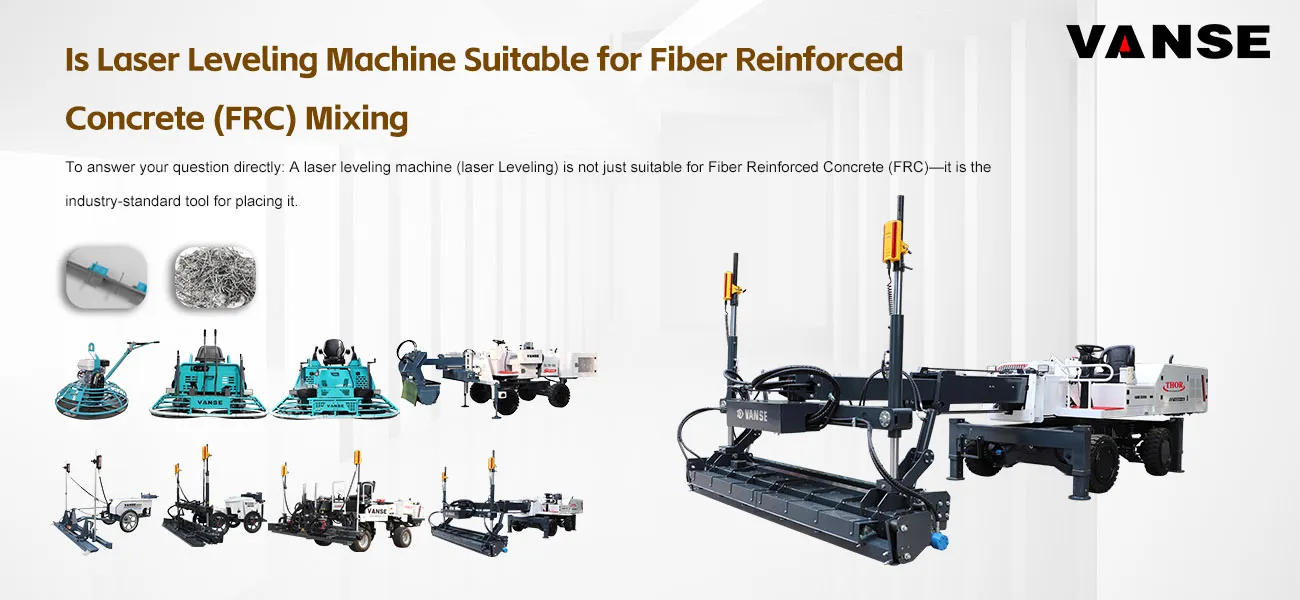
To answer your question directly: A laser leveling machine (laser Leveling) is not just suitable for Fiber Reinforced Concrete (FRC)-it is the industry-standard tool for placing it.
However, it’s important to clarify the terminology: the machine does not "mix" the fibers into the concrete; it specializes in distributing and leveling the FRC mix once it has been discharged from the truck.
Here is how the laser leveling machine interacts with FRC and the specific technical advantages it offers.
1. Distribution VS Mixing
The Mixing: Fibers (Steel or Synthetic) must be added at the batch plant or in the truck mixer. The laser Leveling receives the FRC after it has been thoroughly mixed.
The Leveling: Once the FRC is on the ground, the laser Leveling’s auger and vibrator head work together. The auger cuts the "peaks" of the fiber-clumped concrete, while the high-frequency vibrator forces the fibers down into the paste, ensuring they don't all stick out of the surface.
2. Why Laser Levelings are Preferred for FRC
Using traditional manual Levelinging with fibers is a nightmare for laborers. The laser Leveling solves three major FRC problems:
Fibre "Balling": If the mix isn't perfect, fibers can clump. A laser Leveling’s powerful auger breaks up minor clumps that a hand-Leveling would simply snag on and pull across the floor.
Surface Flatness (FF): Fibers increase the "internal friction" of concrete, making it stiffer. A laser Leveling has the hydraulic power to strike off this stiff material much more accurately than human power.
Submerging the Fibers: The vibration of the Leveling head is tuned to help the heavy aggregate and fibers settle slightly below the surface (the "cream"), which is essential for a smooth finish.
3. Potential Challenges to Watch For
While the machine is suitable, you must adjust your operation based on the Fiber Type:
| Fiber Type | Challenge with Laser Leveling | Technical Fix |
| Macro-Synthetic | Can "spring back" after the Leveling passes, causing micro-bumps. | Increase the vibration frequency on the Leveling head. |
| Steel Fiber | Highly abrasive; wears down the Leveling's auger and plow. | Use hardened steel components or "wear-strips" on the machine. |
| High Dosage Rates | The mix becomes "harsh" and hard to move. | Use a mid-to-high range water reducer (superplasticizer) to maintain flow. |
4. Technical Integration Tips
Plow Height Adjustment: When running FRC, set the plow slightly higher than a standard mix. This prevents the plow from "dragging" the fibers and creating tears in the surface.
Consistency is King: The laser Leveling relies on a consistent "slump." If one truck has a high fiber dosage and the next has less, the Leveling will settle differently, ruining your floor flatness.
Auger Direction: Ensure the auger is pushing the excess FRC toward the "wet" side of the pour to prevent fibers from accumulating in one spot and creating a "dead zone" of reinforcement.
Expert Note: If you are using Steel Fibers, ensure they are the "hooked-end" or "glued-bundle" variety. These distribute more evenly under the laser Leveling's auger than loose, straight fibers, which tend to "nest" and cause the machine to struggle.
Would you like me to provide a specific "Leveling Maintenance Checklist" for projects involving high-dosage steel fiber concrete? Contact us NOW
Note: The parameters provided in this document are for reference only and are not mandatory. Due to differences in technical characteristics between different brands and models of laser levelers, please consult the manufacturer for a suitable solution before actual operation. This reference document assumes no responsibility for any issues arising from failure to follow the manufacturer's instructions.
Thanks to All the Friends Who Support and Trust Shandong Vanse Machinery Technology Co., Ltd.
If you want to know more about Shandong Vanse Machinery Technology Co., Ltd. or have any questions, please feel free to contact us:
Our Factory
Shandong Vanse Machinery Technology Co., Ltd.








Share this article

About the Author: Shandong Vanse Machinery Technology Co., Ltd.
Shandong Vanse Machinery Technology Co., Ltd. is a high-tech manufacturer specializing in concrete construction machinery, including laser screeds and related equipment. The company integrates R&D, production, and global sales, with products exported to over 60 countries and widely used in infrastructure projects worldwide.
Previous Post
Next Post
Related Articles
You Might Also Like
How to ensure stable construction quality when using laser leveling machine to level large-area floor concrete?
– Before construction, the site should be thoroughly cleaned to remove debris, garbage and loose parts of the original ground. For example, for the renovation project of old factory buildings, all oil stains and broken concrete blocks on the ground need to be cleaned up. For the base, if there is any unevenness, it needs to be repaired and compacted. If the base is a soil foundation, it should be layered and rolled according to the design requirements to make its compaction degree reach more than 90%, providing a solid foundation for concrete pouring. – At the same time, the drainage slope should be set. According to the purpose of the site and the design requirements, the general drainage slope is not less than 0.3% – 0.5%. Through precise measurement and layout, determine the drainage direction and slope control points to ensure smooth drainage and avoid water accumulation affecting the quality of the floor. – Select qualified concrete raw materials, including cement, sand and gravel, admixtures, etc. Cement should be selected with strength grades that meet the design requirements, such as ordinary Portland cement P.O42.5 or P.O52.5, and the stability and setting time of cement should be checked. The particle size and mud content of sand and gravel should meet the specifications. For example, the maximum particle size of coarse aggregate should not be greater than 31.5mm, and the mud content should not exceed 1%; the mud content of fine aggregate should not exceed 3%. – Strictly design and test the concrete mix ratio. According to the use function of the floor (such as heavy-duty industrial floor, ordinary warehouse floor, etc.), strength requirements and construction environment, the best mix ratio is determined through laboratory trial mixing. During the construction process, concrete mixing should be carried out strictly according to the mix ratio, and the performance indicators such as slump of concrete should be tested regularly. The slump is generally controlled between 120-180mm to ensure good working performance of concrete. – Before construction, fully commission the concrete laser leveling machine. Check the operating status of the engine or motor to ensure the normal operation of the power system. For example, the engine should start quickly, run smoothly, and have no abnormal noise and shaking. For the laser system, it is necessary to perform precise calibration and adjust the height and angle of the laser transmitter so that the laser plane it emits is consistent with the design elevation of the floor. – Calibrate the scraper, vibrator and other working parts of the leveler. The flatness error of the scraper should be controlled within ±1mm, and the frequency and amplitude of the vibrator should be adjusted according to factors such as the slump and thickness of the concrete. Generally, the vibration frequency is between 3000-5000 times/minute, and the amplitude is between 3-5mm to ensure that the concrete can be fully vibrated and leveled. – Use appropriate concrete pouring methods, such as pumping or self-unloading. During the pouring process, the pouring speed and height should be controlled to avoid segregation of concrete. For example, when pumping concrete, the discharge port height should not exceed 1.5m, and the concrete should be evenly distributed on the site. – Use the spreading function of the laser leveler or cooperate with other spreading equipment to spread the concrete evenly on the site. The thickness of the material should be slightly higher than the design elevation, generally 10-20mm higher, to leave a margin for the leveling work. During the material laying process, care should be taken to avoid the accumulation of concrete in one place, resulting in excessive local thickness. – When operating the laser leveling machine, the equipment should be kept moving at a uniform speed, and the speed is generally controlled between 1-2m/min. The operator should adjust the scraper height and vibration frequency of the leveling machine in time according to the laser signal and the automatic leveling function of the equipment. For example, when the laser receiver detects that the ground is higher than the design elevation, the leveling machine automatically adjusts the scraper to descend and scrapes off excess concrete; when it is lower than the design elevation, the scraper rises, and the vibrator strengthens the vibration to fill the low-lying area with concrete. – During the leveling process, attention should be paid to the connection of adjacent construction areas. The leveling work of adjacent areas should be completed before the initial setting of the concrete, and the flatness and density of the connection should be guaranteed. Generally, the overlapping construction method is adopted, and the overlapping width is between 10-20cm to ensure the flatness and integrity of the entire floor. – Professional quality inspection personnel are equipped to check the flatness, density and elevation of the floor in real time during the construction process. Use tools such as level, 2m ruler and feeler gauge for inspection. For example, for each construction area (such as 100-200 square meters), use 2m ruler and feeler gauge to check the flatness, and the flatness error should be controlled within ±3mm; use level to check the elevation, and the elevation error should be controlled within ±5mm. – For parts that do not meet the quality requirements, timely adjustments and repairs should be made. If it is found that the local flatness exceeds the tolerance, it can be repaired by using a small leveling tool or manual smoothing method; for areas with insufficient density, use a flat vibrator to vibrate again or an inserted vibrator to supplement the vibration. – After the concrete is leveled, the finishing treatment is carried out according to the use requirements of the floor. If it is an industrial floor that requires wear resistance, mechanical smoothing and manual fine smoothing can be carried out after the initial setting of the concrete. Mechanical troweling generally uses a driving trowel, and the number of troweling passes is not less than 3 times, so that the floor surface reaches a certain gloss and hardness. – After finishing, timely maintenance should be carried out. You can use methods such as covering with plastic film, straw mats or spraying curing agents. The curing time is determined according to factors such as the type of concrete and the ambient temperature, and is generally not less than 7-14 days. During the curing period, the concrete surface should be kept moist to avoid cracks in the concrete due to water loss. – During the curing period, the floor should be protected as a finished product, and warning signs should be set up to prevent people and vehicles from walking or working on the floor that does not meet the strength requirements. For example, for heavy-duty industrial floors, heavy vehicles are strictly prohibited from passing when the concrete strength does not reach more than 70% of the design strength. – After the curing period, quality acceptance is carried out in accordance with design requirements and relevant standards. The acceptance content includes indicators such as the flatness, strength, and thickness of the floor. For example, the thickness and strength of the floor can be tested by core sampling, and the strength should reach the designed strength level; a laser flatness meter is used to test the flatness of the entire floor to ensure that the flatness of large-area floors meets quality requirements.Why is my concrete floor dusty after power troweling?
It's a nightmare scenario for any contractor: you finish a massive warehouse pour, the floor looks like a mirror, but a week later, a fine white powder starts coming off the surface every time someone walks on it. In the industry, we call this "Dusting" (or powdering), and it usually means the top 1-3mm of the concrete is too weak. If you're asking "Why is my floor dusty?" the answer usually lies in the relationship between your technique and your Power Trowel settings. Here's a breakdown of the common culprits and how the right gear can prevent it. This is the #1 cause. If you start your first pass while there is still a "sheen" of water on the slab, you are essentially mixing that extra water into the top layer of cement paste. This destroys the water-to-cement ratio at the surface, leaving it soft and chalky. The Pro Fix: You have to wait until the bleed water has evaporated. Vanse Insight: When you're using a high-performance machine like the Vanse VS836 series, you have the stability and weight (up to 380kg+) to wait for the perfect window. Because Vanse machines are so efficient, you don't need to rush the start; you can wait for the concrete to set properly and still finish the entire bay on time. It's tempting to keep running the machine to get that ultra-black, burnished look. However, if your blades are at too sharp an angle or your RPM is too high on a surface that has already begun to dry out, you can actually "burn" the life out of the cement paste. You're essentially grinding the surface instead of finishing it. The Pro Fix: Use precise pitch control and don't over-work the slab once it has reached its density. Vanse Insight: This is where Vanse's precision blade pitch system really shines. Whether you're using the walk-behind or the Ride-on Power Trowel, the adjustment is smooth and immediate. This allows you to dial back the aggression as the floor hardens, preventing that localized friction that leads to dusting. We've all seen it-a crew member spraying a little water on the floor because it's "closing up" too fast. This is a guaranteed way to get a dusty floor. That "finishing water" never integrates into the slab; it just sits on top and creates a weak, unbonded film. The Pro Fix: If the floor is getting away from you, you don't need water-you need more "horsepower." Vanse Insight: Instead of reaching for the hose, pros reach for a Vanse VS1046. With a 35HP BRIGGS & STRATTON engine, these machines have the raw torque to move stiff concrete and close the surface without needing to "wet it down." High torque equals a harder finish without the dust. If the environment is too hot or windy, the surface dries before the bottom of the slab. This creates a "crust" that is brittle. The Pro Fix: Use a curing compound or wet-cure the floor immediately after the final pass. Cause of Dusting Prevention Strategy Vanse Advantage Premature Finishing Stable, heavy-duty compaction at the right time. Balanced Rotor Design for smooth early-stage floating. Surface Friction Precise control of blade angle. Micro-adjustable Pitch Control on all models. Weak Surface Paste Avoiding "finishing water" through high efficiency. High-Torque Honda Engines to handle dry, stiff mixes. Uneven Surface Consistent pressure across the rotor. Heavy-duty Gearboxes that prevent "chatter" marks. A dusty floor is usually a sign that the surface was "abused" during the finishing stage. By combining the right timing with a professional-grade Power Trowel from Vanse Machinery ( www.vansemac.com ), you ensure that the cement paste is compacted and densified, not ground down into powder. If you're tired of "dusty floor" callbacks, it might be time to look at the precision and power that a Vanse machine brings to your job site. Don't just finish the floor-densify it. Note: The parameters provided in this document are for reference only and are not mandatory. Due to differences in technical characteristics between different brands and models of laser levelers, please consult the manufacturer for a suitable solution before actual operation. This reference document assumes no responsibility for any issues arising from failure to follow the manufacturer's instructions.Must-have accessories to boost power trowel functionality
A stock power trowel is a great machine, but running it without the right accessories is like buying a sports car and putting budget tires on it. To truly maximize your machine's efficiency, achieve higher FF (Flatness) numbers, and make the operator's life easier, you need to trick it out. Here are the must-have accessories to elevate your power trowel from a basic finishing tool to a precision instrument. If your goal is high-tolerance floors, these are non-negotiable. Clip-On Float Pans: You cannot achieve a Superflat floor with just blades. Float pans clip directly over the finishing blades. They increase the machine's footprint, allowing it to "bridge" low spots and shave off high spots during the critical early stages of curing. Weight Kits: As concrete cures and hardens, you need more downward pressure to effectively burnish and seal the surface. Bolt-on weight kits allow you to add calibrated mass to the trowel's frame. This is especially vital for ride-on trowels when you transition to the final finishing passes. Edging Rings/Free-Wheeling Rotors: For walk-behind trowels, a rotating outer ring allows the operator to run the machine directly against walls, columns, or forms without damaging the machine or the concrete. It practically eliminates the need for manual hand-troweling the perimeters. Concrete waits for no one, and you are constantly fighting the environment (sun, wind, and darkness). On-Board Sprayer Systems: Wind and dry air can cause the surface of the slab to dry out faster than the bottom (crusting). An automated, push-button sprayer tank mounted on the steering column lets the operator hit dry spots with a fine mist of water or evaporation retarder without stopping the machine. High-Output LED Lighting Kits: Many commercial pours happen at night or in poorly lit, unfinished warehouses. Bolt-on LED light bars that run off the machine's alternator illuminate the immediate work area, ensuring the operator can actually see the "cream" and blade marks they are trying to fix. Moving a 1,000-pound ride-on trowel or even a 250-pound walk-behind off the slab without damaging the fresh concrete or the blades requires the right gear. Trowel Dollies (Transport Wheels): Dragging a trowel by its guard ring bends the frame and ruins the rotor pitch. A heavy-duty set of transport wheels hooks under the guard ring, allowing one person to tilt and roll the machine effortlessly across rebar, dirt, or finished floors. Lifting Bails/Slings: A certified, heavy-duty lifting bail allows a crane or forklift to safely hoist the trowel onto elevated decks or over high foundation walls without warping the machine's center of gravity. Accessory Best Used For Walk-Behind or Ride-On? Float Pans Initial pass, flattening (FF), embedding aggregate Both Weight Kits Late-stage finishing, burnishing hard concrete Primarily Ride-On Edging Rings Getting tight to walls and columns Walk-Behind Sprayer System Applying evaporation retarders, fixing dry spots Ride-On LED Lights Early morning/night pours, dark warehouses Both Transport Dolly Moving equipment safely off the slab Both Pro Tip: If you invest in float pans, make sure you match the profile to your work. Flat pans are better for sheer flatness and cutting high spots, while Z-pans (beveled edge) are better for transitioning over slightly uneven joints without digging in. Would you like me to detail the exact sequence of blade and pan changes required to achieve a highly densified, polished concrete finish? Contact us NOW Note: The parameters provided in this document are for reference only and are not mandatory. Due to differences in technical characteristics between different brands and models of laser levelers, please consult the manufacturer for a suitable solution before actual operation. This reference document assumes no responsibility for any issues arising from failure to follow the manufacturer's instructions.