Technical Knowledge
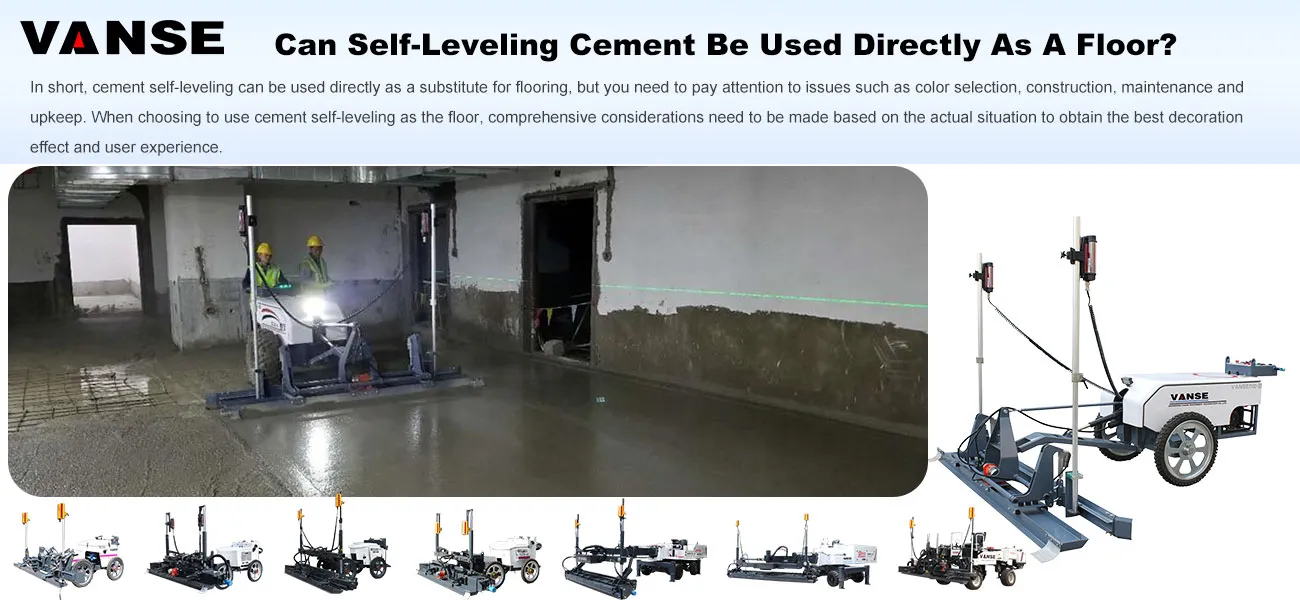
Can self-leveling cement be used directly as a floor?
September 12, 2023

As a special concrete material, self-leveling cement has the characteristics of strong fluidity, high strength, low shrinkage and high density. It is often used for floor paving in industrial, commercial and residential buildings. In recent years, with the popularity of minimalist style and industrial style, cement self-leveling has gradually become a popular choice for interior decoration. So, can self-leveling cement be used directly as a floor?
First of all, it needs to be clear that self-leveling cement is not a floor material in itself, but is used for leveling and laying the ground. However, in some cases, cement self-leveling can be used directly as a floor replacement. For example, in some industrial-style home decorations, self-leveling cement is used as the floor material, and is paired with furniture and decorations made of metal, wood and other materials to create a unique atmosphere.
When using cement self-leveling as a floor, you need to pay attention to the following points:
Color selection and construction
The color of self-leveling cement is relatively single. It is necessary to select the appropriate color before construction, or add an appropriate amount of pigment to the cement for color mixing. At the same time, it is necessary to find professional construction personnel to carry out the construction to ensure the construction quality and effect.
Maintenance and care
As a hard floor material, self-leveling cement requires regular cleaning and maintenance. During use, care must be taken to avoid scratches and wear to avoid affecting the service life and aesthetics.
Applicable occasions
Cement self-leveling is suitable for floor laying in some specific occasions, such as industry, commercial, residential, etc. For some occasions where softness and comfort are required, such as bedrooms, cement self-leveling may not be the best choice.
In short
Cement self-leveling can be used directly as a substitute for flooring, but you need to pay attention to issues such as color selection, construction, maintenance and upkeep. When choosing to use cement self-leveling as the floor, comprehensive considerations need to be made based on the actual situation to obtain the best decoration effect and user experience.
Note: The parameters provided in this document are for reference only and are not mandatory. Due to differences in technical characteristics between different brands and models of laser levelers, please consult the manufacturer for a suitable solution before actual operation. This reference document assumes no responsibility for any issues arising from failure to follow the manufacturer's instructions.
Thanks to All the Friends Who Support and Trust Shandong Vanse Machinery Technology Co., Ltd.
If you want to know more about Shandong Vanse Machinery Technology Co., Ltd. or have any questions, please feel free to contact us:
Our Factory
Shandong Vanse Machinery Technology Co., Ltd.


About the Author: Shandong Vanse Machinery Technology Co., Ltd.

Shandong Vanse Machinery Technology Co., Ltd. is a high-tech manufacturer specializing in concrete construction machinery, including laser screeds and related equipment. The company integrates R&D, production, and global sales, with products exported to over 60 countries and widely used in infrastructure projects worldwide.

Shandong Vanse Machinery
Leading manufacturer specializing in high-performance concrete laser screeds, telescopic arm flatwork handlers, and mechanical ride-on power trowels.
Post overview
Main PRODUCT Categories
Need Machine Guidance?
Speak directly with Shandong Vanse field specialists for tailored equipment quotes and site planning.
Contact Us TodayRelated Articles
You Might Also Like
April 9, 2024
Floor engineering laser leveling/ leveling construction technology
• • • ★ • • •Pre-construction preparation • • • ★ • • • Before carrying out laser leveling construction of floor projects, adequate preparation is the key to ensuring construction quality and progress. The following are the main contents of preparation before construction: 1. On-site investigation and evaluation: Conduct a detailed investigation of the construction site to understand basic conditions such as terrain, landforms, and soil conditions, evaluate the difficulty of construction and possible problems, and provide a basis for the formulation of subsequent construction plans. 2. Construction plan formulation: Based on the on-site survey results and engineering requirements, formulate a detailed construction plan, including construction process, personnel organization, equipment configuration, construction schedule, etc. 3. Personnel training and preparation: Provide operating training for laser leveling equipment to personnel involved in construction to ensure that they are familiar with equipment performance, operating essentials and safety precautions. At the same time, construction personnel should be equipped with necessary labor protection supplies. 4. Equipment inspection and debugging: Conduct a comprehensive inspection of construction equipment such as laser levelers and mixed soil pumps to ensure their good performance, safety and reliability. Carry out necessary debugging and calibration of equipment to ensure that it can work accurately and efficiently during the construction process. 5. Site layout and preparation: Clean the construction site to ensure there is no debris or water accumulation, and provide sufficient working space for construction equipment. Set up construction signs, warning signs and other safety facilities to ensure safety during construction. • • • ★ • • •Material selection and blending • • • ★ • • • The materials required for laser leveling construction of floor projects mainly include cement, aggregates, additives, etc. Choosing appropriate materials and reasonable mixing ratios are crucial to ensuring construction quality. 1. Cement selection: Choose cement with stable quality and meeting the requirements to ensure the strength and durability of the concrete. 2. Aggregate selection: Select appropriate aggregates, such as sand, stone, etc., according to project requirements. Aggregates should have good gradation and particle shape to improve the compactness and workability of the concrete. 3. Use of additives: According to the needs of the project, an appropriate amount of water reducing agent, slow agent and other additives can be added to improve the working performance and hardening performance of the concrete. 4. Material preparation: Material preparation is carried out according to the design requirements, and key parameters such as water-cement ratio and aggregate content are strictly controlled to ensure that the quality of the concrete meets the standard requirements. • • • ★ • • •Basic Processing • • • ★ • • • Before laser leveling construction, the foundation needs to be treated to ensure the flatness and solidity of the floor. 1. Foundation cleaning: Remove oil, debris, etc. from the foundation surface to ensure that the foundation surface is clean and dry. 2. Foundation leveling: If the surface of the foundation is uneven, mortar and other materials must be used for leveling to ensure the quality of subsequent construction. 3. Foundation solidification: The newly poured foundation needs to be cured and cured for a certain period of time to ensure that the foundation strength reaches the required level before laser leveling construction is carried out. • • • ★ • • •Laser Equipment Calibration • • • ★ • • • Laser leveling machine is the core equipment for laser leveling construction of floor projects, and its calibration accuracy is directly related to the quality of construction. 1. Laser transmitter installation and calibration: Install the laser transmitter in a fixed position and ensure that its height and angle meet the requirements. Calibration using a laser receiver ensures that the laser beam is accurately projected onto the ground to be leveled. 2. Laser receiver installation and debugging: Install the laser receiver on the concrete laser leveler to ensure that it can accurately receive the laser signal from the laser transmitter. Make adjustments to the laser receiver as needed to ensure it is working properly. • • • ★ • • • Concrete Pouring • • • ★ • • • Concrete pouring is a key link in laser leveling construction of floor projects, and the quality and speed of concrete pouring need to be strictly controlled. 1. Concrete mixing and transportation: Mix concrete according to the material mixing ratio to ensure that the concrete is evenly mixed and free of impurities. Use equipment such as concrete pumps to transport concrete to the construction site to ensure that the concrete maintains good working performance during the construction process. 2. Concrete pouring speed: According to the construction plan and actual site conditions, the concrete pouring speed should be reasonably controlled to ensure that the concrete can cover the entire construction area in a timely and even manner. 3. Concrete pouring quality: During the pouring process, the uniformity and compactness of the concrete should be checked to ensure that the concrete pouring quality meets the design requirements. • • • ★ • • •Laser Leveling Operations • • • ★ • • • Laser leveling operation is the core step of laser leveling construction in floor engineering, which requires operators to master equipment operation skills. 1. Operator requirements: Operators should receive professional training and be familiar with the performance characteristics, operating essentials and safety precautions of the laser leveler. During the construction process, stay focused and strictly follow the operating procedures. 2. Leveling operation points: After starting the laser leveling machine, adjust the height and angle of the scraper according to the laser signal to ensure that the scraper maintains an appropriate distance and angle from the ground. During operation, the stability of the scraper must be maintained to avoid adverse effects such as shaking or ripples on the scraper. At the same time, the leveling speed must be controlled according to construction requirements to ensure the best leveling effect. 3. Construction quality monitoring: During the leveling process, the construction quality should be monitored in real time to observe whether the ground is flat and smooth, and whether there are cracks, sand and other defects. If problems are found, the machine should be stopped immediately for inspection and equipment parameters or construction methods should be adjusted to ensure that the construction quality meets the design requirements. • • • ★ • • •Conservation and Protection • • • ★ • • • After the laser leveling construction of the floor project is completed, certain maintenance and protection work is required to ensure the durability and beauty of the floor. 1. Maintenance measures: The floor should be maintained within a period of time after the construction is completed (usually 7-14 days). During the maintenance period, adverse factors such as heavy pressure and flooding should be avoided, and the floor surface should be kept dry and clean. At the same time, laser leveling construction technology for floor engineering can be used. • • • ★ • • •Conservation and Protection (continued) • • • ★ • • • 1. Use special curing agents to maintain the floor surface to enhance the wear resistance, dustproof and anti-slip properties of the floor. 2. Protection measures: During the use of the floor, necessary protective measures should be taken to prevent the floor from being scratched, worn and contaminated. For example, set up protective mats or anti-slip mats on the passages in and out of the construction area to reduce wear and tear on the floor: clean and maintain the floor regularly, and remove dirt and debris in a timely manner. • • • ★ • • •Quality inspection and acceptance • • • ★ • • • Quality inspection and acceptance are important links to ensure the quality of laser leveling construction of floor projects, and they need to be carried out in strict accordance with relevant standards and specifications. 1. Quality inspection: During and after construction, the floor should be inspected for various quality indicators, including flatness, levelness, strength, wear resistance, anti-slip, etc. The detection method can use a combination of visual inspection, measuring instrument measurement, laboratory testing and other methods to ensure that the detection results are accurate and reliable. 2. Acceptance standards: The acceptance standards for laser leveling construction of floor projects should comply with relevant national standards and specifications, as well as the stipulations in the project contract. During acceptance, check whether the various quality indicators of the floor meet the requirements and whether there are defects such as cracks, sand, and hollows. If problems are found, rectification and repair should be carried out in a timely manner to ensure that the floor construction quality meets the acceptance standards. 3. Acceptance procedure: The acceptance procedure should include three stages: initial inspection, preliminary inspection and final inspection. The initial inspection is carried out during the construction process, mainly to check whether the construction technology of each roof meets the requirements; the re-inspection is carried out after the construction is completed, and all quality indicators of the floor are comprehensively tested; the final inspection is during the maintenance period Conducted after completion, the final quality of the floor is evaluated and confirmed. During the acceptance process, relevant records and documentation should be compiled for subsequent review and audit. • • • ★ • • •Summary• • • ★ • • • The laser leveling construction technology for floor engineering is an efficient and accurate construction method that can effectively improve the flatness and construction efficiency of the floor. During the construction process, various operations should be carried out strictly in accordance with the construction technology requirements to ensure The construction quality meets the design requirements. At the same time, during the construction process and after the construction is completed, necessary maintenance and protection work should be carried out on the floor to extend the service life and aesthetics of the floor. Finally, through the quality inspection and acceptance process, the reliability and stability of the laser leveling construction quality of the floor project are ensured.Read More
September 11, 2025
How should maintenance standards for equipment used in concrete construction be established?
When developing maintenance standards for concrete construction equipment, it's necessary to consider the technical characteristics of each equipment type (such as mixing equipment, conveying equipment, pouring equipment, and vibrating equipment), construction scenario requirements, and industry standards. This approach aims to create a systematic standard that covers the entire lifecycle, is quantifiable and implementable, and assigns specific responsibilities. The following is the specific framework and core content: Before developing standards, it's important to first clarify the underlying foundations to ensure they are legally compliant, practical, and avoid being divorced from equipment characteristics or industry requirements. Equipment Technical Documentation Based on the manufacturer's operating and maintenance manuals, key parameters (such as lubrication cycles, replacement thresholds for wearing parts, and maintenance tool models) are extracted. For example, for a mixer, "mixing blades should be replaced if wear is ≤3mm" and "gear oil should be changed every 500 hours for the reducer" are standard "technical baselines." Industry and national standards Reference mandatory or recommended specifications, such as: Technical Regulations for Safety in the Use of Construction Machinery (JGJ33-2012): Clarifies safety requirements for equipment maintenance (such as powering off before maintenance and posting warning signs); Technical Specifications for Concrete Mixing Plants (Buildings) (GB/T 10171-2021): Specifies maintenance cycles and performance testing indicators for mixing equipment; Technical Specifications for Concrete Pumps (GB/T 13333-2014): Clarifies maintenance requirements for the hydraulic system and piping of concrete pumps. Construction scenarios and equipment load Based on project specific adjustments (e.g., high temperature, high humidity, or high-frequency construction scenarios require shortened maintenance intervals): For example, for concrete mixer trucks in tropical regions, the hydraulic oil filter replacement interval needs to be shortened from the standard 1,000 hours to 800 hours. For example, when continuously pouring large volumes of concrete, the insulation layer of the vibrator needs to be inspected every 8 hours instead of every 8-hour shift. Concrete construction equipment varies greatly. Based on the principle of "classification and standardization," the standard should be broken down into "equipment classification modules." Each module covers four dimensions: daily maintenance, scheduled maintenance, fault prevention, and safety requirements, ensuring coverage of the entire equipment lifecycle. Using the four most critical types of equipment in concrete construction as examples, this standard specifies specific maintenance content, cycles, standards, and responsible individuals: Device Type Maintenance Dimension Maintenance cycle Core maintenance content (quantifiable standards) 1. Mixing equipment (mixing machine, batching machine, cement silo) Daily Maintenance Daily before/after construction 1. Mixer: Clean any remaining concrete in the drum (no lumps or adhesion), and check the blade/liner fastening bolts (no looseness, torque ≥ 80 N·m). 2. Batching machine: Clean any debris from the hopper, and check the conveyor belt for deviation (≤ 50 mm/10 m). 3. Cement silo: Check the sensitivity of the level gauge (analog signal response time ≤ 2 seconds), and the safety valve for leaks. Periodic Maintenance (Medium Repair) Every 300-500 man-hours 1. Replace the mixer liner (if wear ≥ 5 mm). 2. Change the gear oil in the reducer (oil quality test: viscosity ≥ 220 cSt, no metal debris). 3. Adjust the tension of the batching machine conveyor belt (deflection ≤ 15 mm/1 m span). Periodic Maintenance (Major Repair) Every 2000-3000 man-hours 1. Disassemble the mixer shaft and check the bearing clearance (≤ 0.05 mm). 2. Calibrate the batching scale for accuracy (error ≤ ±1%). 3. Repair the anti-corrosion coating on the cement silo interior (no rust on ≥ 0.1 m2). 2. Conveying equipment (concrete pump trucks, trailer pumps, mixer trucks) Daily Maintenance Daily after construction 1. Pump Truck: Flush the delivery pipeline (no concrete residue, smooth water flow), check the outrigger cylinder seals (no oil leakage, no scratches on the piston rod); 2. Mixer Truck: Clean the tank (no hardening on the tank wall), check the tire pressure (±0.2 bar). Periodic Maintenance Every 1000 km / 500 man-hours 1. Pump Truck: Replace the hydraulic oil filter (pressure differential ≥ 0.3 MPa), inspect the boom welds (no cracks, weld height ≥ 8 mm); 2. Mixer Truck: Replace the tank liner (wear ≥ 10 mm), and maintain the drive system (bearing temperature ≤ 60°C). 3. Vibrating equipment (insertion vibrator, flat plate vibrator) Daily Maintenance Every 8-hour shift 1. Check the cable insulation (no damage, ground resistance ≤ 4Ω); 2. Vibrator: Test run (amplitude ≥ 0.8 mm, no abnormal noise), and check the connectors for looseness. Periodic Maintenance Every 50 shifts 1. Replace the vibrator bearing (clearance ≥ 0.1 mm); 2. Clean the motor cooling vents (no dust blockage, temperature rise ≤ 40°C). 4. Measuring equipment (sand and gravel scales, cement scales, admixture scales) Daily Maintenance Daily 1. Clear the scale hopper of any accumulated material (no material hanging, no skew); 2. Calibrate the zero point (error ≤ ±0.5kg) and check the sensor wiring (no looseness). Periodic Maintenance Every 30 days 1. Perform dynamic calibration (load 100% of the rated weight, error ≤ ±1%); 2. Check the sensor protection (no moisture, no deformation due to impact). Lubrication Management Standards Follow the "Equipment Lubrication Chart" (specify the lubricant type, filling point, cycle, and amount). For example, use 3# lithium-based grease for the mixer bearings, refilling every 100 working hours at a rate of 50g each time. After lubrication, record the "lubrication time, person performing the lubrication, and oil quality" to avoid over-lubrication or under-lubrication. Consumable Parts Management Standards Maintain a "consumable parts ledger" (including model, inventory threshold, and replacement cycle), such as for agitator blades, conveyor belts, vibrators, and cables, with a minimum inventory of three sets. When replacing consumable parts, "model matching" is required. Substitution with non-genuine parts is prohibited (exceptional circumstances require approval from the technical director). After replacement, a test run is required to confirm compliance. Safety Maintenance Standards Before maintenance, power and gas must be turned off, and a warning sign must be posted (e.g., "Equipment under maintenance, do not start"). Safety belts must be worn and a warning area must be set up for overhead work (e.g., pump truck boom maintenance). Electrical equipment maintenance requires a "certified operator" (electrician's license). Hydraulic system maintenance must be depressurized (reduced to 0 MPa) to prevent hydraulic fluid spray and injury. Record and traceability standards Establish an "Equipment Maintenance Record Form" (electronic or paper) that includes: equipment number, maintenance date, maintenance items, test data, abnormalities, person responsible, and inspector. Record retention period should be ≥ the equipment's service life to facilitate tracing the cause of a malfunction (e.g., if a mixer blade breaks, the record can be used to verify whether it has not been replaced beyond the specified time limit). Clarify the responsibility system Responsibilities are divided into different levels: Operators are responsible for "daily maintenance" (cleaning, inspection, and simple tightening); repair workers are responsible for "regular maintenance" (disassembly, replacement, and calibration); technical leaders are responsible for "standard review and exception handling"; and project managers are responsible for "resource support (spare parts, tools, and funding)." A "Equipment Maintenance Responsibility Letter" is signed, linking maintenance effectiveness to performance appraisals (e.g., if equipment failure occurs due to inadequate maintenance, the responsible individual's performance will be deducted). Supervision and Inspection Mechanism Daily Inspections: Technicians will spot-check the Maintenance Record Form daily and verify maintenance effectiveness on-site (e.g., randomly checking the wear of the mixer blades to see if it matches the records). Regular Assessments: Monthly "Equipment Maintenance Evaluations" are conducted, rewarding teams/individuals with a maintenance compliance rate ≥95%. Those failing to meet the standards will be given a deadline to rectify the situation. Fault Review: After equipment failure, analysis will be conducted to determine whether the cause was maintenance failure, and standards will be updated (e.g., if a crack on a pump truck boom was caused by untimely weld inspection, the weld inspection cycle will be shortened). Personnel Training Standards New employees must pass "equipment maintenance training + practical assessment" (e.g., identifying wearing parts of the mixing unit and completing maintenance records) before they can begin work. Maintenance skills training is organized quarterly (manufacturer technicians are invited to explain key maintenance points and common troubleshooting for new equipment) to ensure personnel skills meet standard requirements. Concrete construction equipment technology evolves rapidly (e.g., new intelligent mixing plants and electric pump trucks), necessitating regular standard updates: Update Cycle: A comprehensive review is conducted annually. Revisions are required immediately if equipment upgrades, construction scenarios change, or industry standards are updated. Update Process: The technical department collects equipment failure data, maintenance feedback, and new regulatory requirements. Discussions are held with maintenance workers, operators, and manufacturer representatives. After revisions are made public, training sessions are held to ensure full awareness. The standards established through the above framework can not only cover the technical requirements of equipment, but also be implemented in specific positions and operations, avoiding "empty" concepts and ultimately achieving the goal of "reducing equipment failures, extending service life, and ensuring construction continuity." Note: The parameters provided in this document are for reference only and are not mandatory. Due to differences in technical characteristics between different brands and models of laser levelers, please consult the manufacturer for a suitable solution before actual operation. This reference document assumes no responsibility for any issues arising from failure to follow the manufacturer's instructions.Read More
December 5, 2023
The Cold Wave Is Coming! If The Laser Leveling Machine Is Not Used For A Long Time, You Need To Pay Attention To 10 Maintenance Tips
The cold wave is coming and the temperature drops sharply. In order to reduce the impact of low temperature on the laser leveling machine equipment, Wanshi Friendly reminds you to do a good job in keeping the laser leveling machine cold and warm to prevent "frostbite" incidents of the equipment, so as to avoid inconvenience to you. or cause unnecessary losses. The cold wave is coming, how to maintain the laser leveling machine in winter? 01 "Great health care" in the off-season, "Roll up your sleeves and do it" in the peak season When the winter cold wave hits, floor construction gradually enters the off-season, and the laser leveling machine is parked for a long time. It is necessary to pay attention to "equipment maintenance" and ensure that the laser leveling machine equipment is in good working condition at all times, so that it can be used for the first time when the construction peak season arrives. Invest in on-site work at once to seize market opportunities. However, low-temperature construction in winter is also a huge challenge and test for concrete and concrete laser leveling machines. Do a good job of maintenance in the off-season and seize market opportunities in the peak season! As the pioneer and leader of laser leveling machines, Wanshi concrete laser leveling machine product series can fully meet the concrete floor pouring and paving construction of different types of construction projects. Currently, it occupies more than 80% of the national market share and the global market share. It is also increasing year by year. Especially as an important construction equipment for high-end floors such as logistics warehouse floors, high-quality factory floors, garage floors, and ultra-flat wear-resistant floors, Wanshi Concrete Laser Leveling Machine plays a vital role for floor builders. effect. 02 Laser leveling machine, winter maintenance tips Today, Wanshi will bring you tips on winter maintenance of concrete laser levelinging machines. I hope you can do a good job in winter maintenance of the equipment, protect your investment, and become your money-making machine! 1. Maintenance recommendations for large laser leveling machines and spreaders: 1) Add diesel and antifreeze suitable for the local temperature according to the area where the equipment is located. 2) When the device is idle, you should pay attention to the battery level. The battery can be removed when the equipment is parked for a long time. If it is difficult to start, an auxiliary battery can be added. 3) Replace the third engine filter. 4) Add butter in time and clean the piston rod and other parts of the oil cylinder. 5) The equipment needs to be cleaned and dried before being put into storage, otherwise the equipment will freeze and cause damage to the pipelines. 6) During winter construction, it is necessary to preheat the equipment and wait until the hydraulic oil reaches the working temperature before proceeding with construction. 2. Maintenance suggestions for small laser leveling machines: 1) After construction, clean the machine, move it to a ventilated and sunny place, and dry it in the sun and blow dry to prevent freezing. 2) Butter should be added in time. 3) Clean the engine carburetor, replace the air filter element, and replace the oil filter element. If it is difficult to start, add an auxiliary battery. 4) The equipment needs to be preheated before use. If something happens to your device, don't worry! When you choose Wanshi equipment, you also choose to have worry-free after-sales protection. We provide all customers with high-quality after-sales service 7 days x 24 hours x 365 days. Wanshi provides 7 days x 24 hours x 365 days round-the-clock service If you have any problems with the operation of your device, you are welcome to contact us at any time. Remote telephone after-sales guidance is an efficient after-sales support method. Our after-sales service engineers will contact you as soon as possible and help you restore normal operation of the equipment as soon as possible.Read More