Technical Knowledge
How can I adjust the laser leveling’s parameters and settings to achieve optimal leveling machine results?
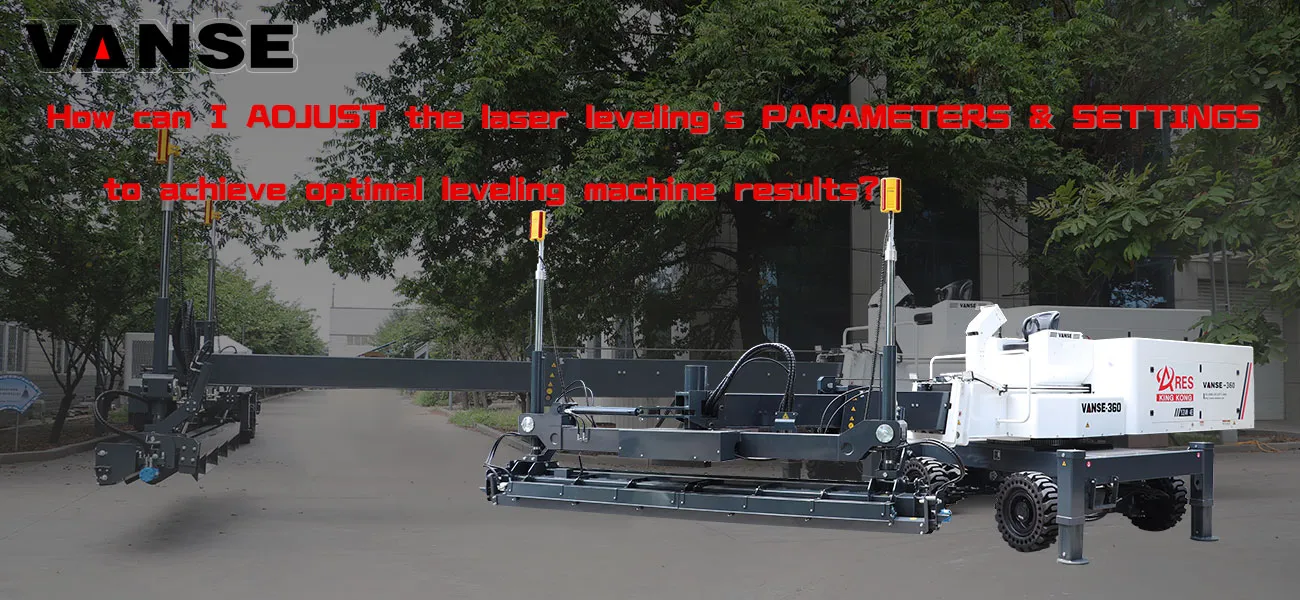
The key to adjusting laser leveling parameters is to "take concrete properties as the basis and laser benchmark as the core". It is necessary to achieve a balance between flatness and efficiency through three steps: matching material conditions, optimizing mechanical parameters, and adjusting the laser system.
1. Match the specific state first: the premise of parameter adjustment
Concrete slumpand Initial setting timeIt is the fault that determines all parameters. Different states require corresponding different settings, otherwise "over-vibration analysis" or "leveling failure" will occur.
| Specific status | Core Impact | Key parameter adjustment direction |
| High slump (≥180mm) | Strong fluidity, easy to segregate and produce sand | 1. Reduce the vibration frequency (3000-4000 times/minute); |
| 2. Slow down the driving speed (3-5m/min); | ||
| 3. Reduce the scraper/warehouse pressure depth | ||
| Medium slump (120-180mm) | Moderate fluidity, easy to level | 1. The vibration frequency is set to 4000-5000 times/minute; |
| 2. Travel speed 5-8m/min; | ||
| 3. Set the scraper/stack pressure depth to 5-10mm | ||
| Low collapse (≤120mm) | Poor fluidity, easy to honeycomb, uneven surface | 1. Increase the vibration frequency (5000-6000 times/minute); |
| 2. Slow down the driving speed to 2-4m/min; | ||
| 3. Appropriately increase the scraper/warehouse pressure depth (10-15mm) |
2. Further optimize core mechanical parameters: precise control of the leveling process
After determining the foundation direction according to the concrete state, it is necessary to make detailed adjustments, vibration, walking, leveling. The three core parameters are the key to determining flatness.
1) Vibration parameters: control density and surface quality
Vibration frequency: The core function is to make the concrete dense. If the frequency is too low, it is easy to hollow out, and if it is too high, it is easy to segregate. It is the first choice for conventional projects.4000-5000 times/minute. For thick concrete (≥200mm), the speed can be appropriately increased to 5500 times/minute, and for thin floors (≤100mm), it needs to be reduced to below 3500 times/minute to avoid vibrating dark and shallow layers.
Vibration depth:The thickness of concrete pouring needs to be covered 1.2-1.5 times. For example, if the thickness of the poured ground is 150mm, the vibration depth should be set to 180-225mm to ensure that the upper and lower layers of concrete are tightly combined without stratification.
2)Operating parameters: balancing efficiency and terrain
Driving speed: Too fast will result in insufficient leveling and vibrating of the concrete, while too slow will affect the construction efficiency. It is recommended to follow the "Slow start, constant speed, slow stopPrinciple, normal speed is controlled at 5-8 m/min, the speed needs to be reduced by 2-3m/min in turning or corner areas to avoid edge abnormalities caused by centrifugal force.
Walking path:use"Overlapping Paths", overlapping working width is200-300 mm, to prevent missing areas, especially suitable for large-area floor construction.
3)Leveling parameters: Fit laser reference
Scraper/Neck Height:Based on the "reference signal" of the laser receiver, the initial height of the scraper must be higher than the design elevation.5-10mm high(Preset vibration subsidence amount), the warehouse height is slightly lower than the scraper (responsible for secondary finishing and leveling).
Adjust:The consistency of the laser receiver determines the response speed of the equipment with high deviation. The large flat ground is set to "Medium sensitivity" (trigger adjustment when the deviation is ±2mm), corner or complex area setting "High sensitivity" (Adjustment is triggered when the deviation is ±1mm) to avoid surface depression caused by excessive adjustment.
3. Final adjustment of the laser system: ensure that the benchmark has no deviation
The premise for all parameter adjustments is that the laser reference is "accurate". If the laser system is offset, even the best mechanical parameters cannot guarantee flatness.
Laser emitter arrangement:
Place it on a hard surface away from vibration sources (such as rollers and pump trucks), and use a spirit level to ensure that the transmitter is level (the bubble is in the center).
After turning on the transmitter, use a tape measure or laser range finder to check whether the laser elevation within the 360° range of the transmitter is consistent (the workpiece must be ≤1mm). If the deviation is large, it needs to be corrected using the leveling screws at the bottom of the transmitter.
Receiver and housing:
Stop at a benchmark point with a known elevation (such as a poured lawn concrete block) and manually adjust the height of the receiver so that the display shows "Benchmark Elevation".
Move the device to another reference point and check whether the display elevation is consistent with the actual height. If the deviation is greater than 1mm, open the host architecture panel and adjust the connection parameters between the receiver and the host. The chassis deviation should be ≤1mm.
Summarize
The adjustment logic for the best leveling effect is "First determine the benchmark (laser layout) → then match the materials (adjust parameters according to collapse) → finally fine control (vibration, movement, flattening and refinement). After adjustment, it is recommended to conduct a trial operation on a small area (2-3㎡) first, check the flatness with a 2-meter ruler (the gap is qualified if it is ≤3mm), and then use the error parameters based on the trial operation results to avoid rework caused by direct large-scale construction.
Parameter comparison table of laser leveling machines for concrete with different slumps
| Concrete slump | Vibration frequency | Travel speed | Scraper/stack pressing depth | Laser receiver is the same |
| ≤120mm (low slump) | 5000-6000 (times/minute) | 2-4 (m/min) | 10-15 (mm) | High deviation (trigger adjustment when deviation is ±1mm) |
| 120-180mm (medium slump) | 4000-5000 (times/minute) | 5-8 (m/min) | 5-10 (mm) | Middle deviation (trigger adjustment when deviation is ±2mm) |
| ≥180mm (high slump) | 3000-4000 (times/minute) | 3-5 (m/min) | Appropriately reduce (mm) | Middle deviation (trigger adjustment when deviation is ±2mm) |
Note: The parameters provided in this document are for reference only and are not mandatory. Due to differences in technical characteristics between different brands and models of laser levelers, please consult the manufacturer for a suitable solution before actual operation. This reference document assumes no responsibility for any issues arising from failure to follow the manufacturer's instructions.
Thanks to All the Friends Who Support and Trust Shandong Vanse Machinery Technology Co., Ltd.
If you want to know more about Shandong Vanse Machinery Technology Co., Ltd. or have any questions, please feel free to contact us:
Our Factory
Shandong Vanse Machinery Technology Co., Ltd.








Share this article

About the Author: Shandong Vanse Machinery Technology Co., Ltd.
Shandong Vanse Machinery Technology Co., Ltd. is a high-tech manufacturer specializing in concrete construction machinery, including laser screeds and related equipment. The company integrates R&D, production, and global sales, with products exported to over 60 countries and widely used in infrastructure projects worldwide.
Previous Post
Next Post
Related Articles
You Might Also Like
How To Control Ground-Based Ground Cracking
There are two ways to control ground-based ground cracking: Control the location of the crack by installing a shrink seam (the crack width cannot be controlled) Control the crack width by installing a reinforcement device (the crack position cannot be controlled) (Vanse YZ30-4E Laser leveling On Working Site) Control the location of the crack by installing a shrink seam: Control the cracking position of the concrete slab; the width of the shrink joint or the crack in the joint is largely controlled by the joint spacing and concrete shrinkage. As the seam spacing and concrete shrinkage increase, the seam width also increases. Similar to the crack, if the seam width is close to about 0.9 mm, the efficiency of locking and transferring the aggregate between the aggregates and avoiding vertical displacement between the seams is greatly reduced. In view of this, many designers use load-conducting designs such as force-transmitting rods, force-transmitting sheets, or continuity-enhancing devices at the shrink seam position to ensure good load transfer and limit vertical displacement between seams. Care must be taken when using the above-mentioned one crack control method on the same floor. If a large number of reinforcing devices pass through the expansion joint, the seam will become too hard to crack and open as designed. When the shrink seam is unable to be activated (ie, cracked and opened) due to the action of the reinforcing device, cracking at a non-seamed portion or a random position is generally generated.How to do a good job of laser leveling machine construction cooperation ?
In order to ensure the construction quality of concrete floors, more and more construction units are choosing to use precision laser leveling machines to lay concrete floors. However, in the process of actual construction work, because some enterprises do not cooperate in the construction work in place, or do not strictly follow the regulations and operate correctly, the problem of low construction quality of concrete floors sometimes occurs. In order to avoid the recurrence of this kind of situation, our company has detailed some construction cooperation matters during the construction process of the laser leveling machine as follows, and we hope that the relevant construction personnel must keep in mind. ❖Wire setting and leveling at the wall: Since the laser leveling machine at the wall cannot be touched, manual leveling is required within 200mm from the wall, so line setting is required as a reference for manual leveling. At the same time, 2 to 3 benchmark points (ground design elevation, ie ±0.0) that will not be disturbed during the construction period are set up for the laser leveling machine at one time, and good communication with each other is required. Bench point accuracy ±1mm. ❖Set formwork (steel formwork, position according to design requirements) along the periphery of the column to form separation joints. The elevation of the top surface of the formwork should be controlled within +0mm and -2mm, so as not to affect the flatness of the joints. ❖Install the construction joint formwork (steel formwork is recommended) along the range to be poured on the day, and the formwork should reserve holes with a spacing of 300mm for the insertion of dowel bars. The elevation of the top surface of the formwork should be controlled within +0mm and -2mm, so as to avoid large deviations in the flatness of the joints of different warehouses. ❖Establishment of the laser transmitter: It is intended to be erected on the column. The specific position should be set in a better position according to the amount of shop injection on the day. If it cannot be erected on the column, it should be erected on a special tripod. ❖In order to ensure the quality of concrete floor paving, each group needs to arrange 10-12 workers to cooperate to level the surface of the concrete paved on the ground, so that the stacking height is slightly higher than the design level (about 20-30mm). At the same time, for the parts near the wall, the outcropping pipeline and the surrounding formwork, arrange 2 workers to manually smooth the concrete material about 20~30cm away from the wall (formwork) side (using a 2m scraper and an iron trowel). Workers responsible for plastering must be trained skilled plasterers. These workers must obey the command and follow the arrangement in order to ensure the quality of the construction. ❖Since the thickness of the concrete reaches 200mm, and due to the setting of steel mesh, in order to ensure that the concrete is compacted by vibration, this project needs to arrange a vibrator to cooperate with the vibration. At the same time, in order to ensure that the protective layer of steel mesh reaches the thickness required by the design (70mm), it is necessary to arrange in advance to manually lift the steel mesh and place support blocks in the area to be laid. ❖The width of the concrete material laid on the platform is required to be no more than 5m each time, and the length is subject to the formwork boundary. The construction direction is from left to right (along the short side direction), from front to back (along the long side direction). The daily injection volume is recommended to be 1200~1500㎡. Calculated on the basis of 12 hours of working time per day, this requires a feed rate of 30 to 40m³. ❖Others: In order to ensure the flatness of the ground, special attention should be paid during the construction of the laser leveling machine: the slump of the concrete sent to the platform must be consistent each time; the concrete feeding speed must reach 40m/h or above, and each batch of concrete The initial setting time must be consistent; ensure that the formwork elevation is accurate, and cannot be disturbed during construction; the environment is coordinated. The concrete floor that has just been constructed cannot be exposed to sunlight, wind, rain, etc. that are unfavorable to concrete health.How to determine the maintenance cycle of concrete laser leveling machine?
As an important equipment in modern construction, the efficient and precise leveling performance of concrete laser leveling machine greatly improves the quality and efficiency of the project. However, the long-term stable operation of any equipment is inseparable from scientific and reasonable maintenance. Therefore, determining the maintenance cycle of concrete laser leveling machine is a vital task. This article will discuss in depth how to determine the maintenance cycle of concrete laser leveling machine from the aspects of equipment use frequency analysis, working environment investigation, manufacturer recommended cycle, component wear inspection, maintenance record, maintenance cost analysis, and safety and performance evaluation. 1. Equipment use frequency analysis + – The use frequency of concrete laser leveling machine is one of the important factors affecting its maintenance cycle. The higher the frequency of equipment use, the faster the wear and aging of its internal mechanical parts, so more frequent maintenance is required. For equipment with high frequency use, the maintenance cycle should be shortened to ensure that the equipment is always in good working condition. On the contrary, for equipment with low frequency of use, the maintenance cycle can be appropriately extended Avoid unnecessary waste of resources. When conducting a frequency analysis, we need to carefully record each use of the equipment, including information such as usage time, workload, and working environment. Through the statistics and analysis of these data, we can derive the average frequency and characteristics of the equipment, which provides an important basis for determining the maintenance cycle. 2. Working environment inspection + – The working environment of the temperature-soluble soil laser leveling machine also has an important impact on its maintenance cycle. The equipment works in a harsh environment, such as dust, high temperature, etc., which will accelerate the corrosion and wear of its components. Therefore, when determining the maintenance cycle, the impact of the working environment must be fully considered. We should conduct on-site inspections of the working environment of the equipment to understand factors such as humidity, temperature, and dust concentration in the environment. At the same time, it is also necessary to pay attention to whether the equipment is often exposed to corrosive substances or subjected to strong mechanical shock during work. Based on this information, we can make appropriate adjustments to the maintenance cycle of the equipment to adapt to different working environments. 3. Manufacturer recommended cycle + – Equipment manufacturers usually give recommended maintenance cycles based on the design and manufacturing process of the equipment. These recommended cycles are usually based on the normal service life and expected wear of the equipment, and have certain reference value. When determining the maintenance cycle of the concrete laser leveling machine, we should refer to the recommended cycle provided by the manufacturer and make comprehensive considerations based on the actual use of the equipment and the working environment. If the equipment does not have any abnormal situation during use and the working environment is good, then maintenance can be carried out according to the cycle recommended by the manufacturer. However, if the equipment fails frequently or the working environment is bad, the maintenance cycle may need to be shortened. 4. Component wear inspection + – The various components of the concrete laser leveling machine will wear during use, and the different degrees of wear will directly affect the performance and life of the equipment. Therefore, regular wear inspection of the components of the equipment is an important basis for determining the maintenance cycle. When inspecting component wear, we should focus on the vulnerable parts and key components of the equipment, such as blades, bearings, seals, etc. By checking the wear of these components, we can understand the overall operating status of the equipment and then determine whether maintenance is needed. At the same time, according to the wear law of the components, the future wear trend can be predicted to provide a basis for formulating maintenance plans. 5. Maintenance records + – Maintenance records are important data reflecting the maintenance of equipment. By analyzing the maintenance records, we can understand the historical maintenance of the equipment and the operating status after each maintenance. This information is of great significance for determining the maintenance cycle. We should establish a complete maintenance record system to record the time, content, personnel and other information of each maintenance in detail. At the same time, we should also track and record the operation of the equipment after maintenance. Through the statistics and analysis of these records, we can find potential problems in the operation of the equipment, so as to carry out preventive maintenance in advance. 6. Maintenance cost analysis + – Maintenance cost is one of the important factors to be considered when determining the maintenance cycle of wet concrete laser leveling machine. Too frequent maintenance will increase maintenance costs, while too long maintenance cycle may lead to more equipment failures and increase the cost of overhaul or replacement of parts. Therefore, we need to conduct a comprehensive analysis of the maintenance cost of the equipment. This includes counting the cost of each maintenance and repair, and analyzing the relationship between the cost and the maintenance cycle. By finding the best balance point, we can reduce maintenance costs while ensuring the normal operation of the equipment. When conducting maintenance cost analysis, it is also necessary to consider the purchase cost and expected service life of the equipment. If the purchase cost of the equipment is high and the expected service life is long, then when determining the maintenance cycle, more attention should be paid to the long-term stable operation of the equipment and the reduction of long-term costs. 7. Safety and performance evaluation + – Safety and performance are key indicators for the operation of concrete laser leveling machines, and are also important bases for determining maintenance cycles. The safety of equipment includes the safety of operators and the safety of the equipment itself, while performance is directly related to construction quality and efficiency. Therefore, we need to regularly evaluate the safety and performance of the equipment. This includes checking whether the safety protection devices of the equipment are intact, whether the operation is convenient, and whether the operation is smooth. At the same time, it is also necessary to test and evaluate the performance indicators of the equipment, such as leveling accuracy and work efficiency. Based on the evaluation results of safety and performance, we can adjust the maintenance cycle. If the safety and performance of the equipment decline or fluctuate, the maintenance cycle should be shortened, and the problem should be checked and solved in time. On the contrary, if the safety and performance of the equipment are stable and good, the maintenance cycle can be appropriately extended. In summary, determining the maintenance cycle of the concrete laser leveling machine requires comprehensive consideration of equipment use frequency, working environment, manufacturer recommended cycle, component wear inspection, maintenance records, maintenance costs, safety and performance evaluation, and other aspects. Only by comprehensively considering these factors can we formulate a scientific and reasonable maintenance plan to ensure the long-term stable operation and efficient construction of the equipment. 8. Specific implementation of safety and performance evaluation + – When implementing safety and performance evaluation, it is necessary to first provide professional training to operators to ensure that they are familiar with the various safety operating procedures of the equipment and can correctly identify and deal with potential safety hazards. At the same time, the equipment manager or maintenance engineer also needs to conduct regular equipment inspections, focusing on whether the safety protection devices and warning signs of the equipment are complete and clear to ensure the safety of the operators. In terms of performance evaluation, professional testing equipment and methods can be used to quantitatively evaluate the various performance indicators of the concrete laser leveling machine. For example, by measuring the leveling accuracy and efficiency of the equipment, the performance status of the equipment can be intuitively understood. At the same time, the performance of the equipment can also be comprehensively evaluated in combination with the actual needs of the construction to determine whether it is necessary to adjust the maintenance cycle or take other improvement measures. In addition, with the continuous advancement of technology and the upgrading of equipment, we also need to pay attention to the safety performance and performance characteristics of the new concrete laser leveling machine. By comparing and analyzing the differences between new equipment and existing equipment, we can provide a reference for formulating a more scientific and reasonable maintenance cycle. 9. Dynamic adjustment of maintenance cycle + – It should be noted that the maintenance cycle of the concrete laser leveling machine is not static. With the increase of equipment use time, changes in working environment and technological progress, the maintenance cycle may need to be adjusted dynamically. Therefore, we should establish a dynamic maintenance cycle adjustment mechanism. This includes regular evaluation and analysis of the equipment's operating conditions, component wear, maintenance costs, etc., and timely adjustment of the maintenance cycle based on the evaluation results. At the same time, it is also necessary to pay attention to changes in industry standards and best practices, and promptly apply new experiences and practices to the maintenance of equipment. 10. Conclusion + – In summary, determining the maintenance cycle of concrete laser leveling machines is a complex and meticulous process that requires comprehensive consideration of multiple factors. Through scientific analysis, reasonable evaluation and dynamic adjustment, we can formulate a maintenance plan that meets the actual needs of the equipment, ensure the safe and stable operation of the equipment and efficient construction, and at the same time, this will also help reduce the maintenance cost of the equipment, extend its service life, and provide strong guarantees for the sustainable development of the enterprise. In future work, we should continue to deepen the research and practice of the maintenance cycle of warm concrete laser leveling machines, constantly explore new methods and means, improve the maintenance level and management efficiency of equipment, and at the same time strengthen exchanges and cooperation within the industry, share experience and resources, and jointly promote the progress and development of maintenance technology for concrete laser leveling machines.